

Data warehouse modernization replaces rigid, on-premises warehousing with cloud-native or lakehouse architectures that cut total cost of ownership, shorten time-to-insight, and prepare data for machine learning. The immediate first step is not a migration plan. It is a discovery and business-outcomes assessment that ties technical scope to specific, measurable results before any workload moves.
TL;DR:
- Teams should prioritize discovery and business-outcomes assessment before planning any migration to identify necessary re-architecture and measurable goals.
- Moving to lakehouse patterns is essential for organizations managing unstructured data and machine learning workloads, as open formats enable both BI and AI to access the same data efficiently.
- Success relies on phased approaches involving pilot projects, parallel runs, and continuous validation, rather than rushing into full enterprise migration without proper sequencing.
- Automated metadata cataloging and code refactoring tools significantly reduce migration time and risk, especially for legacy stored procedures and SQL dialects.
- Building governance, security, and domain ownership from the start prevents operational delays, improves trust, and aligns modernization with compliance and audit requirements.
Table of Contents
- What Does Data Warehouse Modernization Actually Involve?
- What Are the Real Drivers Behind Modernization Projects?
- Why Do So Many Modernization Projects Stall or Fail?
- How Should a Phased Modernization Roadmap Actually Work?
- What Governance and Security Controls Belong in Day One?
- What Technical Migration Patterns Actually Reduce Risk?
- Which KPIs Actually Prove Modernization Worked?
- How Do Government Modernization Contracts Deliver Measurable Outcomes?
- What Should Teams Budget for Timeline and Cost?
- How Do Data Lakes and Data Mesh Fit Into a Modern Warehouse?
- How Is Automation Changing the Modernization Process Itself?
- What Do Successful Modernization Programs Actually Look Like?
- Where Should Teams Start This Quarter?
- A Defined-Scope Partner for Government Data Modernization
- Sources
What Does Data Warehouse Modernization Actually Involve?
Modernization means moving analytical workloads off legacy platforms and onto architectures built for elastic compute, open storage formats, and AI workloads. Three patterns dominate current projects, and picking the wrong one early tends to cost teams months later.
- Cloud data warehouse: a managed, SQL-first platform optimized for structured reporting and business intelligence, usually the fastest replatform path for teams with heavy BI dependency.
- Lakehouse: combines lake-style storage of raw and semi-structured data with warehouse-style querying, using open table formats like Delta Lake or Apache Iceberg so multiple engines can read the same data without duplication.
- Medallion architecture: organizes data into Bronze (raw ingestion), Silver (cleaned and conformed), and Gold (business-ready) layers, giving teams a traceable path from source system to dashboard.
Teams with mostly structured, well-governed data and a strong BI focus tend to replatform onto a cloud data warehouse with minimal redesign. Teams juggling streaming data, unstructured content, or machine learning pipelines generally need a re-architecture toward lakehouse patterns, because open formats let both BI and ML workloads draw from the same tables instead of maintaining separate copies.
What Are the Real Drivers Behind Modernization Projects?
Cost is the headline driver, but it is rarely the only one. Elastic compute and storage tiering let teams pay for what they use instead of provisioning for peak load year round, which is a fundamentally different cost model than a fixed-capacity legacy appliance.
- Cost control: separate storage from compute so idle warehouses stop burning budget overnight.
- Faster time-to-insight: modern catalogs and self-service layers cut the wait between a business question and a usable answer.
- AI/ML readiness: low-latency access and feature stores let models train on current data instead of stale exports.
- Reliability and interoperability: open formats reduce vendor lock-in and let multiple compute engines query the same tables.
Statistic callout: Cloud storage and backup adoption is now widespread across enterprises of every size, according to Statista's tracking of worldwide cloud usage by company size. That scale of adoption is exactly why AI/ML readiness has become the most urgent forcing function for modernization. Lakehouse patterns let machine learning teams work directly against production tables without repeated, heavy ETL cycles.
Why Do So Many Modernization Projects Stall or Fail?
Most failures trace back to a handful of predictable causes, not bad technology choices.
- Undocumented legacy logic. Decades-old stored procedures and hand-tuned SQL often encode business rules nobody wrote down, and rediscovering that logic during migration is consistently the biggest source of delay.
- Governance and ownership gaps. When nobody owns a dataset's quality or definition, adoption stalls because business users do not trust the new platform's numbers.
- Skills and change-management shortfalls. Analysts trained on legacy SQL dialects and BI tools need real transition time, not a weekend of documentation.
- Budget creep and unrealistic timelines. Fixed-bid assumptions built on legacy complexity estimates rarely survive contact with the actual codebase.
Each of these is a known pattern with known mitigations. That is precisely why they still keep showing up in common IT modernization mistakes government leaders make, project after project.
How Should a Phased Modernization Roadmap Actually Work?
A modernization roadmap succeeds or fails on sequencing. Skipping discovery to save time almost always costs more time later, once the legacy logic problem surfaces mid-migration.
- Align executives on measurable outcomes. Define what success means in business terms, cost per query, decision speed, audit turnaround, before writing a single line of migration code.
- Run discovery. Catalog metadata, audit SQL and stored procedures, and map dependencies between reports, tables, and downstream consumers.
- Pilot a high-impact workload. Choose one workload where success is visible and measurable, then migrate it fully to prove ROI before scaling.
- Apply a hybrid split. A widely used pattern preserves roughly 70% of workloads through lift-and-shift while redesigning the remaining 20%, an approach Valorem Reply reports 30 to 40% cost reductions within months when paired with real governance work.
- Validate through coexistence. Run change data capture and shadow reporting so old and new systems produce parallel outputs, then reconcile automatically before cutover.
- Scale and optimize continuously. Once validated, expand to remaining workloads and tune for AI/ML access patterns as usage grows.
Pro Tip: Never schedule the pilot workload as your most complex one. Pick something visible enough to prove value but simple enough to finish on schedule, then use that credibility to fund the harder migrations.
Full enterprise programs typically run a timeline that typically spans multiple quarters to a few years in iterative waves rather than one continuous push, and that pacing is a feature, not a delay.
What Governance and Security Controls Belong in Day One?
Governance retrofitted after migration tends to create permanent operational drag, because access patterns and bad habits harden fast once a platform goes live. Building governance before migrating production workloads avoids that trap entirely.
- Assign named data owners for every domain and enforce role-based access control down to the row and column level.
- Automate lineage tracking, quality checks, and reconciliation so data drift gets caught before it reaches a dashboard.
- Write explicit access and auditability policies for machine learning and large language model consumption, since model training pipelines touch data differently than a BI report does.
- Treat schema and pipeline changes like application code: run them through CI/CD with automated testing rather than manual deployment.
None of this is optional overhead. It is the difference between a platform people trust and one they quietly route around.
What Technical Migration Patterns Actually Reduce Risk?
The shift from ETL to ELT is the single biggest technical change in modern data integration strategies. Instead of transforming data before loading it, ELT loads raw data first and transforms it inside the cloud warehouse itself, taking advantage of elastic compute that legacy ETL servers never had.
- ETL to ELT migration: push transformation logic into the warehouse or lakehouse engine, where it scales with demand instead of bottlenecking on a fixed server.
- Change data capture and parallel runs: stream incremental changes and run old and new systems side by side rather than attempting a single risky cutover.
- Pattern-based transformation tools: automated refactoring converts legacy stored procedures into modern SQL or code far faster than manual rewrites, and with fewer missed edge cases.
- Workload-specific compute: route BI queries to a SQL warehouse engine, heavy transformation to distributed processing engines, and model training to GPU-backed compute rather than forcing every workload through one engine.
Mainframe-sourced data adds its own wrinkle here, since mainframe modernization work often has to happen in parallel with warehouse migration rather than after it.
Which KPIs Actually Prove Modernization Worked?
Technical metrics and business metrics tell different parts of the story, and a modernization program needs both to justify continued investment.
- Technical KPIs: query latency, cost per query, and data freshness (how current the data is when a user queries it).
- Business KPIs: decision velocity, the percentage of users actively on the new platform, and operational cost per report.
- Governance health: percentage of datasets with assigned owners and passing automated quality checks.
Statistic callout: Organizations that pair a hybrid migration approach with governance and change management report cost reductions of 30 to 40% within months, not years. Set SLAs against these numbers early and run ROI reviews quarterly so drift gets caught before it becomes a budget conversation nobody wants to have.
How Do Government Modernization Contracts Deliver Measurable Outcomes?
Public-sector modernization programs succeed when the contract itself is structured around outcomes instead of hours billed. Defined-scope work packages let an agency know exactly what gets delivered, by when, and against what measurable standard, which is a fundamentally different arrangement than staff augmentation.
- Discovery and assessment scoped to a specific system or dataset, not open-ended consulting time.
- Compliance automation built to the agency's actual audit requirements, not a generic template.
- Real-time dashboards giving program leadership visibility into status without waiting for a manual report.
- A security baseline defined and tested before go-live, not patched in afterward.
Programs structured this way tend to report reduced processing times, stronger audit readiness, and program visibility that survives leadership turnover, because the outcomes are documented in the contract itself rather than tribal knowledge. Agencies evaluating this model can review examples in government data warehouse implementations built around the same defined-scope logic.
What Should Teams Budget for Timeline and Cost?
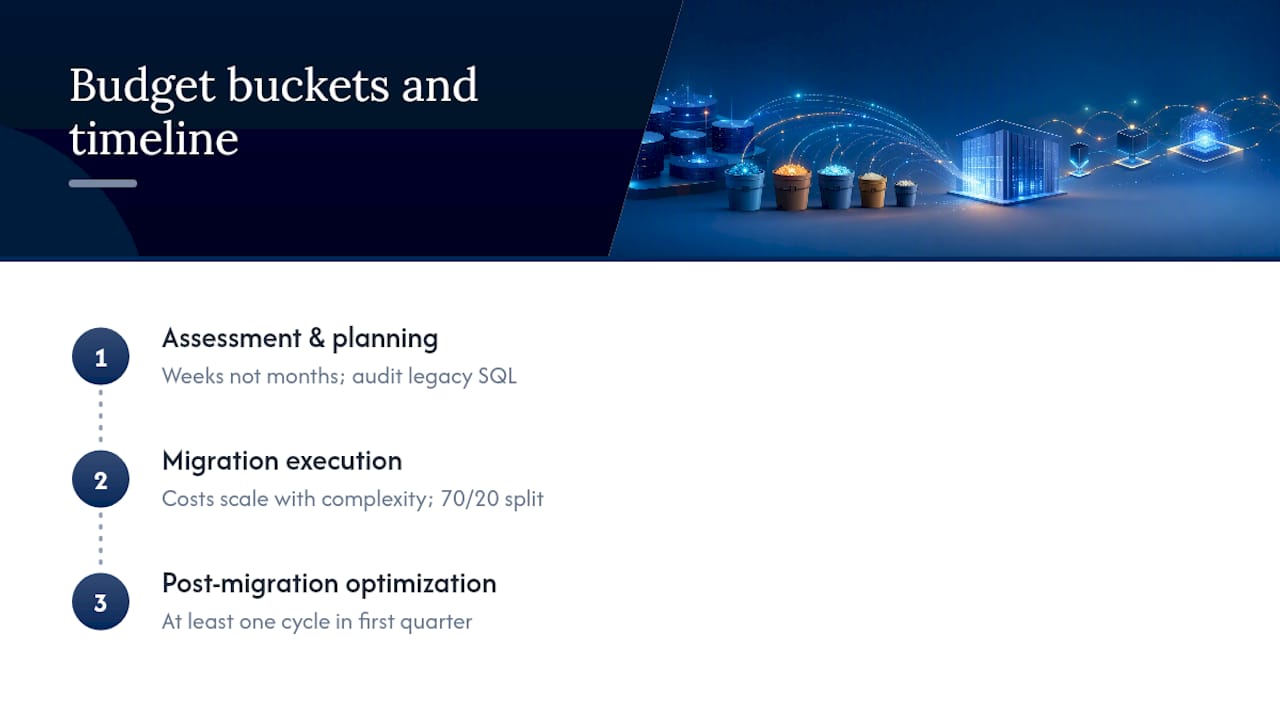
Modernization costs break into three buckets: assessment and planning, migration execution, and post-migration optimization, and teams that budget for only the second bucket consistently run over.
Assessment typically runs weeks, not months, but skipping it to save time is the single most common way projects blow their later budget. A thorough audit of legacy SQL, stored procedures, and undocumented dependencies costs far less than discovering that logic mid-migration, when it stalls a pilot workload everyone is watching.
Migration execution costs scale with workload complexity, not data volume alone. A dataset with clean, well-documented logic migrates faster and cheaper than a smaller dataset tangled in decades of undocumented business rules. This is why the 70/20 hybrid split works financially as well as technically: lifting most workloads with minimal change keeps costs predictable, while the redesigned 20% absorbs the complexity budget.
Post-migration optimization is the bucket teams forget to fund. Compute costs in cloud platforms respond directly to query patterns and indexing choices, and a platform left untuned after go-live can quietly cost more than the legacy system it replaced. Budget for at least one dedicated optimization cycle in the first quarter after cutover.
Timelines run a timeline that typically spans multiple quarters to a few years for full enterprise scope, but that number hides enormous variance. A single-domain pilot can prove value in eight to twelve weeks. A full legacy estate with multiple downstream systems, as covered in legacy modernization cost planning, needs the full multi-year window with iterative funding checkpoints rather than one lump budget approval.
How Do Data Lakes and Data Mesh Fit Into a Modern Warehouse?
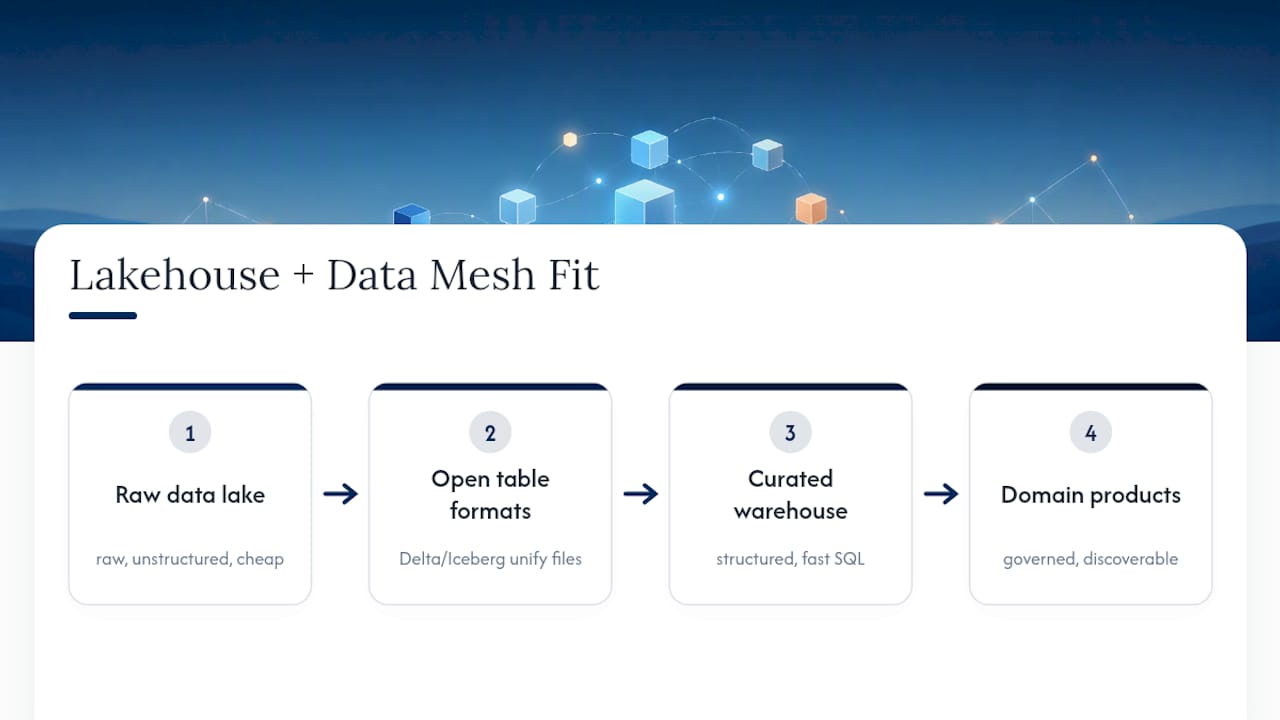
Data lake and data warehouse are not competing choices anymore. They are complementary layers in the same architecture, which is exactly what the lakehouse pattern formalizes.
A data lake stores raw, unstructured, and semi-structured data cheaply and at scale, capturing everything from log files to sensor streams without forcing a schema upfront. A data warehouse imposes structure and optimizes for fast, repeatable SQL queries against curated data. The old debate over data lake vs data warehouse assumed teams had to pick one. Open table formats like Delta Lake and Apache Iceberg dissolve that choice by letting both lake-style storage and warehouse-style querying operate against the same underlying files.
Data mesh adds an organizational layer on top of this technical foundation. Instead of one central team owning all data pipelines, a mesh model assigns ownership of specific data domains, customer records, financial transactions, program metrics, to the teams closest to that data. Each domain team publishes its data as a governed, discoverable product that other teams can consume through shared standards.
This matters for modernization because centralized data platforms tend to become bottlenecks as an organization scales. A mesh approach distributes that load, but it only works if the underlying technical platform supports consistent governance and cataloging across domains. Trying to run data mesh on top of a fragmented, ungoverned legacy warehouse tends to multiply the governance gaps rather than solve them. Modernization projects that plan to eventually adopt mesh principles should build domain-level ownership and cataloging into the architecture from the start, not retrofit it after the platform is already live.
How Is Automation Changing the Modernization Process Itself?
Automation now touches nearly every phase of a modernization project, not just the pipelines it eventually produces. That shift is changing what "phased roadmap" actually means in practice.
Discovery, historically the slowest phase, now benefits from automated metadata cataloging tools that scan legacy databases and build dependency maps in days instead of weeks. This does not eliminate the need for human review of undocumented business logic, but it narrows where that review needs to focus.
Code conversion is where automation makes the biggest dent in project timelines. Pattern-based transformation tools can convert large volumes of legacy stored procedures and SQL dialects into modern equivalents automatically, flagging only the ambiguous cases for manual review. That flips the traditional ratio of manual-to-automated conversion work, and it is the main reason projects that once took years can now compress into shorter, iterative waves.
AI's role extends past migration mechanics into the platform's ongoing operation. Once data lands in a lakehouse with open table formats, machine learning models can train directly against current production data instead of waiting for a separate export and transformation cycle. This is the practical meaning of AI readiness: not that a warehouse has an AI feature bolted on, but that its architecture removes the friction between "data exists" and "a model can use it."
Automation also reshapes governance. Automated lineage tracking and quality checks catch data drift continuously instead of during periodic manual audits, which matters enormously once multiple teams and, increasingly, AI agents are querying the same platform.
What Do Successful Modernization Programs Actually Look Like?
Concrete outcomes matter more than architecture diagrams when evaluating whether a modernization program worked. The strongest examples share a specific pattern: a narrow, high-impact pilot proved value before the organization committed to full-scale migration.
A finance or operations team migrating a single reporting domain, say, monthly compliance reporting, onto a cloud data warehouse first, then using that proof point to secure funding for the harder domains, is a far more reliable path than an enterprise-wide big-bang cutover. The pilot's value comes from being small enough to finish on schedule and visible enough that its success is undeniable to budget holders.
In government and compliance-heavy environments specifically, successful implementations tend to center on measurable audit and processing outcomes rather than purely technical wins. A dashboard that gives program leadership real-time visibility into case processing times, replacing a manual report that took days to compile, is the kind of outcome that builds durable trust in a modernization initiative. That trust then makes the next phase easier to fund and staff, because stakeholders have already seen the platform deliver.
The common thread across working implementations is sequencing discipline: discovery before migration, pilot before scale, governance before production load. Programs that skip steps to hit an arbitrary deadline tend to be the ones revisiting failed migrations eighteen months later. Programs that respect the sequence, even when it feels slower at the outset, are the ones still running the same platform three years on without a second modernization project to fix the first one.
Where Should Teams Start This Quarter?
Run discovery before anything else, and resist the urge to redesign everything at once. A hybrid approach, pilot one workload, validate it, then scale, consistently outperforms a full rebuild. For public-sector teams, review strategic IT partnership models and SOW structures before writing scope.
— Randy
A Defined-Scope Partner for Government Data Modernization
A defined-scope partner owns modernization work packages outcome by outcome, discovery, compliance automation, dashboards, security baselines, rather than supplying staff hours to manage. That distinction matters most for prime contractors and agencies running compliance-heavy programs where audit readiness and program visibility carry real consequences. As a certified firm, the company takes on clearly scoped modernization packages that reduce processing times and give leadership real-time visibility into program status. If your team is weighing a phased rollout like the one outlined above, explore IT modernization solutions for government agencies and request a discovery conversation scoped to your agency's specific outcomes.
Sources
- Statista: worldwide share cloud usage for data storage and backup by size
- Databricks Blog: Data Warehouse Modernization
- Valorem Reply: Enterprise Data Warehouse Modernization Roadmap for 2026
- Data Consulting Firms: Legacy Data Warehouse Modernization Strategy