

Legacy modernization cost is the total financial exposure of upgrading an aging system, spanning direct spend on migration, licensing, and vendor labor plus the indirect costs of lost productivity, security risk, and integration workarounds. Per-application efforts typically run from the mid-six figures into the low millions, and federal agencies alone spend roughly 80% of IT budgets just maintaining what already exists. Before committing to a number, commission a discovery-driven lifecycle cost analysis. Guessing at this figure is the single most expensive mistake a finance team can make.
TL;DR:
- Most legacy modernization costs are underestimated because indirect expenses like lost productivity, security risks, and manual workarounds are rarely included in vendor quotes.
- Support escalation, talent premiums for legacy skills, and integration debt significantly drive up the true costs over time, often outweighing initial estimates.
- Simplistic rehosting or replatforming approaches are cheaper but may continue technical debt; more extensive options like refactoring or rewriting have higher costs but reduce long-term risks.
- Building a lifecycle cost analysis helps compare "keep as-is" versus "modernize" over several years, revealing that some systems are cheaper to maintain than upgrade.
- A comprehensive budget should include discovery, contingency, and a phased plan, with empirical data showing that application complexity heavily influences modernization costs.
Table of Contents
- What Legacy Modernization Cost Actually Includes
- What Hidden Costs Get Missed in a Legacy System Upgrade Expense?
- How Much Does Modernization Cost by Approach?
- How Do You Build a Modernization Business Case?
- Budgeting for Discovery, Procurement, and Contingencies
- What Do GAO and TMF Data Reveal About Modernization Risk?
- A 90-Day Program for a Defensible Modernization Budget
- How Primereadysub Turns This Playbook Into a Funded Program
- Primary Sources and Further Reading
- Sources
What Legacy Modernization Cost Actually Includes
Most budget requests undercount legacy modernization cost because they only capture what shows up on a vendor invoice. Direct costs are easy to spot: infrastructure, software licenses, migration labor, and vendor support contracts. Indirect costs are where the real money hides, and they rarely get their own line item.
Consider how a single legacy application drains a budget. The license renewal shows up in the IT procurement ledger. The three additional developer hours spent each week working around a broken API sits buried inside general payroll. The compliance officer's time spent manually reconciling records for an audit gets coded as "administrative overhead." None of these indirect costs get flagged as modernization-related, so when someone finally asks "what does this system cost us," the honest answer requires pulling data from four or five different departments.
This is exactly why GAO's federal IT spending research found that agencies dedicate around 80% of their annual technology budget to operating and maintaining existing systems, leaving a shrinking slice for anything forward looking. That ratio does not happen because agencies enjoy running old code. It happens because nobody built a full accounting of what the old code actually costs until the number was too large to ignore.
Lifecycle cost analysis solves this by forcing every relevant cost, distributed or concentrated, into a single multi-year comparison between "keep as-is" and "modernize." The Technology Modernization Fund's evaluation work reinforces why this framing matters: measured in narrow annual terms, many modernization investments look unimpressive, but measured across a five-to-ten-year horizon that includes avoided maintenance and avoided risk, the picture changes substantially.
Build your taxonomy around these categories before you collect a single number from finance or operations:
- Direct capital costs: migration labor, new licenses, cloud infrastructure, vendor implementation fees.
- Direct operational costs: ongoing support contracts, extended security updates, recurring subscription fees.
- Indirect productivity costs: developer time lost to workarounds, manual data reconciliation, duplicate entry.
- Indirect risk costs: compliance exposure, breach probability, audit remediation time.
- Opportunity costs: features and integrations the organization cannot pursue because the legacy system cannot support them.
What Hidden Costs Get Missed in a Legacy System Upgrade Expense?
A cost baseline built only from vendor quotes will underestimate the true legacy system upgrade expense by a wide margin. The gaps tend to cluster in six predictable places, and each one deserves its own line before you present a budget to a board or appropriations committee.
- Maintenance and O&M escalation. Support costs for aging platforms rarely stay flat. Extended Security Updates, custom support agreements, and specialized vendor contracts climb every renewal cycle as the platform ages further past its supported end-of-life date.
- Talent premiums for legacy skills. COBOL, RPG, and other older-language specialists command a premium precisely because the labor pool keeps shrinking while the systems keep running.
- Developer productivity loss. Every hour spent patching around brittle integrations is an hour not spent on work that moves the mission forward. This cost never appears on an invoice, but it shows up in slower delivery and burned-out staff.
- Integration and API debt. Legacy systems built before modern API standards often require custom middleware for every new connection. Each new integration adds a little more fragility to a system that was never designed to flex.
- Manual exception handling. When automation cannot cross a legacy boundary cleanly, someone on staff becomes the human workaround, often for years, at a real and recurring payroll cost.
- Security and compliance exposure. Aging systems accumulate unpatched vulnerabilities and audit findings, and the remediation clock starts running the moment a finding gets written up.
Statistic Callout: GAO reporting found that ten critical federal legacy systems collectively cost about $337 million annually to operate and maintain, with some systems 8 to 51 years old and running in languages like COBOL. That figure covers operations and maintenance alone, before a single dollar goes toward modernization.
Public-sector case studies also show that non-vendor categories, internal staffing, training, quality assurance, and transition management, routinely absorb a large share of total project effort. If your budget request only accounts for the systems integrator's invoice, you are missing the labor cost of your own staff supporting the transition. The Digital Leaders analysis of legacy risk frames this well: legacy is a risk profile that compounds quietly, not a static backlog that waits patiently for attention.
How Much Does Modernization Cost by Approach?
The question "how much does modernization cost" has no single answer because the technical approach you choose changes the cost structure entirely. Five approaches dominate real-world programs, each with a distinct cost and risk profile.
- Rehost ("lift and shift"): move the application to new infrastructure with minimal code change. Cheapest and fastest, but it carries forward the underlying technical debt.
- Replatform: shift to a new runtime environment (often cloud-managed) with moderate code adjustments. Balances cost against modest improvement.
- Refactor: restructure code without changing external behavior, improving maintainability and performance. Higher labor cost, lower long-term risk.
- Rewrite: build the application from scratch on modern architecture. Highest cost and longest timeline, but it removes legacy constraints entirely.
- Replace (COTS): retire the custom system in favor of a commercial off-the-shelf or SaaS product. Cost shifts from development to licensing and configuration.
Industry aggregations commonly place moderate-complexity application modernization costs in the mid-six-figure to low-seven-figure range per application, though that range should be treated as an illustrative ballpark rather than a firm quote. Every organization's mix of systems is different, and the only way to convert that ballpark into a defensible number is per-application analysis.
Statistic Callout: Empirical work behind the DHS Cloud One migration cost model shows that per-application costs correlate strongly with source lines of code (SLOC), the number of external interfaces, and the target environment. Two applications that look similar on the surface can carry very different price tags once you measure their actual code volume and integration count.
Four variables drive most of the variance you will see between a low estimate and a high one: total SLOC, interface count, data migration complexity, and regulatory or compliance scope. A payroll system touching twelve downstream reporting feeds and subject to federal audit requirements will cost meaningfully more to modernize than a standalone scheduling tool of similar size.
To move from per-application estimates to a portfolio-level number, resist the urge to simply multiply an average cost by application count. Segment your inventory by complexity tier, apply distinct cost bands to each tier, then layer in a shared-services discount for common infrastructure. A detailed application modernization guide walks through how professional teams scope these programs application by application rather than guessing at a blended average.
How Do You Build a Modernization Business Case?
A defensible business case rests on comparing the full cost of "keep as-is" against the full cost of "modernize" over a multi-year horizon, not a single fiscal year. GAO's own life-cycle cost comparison guidance makes an important point that gets lost in modernization enthusiasm: sometimes the analysis shows that maintaining the current system actually costs less than modernizing it, and that is a legitimate outcome, not a failure of the process.
Build the comparison in this order:
- Baseline the current-state cost. Include O&M, security patching, talent premiums, manual workaround labor, and compliance exposure, not just the maintenance contract.
- Model the modernization cost. Include discovery, implementation, data migration, training, and a transition period where both systems may run in parallel.
- Quantify non-financial benefits conservatively. Faster processing times and improved audit readiness matter, but assign them a defensible financial proxy (hours saved multiplied by loaded labor rate) instead of a vague claim.
- Apply discounting and sensitivity analysis. Run the numbers at optimistic, expected, and pessimistic cost scenarios so decision-makers see a range, not a single fragile figure.
- Frame the value case around cost avoidance, not just savings. The Technology Modernization Fund's own results show that many of its roughly $1.03 billion in funded projects delivered modest short-term savings but substantial projected savings and time reductions in later fiscal years. Reviewers who expect immediate payback will be disappointed by a program that is actually performing well on a longer horizon.
Pro Tip: Present your business case with three funding scenarios, fully funded upfront, phased across two budget cycles, and grant-supplemented, since procurement committees respond better to options than to a single all-or-nothing ask.
Non-financial benefits deserve real scrutiny before you convert them into dollars. If you cannot defend the labor-rate assumption behind a productivity gain in front of a skeptical CFO, use a more conservative proxy or leave it as a qualitative benefit rather than inflating the financial case.
Budgeting for Discovery, Procurement, and Contingencies
Every credible legacy system transformation budget starts with discovery, and skipping it is the most common way estimates fail an audit later. A thorough application analysis, covering code volume, dependency mapping, data quality, and interface inventory, commonly costs $70,000 to $100,000 per application for federal-grade analyses. That figure looks large in isolation, but it is a small fraction of the multi-million-dollar modernization spend it protects against.
Build these elements into your initial budget plan:
- Contingency buffer of 15% to 25% on both schedule and cost, sized larger for programs with heavy regulatory scope or unclear legacy documentation.
- A clear statement of work that defines outcome-owned deliverables rather than open-ended staff augmentation, which keeps oversight burden low for the receiving agency.
- A funding-mechanism decision early: fixed-price contracts protect budget certainty on well-scoped work, while time-and-materials arrangements fit discovery-phase uncertainty better.
- A disposition plan for the legacy system, since GAO reviewers have specifically flagged incomplete modernization plans as a driver of cost overruns and schedule delays.
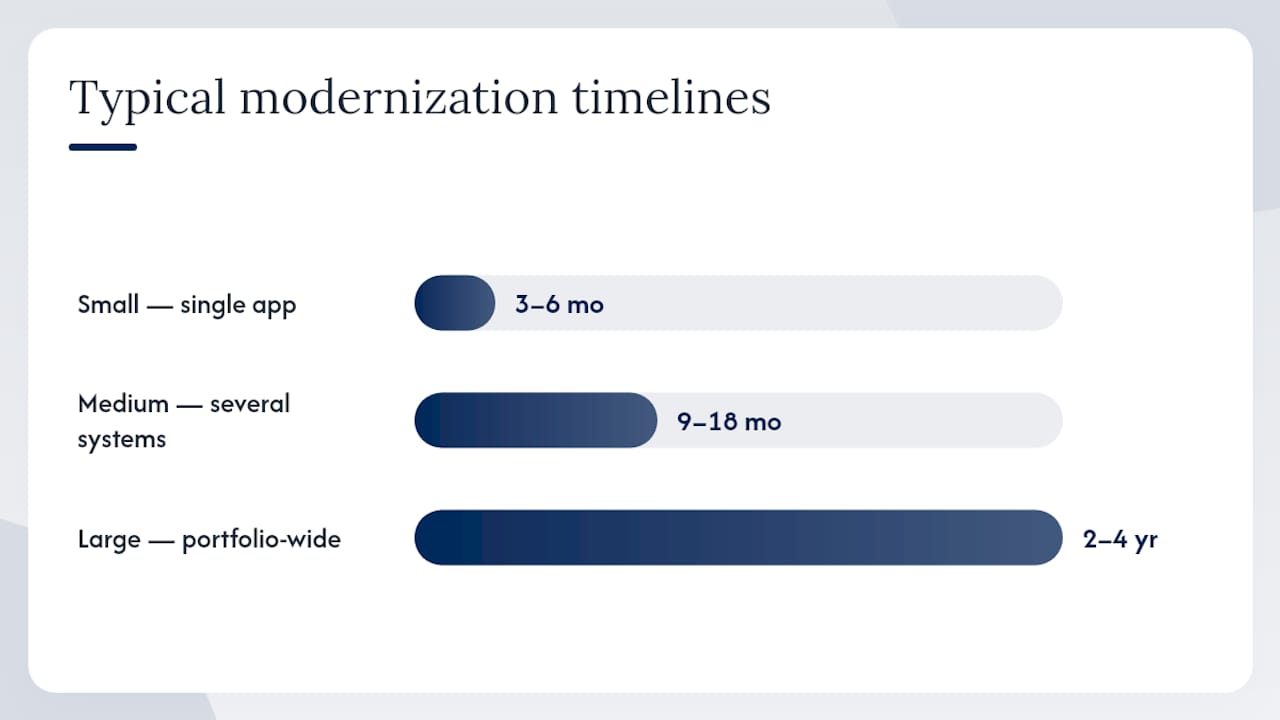
Timelines scale predictably with scope. A small, single-application modernization with limited interfaces often runs three to six months from discovery to cutover. A medium program covering several interconnected systems typically runs nine to eighteen months. Large portfolio-wide transformations, the kind most state agencies and federal departments actually face, commonly span two to four years when sequenced by criticality rather than attempted all at once.
What Do GAO and TMF Data Reveal About Modernization Risk?
Public oversight reporting gives finance and IT leaders something rare in this field: real numbers instead of vendor projections. Three sources carry the most weight for budgeting decisions.
- GAO's ongoing review of federal legacy systems found that agencies still direct about 80% of IT budgets toward operating systems that are, in some documented cases, five decades old.
- A separate GAO review identified ten critical legacy systems with combined annual O&M costs of roughly $337 million, several running on COBOL with no clear replacement plan.
- The Technology Modernization Fund's performance data shows that near-term savings from its roughly $1.03 billion in funded projects have been modest, while projected savings and time reductions grow substantially in later fiscal years, a pattern that should inform how any agency presents its own multi-year value case.
- The DHS Cloud One dataset demonstrates that per-application migration costs can be modeled with real accuracy once SLOC, interface count, and target environment are known, replacing guesswork with regression-backed estimates.
Rutledge & Associates has built its scoped modernization work directly around these findings, treating discovery investment and outcome-owned deliverables as the mechanism that turns GAO's cautionary data into an actual funded program rather than another report that gathers dust.
A 90-Day Program for a Defensible Modernization Budget
Getting from "we know legacy is expensive" to a funded, board-approved program takes a structured 90 days, not an open-ended study.
Days 1 to 30: Inventory every legacy application, tag each by criticality and risk, and stand up a governance group that includes finance, IT, security, and the business owners of affected systems.
Days 31 to 60: Commission prioritized discovery on your top three to five highest-risk applications, and build a risk register that tracks cost exposure alongside operational risk.
Days 61 to 90: Draft a pilot statement of work for the single highest-value application, present the lifecycle cost comparison to leadership, and trigger procurement once the pilot scope is approved.
Success at day 90 looks like a real cost baseline, a validated pilot ready for a statement of work, and a procurement process already in motion instead of still stuck in committee.
— Randy
How Primereadysub Turns This Playbook Into a Funded Program
Primereadysub is the alternative to open-ended staff augmentation for agencies and prime contractors trying to move from budget guesswork to a funded modernization program. Where generic IT vendors quote broad hourly rates and leave scope loosely defined, Primereadysub owns clearly bounded work packages, discovery, lifecycle cost modeling, and modernization delivery, so agencies get a fixed, auditable scope instead of an open staffing contract that grows unpredictably. That outcome-owned structure reduces the procurement and oversight burden that typically slows public-sector programs, since reviewers are approving a defined deliverable rather than a headcount request. As a certified SDVOSB, woman-owned, and SBA-certified firm already active in state and federal modernization work, Primereadysub can run the application analysis this article describes and convert it directly into a board-ready budget. Readers ready to move past estimation and into a scoped engagement can explore Primereadysub's modernization services and request a discovery-phase proposal.
Primary Sources and Further Reading
- GAO: Agencies Need to Continue Addressing Critical Legacy Systems, documenting the 80% O&M spending ratio driving modernization urgency.
- GAO: Technology Modernization Fund savings analysis, showing realized versus projected savings across roughly $1.03 billion in funded projects.
- DHS Cloud One application migration cost model, the empirical basis for per-application cost estimation.
- GAO: Modernization Plans for Critical Legacy Systems, quantifying the $337 million annual cost of ten critical federal systems.
Sources
- Information Technology: Agencies Need to Continue Addressing Critical Legacy Systems (GAO)
- Technology Modernization Fund: Small Savings Achieved So Far, but Substantial Future Savings Expected (GAO)
- Cloud One application migration cost model (DHS)
- Information Technology: Agencies Need to Develop and Implement Modernization Plans for Critical Legacy Systems (GAO-23-106821)