

State agencies pour millions into IT projects, then declare success when the final deployment check clears. But completed deployments and working systems are not the same thing. Agencies that continue relying on milestone-based thinking often find that modernized infrastructure still produces slow service delivery, audit failures, and fragmented data. The strategies that actually drive lasting improvement treat technical goals as constraints on the path to mission outcomes, not as destinations in themselves. This guide covers proven approaches to modernization, compliance automation, and efficiency that public-sector IT leaders are using right now.
Table of Contents
- Why outcomes, not metrics, drive modernization success
- Compliance automation with NIST CSF 2.0: Risk-based strategies
- Cloud adoption and security: FedRAMP's role in public-sector IT
- Outcome-based contracting for modernization projects
- Global perspective: Learning from UK's Government Digital Service
- Why technical-first thinking holds agencies back—and how to move forward
- Partnering for public-sector IT modernization success
- Frequently asked questions
Key Takeaways
| Point | Details |
|---|---|
| Prioritize outcome-based frameworks | Modernization efforts succeed when they focus on actual mission results, not just technical checklists. |
| Automate compliance using risk profiles | NIST CSF 2.0 enables ongoing compliance automation by aligning risk management processes and workforce strategy. |
| Use FedRAMP for secure cloud adoption | FedRAMP provides a standardized security and authorization pathway, streamlining cloud migration in public-sector IT. |
| Procurement should tie to measurable outcomes | Outcome-based contracting and staged evaluation reduce risk and foster iterative delivery for lasting IT modernization. |
| Learn from global digital leaders | Studying the UK’s GDS helps agencies strengthen infrastructure and elevate leadership for better service delivery. |
Why outcomes, not metrics, drive modernization success
Now that the misconception about technical metrics is clear, the foundational shift toward outcome-based modernization deserves a closer look. The difference between a technically successful project and a genuinely successful one is often measured in years of rework.
Traditional IT projects in government tend to define success through deliverables: a system goes live, a migration completes, a server count decreases. These are inputs, not impacts. Outcome-based modernization reframes the conversation around what actually changes for the people who depend on the agency. As public-sector IT best practices emphasize, the focus should fall on service delivery, decision quality, and resource efficiency, with technical metrics treated as constraints rather than goals.
| Approach | Success defined by | Risk profile | Flexibility |
|---|---|---|---|
| Technical metrics focus | Deliverables, uptime, system count | High (scope creep, misaligned effort) | Low |
| Outcome-based focus | Service speed, audit readiness, cost per transaction | Moderate (iterative adjustment) | High |
The distinction matters at every level of agency IT leadership. A network upgrade that reduces latency by 40 percent is only valuable if that latency was actually slowing down case workers or citizen-facing services. Outcome frameworks force that question to be answered before budget is allocated, not after.
Key differences between these two approaches include:
- Goal definition: Technical approaches ask "what do we build?" Outcome approaches ask "what changes for users?"
- Measurement timing: Technical success is measured at project close. Outcome success is measured continuously.
- Budget alignment: Outcome frameworks tie funding to demonstrated impact, reducing the risk of over-investing in low-value systems.
- Stakeholder accountability: Outcomes are visible to non-technical leadership, which creates broader organizational support.
"When the measure of success is a technical checklist, agencies lose the ability to course-correct before a project causes real harm to service delivery."
Selecting the right implementation partner selection guide is inseparable from this shift. Partners who default to feature lists and deployment counts are not aligned with outcome-driven modernization. Agencies and prime contractors modernization partnerships that prioritize mission accountability bring a fundamentally different delivery model to the table.
Compliance automation with NIST CSF 2.0: Risk-based strategies
While outcome focus is critical for modernization, robust compliance and risk management are essential for sustained success, especially with evolving federal and state regulations.
The release of the NIST Cybersecurity Framework 2.0 marked a significant maturation of federal cybersecurity guidance. Rather than prescribing a checklist, NIST CSF 2.0 organizes practice around cybersecurity risk management outcomes, giving agencies the flexibility to calibrate controls to their actual threat environment. This is a critical distinction for state agencies operating across diverse program areas with varying risk tolerances.
The framework is structured around six core functions: Govern, Identify, Protect, Detect, Respond, and Recover. Each function supports continuous risk management rather than periodic audit preparation. Agencies that treat compliance as a one-time assessment exercise consistently find themselves scrambling when federal reviews occur. Agencies that operationalize the framework, embedding it into daily workflows and DevOps pipelines, maintain a far more defensible posture.
Practical steps for operationalizing NIST CSF 2.0:
- Create agency-specific profiles. The framework's profile tool allows agencies to map current state against target state, identifying priority gaps based on mission criticality rather than generic risk categories.
- Integrate controls into the DevOps pipeline. Automated policy checks, configuration scanning, and vulnerability detection should run continuously, not before annual audits.
- Use the Quick-Start Guide for workforce onboarding. NIST's Quick-Start Guide provides a structured entry point for teams new to the framework, reducing the learning curve for IT staff who manage day-to-day compliance.
- Align enterprise risk management with cybersecurity posture. Budget requests, vendor contracts, and system acquisition decisions should all reflect documented cybersecurity risk. This closes the gap between IT and executive-level risk conversations.
- Establish metrics tied to risk outcomes. Mean time to detect (MTTD) and mean time to respond (MTTR) are far more informative than patch counts or firewall rule tallies.
Pro Tip: Before selecting an automation tool, map your agency's current NIST CSF profile gaps. Automation that targets your actual risk profile will generate far fewer false positives and deliver clearer audit evidence than off-the-shelf scanning tools applied without context.
For agencies building toward a contract-ready partnership, the ability to demonstrate a living, continuously updated compliance posture is increasingly a contract requirement rather than a bonus. Reviewing the full framework at the NIST CSF homepage gives leadership a clear picture of what auditors and federal partners now expect.
Cloud adoption and security: FedRAMP's role in public-sector IT
With compliance processes aligned, mastering secure and efficient cloud adoption is a top modernization priority, and FedRAMP plays a central role in that process.
The Federal Risk and Authorization Management Program, or FedRAMP, exists because the federal government recognized that each agency independently vetting cloud vendors created redundant, inconsistent, and costly security reviews. FedRAMP's structure provides standardized cloud authorization pathways, meaning a cloud service provider that achieves FedRAMP authorization has already passed a rigorous, government-standard security review.

For state agencies, FedRAMP authorization is not a legal requirement in the same way it is for federal agencies. However, it functions as a powerful vendor screening tool. A FedRAMP-authorized provider has documented security controls across 325 or more requirements based on NIST SP 800-53, undergone third-party assessment, and committed to continuous monitoring reporting. That baseline dramatically reduces the agency's own due diligence burden.
Key considerations for state agencies evaluating cloud vendors:
- FedRAMP High vs. Moderate authorization levels: High authorization is required for systems handling particularly sensitive data. For most state program applications, Moderate authorization provides adequate assurance without over-engineering security overhead.
- Continuous monitoring obligations: FedRAMP-authorized providers submit monthly automated scans and annual assessments. Agencies gain near real-time visibility into the security posture of services they rely on.
- Impact on procurement timelines: Requiring FedRAMP authorization in solicitations filters out less mature vendors early, reducing evaluation time and vendor risk.
- State-specific equivalency programs: Several states have developed programs that leverage FedRAMP as a baseline, extending its value to agencies that operate independently of federal procurement vehicles.
The practical impact on IT leadership is substantial. Moving to FedRAMP-authorized platforms reduces the time your security team spends on initial vendor assessments, which in turn frees capacity for the continuous monitoring and incident response work that actually reduces risk. Agencies focused on building IT partnerships with vendors who understand these authorization pathways avoid the costly delays that occur when cloud migration stalls over unresolved security documentation.
Outcome-based contracting for modernization projects
To make these modernization strategies stick, agencies need procurement models that emphasize outcomes. The contracting structure itself either supports or undermines the modernization approach.
Outcome-based contracting (OBC) reframes the acquisition around what the agency needs to achieve rather than what the contractor needs to deliver. OBC best practices position this approach as a practical acquisition model that aligns procurement with measurable mission outcomes and iterative delivery, rather than predefined technical artifacts like system specifications and deliverable lists.
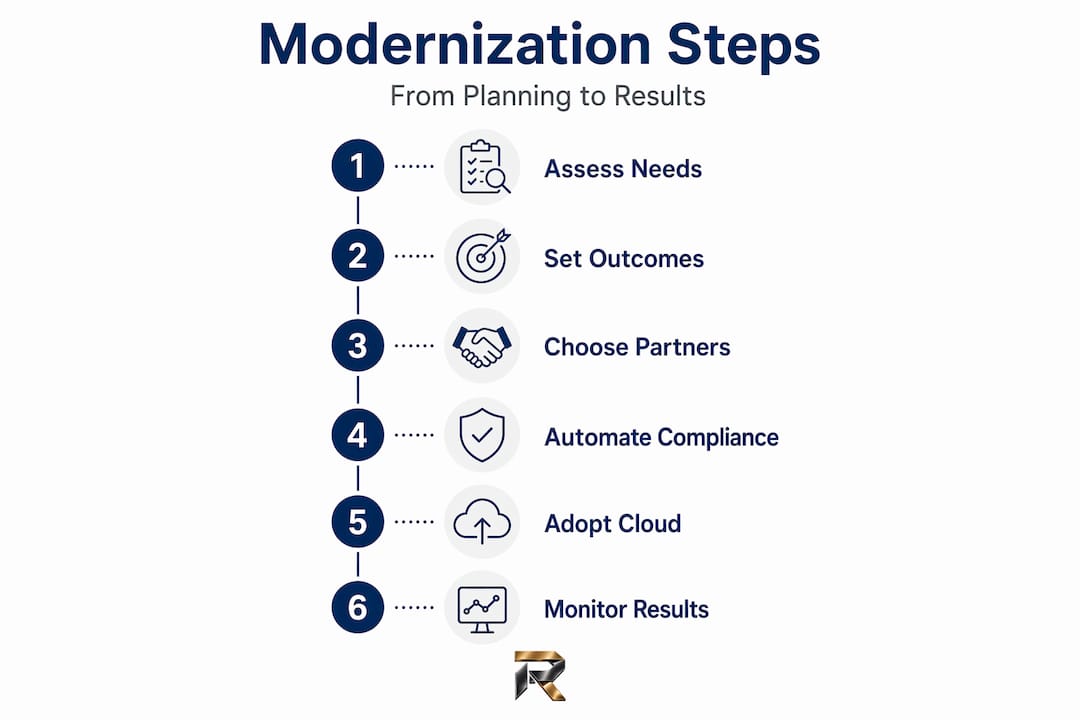
The traditional statement of work approach creates an incentive misalignment. Contractors are rewarded for delivering against specifications, even when those specifications no longer reflect the agency's actual operational needs. OBC addresses this by structuring the contract around performance metrics that reflect real program outcomes: reduction in manual processing time, increase in citizen self-service completion rates, measurable improvement in audit findings.
How to implement outcome-based contracting in practice:
- Define measurable outcomes before issuing the solicitation. This seems obvious, but many agencies skip the internal alignment work that makes outcome metrics credible. Outcomes must be specific, time-bound, and tied to program performance data.
- Use staged funding tied to demonstrated results. Rather than funding the full contract at award, release incremental funding as contractors demonstrate achievement of defined milestones. This surfaces risk early and preserves agency leverage.
- Build in iterative review cycles. Quarterly or semi-annual performance reviews should be contractually required, with provisions for scope adjustment based on performance data.
- Structure acceptance criteria around user impact. A new case management system is not accepted because it "goes live." It is accepted when it demonstrably reduces case processing time by the specified threshold.
- Require transparency in the contractor's methodology. Contractors operating under OBC structures should provide regular visibility into their delivery approach, not just final deliverables.
"Outcome-based contracting does not reduce accountability—it concentrates accountability on the results that actually matter to the agency's mission."
Pro Tip: When drafting outcome metrics for a solicitation, involve program staff alongside IT leadership. Program staff know what operational friction looks like on the ground. IT leaders know what is technically measurable. The overlap between those two perspectives produces the most defensible and meaningful outcome targets.
Agencies looking at flexible contracting approaches that reduce vendor lock-in and support iterative modernization will find OBC to be a foundational tool in that effort.
Global perspective: Learning from UK's Government Digital Service
While U.S. agencies have unique regulatory challenges, global leaders offer proven frameworks and lessons that translate well across contexts.
The UK's Government Digital Service (GDS) operates as the central digital capability and standards body for the British government. Its model has influenced digital government strategy across Europe, Canada, and Australia, and it offers concrete lessons for U.S. state agencies tackling similar modernization challenges. The UK GDS blog functions as a real-time resource for practitioners, documenting lessons from live projects, not just completed ones.
Several GDS priorities translate directly to the state agency context:
- Joining up services across departments. The GDS model consistently pushes against siloed service delivery. Citizens interacting with government should not need to re-enter the same information across different programs. This interoperability goal requires shared data infrastructure and cross-agency governance, both of which require leadership commitment before technical investment.
- Strengthening digital and data infrastructure. GDS prioritizes foundational data infrastructure over point solutions. Shared platforms, common data standards, and reusable components reduce long-term cost and accelerate future modernization.
- Elevating digital leadership and talent. GDS has consistently advocated for placing qualified digital leaders at the executive table, not just in IT departments. Decisions about service design, procurement, and data governance require digital expertise at the decision-making level.
- User research as a disciplined practice. GDS embeds user research throughout the development process. Assumptions about what citizens or program staff need are tested with actual users before being built into systems.
State agencies that adopt even two or three of these practices systematically will see meaningful improvement in modernization outcomes. The GDS model is not aspirational. It is operational, and its core lessons have been stress-tested across a government that manages services at comparable scale and complexity to large U.S. states.
Why technical-first thinking holds agencies back—and how to move forward
Having explored global and U.S. best practices, it is worth examining what most articles miss about why agency digital transformation succeeds or fails.
The most common failure pattern in government IT modernization is not poor technology selection. It is the persistence of technical-first thinking at the leadership level. Agencies that frame their modernization goals primarily around infrastructure replacement, system consolidation, or software upgrades consistently underinvest in the governance, change management, and outcome measurement capabilities that actually determine whether the investment pays off.
Technical-first thinking produces a specific kind of project success and program failure. The project closes on time and on budget. The system works as specified. But two years later, the agency is still running manual workarounds because the new system's workflow assumptions never matched the real program environment.
What outcome-driven modernization requires is a willingness to slow down the technical decision-making long enough to align on what success looks like operationally. That alignment work is often less visible than infrastructure procurement and harder to budget for, but it is where the return on investment is actually generated.
Partnership quality is the other underappreciated factor. Agencies that select vendors and strategic IT partnerships based purely on technical certifications and prior contract volume often end up with capable executors who have no investment in the agency's mission outcomes. The most effective modernization partners bring a consistent orientation toward program impact, continuous improvement, and risk transparency, not just technical delivery.
The hardest lesson from successful modernization projects is that risk management is not a phase. It is a posture. Agencies that build continuous risk assessment into their operating model, rather than treating it as a pre-launch checklist, consistently demonstrate stronger audit performance and faster course correction when conditions change.
Partnering for public-sector IT modernization success
Applying these strategies requires more than good intentions. It requires partners who understand public-sector compliance environments, outcome-based delivery models, and the operational realities of state agency IT programs.
Rutledge & Associates brings that combination of technical depth and mission orientation to agencies in Maryland, New York, and Florida. Through Prime-Ready partner solutions, the firm provides subcontracting support that prime contractors can rely on for complex, compliance-heavy programs without the management overhead of staff augmentation models. From compliance automation and DevOps pipeline development to real-time program dashboards, the focus is always on demonstrable outcomes, not just delivered systems.
Frequently asked questions
What is outcome-based IT modernization?
Outcome-based modernization focuses on service delivery, decision quality, and efficient resource use rather than terminal technical metrics, treating completed deployments as inputs rather than program success indicators.
How does NIST CSF 2.0 support compliance automation?
NIST CSF 2.0 provides voluntary guidance, profiles, and a Quick-Start Guide that agencies use to operationalize continuous risk management, embedding compliance into daily workflows rather than treating it as a periodic audit activity.
What is FedRAMP and why does it matter?
FedRAMP sets security rules and establishes a standardized authorization pathway for cloud service adoption, giving state agencies a reliable baseline for evaluating vendor security maturity without conducting redundant independent reviews.
Which international digital government model offers valuable lessons?
The UK Government Digital Service emphasizes joined-up services, shared data infrastructure, and elevated digital leadership, offering state agencies a tested operational model rather than a theoretical framework.
How can contracting approaches reduce risk in IT modernization?
Outcome-based contracting ties procurement to measurable mission outcomes and iterative delivery cycles, surfacing delivery risk early and preserving agency leverage throughout the modernization process rather than only at project close.