

Agency partnerships in public sector IT are frequently misread as straightforward procurement transactions. A prime contractor finds a capable subcontractor, signs an agreement, and the work gets done. That framing is dangerously incomplete. The reality involves layered compliance obligations, structural tradeoffs with legal consequences, and a selection process that demands evidence of technical capability, regulatory readiness, and documented past performance. For primes managing complex IT modernization programs, the quality of their subcontracting relationships directly shapes both contract performance and audit outcomes.
Table of Contents
- Understanding agency partnerships in public sector IT
- Compliance, liability, and risk: Prime contractors' obligations
- Structuring agency partnerships: Teaming agreements, JVs, CTAs
- Finding and qualifying partners: Capability statements and engagement tactics
- Beyond checklists: What most guides miss about agency partnerships
- Next steps: Connect with prime-ready IT partners
- Frequently asked questions
Key Takeaways
| Point | Details |
|---|---|
| Compliance is critical | Prime contractors must ensure all subs meet strict compliance frameworks like CMMC and FedRAMP. |
| Choose the right partnership structure | Teaming, JVs, and CTAs have different risks and enforceability; define material terms up front. |
| Capability statements matter | Well-crafted statements boost success by showcasing experience, credentials, and readiness for IT modernization. |
| Flexibility after award | Primes benefit most when partnership structures allow post-award adaptation without sacrificing compliance. |
Understanding agency partnerships in public sector IT
Agency partnerships in government contracting encompass a range of formal structures: prime and subcontractor arrangements, teaming agreements, joint ventures (JVs), and contract teaming arrangements (CTAs). Each carries different implications for liability, set-aside eligibility, and operational control. Choosing the wrong structure at the outset can create compliance exposure or cost a prime its competitive positioning.
Building strategic IT partnerships requires understanding what each structure actually obligates. A teaming agreement is typically a pre-award commitment between a prime and one or more potential subs to pursue a contract together. A JV is a separate legal entity formed by two or more firms. A CTA is a more formal arrangement used specifically on certain multiple-award vehicles, requiring shared performance responsibilities.
| Structure | Legal entity | Set-aside eligibility | Risk level | Setup cost |
|---|---|---|---|---|
| Teaming agreement | No | Prime's status | Low to medium | Minimal |
| Joint venture | Yes | Dependent on size/status | Medium | $5,000 to $25,000 |
| CTA | No | Shared | Medium | Moderate |
| Subcontract | No | Prime's status | Prime bears sub risk | Low |
When it comes to major IT vehicles, the landscape is competitive. Alliant 2 and 3 are among the most significant IT government-wide acquisition contracts (GWACs), covering cloud, cybersecurity, and modernization work, with 80 prime holders split between 61 large and 19 small businesses. Task orders are competed with fair opportunity among contract holders, and small business pools are used to help primes meet subcontracting goals. This structure makes the selection of compliant, capable subs a strategic priority, not an afterthought.
Primes also carry specific regulatory obligations toward their subs. Under federal acquisition rules, primes must conduct cost and price analysis on proposed subcontractors per FAR 15.404-3, obtain consent to subcontract under FAR 44.2, and flow down compliance requirements including CMMC, NIST, FedRAMP, and DFARS 7012. Critically, primes remain liable for subcontractor performance.
The key compliance frameworks IT subs must meet include:
- CMMC (Cybersecurity Maturity Model Certification): Required for defense-related contracts handling controlled unclassified information.
- NIST SP 800-171: The technical framework underlying CMMC compliance for protecting federal data.
- FedRAMP (Federal Risk and Authorization Management Program): Required for cloud service providers working with federal agencies.
- DFARS 7012: Defense acquisition rule requiring rapid reporting of cyber incidents.
- FAR 52.204-21: Basic safeguarding requirements for federal contract information.
Partner selection should weigh technical capability against compliance readiness. A sub with strong cloud architecture credentials but no FedRAMP documentation creates risk. Past performance on similar scope and contract size matters equally. Primes building contract-ready partnerships benefit from vetting both dimensions before any agreement is signed.

Compliance, liability, and risk: Prime contractors' obligations
Compliance in agency partnerships is not a single checkpoint. It is an ongoing obligation that primes must actively manage from pre-award through contract closeout. Two regulatory touchstones define the baseline: FAR 15.404-3, which requires cost and price analysis on subcontract proposals, and FAR 44.2, which governs consent to subcontract on cost-reimbursement and certain other contracts.
Primes are not only responsible for their own performance. Under federal acquisition rules, primes remain fully liable for subcontractor performance failures, including compliance violations, missed deliverables, and cost overruns.
This liability profile changes how primes should think about sub selection. The question is not simply whether a sub can perform the work. It is whether that sub's compliance posture, documentation practices, and incident response capabilities meet the standards the prime is contractually bound to uphold.
| Compliance framework | Applies to | Prime's flow-down obligation |
|---|---|---|
| CMMC Level 2/3 | DoD contracts with CUI | Must verify and document sub certification |
| FedRAMP | Cloud services to federal agencies | Must confirm ATO status of sub's cloud platform |
| NIST SP 800-171 | Federal data handling | Must flow down CUI protection requirements |
| DFARS 7012 | Defense acquisitions | Must require 72-hour cyber incident reporting |
Common pitfalls in this space cluster around documentation gaps. Primes that rely on informal assurances from subs rather than verified compliance artifacts face serious audit exposure. Scope ambiguity in subcontract agreements is another persistent problem. When the sub's deliverables are loosely defined, disputes about performance standards become difficult to resolve and may surface during agency reviews.
Pro Tip: Build compliance verification into your subcontract award process. Require subs to submit current System Security Plans (SSPs), FedRAMP authorization letters, or CMMC assessment summaries as part of their proposal package. This step converts a compliance obligation into documented evidence before work begins.
Excessive subcontracting also carries a specific structural risk: affiliation. Under SBA rules, if a prime subcontracts more than 50% of the work on a services contract (outside of construction), the prime may lose its small business designation for that contract. This rule is particularly relevant for prime contractor roles on set-aside vehicles where maintaining size status is tied to contract eligibility.
The flexible contracting guide for public sector IT is especially relevant here, because the tradeoffs between retaining work in-house versus subcontracting it require careful analysis against both performance needs and regulatory constraints.
Structuring agency partnerships: Teaming agreements, JVs, CTAs
Structure choice is where many primes underestimate risk. Teaming agreements are attractive because they are easy to form and require minimal upfront investment. However, teaming agreements are frequently unenforceable post-award because courts and boards have treated them as "agreements to agree" when material terms like scope and pricing are absent. A sub that contributed proposal resources based on a teaming arrangement may find itself without work after award if the prime is not legally bound to assign the promised scope.
Teaming agreements
- Pros: Low setup cost, flexible, easy to form pre-award
- Cons: Often unenforceable without specific scope and price terms; sub carries significant post-award risk
Joint ventures
- Pros: Creates a legal entity with enforceable shared obligations; enables mentor-protégé benefits; supports set-aside eligibility for qualifying JVs
- Cons: Setup costs range from $5,000 to $25,000; requires formal governance structure and operating agreement
Contract teaming arrangements (CTAs)
- Pros: Useful on multi-award vehicles; allows complementary capabilities to be presented jointly; shared performance accountability
- Cons: Both parties are exposed to performance risk; requires coordinated delivery management
The affiliation risk introduced by excessive subcontracting is particularly acute for primes on small business set-asides. Subcontracting more than 50% of contract value in a services context can trigger SBA affiliation findings, which may disqualify the prime from the set-aside. This threshold applies to the primary and vital portions of the work, not just total dollar value.
A practical example illustrates how these tradeoffs play out. Consider a prime holding an Alliant 3 task order for cloud modernization at a state health agency. The prime qualifies as a small business under its NAICS code, but the technical scope requires deep DevSecOps and FedRAMP compliance automation expertise. Forming a JV with a certified SDVOSB sub that holds the technical capability allows the prime to maintain set-aside eligibility while presenting a stronger technical approach. The $10,000 to $15,000 in JV setup costs is justified by the contract value and the enhanced competitive posture. Primes managing multi-partner projects at this level need governance structures that reflect the actual complexity of shared delivery.
Finding and qualifying partners: Capability statements and engagement tactics
Locating the right subcontracting partner involves more than a search on SAM.gov. The most productive outreach channels depend on timing, target agency, and contract vehicle. The following steps outline a structured approach to sub identification and qualification for IT modernization programs.
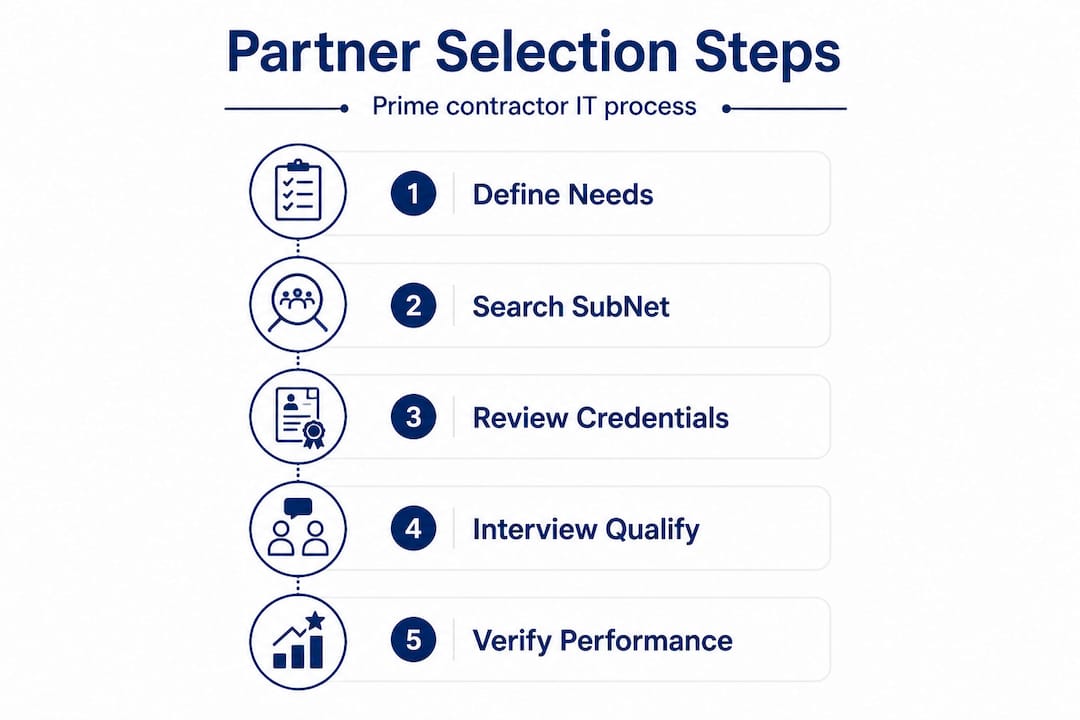
1. Identify target NAICS codes and compliance requirements Before searching, define the specific technical needs: cloud migration, DevSecOps pipeline implementation, compliance automation, or dashboard development. Map these to NAICS codes such as 541512 (Computer Systems Design) or 541519 (Other Computer Related Services). This framing drives targeted searches.
2. Search SBA SubNet and supplier portals SBA SubNet is a free platform where primes post subcontracting opportunities and subs post capability listings. Supplier portals maintained by large federal contractors also carry active solicitations. Both channels are most effective when used within the 30 to 90 day window following contract award, when primes are actively staffing their delivery teams.
3. Review capability statements for compliance credentials A strong capability statement for an IT modernization sub should include: NAICS codes and business size certifications (SDVOSB, WOSB, SBA 8(a)); a differentiators section that addresses compliance posture (CMMC level, FedRAMP ATO holders, NIST 800-171 documentation); and past performance summaries on contracts of similar scope and dollar value.
4. Conduct a structured qualification interview Move beyond the capability statement. Ask subs to walk through a recent compliance-heavy deliverable: what documentation they produced, what audit findings resulted, and how they resolved gaps. This conversation surfaces operational maturity that a one-page statement cannot convey.
5. Verify past performance independently Use CPARS (Contractor Performance Assessment Reporting System) and direct reference checks with listed contracting officers. Past performance verification is not optional. It is a requirement under FAR 15.404-3 and a practical indicator of what a sub will deliver under pressure.
Pro Tip: When tailoring a capability statement for cloud and compliance IT projects, quantify outcomes rather than listing activities. "Reduced processing time by 40% through automated compliance workflows" signals delivery orientation. "Provided cloud migration support" does not.
Prime partners in Maryland and the broader mid-Atlantic region operate in a dense federal contracting market where reputation travels quickly. Targeted outreach to agency small business offices and post-award networking through contract vehicles are both productive strategies, especially for subs pursuing their first major teaming relationship.
Primes may also benefit from evaluating subs that function as an operational services partner rather than simple staff augmentation. Outcome-oriented subs that own defined scopes reduce oversight burden and increase program predictability.
Beyond checklists: What most guides miss about agency partnerships
Most guidance on agency partnerships focuses on the mechanics: which FAR clauses apply, how to format a capability statement, where to post subcontracting opportunities. That coverage is necessary but not sufficient. The harder lesson, learned through actual program delivery, is that structural and regulatory compliance does not guarantee a functional partnership.
The core tension in these relationships is asymmetric. Primes want flexibility post-award. They want to retain discretion over how work is assigned, which subs receive which task orders, and how scope shifts are handled as agency priorities evolve. Subs, particularly smaller firms investing proposal resources in a teaming arrangement, want commitment. They want defined scope, clear payment terms, and enforceable expectations. These priorities do not naturally align, and when they are not addressed explicitly before award, the partnership deteriorates under delivery pressure.
Federal teaming structures confirm that primes seek post-award subcontracting flexibility while subs demand commitments. JVs, CTAs, and mentor-protégé arrangements offer stronger protections for both parties, but the $5,000 to $25,000 setup cost is a real barrier for smaller primes on lower-value contracts. The pragmatic answer is not to default to the cheapest structure. It is to match the structure to the actual risk and value profile of the contract.
The hidden negotiation in any teaming discussion is the gap between what the prime is willing to commit in writing and what the sub needs to feel protected. Closing that gap through honest, early conversation about scope definition, performance metrics, and dispute resolution is what distinguishes high-performing partnerships from paper agreements that unravel at the first scope change. IT partnership strategies that account for this tension from the outset produce better outcomes on both sides.
Risk is highest when material terms are vague. Not ambiguous, not slightly unclear. Vague. "Sub will support cloud modernization activities" is a setup for conflict. "Sub will deliver FedRAMP boundary documentation and system security plan updates for the identified three systems within 60 days of task order award" is a commitment both parties can be held to. The difference in language is 30 seconds of additional drafting. The difference in program outcomes can be measured in months and hundreds of thousands of dollars.
For primes focused on multi-partner management, this principle scales across every teaming relationship on the program.
Next steps: Connect with prime-ready IT partners
Primes ready to build compliant, outcome-focused IT modernization teams need partners who own defined scopes, arrive audit-ready, and reduce program management overhead rather than adding to it. Rutledge & Associates, LLC specializes in exactly this kind of engagement, bringing certified SDVOSB and SBA credentials alongside deep technical delivery in DevSecOps, FedRAMP compliance automation, and real-time program dashboards. Whether your program is based in Maryland, New York, or Florida, the IT partners for primes resource connects you with structured, low-oversight subcontracting options. Explore the full range of capabilities at Rutledge & Associates or review active opportunities available through New York IT partners.
Frequently asked questions
What are the key compliance requirements for IT subs on government projects?
IT subcontractors on government programs must meet frameworks including CMMC, NIST SP 800-171, FedRAMP, and DFARS 7012, with primes responsible for flowing these requirements down and verifying compliance.
Where do I find partners for public sector IT contracts?
The most reliable channels include SBA SubNet, supplier portals, and direct post-award outreach conducted within 30 to 90 days of contract award, when primes are actively building delivery teams.
Are teaming agreements enforceable for government contracts?
Teaming agreements are frequently unenforceable post-award if they lack material terms such as defined scope, pricing, and performance obligations, leaving subcontractors without recourse if the prime reassigns work.
What should capability statements include for IT modernization projects?
Strong capability statements should detail applicable NAICS codes, business certifications (SDVOSB, WOSB, 8(a)), past performance on comparable contracts, and current compliance credentials such as CMMC certification or FedRAMP authorization to operate documentation.
Recommended
- Strategic IT partnerships: driving modernization success
- Defining Prime Contractor Roles for IT Modernization Success
- What is a contract-ready partnership? Guide for public sector IT
- Proven strategies to build successful IT partnerships in the public sector
- Why choose an operational services partner: boost efficiency