

Many prime contractors in public-sector IT believe their primary job is to coordinate subcontractors and collect deliverables. That assumption creates serious problems. The prime contractor is not a middleman. The prime holds full legal, financial, and compliance responsibility for every aspect of contract performance, regardless of how much work flows to subcontractors. In complex IT modernization programs, where cloud migrations, DevOps pipelines, and data analytics platforms span multiple vendors and regulatory frameworks, that accountability gap can derail entire programs. This article defines prime contractor roles precisely, outlines compliance requirements, and provides actionable structure for managing IT modernization contracts effectively.
Table of Contents
-
Edge cases and risk: Subcontractor oversight and contract types
-
Strategic subcontracting: How primes enhance IT project outcomes
-
The real reason prime role definition matters more than ever
Key Takeaways
| Point | Details |
|---|---|
| Prime contractor’s core role | The prime holds the main contract, leads project execution, and is legally responsible for compliance and delivery. |
| Compliance demands | Primes must manage small business plans, flow down contract requirements, and meet all regulatory standards. |
| Risk and performance | Primes shoulder full project risk in most contract types and must perform a minimum share of the work by law. |
| Strategic value | Effective prime role definition allows for stronger teamwork, smoother audits, and better IT modernization results. |
| Ongoing improvement | Clear prime responsibilities adapt to changing IT needs and reduce costly errors for agencies and contractors. |
What is a prime contractor in government IT projects?
A prime contractor is the entity that signs the contract directly with the government agency. That single fact carries enormous weight. The agency does not contract with subcontractors. It contracts with the prime, and the prime answers for everything: schedule, cost, compliance, security, and quality of deliverables.
“Prime contractors are entities that hold direct contracts with the government, managing the overall project, subcontractors, budget, and ensuring full compliance and delivery as per contract terms.” SBA Prime Subcontracting Guide
In government IT modernization, the prime role is especially demanding because the supply chain is rarely simple. A single task order might involve cloud infrastructure specialists, cybersecurity firms, data engineers, and DevOps teams. The prime must coordinate all of them, ensure their work integrates correctly, and guarantee the final product meets the agency’s technical and regulatory requirements.
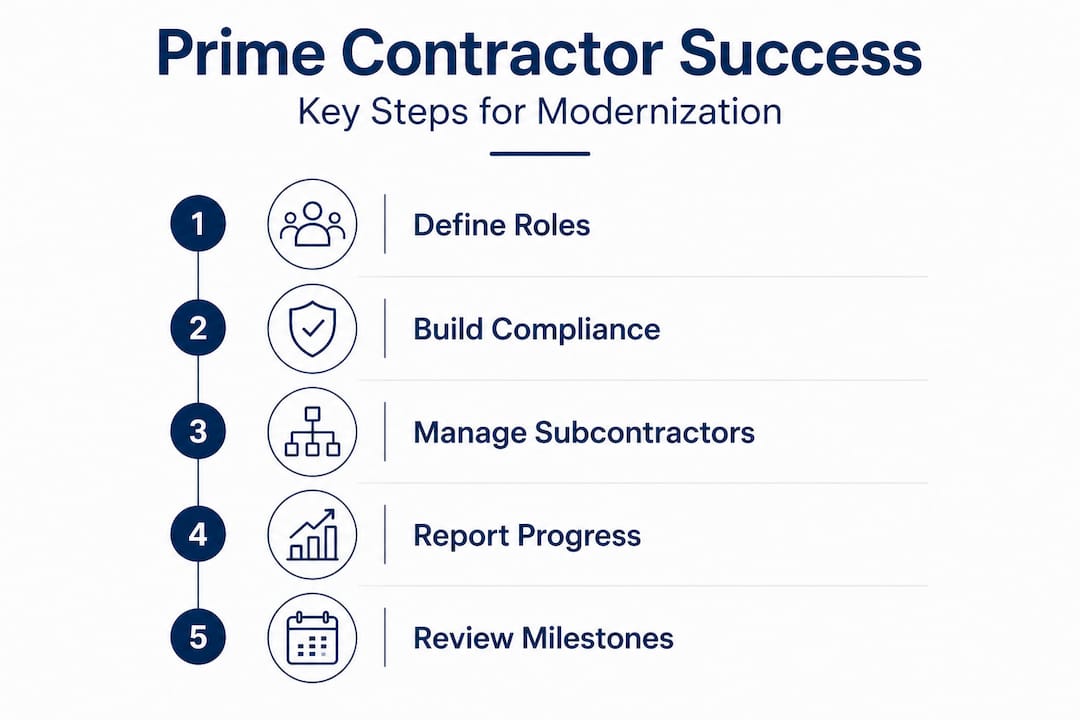
Core duties of a prime contractor include:
-
Serving as the single point of accountability to the contracting officer
-
Managing subcontractor performance, schedules, and deliverables
-
Maintaining budget control and financial reporting obligations
-
Ensuring compliance flows down to every subcontractor on the team
-
Delivering the final integrated solution that meets contract specifications
The most common misconception is that delegation equals transfer of responsibility. It does not. If a subcontractor misses a security control or delivers non-compliant code, the prime owns that failure in the eyes of the agency. Working with prime-ready IT partners who understand this accountability structure from day one reduces the risk of that kind of gap significantly.
IT modernization adds layers of complexity that traditional construction or services contracts do not face. Compliance requirements under frameworks like FedRAMP, FISMA, and Section 508 must be tracked across every system component, whether the prime built it or a subcontractor did. That is the operational reality of holding a government IT prime contract.

Key responsibilities and compliance requirements for primes
Once you understand what a prime contractor is, the next question is what they are actually required to do. The answer goes well beyond project management. Federal regulations impose specific obligations that primes must track, document, and report on throughout contract performance.
The top compliance responsibilities for IT prime contractors:
-
Prepare and submit a small business subcontracting plan when required under FAR 52.219-9, which applies to contracts above certain dollar thresholds awarded to large businesses.
-
Monitor subcontractor compliance with all applicable federal regulations, including labor laws, cybersecurity standards, and data handling requirements.
-
Maintain accurate records of subcontractor payments, performance, and any corrective actions taken.
-
Report subcontracting activity through the Electronic Subcontracting Reporting System (eSRS) on a scheduled basis.
-
Ensure all subcontractors meet the technical qualifications specified in the prime contract, including any clearance or certification requirements.
In IT modernization specifically, GWACs manage compliance with the Clinger-Cohen Act, which requires federal agencies to use disciplined program management for major IT investments. Primes operating under vehicles like GSA STARS III must demonstrate structured program management, disclose the breakdown of work performed by each team member, and align delivery with agency capital planning processes.
| Responsibility area | Prime contractor obligation | Key regulation |
|---|---|---|
| Subcontracting plan | Submit and update annually | FAR 52.219-9 |
| Compliance flowdown | Pass all applicable clauses to subs | FAR 52.212-5 |
| Cybersecurity | Ensure FISMA and FedRAMP alignment | NIST SP 800-53 |
| Reporting | File eSRS reports on schedule | FAR 52.219-9(d) |
| Program management | Follow Clinger-Cohen Act requirements | 40 U.S.C. 11101 |
Pro Tip: Do not wait until contract award to build your subcontracting plan. Draft it during proposal development so you can present a credible, compliant teaming structure from day one. Agencies and contracting officers notice when the plan is clearly an afterthought.
Adopting professional IT transformation practices means building compliance infrastructure before the contract starts, not scrambling to retrofit it during performance. That includes establishing document management protocols, setting up reporting cadences, and confirming that every subcontractor has reviewed and accepted the applicable flowdown clauses.
Edge cases and risk: Subcontractor oversight and contract types
Compliance and responsibility become more complicated when primes rely heavily on subcontractors or when the contract type creates asymmetric risk. These are the situations where unclear role definitions cause the most damage.
Federal regulations establish minimum performance thresholds. FAR minimum performance rules require primes to perform a defined percentage of work themselves, such as 12% in construction contracts or specific thresholds for small business set-aside contracts. Exceeding the allowable subcontracting percentage without authorization can trigger compliance violations, contract termination, or suspension and debarment proceedings.
“Avoid over-subcontracting without risk-adjusted contract type; document commercial item determinations and maintain clear records of prime-performed work.”
The contract type itself changes the risk profile significantly. Under a fixed-price contract, the prime absorbs all cost overruns regardless of which subcontractor caused them. If a sub delivers late or requires rework, the prime pays. Under cost-reimbursement contracts, the government shares some risk, but the prime still must justify all costs and demonstrate that expenditures were allowable, allocable, and reasonable under FAR cost principles.
Comparison of contract types and prime risk exposure:
| Contract type | Prime cost risk | Subcontractor risk transfer | Documentation burden |
|---|---|---|---|
| Firm fixed-price | High, prime absorbs all overruns | Low, prime retains full risk | Moderate |
| Cost-plus fixed-fee | Shared with government | Moderate, costs must be justified | High |
| Time and materials | Moderate | Moderate | High |
| Indefinite delivery | Varies by task order type | Depends on task order terms | Moderate to high |
Edge cases also arise around what counts as “reasonably knowable” compliance. If a subcontractor operates in a regulated space and the prime did not conduct adequate due diligence, the prime may still be held responsible for the sub’s violations. This is especially relevant in IT when subcontractors handle personally identifiable information (PII) or operate systems that process federal data.
Pro Tip: Maintain a compliance matrix for each subcontractor that maps their specific scope to the applicable contract clauses. Update it at every major milestone. This single document can significantly reduce audit preparation time and demonstrate proactive oversight to the contracting officer.
IT modernization best practices require primes to build oversight into the program structure, not treat it as an administrative afterthought. That means regular compliance reviews, documented corrective action processes, and clear escalation paths when a subcontractor falls short.
Strategic subcontracting: How primes enhance IT project outcomes
Role definition is not only a compliance exercise. When done well, it becomes a strategic tool that improves IT project outcomes, reduces agency workload, and positions the prime for follow-on work.
The most effective prime contractors in IT modernization treat their subcontractor relationships as a structured capability network. They identify gaps in their own technical bench early, source subcontractors who fill those gaps precisely, and integrate them into a unified delivery team rather than managing them as isolated vendors.
Best practices for structuring prime-sub relationships in IT modernization:
-
Define each subcontractor’s scope in writing before contract award, not after
-
Establish shared performance metrics so all team members are aligned to the same outcomes
-
Conduct joint kickoff sessions that include agency stakeholders, the prime’s program manager, and key subcontractor leads
-
Build a single integrated project schedule that the prime owns and all subs contribute to
-
Require subcontractors to participate in agency status reviews so the prime is not the only source of project information
Primes who lead teaming and manage compliance effectively reduce the administrative burden on the contracting officer’s representative (COR). That matters because agency staff are stretched thin. A prime that shows up with organized reporting, clear subcontractor accountability, and proactive issue identification earns trust that translates into better past performance ratings and stronger positions for future competitions.
In practice, this looks like a prime contractor that delivers a weekly integrated status report covering all subcontractor work streams, flags risks before they become problems, and presents solutions rather than just problems. Agencies remember that kind of performance.
Pro Tip: Define roles before the kickoff meeting, not during it. When the prime walks into the first agency meeting with a clear RACI (Responsible, Accountable, Consulted, Informed) matrix covering every team member, it signals organizational maturity and reduces the chance of scope gaps emerging mid-performance.
Effective teaming strategies for modernization also support small business goals. When primes structure their subcontracting plans to genuinely develop small business partners rather than simply check a box, they build a more resilient delivery team and demonstrate commitment to program goals that agencies and oversight bodies track closely.
The real reason prime role definition matters more than ever
Industry experience reveals something that compliance checklists do not capture: the agencies that struggle most with IT modernization are almost always the ones where prime contractor roles were left ambiguous at the start. Not because the prime was incompetent, but because no one took the time to define who was responsible for what, at what level of detail, before the work began.
We have seen programs where the prime assumed the agency would handle user acceptance testing coordination, and the agency assumed the prime would. Neither did. The result was a six-month delay and a contract modification that cost both parties time and credibility. That kind of failure is entirely preventable.
The conventional wisdom says role definition is a contract administration task. We disagree. It is a strategic decision that shapes every downstream outcome. Primes who see beyond contract checklists help agencies meet IT deadlines and avoid costly oversights because they invest in clarity before performance begins, not after problems surface.
In 2026, federal IT modernization programs are moving faster than ever. Cloud-native migrations, zero-trust architecture implementations, and AI-enabled data analytics platforms are being delivered under aggressive timelines with significant congressional and oversight scrutiny. In that environment, ambiguity is not a minor inconvenience. It is a program risk.
The primes that succeed are the ones that treat role definition as a living document, revisit it at each major milestone, and communicate changes proactively to both the agency and their subcontractors. They also invest in insights on IT compliance that keep their teams current with evolving regulatory requirements, rather than relying on what worked on the last contract.
The uncomfortable truth is that most role definition failures are not caused by bad actors. They are caused by well-intentioned teams that assumed shared understanding without verifying it. Over-communicating expectations is not a sign of distrust. It is a sign of professional discipline.
Make prime role definition your IT advantage
If you are a prime contractor or agency official working through the complexity of IT modernization, you do not have to navigate it alone. At Rutledge and Associates, LLC, we operate as a Prime-Ready IT Modernization Partner built specifically for public-sector programs. We bring contract-ready subcontracting support, DevOps delivery capability, and data analytics expertise to prime teams that need a reliable, compliance-aware partner. Our approach reduces your administrative overhead, strengthens your subcontracting plan, and helps you deliver measurable outcomes to your agency clients. Whether you are structuring a new teaming arrangement or reinforcing an existing program, we are ready to support your next step.
Frequently asked questions
What is the difference between a prime contractor and a subcontractor?
A prime contractor holds the direct contract with the government and is accountable for all project outcomes, while a subcontractor works under the prime’s direction and has no direct contractual relationship with the agency.
What compliance requirements do IT primes face?
IT primes must manage project delivery, maintain all compliance documentation, and often prepare small business subcontracting plans as required by FAR 52.219-9, in addition to meeting program-specific rules under GWACs and applicable cybersecurity frameworks.
How much work must a prime perform versus subcontractors?
FAR minimum performance thresholds require primes to directly perform a defined percentage of contract work, which varies by contract type and set-aside category, such as 12% in construction or specific percentages for small business set-asides.
What should a prime do to reduce risk in fixed-price contracts?
Primes should document each subcontractor’s scope precisely, consider whether the contract type matches the actual risk distribution, and ensure commercial item determinations are documented as a best practice, since fixed-price contracts place full cost risk on the prime regardless of subcontractor performance.