

Most public sector procurement officers assume that rigid contract structures are the safest path to compliance and cost certainty. That assumption is wrong more often than it should be. Traditional, waterfall-style procurement frequently produces budget overruns, delayed deliverables, and IT systems that are outdated before they go live. Flexible contract models offer a disciplined alternative, one that preserves oversight while enabling the adaptability that modern government IT demands. This article breaks down what flexible contracting is, how its structures work, where the risks live, and how procurement professionals can apply it effectively to IT modernization.
Table of Contents
- What is flexible contracting in public sector IT?
- Structures and mechanics: How flexible contracting works
- Performance-based and outcome-based contracting: Driving accountability
- Risks, controls, and edge cases in flexible contracting
- Best practices: Applying flexible contracting to IT modernization
- Our take: Why balanced flexibility is the future of public sector IT contracting
- Partner with a prime-ready team for flexible, compliant IT modernization
- Frequently asked questions
Key Takeaways
| Point | Details |
|---|---|
| Adaptive structures | Flexible contracting relies on modular, outcome-based vehicles for IT modernization success. |
| Risk allocation | Choosing the right contract type shifts risk responsibly between agency and contractor. |
| Governance required | Agility must be paired with strict oversight to avoid execution drift and non-compliance. |
| SME and small business access | Flexible frameworks enable participation by specialized and emerging suppliers. |
| Continuous improvement | Best results come from iterative, data-driven contract and project management. |
What is flexible contracting in public sector IT?
Flexible contracting in government IT is not the absence of rules. It is the design of contract structures that can respond to changing requirements, phased delivery, and evolving technology without voiding compliance or sacrificing accountability. Flexible contracting in public sector procurement refers specifically to adaptable contract structures and vehicles that enable agility in IT modernization projects, and they can take many forms.
The most common vehicles include:
- GWACs (Governmentwide Acquisition Contracts): Pre-competed, multi-agency vehicles like Alliant 2 or VETS 2 that give agencies access to a wide range of IT services with built-in flexibility.
- IDIQs (Indefinite Delivery, Indefinite Quantity): Contracts where the exact scope and timing are defined through task orders, making them well-suited for long-horizon IT programs.
- Modular contracting: Divides large IT systems into smaller, independently deliverable increments. Each module has its own requirements and acceptance criteria.
- Hybrid CLINs (Contract Line Item Numbers): Allow different contract types within a single vehicle, mixing fixed-price and time-and-materials components.
- Outcome-based contracts: Tie payments to mission results rather than activity or hours delivered.
One persistent misconception is that flexibility inherently weakens oversight. In practice, modular and iterative contracting actually increases the frequency of accountability checkpoints. Because each increment requires acceptance before the next begins, program managers have more structured opportunities to identify problems early.
"Flexibility in contracting is not the reduction of discipline. It is the intelligent redistribution of oversight across a program's lifecycle, focused where risk is highest and pace is fastest."
The shift away from rigid procurement reflects a broader recognition that government IT projects are not static. Requirements shift. Platforms evolve. Policy mandates change. Contracts that cannot adapt to these realities end up either locked into obsolete approaches or expensively modified mid-performance.

Structures and mechanics: How flexible contracting works
With a foundational definition established, it is important to see the mechanics and legal scaffolding that actually make flexibility possible in the field. The mechanics include multiple contract types, hybrid structures within task orders, benchmarked labor rates, and small business subcontracting credits, all working together within a compliance framework.
The table below compares common contract vehicles and their key flexibility characteristics:
| Vehicle | Flexibility level | Payment structure | Best fit |
|---|---|---|---|
| GWAC (e.g., Alliant 2) | High | Task order driven | Multi-agency IT modernization |
| IDIQ | High | Variable by task order | Long-duration, uncertain scope |
| Modular contract | Medium-high | Milestone or fixed-price per module | Phased system replacements |
| Outcome-based contract | High | Payment tied to outcomes | Mission-critical service delivery |
| Firm-fixed-price | Low | Set at award | Stable, well-defined requirements |
| T&M (Time and Materials) | Medium | Labor hours plus materials | Research, prototyping, early design |
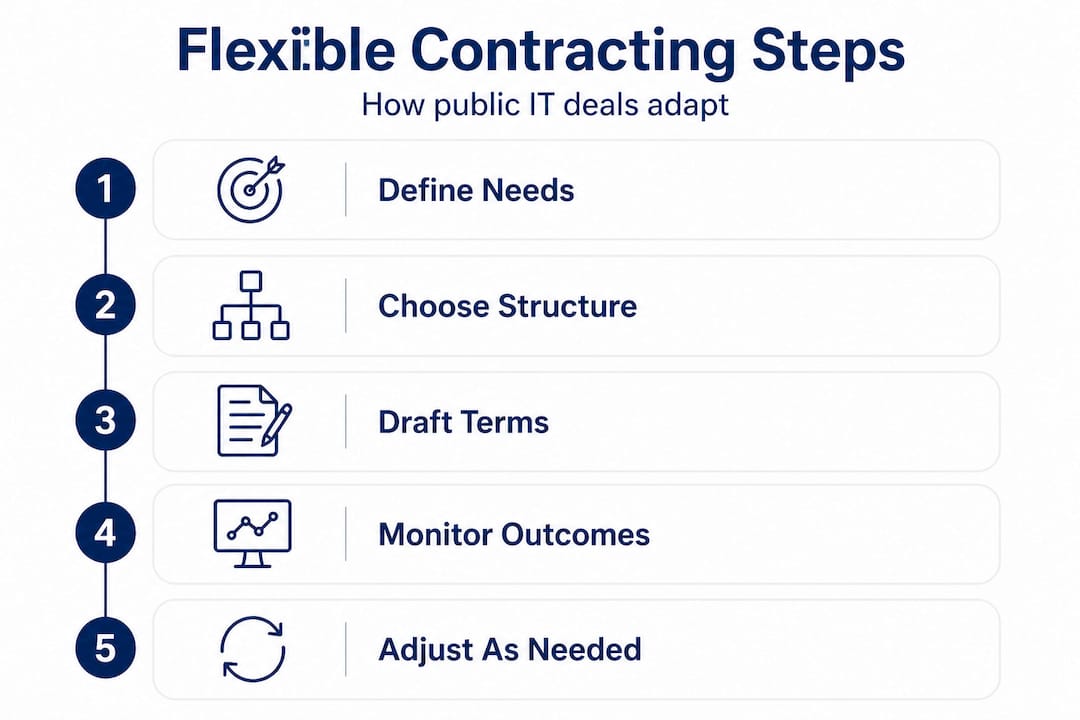
Structuring a flexible contract involves several deliberate steps:
- Define the acquisition strategy. Determine which vehicle best matches program risk, duration, and budget certainty.
- Establish the CLIN structure. Use hybrid CLINs where some tasks are fixed-price and others allow time-and-materials for early-phase uncertainty.
- Set performance metrics at the task order level. Each task order should carry its own acceptance criteria, not just reference the base contract.
- Incorporate small business credits. Multi-award vehicles and subcontracting plans can expand the pool of qualified performers while supporting socioeconomic goals.
- Build in formal review gates. These are structured decision points where the government evaluates whether to continue, modify, or close out a module.
Pro Tip: Choose fixed-price for clearly defined deliverables and stable requirements. Reserve time-and-materials for early-stage design, discovery, or prototyping work where scope cannot yet be fully specified. Using fixed-price wherever possible improves compliance and shifts financial risk appropriately to the contractor. Review compliance practices for IT contracts to align your CLIN structure with agency audit requirements.
Small business participation is another structural lever. Multi-year IDIQs with subcontracting plans allow primes to bring in certified small businesses, including SDVOSBs and woman-owned firms, at the task order level. This creates flexibility not only in scope but in team composition, matching the right expertise to each increment without renegotiating the base contract.
Performance-based and outcome-based contracting: Driving accountability
Besides structure and mechanics, how contracts are executed and measured is just as critical. This is where performance and outcomes come in. Methodologies emphasize performance-based and outcome-based contracting that ties payments to mission outcomes through iterative delivery, rather than to the number of hours logged or documents produced.
Performance-based acquisition (PBA) and outcome-based contracting (OBC) are related but distinct. PBA focuses on measurable service levels, such as system uptime, processing time, or defect rates. OBC goes further, defining the mission result the government actually needs, such as reducing benefit processing backlogs by 40% or achieving FedRAMP authorization within 12 months.
The contrast with traditional contracting is significant:
| Dimension | Traditional contracting | Outcome-based contracting |
|---|---|---|
| Focus | Inputs and activities | Results and mission outcomes |
| Risk allocation | Primarily government | Shared or contractor-held |
| Payment triggers | Deliverables submitted | Outcomes achieved |
| Compliance emphasis | Procedural adherence | Audit-ready performance data |
| Progress measurement | Schedule and cost variance | KPIs and acceptance criteria |
Keys to successful outcome-based contracting include:
- Clear, quantifiable metrics defined at the outset and tied directly to program goals.
- Dedicated product or program teams on both the government and contractor side who own results, not just tasks.
- Active governance structures with regular review cycles, not just end-of-period evaluations.
- Transparent data sharing so both parties can monitor progress and intervene before performance drifts.
Pro Tip: Integrating agile delivery practices with Earned Value Management (EVM) in OBC contracts creates a powerful accountability framework. Agile sprints provide frequent delivery checkpoints while EVM tracks cost and schedule performance against the baseline. The combination helps agencies detect problems early rather than at contract close-out. Review performance-based contracting best practices for specific implementation guidance.
The strongest OBC contracts also include incentive structures. Fixed-price incentive fee arrangements reward contractors who deliver faster or at lower cost than the baseline, aligning contractor economics with government mission priorities rather than just billing targets.
Risks, controls, and edge cases in flexible contracting
With flexibility comes risk. Understanding pitfalls and how to enforce smart controls is essential for compliance-focused procurement. Flexible contracting introduces specific vulnerabilities that must be actively managed, or they compound quickly over a program's lifecycle.
Key risks include:
- Scope creep: When task orders expand informally beyond their original scope, often through incremental additions that seem minor individually but accumulate into significant unpriced work.
- Personal services: If the government exercises day-to-day control over contractor personnel, the arrangement may cross into personal services contracting, which requires special authorization.
- Inherently governmental functions: Flexible arrangements that give contractors decision-making authority over policy, enforcement, or resource allocation can cross legal boundaries.
- Execution drift: When program direction shifts informally without formal contract modification, accountability gaps emerge and audit trails break down.
- Cost-reimbursement overuse: Using cost-reimbursement mechanisms when fixed-price is actually feasible transfers risk to the government unnecessarily and reduces contractor accountability.
Edge cases require disciplined management, specifically avoiding personal services contracts, preventing inherently governmental functions, managing scope creep, and using cost-reimbursement only when fixed-price is genuinely unreasonable. These are not hypothetical concerns. They are patterns that appear repeatedly in inspector general reports and Government Accountability Office findings.
Controls that mitigate these risks include:
- Flow-down clauses that pass contract terms and compliance requirements from prime contractors to subcontractors, maintaining consistent standards across the delivery team.
- Earned Value Management Systems (EVMS) that provide objective performance data at defined thresholds.
- Documented scope baselines with formal change control processes for any modifications.
- Regular compliance reviews conducted by the Contracting Officer's Representative (COR), not just at milestones.
"Flexibility that is not bounded by clear governance is not agility. It is ambiguity with a contract number attached." Unchecked flexibility, as research on hidden costs confirms, can generate execution gaps that are far more expensive than the overruns they were meant to prevent.
Managing flexible contracts also means knowing when not to use flexible mechanisms. For stable, well-understood requirements, a firm-fixed-price contract with defined deliverables outperforms any hybrid structure in terms of cost predictability and contractor accountability. Flexibility is a tool, not a default. Review flexibility and compliance in IT contracts for examples of how controls are structured in complex IT programs.
Best practices: Applying flexible contracting to IT modernization
Understanding risk and mechanics is half the journey. The practical reality is how to apply flexible contracting for modernization success. Procurement officers and project managers who implement these contracts most effectively tend to follow a consistent set of operational principles.
- Assess your requirements maturity before selecting a vehicle. If requirements are well-defined, lean toward fixed-price. If they are evolving, modular or IDIQ structures allow iteration without full re-procurement.
- Choose GWACs for access and subcontracting flexibility. Vehicles like subcontracting credits and multiple-award vehicles provide access to a broad supplier base while supporting small business participation goals.
- Write task orders with acceptance criteria, not just deliverable lists. A list of documents to produce is not the same as a standard of performance. Acceptance criteria define what "done" actually means.
- Build governance into the contract structure, not just the program plan. Review gates, data reporting requirements, and formal change control should be contract terms, not internal procedures that can be waived under schedule pressure.
- Monitor for execution drift continuously. Assign COR coverage proportional to program risk. High-complexity, high-value task orders warrant more frequent touchpoints.
- Use incentive fee structures where mission outcomes are quantifiable. This aligns contractor and government interests more effectively than cost-plus-fixed-fee arrangements.
Pro Tip: Balance modularity with oversight discipline. Breaking a large program into modules prevents single-point-of-failure risk but creates integration challenges. Each module should have defined interfaces and a clear integration plan before the first task order is awarded. Review flexible contracting for public sector IT to see how modular structures have been applied in state-level modernization programs.
Continuous procurement strategies, where agencies maintain active vehicles and award task orders in rolling cycles, consistently outperform "big bang" single-award contracts for IT modernization. The evidence is consistent: phased delivery with iterative acceptance produces better outcomes, earlier course correction, and lower total cost of ownership.
Our take: Why balanced flexibility is the future of public sector IT contracting
The public sector IT contracting conversation often frames flexibility and control as opposites. That framing is the real problem. The organizations that produce the worst outcomes are not those that chose too much flexibility or too little. They are the ones that chose without intention, defaulting to familiar structures rather than designing contracts around specific program realities.
Maximum flexibility is not the goal. Neither is rigid specification. The optimal approach uses structured adaptability, meaning iterative checkpoints, hard-wired governance, and clear outcome definitions, applied with the discipline of an engineer rather than the optimism of a planner.
The surprising lesson from well-run modernization programs is that control comes primarily from clarity of outcomes, not from contract structure alone. When a program knows precisely what mission result it is pursuing, measured in processing time, uptime, cost per transaction, or audit readiness, it can hold any contractor accountable regardless of which vehicle was used. When that clarity is absent, no contract structure compensates.
"The contracts that consistently perform best are not the most flexible or the most rigid. They are the ones where every party knows exactly what success looks like and has a financial stake in achieving it."
The uncomfortable truth for procurement professionals is that designing this kind of contract takes more work upfront. Writing real acceptance criteria is harder than listing deliverables. Structuring incentive fees requires actuarial thinking. Governance planning requires political will. But the upfront investment pays off in programs that actually deliver. Review insights on IT contracting flexibility for a closer look at how this approach has been applied across complex government IT environments.
Partner with a prime-ready team for flexible, compliant IT modernization
Putting these principles into practice requires a subcontracting partner who understands both the compliance requirements and the delivery mechanics of public sector IT. Rutledge & Associates, LLC is an SDVOSB, woman-owned, and SBA-certified firm that specializes in owning clearly defined scopes within complex government modernization programs. The firm brings expertise in compliance automation, DevOps pipelines, and real-time program visibility to prime contractors working in compliance-heavy environments. If your program needs a prime-ready IT contracting partner who delivers outcomes rather than hours, explore how Rutledge & Associates supports modernization efforts across Maryland, New York, and Florida. Visit public sector IT expertise to learn more about their capabilities and past performance.
Frequently asked questions
What is the difference between modular contracting and outcome-based contracting in IT projects?
Modular contracting breaks IT delivery into incremental deliverables, each independently accepted, while outcome-based contracts tie payments to achieving mission results over a defined performance period.
Why is fixed-price preferred in flexible contracting for public sector IT?
Fixed-price contracts shift financial risk to the contractor and produce predictable costs, making oversight more straightforward. As contract types guidance confirms, IDIQs and multi-year structures add flexibility around quantities without sacrificing price certainty.
What controls prevent scope creep in flexible contracting?
Strong governance, documented scope baselines, flow-down clauses, and formal change control processes are the primary safeguards. High-frequency data reviews further reduce the risk of execution drift between formal review gates.
When should cost-reimbursement be used in government IT contracts?
Cost-reimbursement is appropriate only when requirements are too uncertain for fixed-price to be reasonable, such as in early-stage research or novel technology development where costs cannot be reliably estimated.
How does flexible contracting support small business participation?
Subcontracting credits and multiple-award vehicles create structured access points for small businesses, SDVOSBs, and woman-owned firms at the task order level, without requiring a separate procurement action for each engagement.