

Managing a multi-partner IT modernization project without a clear structure is one of the fastest ways to burn budget, miss milestones, and damage agency credibility. When two or more firms share delivery responsibility, every ambiguity in scope, roles, or accountability creates friction that compounds over time. DevOps pipelines stall when integration ownership is unclear. Compliance gaps emerge when no single partner tracks audit requirements end to end. This guide provides a systematic, step-by-step approach to structuring, launching, and sustaining multi-partner projects so your team delivers outcomes, not excuses.
Table of Contents
Key Takeaways
| Point | Details |
|---|---|
| Lay strong foundations | Use structured methodologies and clear agreements to set your project up for success. |
| Choose the right structures | Match your partner model to your project’s scope for optimal clarity and protection. |
| Align IT and business | Foster shared accountability with fusion teams and regular communication. |
| Monitor and adapt | Continuously verify progress, handle edge cases, and recalibrate processes together. |
| Build trust and flexibility | Success depends as much on behavioral alignment as on technical process. |
What you need before starting: Laying the foundation
With the challenge clearly defined, the next step is ensuring you have the right foundation and agreements in place before a single sprint begins.
Most project failures are preventable. They trace back to decisions, or the absence of them, made in the first two to four weeks. Scope creep, duplicated effort, and partner disputes almost always originate in foundational gaps rather than technical failures. Getting this layer right is non-negotiable.
Start with a complete stakeholder map. Identify every agency stakeholder, contracting officer, prime contractor, and subcontractor who has a role or a stake in project outcomes. Document the prime/sub relationships explicitly, including who holds contract authority, who manages deliverables, and who has approval rights. Ambiguity here creates disputes later.
The 11-step project partnering process provides a proven structure: scoping, stakeholder identification, partner selection, charter creation, team formation, systems integration, launch, monitoring, improvement, knowledge capture, and scaling. Each step has a distinct purpose, and skipping any one of them creates a gap that will surface under pressure.
Essential documents and tools to have in place before launch:
-
Project charter with defined scope, deliverables, and success criteria
-
Teaming agreements covering roles, responsibilities, and exclusivity terms
-
RACI matrix mapping each deliverable to a responsible party
-
Software Bill of Materials (SBOM) requirements, especially for cloud-native or AI-integrated systems
-
Shared communication protocols and escalation paths
-
Data handling and security classification agreements
-
Baseline schedule with partner-specific milestones
| Foundation element | Why it matters | Risk if missing |
|---|---|---|
| Project charter | Aligns all partners on scope and goals | Scope disputes, missed deliverables |
| Teaming agreement | Defines legal roles and IP ownership | Contract disputes, liability gaps |
| RACI matrix | Clarifies accountability per task | Duplicated effort or dropped tasks |
| SBOM requirements | Tracks software components for compliance | Audit failures, security vulnerabilities |
| Escalation protocol | Provides a path to resolve blockers fast | Delays, unresolved conflicts |
For agencies pursuing IT modernization partner insights, the foundational planning phase is also the right time to assess whether your current partner mix has the technical depth and compliance readiness your program requires.
Pro Tip: Establish knowledge capture and monitoring mechanisms in the charter itself, not as an afterthought. Partners who agree upfront on how progress is tracked and how lessons are documented operate with far less friction throughout the project lifecycle.
Structuring the right partnerships: Frameworks that work
Once you are clear on foundational needs, choosing and structuring the right partnerships is critical to avoiding friction down the line.
Not all partnership structures are equal. The model you choose determines how risk is allocated, how decisions get made, and how disputes are resolved. In public-sector IT work, the wrong structure can trigger compliance issues or create ambiguity that contracting officers will flag during reviews.
The four most common models in government IT contracting each serve a distinct purpose:
| Structure | Best use case | Key advantage | Key risk |
|---|---|---|---|
| Prime-Subcontractor | One firm holds the contract, subs deliver components | Clear accountability chain | Sub has limited contract visibility |
| Contractor Teaming Arrangement (CTA) | Multiple firms jointly respond to a solicitation | Shared risk and capability | Coordination complexity |
| Joint Venture (JV) | Two firms form a new legal entity | Combines past performance | Legal and tax complexity |
| Mentor-Protégé | Established firm guides a small business | Builds small business capacity | Requires long-term commitment |
Teaming agreements for government contracts should specify roles, responsibilities, pricing, exclusivity terms, IP protection, and term/termination conditions. These are not optional details. They are the legal framework that governs how partners behave when the project gets difficult.
Steps to select and implement the right partnership structure:
-
Assess the solicitation requirements. Review the contract vehicle, set-aside status, and any teaming restrictions before selecting a structure.
-
Map capability gaps. Identify what your organization cannot deliver alone and what a partner must provide, whether that is cloud infrastructure, cybersecurity compliance, or DevOps automation.
-
Evaluate partner past performance. In government contracting, past performance on similar agency systems matters as much as technical capability.
-
Draft and negotiate the teaming agreement. Use legal counsel familiar with FAR and DFARS requirements to ensure the agreement is enforceable and compliant.
-
Register and formalize the arrangement. Ensure all entities are registered in SAM.gov and that the agreement is documented before proposal submission.
For teams building collaborative project partnerships in federal or state IT work, the choice of structure also affects how you present your team’s qualifications in proposals. Contracting officers scrutinize partner arrangements closely, and a well-structured agreement signals organizational maturity.
Pro Tip: Always clarify exclusivity terms in your teaming agreement. A partner who is simultaneously working with a competitor on the same procurement creates a conflict of interest that can disqualify your entire team. Address this explicitly, in writing, before the solicitation closes.
Building operational alignment: Teams and leadership models
With partnership structures set, the project must now ensure ongoing operational alignment among all partners throughout the delivery lifecycle.

Structure on paper means little if the people doing the work are operating in silos. This is where most multi-partner projects lose momentum. Technical teams pursue their workstreams independently, business stakeholders lose visibility, and the integration points between partners become the weakest links in the delivery chain.
The fusion team model addresses this directly. Fusion teams combine IT and business staff under shared accountability for digital initiative outcomes, using a co-leadership model where business leaders head the team supported by IT. This is not a cosmetic change. It is a structural shift in how decisions get made and how success is measured.
The data supports this approach. Only 48% of digital initiatives succeed without strong alignment between IT and business stakeholders. That means more than half of all digital projects, including IT modernization efforts, fail or underdeliver when the organizational model keeps technical and business functions separate.
Action steps for forming effective fusion teams in a multi-partner environment:
-
Assign a joint team lead from both the prime and the lead agency, not just from the contractor side
-
Define shared KPIs that reflect business outcomes, not just technical deliverables
-
Hold weekly cross-partner standups that include both IT and program staff
-
Use a shared project management platform accessible to all partners with role-based permissions
-
Establish a joint decision log so every significant choice is documented with the rationale and the approving parties
-
Conduct monthly integration reviews to assess how partner workstreams are connecting
“Shared accountability is not a cultural aspiration. It is an operational requirement. When every partner on a multi-firm project can see how their work connects to the agency’s mission outcome, delivery quality improves and disputes decrease.”
This model requires intentional design. You cannot simply declare that teams are aligned. You must build alignment into the project’s operating rhythm through regular structured touchpoints, shared metrics, and co-owned milestones. For program managers tracking PMI program management updates, the fusion team approach aligns directly with current best practices for benefits realization in complex programs.
Monitoring, verification, and handling edge cases
Once the teams are operating, effective ongoing monitoring and flexibility for edge cases ensures project resilience over the full delivery timeline.
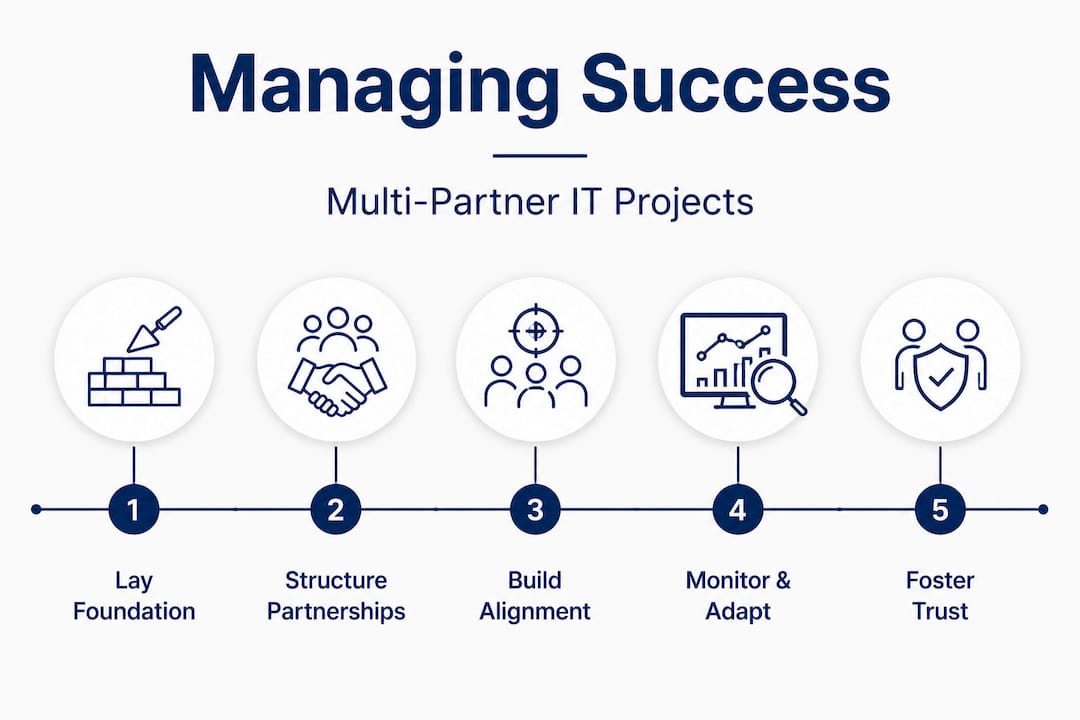
Monitoring in a multi-partner environment is more complex than in a single-vendor engagement. You are tracking deliverables across organizational boundaries, each with different internal processes, toolsets, and reporting cadences. Without a deliberate monitoring architecture, gaps will appear between partners and go undetected until they become critical.
Core monitoring and verification tools for multi-partner IT projects:
-
Integrated master schedule (IMS) with partner-specific task assignments and dependencies
-
Shared DevOps pipeline dashboards showing build, test, and deployment status across all teams
-
Compliance tracking matrix aligned to NIST, FedRAMP, or agency-specific control frameworks
-
Audit log requirements written into each partner’s statement of work
-
Monthly earned value reporting to track cost and schedule performance against baseline
-
Formal change control process requiring multi-partner sign-off on scope modifications
Edge cases require specific preparation. Vendor lock-in mitigation for classified data can be addressed through consortiums or special-purpose vehicles, along with requirements for SBOMs, audit rights, and outcomes-based contracts. These are not theoretical concerns. Federal AI and cloud modernization programs have encountered all of these scenarios, and the projects that handled them well had contractual provisions in place before the issue arose.
SBOMs deserve particular attention. As agencies modernize legacy systems and integrate commercial cloud services, the software supply chain becomes a compliance and security risk. Requiring SBOMs from all partners, and including SBOM submission as a contract deliverable, gives your team the visibility needed to respond to vulnerabilities quickly.
“PMI’s principle-led approach to program management, including its new Collaboration domain, emphasizes that multi-project benefits realization depends on structured collaboration across organizational boundaries, not just within individual project teams.”
For teams managing multi-partner project management at scale, the monitoring architecture should be established in the project’s first 30 days and reviewed quarterly for adequacy as the project evolves.
Pro Tip: Schedule formal alignment reviews every 60 to 90 days with all partners present. These reviews are not status updates. They are structured assessments of whether the partnership is operating as designed, whether roles remain clear, and whether any contractual provisions need adjustment. Teams that do this consistently resolve disputes before they escalate.
What most project managers miss about multi-partner initiatives
There is a tendency in government IT project management to treat process as the solution to every problem. More documentation, more meetings, more governance layers. The assumption is that if the process is rigorous enough, outcomes will follow. That assumption is only partially correct.
What most guides do not address is the behavioral layer. In collaborative, multi-firm project environments, the partners who deliver consistently are not necessarily the ones with the most detailed project plans. They are the ones who have built trust at the working level, where individual engineers, analysts, and program managers interact daily across organizational lines.
Trust in a multi-partner context is not a soft concept. It is a measurable operational factor. When partners trust each other’s competence and intent, they share information earlier, escalate problems faster, and resolve conflicts without involving legal teams. When trust is absent, every interaction becomes transactional, and the overhead of managing the relationship consumes capacity that should go toward delivery.
Public-sector project managers face a specific tension here. Government contracting environments are built around control mechanisms: oversight, documentation, compliance verification. These are necessary. But they can crowd out the relational investment that makes multi-partner teams function well. The most effective program managers we have seen balance control and adaptation deliberately. They maintain rigorous documentation and governance while also investing in the human infrastructure of the partnership.
The practical implication is this: your project plan should include explicit activities for building and maintaining partner alignment, not just technical milestones. Joint retrospectives, shared lessons-learned sessions, and informal cross-partner working groups are not overhead. They are delivery infrastructure. Projects that treat them as optional tend to experience the friction and delays that structured process alone cannot prevent.
Conventional wisdom also overvalues the initial planning phase relative to ongoing recalibration. The best-performing multi-partner projects we observe are not the ones with the most thorough kickoff. They are the ones that recalibrate frequently, adjust roles and responsibilities as the project evolves, and maintain clarity about outcomes even as the path to those outcomes changes. Flexibility within structure is the actual differentiator.
Get support for your next multi-partner project
If your agency or prime contracting team is preparing for a complex IT modernization, DevOps, or data analytics engagement involving multiple partners, having a contract-ready, outcomes-focused subcontractor in your corner changes the delivery equation significantly. At Rutledge & Associates, we bring structured delivery capacity, compliance readiness, and hands-on technical expertise to multi-partner programs from day one.
As a Prime-Ready IT Modernization Partner, we provide primes and agencies with proven tools, teaming support, and technical execution across cloud-native systems, DevOps pipelines, and data analytics platforms. Whether you need a reliable sub to fill a capability gap or a delivery partner to strengthen your proposal, we are built for the complexity of public-sector multi-partner work. Explore our capabilities and see how we support government-focused teams at every stage of the project lifecycle.
Frequently asked questions
What is the most common cause of multi-partner project failure?
Unclear scope and undefined roles often lead to communication breakdowns and missed deliverables. A structured partnering process that includes explicit scoping, stakeholder identification, and charter creation addresses these root causes before they become project-threatening issues.
How can we resolve disputes between partners quickly?
Resolve disputes using predefined processes in your teaming or partnership agreements and regular alignment reviews. Teaming agreements for government work should include a dispute resolution clause that specifies escalation steps, timelines, and decision authority.
Why are fusion teams effective for public-sector IT projects?
Fusion teams align IT with business objectives, boosting accountability and digital initiative success rates. By combining IT and business staff under shared leadership, agencies reduce the gap between technical delivery and mission outcomes.
How should we protect sensitive data in a multi-partner setup?
Mitigate risks with detailed audit rights, SBOMs, and consider special-purpose entities for classified projects. Vendor lock-in and data risks are best addressed through contractual provisions established before project launch, not after an incident occurs.