

Most prime contractors assume that a subcontractor with an active SAM registration and a few relevant past performance references qualifies as a ready teaming partner. That assumption routinely delays contract execution, triggers compliance reviews, and in some cases disqualifies bids entirely. A contract-ready partnership requires a subcontractor to demonstrate full preparedness through certifications, registrations, compliance alignment, and operational readiness, allowing primes to move quickly from teaming to bid submission without extensive re-vetting. This guide breaks down every layer of that readiness, from foundational requirements to expert vetting practices.
Table of Contents
- Understanding contract-ready partnership: Definition & essentials
- Key certifications and registration requirements for government contracting
- Regulatory nuances: Subcontracting rules and compliance pitfalls
- Beyond readiness: Vetting partners and reducing failure risk
- What most guides miss about contract-ready partnerships
- Partner with proven, prime-ready specialists
- Frequently asked questions
Key Takeaways
| Point | Details |
|---|---|
| Contract-ready defined | A contract-ready partnership means full compliance, certifications, and operational preparation for seamless public sector teaming. |
| Certifications matter | CCR™, SAM, and CMMC/NIST compliance are key credentials evaluated by prime contractors. |
| Vetting reduces risk | Rigorous partner vetting and trial engagement cut the chance of costly contract failures. |
| Regulatory nuances critical | Knowing subcontracting rules and flow-down compliance is vital to project success. |
| Real value is risk reduction | True readiness is less about paperwork and more about trust, delivery, and integration fit. |
Understanding contract-ready partnership: Definition & essentials
The term "contract-ready" gets used loosely, which is part of the problem. Primes hear it from dozens of prospective teaming partners, most of whom mean they have a SAM registration and a capability statement. That is not what the term means in practice, and the gap between perception and reality is where most government IT partnerships fracture.
A genuine contract-ready partnership involves a subcontractor that has already resolved the compliance, registration, and operational questions that would otherwise slow down teaming. The prime does not need to coach the partner through government contracting basics. The partner arrives prepared.
The essential components of contract-ready status fall into four distinct categories:
- Certifications: Credential-based proof that the firm understands procurement processes, compliance frameworks, and risk management. This includes credentials like CCR™ as well as any sector-specific certifications relevant to the contract.
- Registrations: Active and current enrollment in SAM.gov, DUNS or UEI assignment, and all applicable representations and certifications. Expired or incomplete registrations disqualify a partner immediately.
- Compliance frameworks: Demonstrated alignment with NIST SP 800-171, CMMC (Cybersecurity Maturity Model Certification) for Department of Defense work, and any agency-specific security requirements.
- Operational readiness: The ability to mobilize a defined scope of work without a long onboarding runway. This means staffing plans, security clearance pipelines, technical environments, and project governance structures already exist.
| Factor | Unvetted partner | Contract-ready partner |
|---|---|---|
| SAM registration | May be expired or incomplete | Active, current, fully accurate |
| Compliance documentation | Self-reported, unverified | Third-party validated or audited |
| Past performance | Vague references | Documented outcomes with contacts |
| Mobilization timeline | 60 to 90 days | 15 to 30 days |
| Security posture | Unknown | NIST or CMMC aligned |
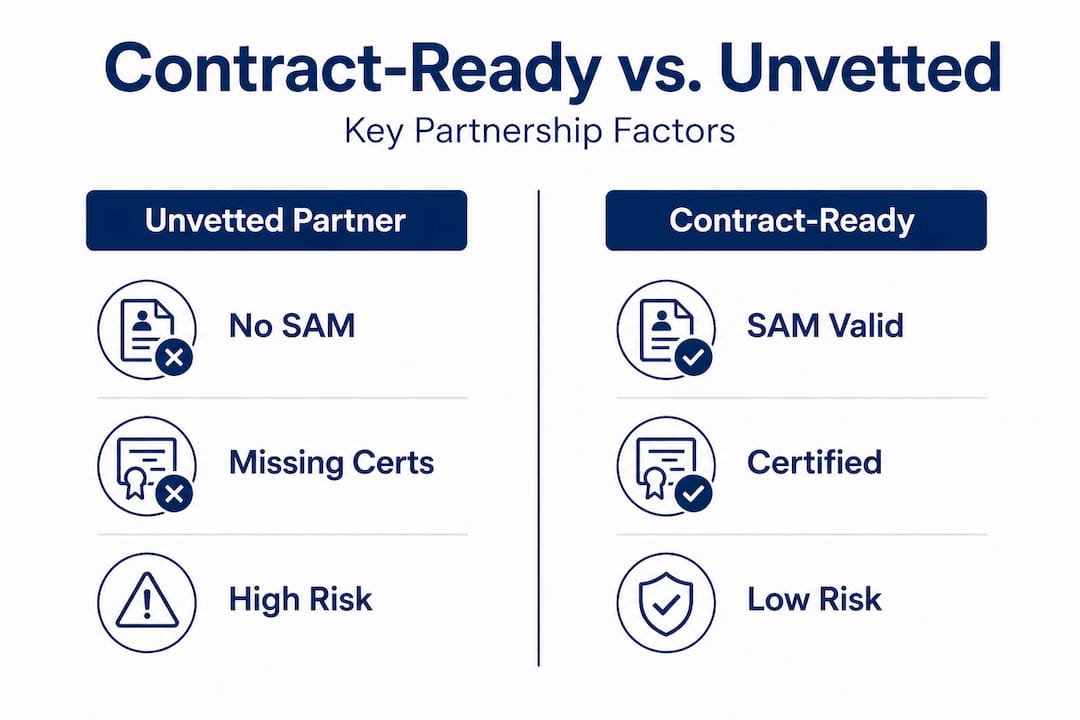
The distinction matters because primes bear the risk. If a subcontractor cannot perform or falls out of compliance mid-contract, the prime contractor faces cure notices, potential termination clauses, and reputational damage with the agency.
Pro Tip: Ask every prospective partner to provide their most recent SAM.gov registration screenshot and their NIST self-assessment score before a teaming conversation progresses. This filters out roughly 40% of underqualified firms before any NDA gets signed.
Understanding key preparedness steps is not about building a checklist. It is about reducing integration risk from the first conversation.
Key certifications and registration requirements for government contracting
With the foundations in place, it is crucial to break down the actual certifications and registrations that determine contract-readiness in the public sector IT space. Many firms believe compliance is binary: either they are compliant or they are not. In reality, different contract vehicles and agencies require different combinations of credentials, and a partner that qualifies for a state IT contract may be completely unprepared for a federal DoD modernization initiative.
The Corporate Contract Ready™ (CCR™) Certification is an exam-based credential that validates a business's competency in corporate procurement processes, risk management, compliance, and contracting workflows. For primes evaluating subcontractors, the CCR™ signals that a firm has deliberately prepared for the mechanics of government and corporate procurement rather than simply stumbling into it. It is not a replacement for government registrations, but it adds a knowledge-validation layer that references and past performance alone cannot provide.
The registrations required for federal contract readiness follow a logical sequence:
- Obtain a Unique Entity Identifier (UEI) through SAM.gov. This replaced the DUNS number and is now the foundational identifier for all federal procurement activity.
- Complete SAM.gov registration in full, including all required NAICS codes, representations and certifications, and financial information. An incomplete profile is functionally equivalent to no profile.
- Assess NIST SP 800-171 compliance against the 110 controls in the framework. Document the System Security Plan (SSP) and any Plan of Action and Milestones (POA&M).
- Pursue CMMC Level 2 or Level 3 certification if the work involves Controlled Unclassified Information (CUI) for the Department of Defense. CMMC is not optional for these contracts and requires third-party assessment.
- Verify small business certifications where applicable: SDVOSB, WOSB, 8(a), HUBZone. These affect both eligibility and set-aside opportunities.
The table below maps certifications and registrations to their primary preparedness function:
| Credential/Registration | Primary function | Applicable scope |
|---|---|---|
| SAM.gov registration | Federal procurement eligibility | All federal contracts |
| CCR™ Certification | Procurement knowledge validation | Federal and state contracts |
| CMMC Level 2/3 | CUI handling authorization | DoD IT contracts |
| NIST SP 800-171 SSP | Security posture documentation | Federal civilian and DoD |
| SDVOSB/WOSB certification | Set-aside eligibility | Small business programs |
State-level contracts introduce additional layers. Firms pursuing compliance requirements for service firms in Florida, for example, must align with Florida Department of Management Services procurement rules in addition to any federal overlays. New York's Office of General Services has its own vendor registration system, and understanding required government registrations at the state level is a separate discipline from federal SAM compliance.
The practical implication: a subcontractor claiming contract-ready status for a multi-state IT modernization program must demonstrate readiness across all applicable jurisdictions, not just the federal baseline.

Regulatory nuances: Subcontracting rules and compliance pitfalls
Building on the foundation of certifications and registrations, several regulatory nuances and potential pitfalls can surprise even seasoned project teams. These are the issues that surface after the teaming agreement is signed, often at the worst possible moment in the proposal or performance cycle.
The Federal Acquisition Regulation (FAR) governs the mechanics of federal subcontracting, and several provisions directly affect how prime contractors must structure partnerships:
- FAR 44.2 requires that primes obtain consent from the contracting officer before subcontracting specific work, particularly on cost-reimbursement contracts. Primes that assume they can bring in a subcontractor without approval expose the contract to audit risk.
- FAR 52.219-14 imposes limitations on subcontracting for small business set-aside contracts. Primes must perform a defined percentage of the work themselves. A partnership where the subcontractor carries the majority of technical delivery may violate this clause even if both parties are small businesses.
- FAR 9.103 governs responsibility determinations. Contracting officers can independently assess whether a subcontractor is responsible, meaning they can block a teaming arrangement that the prime has already committed to.
Readiness does not guarantee awards. Primes must obtain consent to subcontract under FAR 44.2, flow down CMMC and NIST requirements throughout the supply chain, and ensure compliance with the limitations on subcontracting under FAR 52.219-14. Non-8(a) joint ventures also carry size standard limits that affect eligibility.
Flow-down compliance is a particularly common gap. When a prime holds a contract with NIST SP 800-171 requirements, those requirements flow down to every subcontractor that handles covered information. A subcontractor that has not completed its own NIST assessment creates a compliance liability for the prime, regardless of how strong the prime's own security posture is.
The compliance nuances for teaming in states like Maryland, where several large federal civilian agency contracts are administered, add further complexity. State agencies may incorporate federal compliance standards into their own contracts, creating a dual-compliance obligation that unprepared subcontractors routinely miss.
Pro Tip: Always verify CMMC and NIST compliance down the full supply chain before bid submission. A single non-compliant subcontractor handling CUI can invalidate the prime's compliance certification for the entire contract.
Common pitfalls that experienced primes watch for include:
- Lapsed certifications: Small business certifications, security credentials, and SAM registrations all have expiration dates. A partner that was compliant during proposal may not be compliant at award.
- Undisclosed teaming restrictions: Some firms carry exclusivity agreements or organizational conflict of interest (OCI) disclosures that limit their ability to team freely.
- Scope creep in the teaming agreement: Vague scope definitions in a teaming agreement create disputes during performance. Contract-ready partners define their deliverables with precision before the agreement is signed.
Beyond readiness: Vetting partners and reducing failure risk
Once regulatory boxes are checked, due diligence does not stop. Confirming that a partner is truly contract-ready and lowering the risk of a failed collaboration requires active verification, not passive acceptance of credentials.
Partnership failure rates of 81% have been traced to poor vetting practices, even among firms that presented strong credentials during initial teaming discussions. Credentials signal intent and baseline preparation. They do not guarantee execution capacity, communication quality, or cultural alignment with the prime's program management approach.
A structured vetting process includes the following steps:
- Reference verification with outcome questions. Do not ask references whether the firm performed well. Ask what specific deliverables they owned, what went wrong, and how the firm responded to problems. Past behavior under pressure is the most reliable predictor of future performance.
- Financial health review. Request the firm's most recent two years of financial statements or bonding capacity documentation. A financially distressed subcontractor creates schedule risk, particularly on fixed-price task orders where cash flow gaps can halt delivery.
- Technical capability demonstration. For IT modernization work specifically, ask for a live demonstration of a relevant past deliverable or a technical walkthrough of their development and security practices. Capability statements describe what a firm claims to do. Demonstrations show what they have actually built.
- Security posture audit. Request the firm's NIST SP 800-171 self-assessment score and SSP. If CMMC is required, confirm third-party assessment status before proceeding.
- 90-day pilot engagement. Before committing to a long-term subcontracting relationship, structure an initial task order or pilot scope that can be evaluated independently. This surfaces execution gaps before they affect the core contract.
81% of partnership failures stem from inadequate vetting rather than technical incompetence. The implication is significant: most failed government IT partnerships could have been prevented with a more rigorous pre-teaming evaluation process.
The expert vetting protocol used by experienced primes prioritizes real-world delivery history over paper credentials. A firm with a CCR™ certification and full SAM compliance that cannot demonstrate measurable outcomes on past government IT work is a higher risk than a technically experienced firm that is still working toward formal certification.
Pro Tip: Always run a short-term pilot engagement if the contract vehicle allows it. A defined 60 to 90-day pilot on a bounded scope reveals communication habits, delivery quality, and compliance discipline far more accurately than any document review.
What most guides miss about contract-ready partnerships
Taking all these technical requirements into account, it is worth stepping back to address what rarely gets acknowledged about successful, contract-ready IT partnerships in the public sector.
Most guides treat contract-readiness as a compliance problem. Get the registrations current, obtain the certifications, document the security posture, and you have a ready partner. That framing is incomplete, and it leads primes to make costly decisions based on credential verification alone.
The real value of a contract-ready partner is integration risk reduction, not paperwork completion. In complex IT modernization programs involving legacy system migration, real-time analytics, and security-hardened cloud environments, the greatest source of project failure is integration friction: two organizations with different technical standards, communication rhythms, and delivery frameworks trying to produce a unified outcome under government scrutiny.
Contrasting views on contract-readiness exist between the corporate certification world and the federal procurement world. The CCR™ model prioritizes knowledge-based risk mitigation, ensuring a partner understands the mechanics of procurement. The federal model prioritizes compliance documentation and responsibility determinations. Neither model alone captures what primes actually need, which is a partner that reduces integration time and delivers defined outcomes without constant oversight.
There is no universal standard. Primes that apply a single vetting framework across all their partnerships regardless of contract type, agency, or technical complexity are optimizing for efficiency at the cost of accuracy. A state health IT modernization contract in New York has different risk profiles than a DoD logistics automation initiative. The vetting framework should follow the risk profile of the specific program.
What consistently distinguishes successful partnerships from failed ones is not the credential stack. It is alignment on communication protocols, shared understanding of deliverable standards, and a verifiable track record of the subcontractor owning clearly defined scopes without requiring the prime to manage their execution. Certifications open the door. Delivery history and operational alignment determine whether the partnership produces value. Primes that prioritize partner selection lessons based on real-world outcomes, not just compliance checklists, consistently report lower integration friction and stronger audit results.
Partner with proven, prime-ready specialists
If you're evaluating subcontracting partners for a government IT modernization initiative and need a firm that brings genuine contract-ready status to the table, Rutledge & Associates, LLC is built for exactly that role. Certified as an SDVOSB, woman-owned, and SBA-certified firm, the company delivers outcome-focused IT modernization services including DevOps pipelines, compliance automation, and real-time dashboards across Maryland, New York, and Florida. Explore prime-ready partner options to review capability alignment and past performance. For a full view of the firm's compliance posture and service scope, visit Rutledge & Associates resources and connect with their team for a direct consultation on your program requirements.
Frequently asked questions
Does contract-ready status guarantee a government contract award?
No. Contract-ready status signals preparedness, but awards depend on additional vetting including FAR 44.2 consent requirements, responsibility determinations, and limitations on subcontracting that must all be satisfied independently.
How often do contract-ready partners get vetted by primes?
Primes conduct fresh vetting every engagement cycle, reviewing references and financials regardless of prior teaming history, because contract conditions, firm capacity, and compliance status change between programs.
What certifications most signal contract-ready preparedness?
The CCR™ credential, active SAM.gov registration, and CMMC or NIST alignment are the top three signals for IT-focused subcontractors pursuing federal or state government partnerships.
Are internal compliance protocols enough without external certifications?
No. Primes and contracting officers require government-recognized registrations including SAM compliance, responsibility determinations, and in many cases third-party security assessments that internal protocols alone cannot satisfy.