

Federal IT services revenue grew 9.3% year over year in the third quarter of 2024, fueled in large part by strategic alliances centered on AI, cloud infrastructure, and cybersecurity modernization. That figure tells a clear story: no single contractor can realistically command every capability required by today's complex government programs. Procurement officers and prime contractors who still approach large-scale IT modernization as a solo effort are not just leaving performance on the table; they are exposing their agencies and programs to avoidable compliance risk. This article maps the rationale, mechanics, and best practices behind government IT partnerships so that your next collaboration is structured for measurable, defensible outcomes.
Table of Contents
- The new reality: Why IT partnerships are now essential
- Compliance and risk: The partnership advantage
- Structuring IT partnerships for success: Teaming agreements and beyond
- Building and sustaining effective IT partnerships
- What most IT partnership guides miss: The underappreciated risks and real-world rewards
- Partner with a prime-ready leader for IT modernization
- Frequently asked questions
Key Takeaways
| Point | Details |
|---|---|
| Partnerships enhance scale | Strategic IT partnerships allow government contractors to combine skills and resources for larger, more complex projects. |
| Boost compliance success | Working with the right partners dramatically improves your ability to meet strict government regulations and avoid costly mistakes. |
| Structure drives results | Clear teaming agreements and well-defined roles are essential to ensuring partnership success and enforceability. |
| Culture fit matters | Evaluating cultural and operational compatibility prevents common partnership failures and lays the groundwork for trust. |
The new reality: Why IT partnerships are now essential
Government IT programs have grown significantly more demanding over the past decade. Scope has expanded, regulatory frameworks have multiplied, and the technology stack required to deliver modern digital services now routinely spans cloud platforms, cybersecurity controls, data analytics, and DevOps automation. No single firm holds deep expertise in all of these areas simultaneously.
Strategic IT partnerships allow prime contractors and procurement officers to pool resources, expertise, and past performance records to pursue and execute complex modernization projects that clearly exceed single-company capabilities. The result is a combined team that can credibly respond to solicitations while distributing execution risk across complementary strengths.
Market data reinforces this shift. Federal IT services revenue jumped 9.3% year over year, driven largely by mergers, acquisitions, and structured partnerships targeting digital modernization. This is not coincidence. Agencies are demanding more, and the market is responding through collaboration.
Key drivers behind the partnership surge include:
- Regulatory complexity. Programs governed by frameworks like FAR, CMMC, FedRAMP, and NIST 800-53 require specialists who live inside those controls daily.
- Demand for scale. Agencies need solutions delivered at speed, which means firms must rapidly access capabilities they do not own internally.
- Innovation pressure. Cloud-native architecture, AI integration, and automation are not optional features; agencies expect them as baseline deliverables.
- Past performance gaps. Small and mid-size firms with deep technical skill often lack the documented contract history to win prime positions independently.
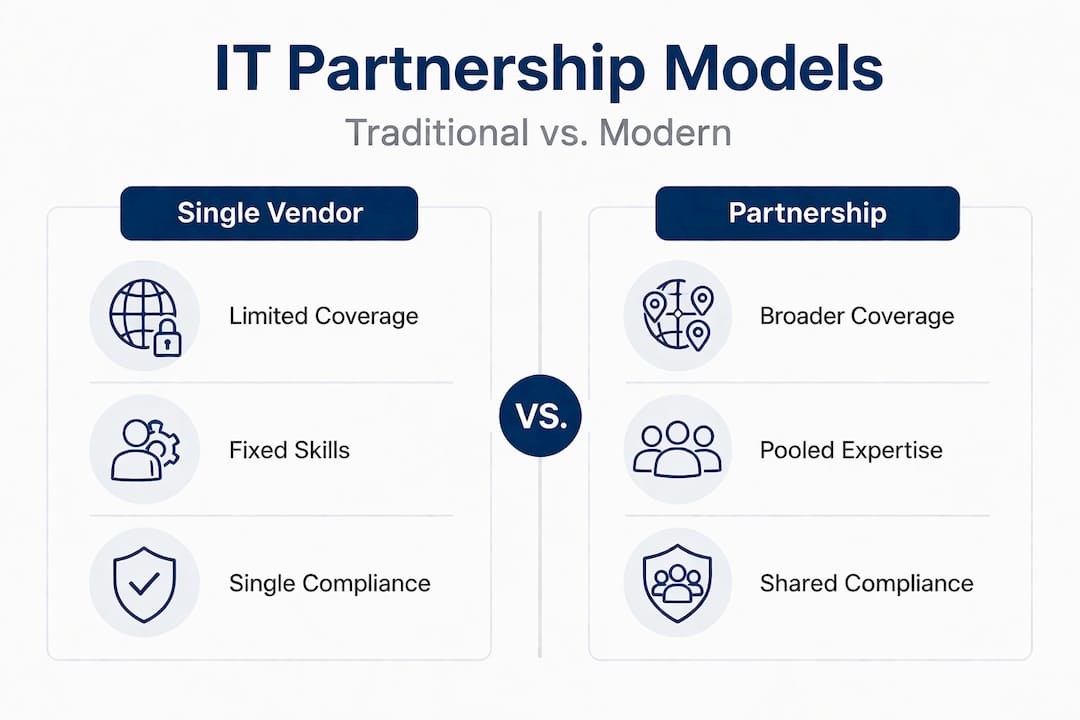
| Factor | Traditional single-vendor model | Partnership model |
|---|---|---|
| Regulatory coverage | Limited to one firm's expertise | Distributed across specialists |
| Past performance depth | Single record | Combined portfolio |
| Technical capability breadth | Narrow | Broad, modular |
| Risk exposure | Concentrated | Shared and diversified |
| Innovation speed | Slower, internal-only | Faster, cross-pollinated |
The New York State ITS collaboration with Google Cloud is a practical illustration. That arrangement brought a commercial cloud leader together with a public sector delivery structure, giving the state access to enterprise-grade infrastructure while ensuring compliance with state procurement rules. Neither party could have achieved the same outcome working independently. You can review common government contract partnership actions that inform how these arrangements are typically structured and pursued.

With the value of IT partnerships established, it is important to explore the risks and requirements for making these collaborations work.
Compliance and risk: The partnership advantage
Compliance in federal and state IT contracting is not a one-time checkpoint. It is a continuous obligation that runs from proposal submission through contract closeout. Programs subject to the Federal Acquisition Regulation (FAR), the Cybersecurity Maturity Model Certification (CMMC), and SBA rules on small business participation require constant, documented attention.
Partnerships ensure compliance with these stringent requirements by leveraging each partner's specialized experience in navigating federal acquisition rules, rather than asking a single firm to master every regulation simultaneously.
Consider how successful teams structure compliance responsibilities:
- Map regulatory requirements to partner strengths. Before a proposal drops, assign each compliance domain to the partner with documented experience in that area. CMMC readiness goes to the cybersecurity specialist; FAR clause management goes to the prime.
- Establish joint compliance reviews. Schedule recurring checkpoints, at minimum quarterly, where each partner presents status against assigned regulatory controls.
- Document everything in writing. Regulators and auditors do not accept verbal agreements. Every compliance task assignment must appear in the teaming agreement or subcontract.
- Create a shared risk register. A single, living document that tracks identified risks, assigned owners, mitigation actions, and current status forces accountability across the team.
- Conduct cross-partner training. Partners need at least baseline familiarity with each other's compliance posture, especially where tasks intersect or hand off between teams.
The contrast between solo and partnership approaches becomes clear when you compare them side by side:
| Compliance checkpoint | Solo contractor approach | Partnership approach |
|---|---|---|
| FAR clause management | Single team handles all clauses | Prime leads; sub provides specialty input |
| CMMC readiness | Internal assessment only | Dedicated cybersecurity partner leads |
| SBA small business goals | May not meet set-aside thresholds | Certified partners fulfill set-aside requirements |
| Audit documentation | One firm's records | Distributed, cross-verified records |
| Incident response | Limited internal capacity | Specialist partner activates immediately |
Vetting a potential partner's compliance posture requires more than reviewing their certifications. Common pitfalls include:
- Accepting self-reported compliance status without requesting third-party assessments
- Overlooking organizational conflict of interest (OCI) risks before signing agreements
- Ignoring a partner's history of contract modifications, cure notices, or terminations for cause
- Failing to verify that small business certifications are current and accurate before bidding
You can explore IT compliance strategies specific to state-level programs to understand how compliance requirements vary across jurisdictions like Maryland, which has its own procurement and cybersecurity standards layered on top of federal rules.
Pro Tip: Request copies of a prospective partner's most recent security assessment, any active System Security Plan (SSP), and at least two references from past federal or state IT contracts before finalizing any agreement. These materials reveal compliance culture, not just compliance status.
Before you assess your own compliance readiness for a partnership, it is worth reviewing strategic GSA partnership considerations that frame what agencies look for before awarding or approving teaming arrangements.
Understanding compliance is only the first step; next, it is crucial to manage partnership mechanics for long-term IT success.
Structuring IT partnerships for success: Teaming agreements and beyond
A handshake understanding between two companies is not a partnership structure. It is a liability. Formalizing the arrangement through enforceable legal instruments is what separates partnerships that deliver from partnerships that dissolve mid-program.
Teaming agreements are temporary pre-bid partnerships that outline roles, exclusivity, work share, IP protection, and the transition path to formal subcontracts. The key mechanics include defining prime and subcontractor roles, the pricing methodology each party follows, and termination clauses designed to avoid what courts call "agreements to agree," which are unenforceable because they lack specificity.
The three primary tools for formalizing government IT partnerships are:
- Teaming agreements. Used pre-award to define the relationship, prevent partners from teaming with competitors, and establish how work will be divided if the team wins the contract. These are binding within their scope but do not replace the subcontract.
- Prime-subcontractor agreements. The enforceable post-award instrument that governs the actual performance relationship, payment terms, deliverables, and dispute resolution.
- Cooperative technical arrangements (CTAs). Used primarily on GSA Schedule contracts, CTAs allow multiple schedule holders to propose a combined solution as a single response, each billing directly against their own schedule contract.
A well-drafted teaming agreement must address at least these critical elements:
- Roles and responsibilities. Which firm leads proposal development? Who manages the customer relationship? Who owns program management?
- Work share percentages. What portion of the total contract value does each partner perform? This must align with any applicable small business subcontracting requirements.
- Intellectual property ownership. Who owns custom code, data models, or platforms developed during performance? This is one of the most frequently litigated points.
- Pricing methodology. Are partners billing at cost plus fixed fee, firm fixed price, or another structure? Misalignment here creates disputes at invoicing time.
- Exclusivity terms. Is either partner free to team with competitors on the same opportunity? Typically, exclusivity is mutual and time-bound.
- Termination clauses. Under what conditions can either party exit the agreement, and what obligations survive termination?
"Vague or non-binding partnership terms are among the leading causes of contract disputes in federal IT programs. Agreements that fail to specify work share, pricing methodology, or IP ownership create ambiguity that agencies and courts cannot resolve in your favor."
Pro Tip: Have legal counsel review the teaming agreement specifically for enforceability, not just completeness. An agreement that includes all the right headings but uses aspirational rather than directive language may still constitute an unenforceable "agreement to agree."
If your programs extend to the southeastern United States, reviewing Florida IT teaming strategies will give you state-specific context for how teaming arrangements interact with Florida's vendor qualification and procurement rules.
Once structure and roles are defined, maintaining operational alignment and trust is essential for ongoing partnership success.
Building and sustaining effective IT partnerships
Winning a contract as a team is the beginning, not the finish line. The operational phase is where many IT partnerships stall or fracture. Sustaining performance requires deliberate investment in communication, accountability, and continuous improvement.
Vendor partnerships evolve from transactional relationships to strategic collaborations through trust and consistent communication. Evaluating partners on financial stability, compliance posture, organizational conflict of interest, and cultural fit is not a one-time exercise; it is an ongoing discipline throughout the life of the contract.
Best practices for sustaining IT partnerships include:
- Establish regular joint leadership meetings. Monthly at minimum, weekly during critical phases. These meetings should review KPIs, flag emerging risks, and confirm work share compliance.
- Use transparent, shared dashboards. Real-time program visibility tools eliminate information asymmetry and prevent the "we didn't know" conversations that erode trust.
- Conduct joint risk reviews. Quarterly reviews of the shared risk register keep both partners aligned on mitigation actions and reduce the likelihood of surprises during audits.
- Document lessons learned formally. Capture what worked and what did not at each major milestone. This builds institutional knowledge that strengthens future bids together.
- Set escalation protocols early. Define in writing who contacts whom, at what threshold, and within what timeframe when performance issues arise.
A practical checklist for evaluating ongoing partner fit includes:
- Are invoices and deliverables submitted accurately and on time?
- Is the partner's compliance posture unchanged since award (certifications current, no new OCI concerns)?
- Is the cultural dynamic between teams productive, or is friction increasing?
- Are KPIs being met, or is there a pattern of missed targets without explanation?
- Does the partner communicate proactively about risks, or only reactively after problems surface?
The CGI-AWS collaboration on federal cloud migration programs illustrates how structured governance sustains large-scale partnerships. CGI brought deep federal contracting experience and compliance infrastructure; AWS contributed cloud platform depth and automation capability. Regular joint governance meetings and shared performance metrics kept both organizations aligned across multi-year delivery.
Pro Tip: Before committing to a full-scale partnership, run a phased pilot on a smaller task order or limited scope of work. A paid pilot reveals how a partner actually performs under delivery pressure, not just how they present during proposal development.
If your programs are centered in the Northeast, reviewing partner evaluation in New York provides relevant context for state-specific qualification requirements and partnership norms. You can also explore additional guidance on nurturing government IT partnerships as programs mature past initial award.
What most IT partnership guides miss: The underappreciated risks and real-world rewards
Most guidance on government IT partnerships focuses on the mechanics: write a good teaming agreement, check compliance boxes, and communicate regularly. That advice is not wrong. But it underestimates the real source of partnership failure, which is the assumption that any partnership is better than no partnership.
Poor partner selection leads to compliance failures, unbalanced work share disputes, and unenforceable teaming agreements that collapse under scrutiny. The risk is not theoretical. Programs have been delayed, modified, or terminated because partner relationships broke down after award, when replacement options are limited and agency trust is already eroded.
The conventional wisdom says: "Find a partner with complementary capabilities and move fast." The more accurate guidance is: find a partner whose compliance culture, financial health, and delivery discipline match the demands of the specific program, then move deliberately.
Due diligence is not a checkbox. It is an analytical exercise that should produce documented evidence on at least four dimensions: past performance references (called directly, not read from a capability statement), financial stability (audited financials or equivalent), active certifications with verified expiration dates, and a frank conversation about how the partner has handled disputes on prior contracts.
The hardest lesson from expert view on partner selection is this: a technically brilliant partner with poor compliance culture will cost you more than the value they bring. Compliance failures on a government IT program are not contained to the subcontractor. They flow upstream to the prime and can affect agency relationships, award fee scores, and future bidding eligibility.
What actually works in sustained IT partnerships is simpler than most guides suggest. Clear scope ownership, written accountability for every compliance task, transparent KPIs visible to both teams, and the willingness to address performance gaps directly and early. These are not glamorous practices. They are the operational discipline that separates partnerships that become long-term strategic relationships from those that produce disputes and modified contracts.
Partner with a prime-ready leader for IT modernization
Rutledge & Associates, LLC brings exactly the compliance depth, technical capability, and outcome focus that prime contractors and procurement officers need in a subcontracting partner. As a certified SDVOSB, woman-owned, and SBA-certified firm, the company satisfies multiple set-aside requirements while delivering clearly scoped modernization outcomes across cloud architecture, DevOps automation, compliance automation, and real-time analytics. If you are evaluating subcontracting partners for complex, compliance-heavy programs in Maryland, New York, or Florida, discover our IT partnership expertise and see how our delivery model reduces oversight burden while improving audit readiness. Prime contractors ready to formalize a subcontracting relationship can learn more about becoming a prime-ready partner. Regional program officers can also explore our Florida modernization partnerships for state-specific capability and past performance details.
Frequently asked questions
What is a teaming agreement and why is it important for IT partnerships?
A teaming agreement is a temporary pre-bid contract that defines each partner's roles, exclusivity terms, work share percentages, and the transition path to a formal subcontract, ensuring that partnership terms are enforceable before a solicitation is awarded.
How do IT partnerships improve compliance for government contracts?
Partnerships distribute regulatory responsibility across partners with specialized expertise, making it significantly easier to meet complex FAR, CMMC, and SBA requirements while reducing the risk that any single compliance gap creates a program-level failure.
What are the biggest partnership risks in government IT projects?
The most serious risks include poor partner selection, vague or unenforceable teaming agreements, and unresolved disputes over work share or compliance responsibilities that surface during performance rather than before award.
How do you evaluate if a potential IT partner is a good fit?
Assess the partner's financial stability, compliance posture, and organizational conflict of interest status, then supplement that analysis with direct reference checks and a review of their documented past performance on similarly scoped programs.