

Application modernization is the process of updating legacy software so it runs on current cloud platforms and architectures instead of aging, hard-to-maintain infrastructure. It covers a spectrum of approaches: rehosting a system on new infrastructure with no code changes, replatforming it for minor cloud optimizations, refactoring or rearchitecting the code itself, or rebuilding an application from scratch on cloud-native architecture. The short verdict: done well, modernization improves agility, tightens security, and makes an organization ready for AI and automated analytics. Done without a clear business case, it burns budget on systems nobody needed to touch.
Government IT teams see this play out constantly on platforms like Microsoft Azure, Kubernetes, and Red Hat OpenShift, where the technology is rarely the hard part. The quickest wins tend to cluster around a few areas:
- Security posture: patching vulnerabilities baked into decades-old code.
- Scalability: handling demand spikes without provisioning new hardware.
- Integration: connecting siloed systems through modern APIs instead of manual data transfers.
Key Takeaways
Application modernization succeeds when the strategy, whether rehost, replatform, refactor, rearchitect, or rebuild, is matched to a specific workload's business value, compliance needs, and team skills rather than applied uniformly across a portfolio.
| Point | Details |
|---|---|
| Definition anchors the decision | Modernization spans rehost, replatform, refactor, rearchitect, and rebuild; pick per workload, not portfolio-wide. |
| Assessment prevents scope surprises | Map dependencies and score business value before committing funding or timelines. |
| Match strategy to risk tolerance | Rehost is fast and cheap; rearchitect costs more upfront but pays off long term. |
| AI readiness depends on modernization | Clean, cloud-native data pipelines are a prerequisite for analytics and AI tools. |
| Outcome-owned delivery reduces risk | Primereadysub delivers defined-scope modernization work packages for compliance-heavy government programs. |
Table of Contents
- What Does Application Modernization Actually Mean for Your Organization?
- Which Modernization Strategy Fits Your Application?
- How Does the Modernization Lifecycle Actually Work?
- How Do You Choose the Right Strategy for Each Application?
- What Technologies and Patterns Enable Modernization?
- What Are the Real Risks, Costs, and Timelines?
- Why Do Public-Sector Modernization Projects Face Unique Constraints?
- Frequently Asked Questions
- Sources
What Does Application Modernization Actually Mean for Your Organization?
For most IT leaders, application modernization definition debates matter less than the outcome: fewer outages, faster feature delivery, and systems that can actually talk to each other. The primary drivers behind modernization budgets are consistent across sectors, but they hit differently depending on what an organization is optimizing for.
- Reducing technical debt so engineering time goes toward new features instead of firefighting old code.
- Enabling AI and analytics, since machine learning models need clean, accessible data that legacy silos rarely provide.
- Improving security posture, closing gaps in unsupported software before they become incidents.
- Lowering operating costs, often by retiring expensive mainframe contracts or oversized data centers.
- Accelerating feature delivery, measured in release frequency rather than annual update cycles.
Each of these maps to a KPI an IT leader can actually track: mean time to resolution (MTTR), deployment frequency, IT spend as a percentage of revenue, or the number of security incidents per quarter. In the public sector specifically, modernized systems are increasingly the prerequisite for AI adoption, since automated analytics and case-management tools depend on clean, cloud-native data pipelines rather than fragmented legacy databases. Agencies that have modernized report tangible gains in security posture and constituent response times, which matters as much to a program owner's credibility as it does to the IT budget.
Which Modernization Strategy Fits Your Application?
Practitioners generally group modernization approaches into what industry shorthand calls "the Rs." Each one solves a different problem, and picking the wrong one for a given workload is where most budgets go sideways. Microsoft's Cloud Adoption Framework treats this as a per-workload decision, not a one-size-fits-all program strategy, recommending you select a migration strategy for each application rather than committing an entire portfolio to one approach.
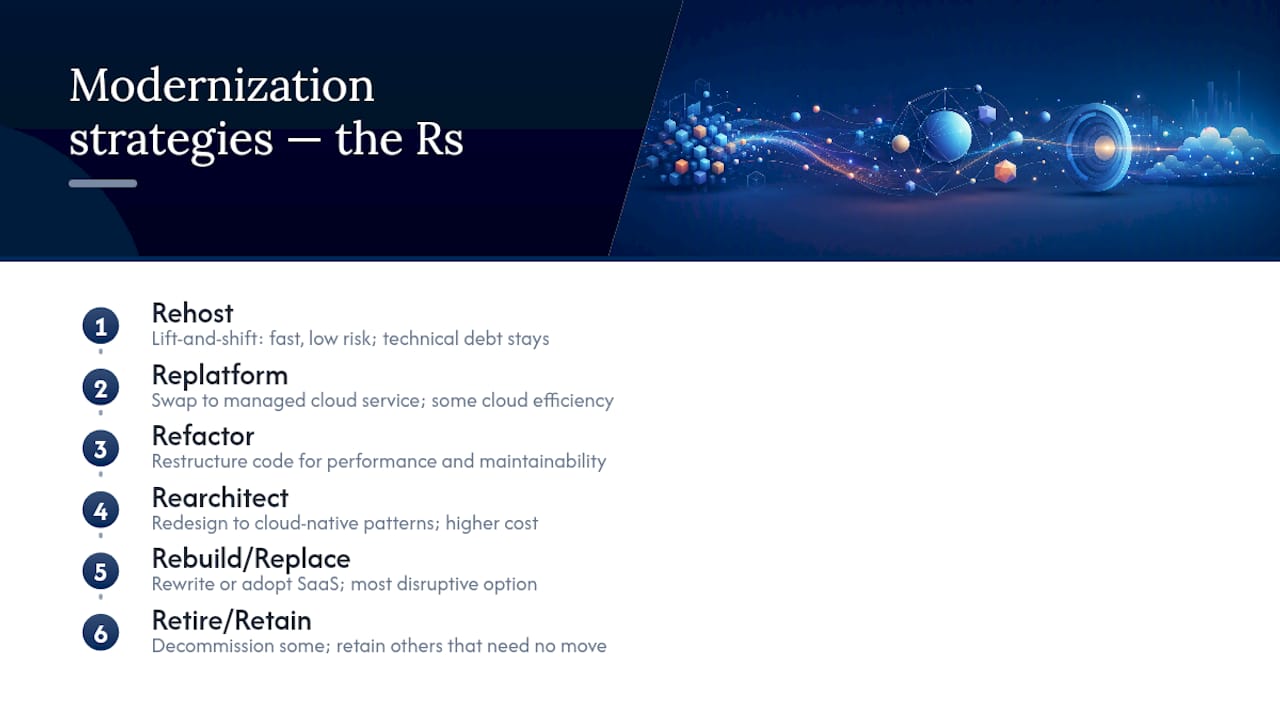
Rehost moves an application to new infrastructure with little or no code change, often called "lift and shift." It is fast and low risk but leaves the underlying architecture unchanged, so technical debt rides along for the trip.
Replatform makes small adjustments, swapping a self-managed database for a managed cloud service, for instance, without rewriting the application logic. It buys some cloud efficiency without the cost of a full rebuild.
Refactor restructures the code itself to improve performance or maintainability while keeping the core functionality intact. This is where teams start breaking apart tightly coupled modules.
Rearchitect goes further, redesigning the application around cloud-native patterns like microservices. It carries higher upfront cost and complexity but tends to deliver the strongest long-term return.
Rebuild or replace starts over, either writing new code or adopting a commercial SaaS product. It is the most disruptive option and the most justified only when the legacy system can't be salvaged economically.
Retire or retain rounds out the framework: some applications should be decommissioned outright, and others genuinely don't need to move yet.
How Does the Modernization Lifecycle Actually Work?
Every credible modernization program moves through four stages, and skipping the first one is the single most common reason projects blow their budget.
- Assessment. Inventory every application, map its dependencies, and score it for business value and technical fit. This is where multidimensional scoring tools that weigh complexity, security, maintainability, and business impact earn their keep, since manual guesswork at this stage is what causes scope surprises later.
- Planning. Decide which "R" applies to each workload, assess risk, and lock in funding and stakeholder buy-in before writing a line of code.
- Delivery. Execute the refactor or replatform work, build CI/CD pipelines, run testing cycles, and plan the cutover so production isn't disrupted.
- Operate. Monitor the new system, build runbooks, verify security posture, and track the metrics that prove the investment worked.
A useful checklist to run through before kickoff:
- Confirm dependency maps exist or commission automated discovery tools to build them.
- Score every application in the portfolio, not just the obvious candidates.
- Align funding and timeline expectations with stakeholders before delivery starts.
- Define cutover and rollback plans before touching production.
- Set monitoring and success metrics before go-live, not after.
Timelines vary widely by scope. A small rehost of a handful of applications can wrap in 8 to 12 weeks. A medium replatform or refactor effort touching a department's core systems often runs 6 to 9 months. A large rearchitect program spanning a mainframe-dependent agency can take 18 months or longer, particularly when hidden interdependencies surface mid-project.
How Do You Choose the Right Strategy for Each Application?
No single formula picks the right "R" for every workload. Instead, weigh a handful of factors against each other for each application in the portfolio.
- Business value: How much does this application matter to revenue, mission delivery, or constituent service?
- Technical complexity: How tightly coupled is it to other systems, and how well documented is that coupling?
- Compliance requirements: Does it handle regulated data that constrains your architecture choices?
- Risk of change: What happens if this system goes down during migration?
- Team skills: Does the staff have cloud-native development experience, or will this require hiring or a partner?
- Integration surface: How many other systems depend on this one's APIs or data feeds?
Ask business stakeholders what breaks if the application is unavailable for a day. Ask technical staff how confident they are in the current documentation. If the answers reveal gaps, that's your signal to modernize during a broader migration rather than deferring. Waiting to modernize an interdependent system until "later" often means doing the assessment work twice.
What Technologies and Patterns Enable Modernization?
The technical building blocks behind most modernization efforts are consistent, even when the strategy differs. Cloud providers like Microsoft Azure and Amazon Web Services (AWS) supply the infrastructure layer, while containers and Kubernetes provide the portability that lets applications move without being locked to one vendor's stack. Red Hat OpenShift extends that model with an enterprise-managed Kubernetes platform many public-sector teams favor for its support model. Microservices architecture, serverless computing, and API-first design round out the pattern set, with CI/CD pipelines and observability tooling (logs, metrics, tracing) making the resulting systems maintainable rather than just modern-looking.

Platform-as-a-service fits well for teams that want less operational overhead. Managed Kubernetes suits teams needing more control over scaling and deployment. Serverless works best for event-driven workloads with unpredictable traffic. Modernized systems built this way are also what make AI integration through APIs practical instead of theoretical.
Pro Tip: Pick platforms based on the skills your team already has, not the newest option on the market. A rearchitect project stalls fast when nobody on staff knows Kubernetes and the roadmap assumed they would.
What Are the Real Risks, Costs, and Timelines?
Hidden dependencies are the top risk, closely followed by data quality issues and skills gaps on the delivery team. Procurement constraints add a layer public-sector teams know well: a contracting cycle can add months to a timeline that looks straightforward on a whiteboard.
Cost and schedule scale with strategy. Rehost is cheapest and fastest upfront but doesn't reduce technical debt. Rearchitect costs more and takes longer but typically delivers the better long-term return on investment. Technical debt compounds this: the longer a system goes untouched, the more expensive and riskier its eventual modernization becomes.
- Mitigate hidden dependencies with automated discovery tools before scoping the project.
- Address skills gaps early by pairing internal staff with experienced partners rather than discovering the gap mid-delivery.
- Track deployment frequency and incident rate throughout execution as early warning signals.
Pro Tip: If your assessment phase surfaces more undocumented integrations than expected, that's not a sign to rush past it. It's a sign your original cost estimate was wrong.
Why Do Public-Sector Modernization Projects Face Unique Constraints?
Government agencies face procurement cycles that don't move at software speed, mainframes running mission-critical workloads nobody fully documented, and staff turnover that erodes institutional knowledge. Portfolio-level sequencing avoids the ripple effects that hit one system when another gets touched carelessly, which is where defined-scope modernization work tends to outperform loosely scoped staff augmentation.
A practitioner's view on modernization priorities
Outcome-owned delivery, not staff augmentation, is what actually reduces client risk on compliance-heavy programs.
Get Modernization Help That Owns the Outcome, Not Just the Hours
Hiring more contractors to sit inside your existing team is not the same as hiring a partner who owns a defined outcome. Primereadysub delivers modernization work as scoped packages, cloud-native re-architecting, DevOps and CI/CD pipeline builds, compliance automation, and real-time dashboards, rather than staff-augmentation hours that need constant oversight. That distinction matters most on compliance-heavy government programs, where an SDVOSB and woman-owned firm with public-sector experience in states like Maryland, New York, and Florida can carry accountability a general contractor staffing pool can't. If your agency or prime contract needs a partner to own a modernization work package end to end, start with Primereadysub's modernization services and scope the first deliverable.
Frequently Asked Questions
What is application modernization in simple terms? It means updating legacy software, often decades old, to run on current cloud platforms and architectures instead of outdated, hard-to-maintain infrastructure.
What is digital transformation compared to application modernization? Digital transformation is the broader business shift toward digital operating models; application modernization is the technical work that makes much of that shift possible.
How long does application modernization take? Small rehost projects can finish in weeks; large rearchitect efforts spanning mission-critical systems often take 18 months or more.
What is the biggest challenge in application modernization? Hidden dependencies and incomplete documentation, which routinely cause underestimated scope and budget overruns.
Do you need to modernize every legacy application? No. Some workloads should be retired, and others can be retained as-is until a clearer business case for change emerges.
Sources
- Select a cloud migration strategy — Microsoft Learn
- What is Application Modernization — Microsoft Azure
- Modernizing federal applications without disrupting mission-critical systems — FedTech Magazine