

IT modernization solutions are defined as structured programs that replace or re-architect legacy government systems to improve efficiency, security, and regulatory compliance. These programs go beyond simple software upgrades. They require rethinking how agencies collect data, automate workflows, and deliver services to the public. Frameworks like the GSA's TIME model and M3 playbook give agencies a repeatable method for making these decisions. Yet 53% of federal executives cite inconsistent funding and budget constraints as primary barriers, and 44% prioritize cybersecurity infrastructure improvement as a top investment area. The gap between ambition and execution is real, and closing it requires more than technology.
What are the common challenges in government IT modernization?
Budget constraints are the single most cited barrier to modernization progress. Federal agency leaders report that 48% say it takes a year or more to move an IT program from pilot to full-scale deployment. That delay compounds cost and risk simultaneously.
The barriers extend well beyond funding cycles. Government IT teams face a combination of structural, technical, and human challenges that interact and reinforce each other:
- Inconsistent funding cycles: Annual appropriations make multi-year modernization commitments difficult to sustain.
- Workforce skill shortages: Agencies struggle to hire and retain staff with cloud, DevOps, and data engineering skills.
- Legacy system complexity: Decades-old systems often lack documentation, making integration with modern platforms unpredictable.
- Governance fragmentation: Multiple oversight bodies slow procurement and create conflicting requirements.
- Pilot-to-scale gap: Programs that succeed in controlled pilots frequently stall before agency-wide rollout.
"Without multi-year, dedicated funding and workforce training investments, modernization progress is slow and often only incremental. Culture acceptance and governance clarity are keys for agency-wide adoption." Federal modernization readiness study
The workforce skill gap deserves particular attention. Ignoring human capital and training ranks as a top barrier to successful modernization, often more impactful than procurement delays or cybersecurity threats. Agencies that treat modernization as a purely technical problem consistently underperform those that invest equally in people.
Which frameworks drive successful IT modernization implementations?

Successful modernization starts with mission outcomes, not technology selection. The best frameworks tie technology decisions to service improvements rather than to vendor capabilities or trend adoption. This distinction separates agencies that complete modernization from those that cycle through failed pilots.
Two frameworks stand out for government environments:
- TIME framework (Technology, Information, Management, Enterprise): Developed to help agencies categorize applications across four dimensions and decide whether to tolerate, invest, migrate, or eliminate each system. It creates a structured basis for portfolio decisions.
- M3 Playbook: Recommended by the GSA, M3 provides detailed steps and inputs from initial assessment through operational improvement. It covers governance, risk management, and change management in a single integrated model.
The table below shows how application rationalization decisions map to modernization outcomes:
| Rationalization Action | When to Apply | Expected Outcome |
|---|---|---|
| Modernize | System is mission-critical with high usage | Improved performance and security |
| Migrate | System is functional but on outdated infrastructure | Reduced maintenance cost |
| Decommission | System is redundant or low-value | Portfolio simplification |
| Tolerate | System is stable with low risk | No immediate investment required |
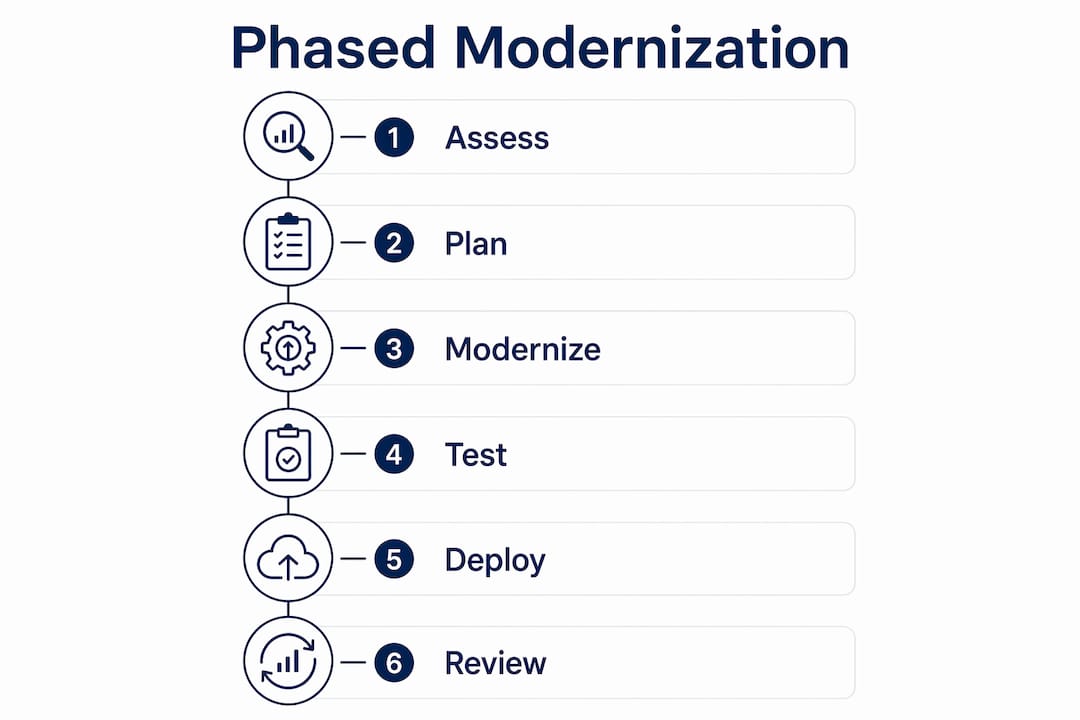
Phased modernization is the most effective execution model for government agencies. Breaking a large program into discrete phases reduces financial exposure, allows course correction, and gives workforce teams time to adapt. Agencies that attempt full-scale replacements in a single effort face higher failure rates and cost overruns.
Pro Tip: Map every technology decision back to a specific mission outcome before committing budget. If you cannot name the service improvement a system change will produce, the change is not ready to fund.
How can integration of emerging technologies and legacy systems be managed effectively?
Legacy system integration with AI, cloud platforms, and modern data systems is technically complex and organizationally disruptive. Only 38% of federal agencies have a comprehensive AI governance strategy, which limits deployment beyond controlled pilot stages. Without governance, AI tools create new compliance risks rather than solving existing ones.
Practical integration requires a layered approach:
- Assess before you migrate: Use multidimensional application assessments that factor security, complexity, business impact, and maintainability to prioritize which systems move first.
- Use interactive dashboards: Modern assessment tools generate real-time dashboards that allow non-technical stakeholders to explore risks and costs dynamically. This builds shared understanding across leadership and IT teams.
- Apply AI to legacy documentation: AI can reverse engineer and document legacy systems, creating a knowledge base that accelerates migration planning.
- Run hybrid environments deliberately: Maintain legacy systems in parallel during transition periods rather than forcing hard cutover dates that create service disruptions.
Pro Tip: Treat your AI governance policy as a prerequisite, not an afterthought. Agencies that deploy AI tools before establishing data ownership rules and audit trails create compliance problems that are harder to fix than the legacy systems they replaced.
The agencies that manage integration most effectively treat it as a data problem first and a technology problem second. Clean, well-governed data moves to new platforms reliably. Poorly governed data creates the same dysfunction in a modern cloud environment that it created in the legacy system.
What role does workforce readiness play in IT modernization?
Modernization is an organizational change program that happens to involve technology. Agencies that frame it only as a technology upgrade consistently underinvest in the human side and pay for it in adoption failures. Workforce training and managing organizational change are as critical as technology investment. Many modernization projects underperform specifically because this is neglected.
Effective workforce readiness strategies share several characteristics:
- Upskilling tied to specific roles: Training programs that target cloud administration, data analysis, or DevOps practices produce measurable competency gains. Generic IT training does not.
- Change champions at the program level: Designating staff members who advocate for new systems within their teams accelerates adoption and surfaces resistance early.
- Funding training as a line item: Agencies that treat training as a budget afterthought cut it first when costs rise. Protecting training funding requires treating it as a capital investment, not an operating expense.
- Aligning technical investments with business outcomes: Staff understand and accept new systems faster when they can see how the change improves their specific work, not just the agency's abstract efficiency metrics.
Pro Tip: Build your workforce readiness plan before you finalize your technology selection. The skills your team needs to operate the new system should influence which system you choose, not the other way around.
The public-sector IT modernization strategies that produce lasting results treat workforce development as a parallel workstream, not a downstream activity. Agencies that sequence training after deployment consistently see lower adoption rates and higher support costs.
How can government IT decision-makers create a phased modernization roadmap?
A phased modernization roadmap begins with a disciplined assessment of the current state, not with a technology wish list. Effective IT consolidation simplifies operations, reduces portfolio complexity, improves security, and enables controlled, standardized modernization. It requires disciplined planning, leadership, and a strong communications strategy for stakeholder buy-in.
A practical phased roadmap follows this sequence:
- Baseline assessment: Catalog all applications using the TIME framework. Score each on complexity, security risk, and business value.
- Prioritize the first phase: Select systems with high impact and manageable complexity for the initial modernization wave.
- Define success metrics: Establish measurable outcomes before work begins, including processing time reductions, compliance rates, and system uptime targets.
- Execute with incremental testing: Phased modernization reduces risk and improves cybersecurity readiness. Incremental data migration and rigorous testing before deployment are critical at each phase boundary.
- Communicate continuously: Stakeholder alignment requires regular updates that connect technical progress to mission outcomes, not just project milestones.
Pro Tip: A communications strategy is not a project management tool. It is a change management tool. Agencies that communicate only when something goes wrong lose stakeholder trust at the moments they need it most.
The contrast between phased and big-bang approaches is significant. Phased programs allow agencies to learn from each wave and apply those lessons forward. Big-bang replacements concentrate all risk into a single deployment event, where a single failure can derail years of investment.
Key Takeaways
Government IT modernization succeeds when agencies combine structured frameworks, phased execution, and workforce investment rather than treating technology selection as the primary decision.
| Point | Details |
|---|---|
| Start with mission outcomes | Define the service improvement you need before selecting any technology or vendor. |
| Use structured frameworks | Apply the TIME model and M3 playbook to make portfolio decisions with consistent criteria. |
| Fund workforce training | Protect training budgets as capital investments; skill gaps derail modernization faster than technology failures. |
| Phase your execution | Break programs into discrete waves to reduce risk, control cost, and allow course correction. |
| Govern AI before deploying it | Establish data ownership and audit trail policies before integrating AI tools into agency workflows. |
Why most modernization programs stall before they finish
The pattern I see most often in government modernization is not technical failure. It is a failure of sequencing. Agencies invest heavily in platform selection and procurement, then discover six months into deployment that their workforce cannot operate the new system and their data is too disorganized to migrate cleanly. At that point, the budget is committed and the timeline is fixed, so they push forward anyway and end up with a modern platform running legacy-era processes.
The agencies that avoid this outcome do one thing differently. They treat the assessment phase as the most important phase, not the most skippable one. They spend real time mapping applications, scoring data quality, and identifying the staff who will own the new systems. That work feels slow. It does not produce visible deliverables. But it is the work that determines whether the deployment phase succeeds or fails.
The other pattern worth naming is the governance gap around emerging technologies. Agencies are under real pressure to show AI adoption, and that pressure leads to deploying tools before the governance structures exist to manage them. The result is AI systems that produce outputs no one can audit and data flows that create new compliance exposure. The agencies doing this well are the ones that treat AI governance as a prerequisite, not a follow-on activity.
If you are a project manager or IT director reading this, the most valuable thing you can do right now is map your current application portfolio against the TIME framework and identify your three highest-risk legacy systems. That single exercise will tell you more about your modernization priorities than any vendor briefing.
— Randy
Primereadysub: a proven partner for public sector modernization
Government agencies in Maryland, New York, and Florida have worked with Primereadysub to move legacy systems to cloud-native architectures, automate compliance workflows, and build real-time program dashboards. Primereadysub operates as an SDVOSB and SBA-certified firm, which means it qualifies for set-aside contracts and brings focused expertise rather than generalist staff augmentation. The firm owns clearly defined scopes, delivers DevOps pipelines and compliance automation, and reduces the oversight burden on prime contractors. For agencies and primes managing complex, compliance-heavy programs, IT modernization partnerships built on defined outcomes are the most reliable path forward.
FAQ
What are IT modernization solutions?
IT modernization solutions are structured programs that replace or re-architect legacy systems to improve efficiency, security, and compliance. They typically combine cloud migration, automation, data governance, and workforce training into a coordinated program.
What is the TIME framework in government IT modernization?
The TIME framework categorizes applications as Tolerate, Invest, Migrate, or Eliminate based on their technical health and business value. It gives agencies a consistent method for making portfolio decisions across hundreds of systems.
Why do government IT modernization projects fail?
Modernization efforts often fail because leaders focus on technology selection rather than mission outcomes, and because workforce training and organizational change management receive insufficient investment.
How long does a government IT modernization program take?
Timelines vary by scope, but 48% of federal agency leaders report it takes a year or more just to move a program from pilot to full-scale deployment. Phased approaches spread this timeline across manageable waves rather than compressing it into a single cutover.
What is the M3 playbook?
The M3 playbook is a GSA-recommended framework that provides detailed steps from initial assessment through operational improvement. It covers governance, risk management, and change management in an integrated model designed for federal agency modernization programs.