

Government IT partnerships are frequently misunderstood as straightforward vendor arrangements, but they represent something structurally and operationally different. Agencies that approach these relationships as simple procurement transactions often find themselves managing fragmented systems, persistent skills gaps, and compliance risks that grow more costly over time. The real value of a government IT partnership lies in structured collaboration, shared accountability, and the capacity to deliver modernized capabilities under strict public-sector stewardship rules. This article explains how these partnerships are defined, how they are formed, what delivery models are emerging, and what genuinely makes them succeed or fail.
Table of Contents
- Defining government IT partnerships: More than procurement
- Partnership mechanics: Acquisition, contract vehicles and procurement frameworks
- Ecosystem-led models and role of lead partners
- Success factors: Trust, governance, and outcome alignment
- Beyond vendor selection: Hard truths for modern government IT partnerships
- Ready to modernize? Find the right IT partner for your agency
- Frequently asked questions
Key Takeaways
| Point | Details |
|---|---|
| Structured collaboration | Government IT partnerships prioritize collaborative delivery under clear accountability and stewardship rules. |
| Procurement frameworks | Effective IT partnerships use contract vehicles and align with federal and agency procurement requirements for compliance. |
| Ecosystem-led models | Lead partners coordinate specialists, simplifying supplier management and reducing complexity. |
| Success fundamentals | Trust, governance, communication, and mission alignment determine whether partnerships deliver modernization. |
| Process simplification | Contracting-process simplification is as critical as vendor selection for partnership success and timely implementation. |
Defining government IT partnerships: More than procurement
The term "government IT partnership" carries different meanings depending on context, and that ambiguity creates real problems for procurement officials trying to structure effective programs. At its core, a government IT partnership is a structured collaboration between a public agency and one or more private-sector organizations designed to deliver IT modernization or service capabilities under public accountability rules.
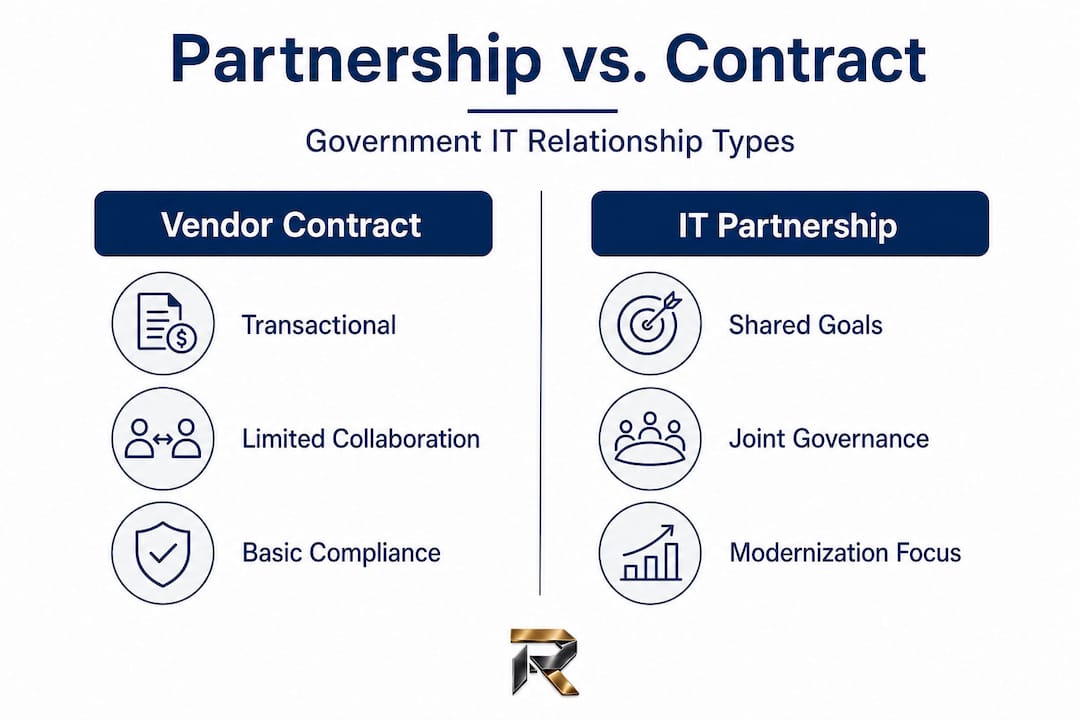
This distinction matters because it separates partnerships from ordinary vendor contracts. A vendor contract is transactional. A partnership, by contrast, involves shared objectives, ongoing governance, and joint accountability for outcomes. The difference shapes how agreements are written, how performance is measured, and how problems are resolved when systems fail or requirements change.
GSA's OneGov framing describes this as a "cultural shift," not just a procurement adjustment. That language signals something important: agencies and their industry partners have to change how they operate together, not just how they sign contracts.
To understand the practical difference, consider how a traditional IT contract typically works versus a structured modernization partnership:
| Characteristic | Traditional vendor contract | IT modernization partnership |
|---|---|---|
| Objective | Deliver a defined product or service | Achieve a modernization outcome |
| Accountability | Vendor delivers; agency accepts | Shared governance and joint review |
| Scope flexibility | Fixed scope, change orders required | Adaptive scope within governance structure |
| Performance measurement | Output-based (deliverables) | Outcome-based (efficiency, compliance, uptime) |
| Communication | Formal and transactional | Ongoing, structured, and collaborative |
| Risk ownership | Agency retains most risk | Risk distributed by capability and responsibility |
The most effective successful IT partnership strategies share three characteristics: clear outcome definitions at the start, governance mechanisms that keep both parties accountable, and communication cadences that surface problems early rather than late.
Key attributes that define true IT partnerships rather than vendor contracts include:
- Shared outcome ownership: Both parties are accountable for whether the modernization objective is achieved.
- Structured governance: Decision-making protocols, escalation paths, and performance review cycles are formalized.
- Compliance integration: Public accountability rules, audit requirements, and security standards are embedded in the partnership structure, not layered on afterward.
- Cultural alignment: The agency and partner operate with compatible expectations about transparency, risk, and performance.
"A government IT partnership is not simply a procurement event. It is an ongoing operational relationship defined by public accountability, shared objectives, and structured governance mechanisms."
Partnership mechanics: Acquisition, contract vehicles and procurement frameworks
Once the concept is clear, practical partnership mechanics come into play. Knowing what a partnership should accomplish is only the first step. Understanding how to form one legally and efficiently within government procurement rules is where execution either succeeds or stalls.

GSA describes IT contract vehicles and purchasing programs as the primary acquisition instruments through which federal IT modernization partnerships are formed. These include Governmentwide Acquisition Contracts (GWACs), Blanket Purchase Agreements (BPAs), Indefinite Delivery Indefinite Quantity (IDIQ) contracts, and task-order mechanisms that allow agencies to place work orders against pre-competed contract vehicles without restarting a full acquisition process each time.
Understanding which instrument fits a specific modernization objective is not a minor detail. Each vehicle comes with its own ordering procedures, competition requirements, and oversight rules.
The following comparison illustrates how common acquisition instruments differ in terms of use case and flexibility:
| Acquisition instrument | Best use case | Competition requirement | Typical modernization fit |
|---|---|---|---|
| GWAC (e.g., Alliant 2) | Large-scale, multi-year IT services | Pre-competed at vehicle level | Cloud migration, enterprise systems |
| BPA | Recurring services from pre-vetted vendors | Streamlined ordering procedures | Ongoing DevOps, security monitoring |
| IDIQ | Flexible, multiple award task orders | Task-order level competition | Analytics platforms, compliance tools |
| GSA Schedule | Commercial IT products and services | Fair opportunity ordering | Licensing, SaaS, integration services |
The most common compliance pitfall in this space involves splitting requirements across contract vehicles or fiscal years to stay below thresholds. This practice, known as requirements splitting, violates Federal Acquisition Regulation (FAR) guidance and creates audit exposure. Agencies should work with contracting officers early to size requirements accurately and select the right vehicle from the start.
A numbered process for establishing a partnership through these mechanisms typically follows this sequence:
- Define the modernization outcome and performance objectives before entering the market.
- Conduct market research to identify capable vendors and relevant contract vehicles.
- Select an appropriate acquisition instrument based on scope, timeline, and competition requirements.
- Develop a statement of work or performance work statement that focuses on outcomes rather than inputs.
- Establish governance and reporting requirements in the contract from the beginning.
- Execute task orders or delivery orders consistent with FAR ordering procedures and agency-specific policy.
Guidance on flexible contracting consistently reinforces that agencies with clearly defined outcomes before entering the acquisition phase experience shorter contracting timelines and fewer scope disputes during execution. For agencies building contract-ready partnerships, the preparation phase is as important as the solicitation itself.
Pro Tip: Build performance metrics and governance checkpoints directly into your statement of work. Contractors who understand how success will be measured from day one deliver better outcomes and require less oversight during execution.
Ecosystem-led models and role of lead partners
With procurement methods established, the delivery models themselves are evolving rapidly. Government IT modernization is no longer a single-vendor proposition. Most agencies today operate environments that involve cloud platforms, legacy on-premise systems, compliance automation tools, data analytics layers, and cybersecurity infrastructure simultaneously. No single vendor covers all of it with equal depth.
This reality has driven the growth of ecosystem-led partnership models, where a lead partner coordinates multiple specialists rather than the agency managing each supplier independently. A CGI report states that external collaboration is "no longer optional" for public-sector agencies managing complex modernization programs.
The data behind this shift is striking. According to the same CGI research, 94% of public-sector respondents say they must prioritize partnerships to keep pace with technological change. Even more telling, 97% report that supplier complexity directly influences their decision to work with a lead partner who can coordinate the broader ecosystem on their behalf.
This is not simply a preference for convenience. When agencies manage five, ten, or fifteen independent suppliers across a modernization program, the coordination overhead alone can consume program management resources that should be focused on outcomes. Accountability becomes diffuse. Problems get deflected between vendors. Audit trails fragment.
Lead partners resolve these problems by assuming coordination responsibility within a clearly defined scope. The agency maintains governance and oversight, but the operational complexity of managing specialist relationships shifts to the lead partner.
Benefits of ecosystem-led models in government IT include:
- Reduced coordination overhead: Agencies interact with fewer direct points of contact while still leveraging specialized expertise.
- Cleaner accountability: The lead partner owns outcomes within their scope, making performance review cleaner and more actionable.
- Faster issue resolution: Problems that would bounce between independent vendors get resolved within the lead partner's operational structure.
- Scalability: New capabilities or specialists can be brought into the ecosystem without restarting a full acquisition process.
- Compliance continuity: Security and audit requirements flow through a single governance layer rather than being maintained separately across multiple vendors.
Understanding prime contractor roles is essential for agencies evaluating this model. The prime contractor in a government IT partnership acts as the lead partner, coordinating subcontractors and specialists while maintaining direct contractual accountability to the agency. Agencies interested in partnering as a prime contractor arrangement should evaluate candidates based on their governance capabilities, not just their technical credentials.
Success factors: Trust, governance, and outcome alignment
Delivery models matter, but only succeed with the right fundamentals and strategies. Technology alone does not determine whether a government IT partnership delivers on its objectives. The CGI report highlights persistent skills shortages and growing complexity as the conditions under which most partnerships are formed, and yet these same challenges can undermine even well-structured relationships if trust and governance are not actively maintained.
Verizon's federal modernization research emphasizes that aligning technology investments with mission objectives is the defining variable for meaningful modernization progress. Technical capability without mission alignment produces systems that work in isolation but fail to serve agency objectives at scale.
Common pitfalls that cause government IT partnerships to underperform include:
- Skills gaps on both sides: Agencies may lack the technical staff to evaluate or oversee modernization work effectively, while industry partners may underestimate the compliance complexity of public-sector operations.
- Fragmented supplier accountability: Without clear scope boundaries and governance structures, accountability for outcomes becomes diluted across too many parties.
- Unclear or shifting objectives: Modernization programs that lack stable, written outcome definitions are vulnerable to scope creep, budget overruns, and performance disputes.
- Inadequate communication cadences: Partnerships that rely on quarterly reviews rather than structured ongoing communication miss problems until they become expensive.
- Governance without authority: Review boards and oversight committees that lack the ability to make binding decisions slow progress without improving outcomes.
The strategic partnership success factors most consistently associated with successful programs include a dedicated governance structure with clear decision rights, written outcome definitions reviewed and updated at regular intervals, and explicit communication protocols that both parties follow throughout the contract period.
Pro Tip: Insist that every IT modernization partnership include a governance accountability matrix, mapping each outcome to a responsible party on both the agency and partner side. This single document prevents more disputes than any contract clause.
"Partnerships ultimately succeed or fail on trust, communication, and the ability to deliver outcomes consistently."
Building trust in these relationships is not passive. It requires consistent performance, transparent reporting, and a willingness on both sides to raise problems before they escalate. Agencies that treat their industry partners as operational collaborators rather than vendors to be managed at arm's length consistently report better outcomes, faster delivery timelines, and lower total program costs.
Beyond vendor selection: Hard truths for modern government IT partnerships
Even with all the guidance above, some realities require a sharper perspective. Most public-sector guidance on IT partnerships focuses heavily on vendor selection criteria, contract structure, and compliance requirements. These are necessary topics. But they consistently underweight a factor that can make IT partnerships difficult to execute: procurement timelines, certification requirements, and contracting friction that slow the entire process before any modernization work begins.
Partnership strategies that focus exclusively on choosing the right vendor, without equally addressing how to simplify and accelerate the contracting process itself, set programs up for delays that erode stakeholder confidence and compress the time available for actual delivery.
The uncomfortable truth is that contracting-process simplification is as strategically important as vendor selection. An agency that identifies the ideal partner and then spends eighteen months navigating contracting friction has effectively lost the efficiency gains that motivated the partnership in the first place.
A second hard truth involves the stewardship responsibilities that government agencies cannot transfer. Expert analysis from Nextgov makes this point clearly: even when industry brings innovation and speed, government missions are defined by legal mandates, layered security review, and accountability structures that commercial models do not carry. Partnerships should reduce friction and cost, but they cannot and should not shift government accountability to commercial partners.
This means that the most sophisticated IT partnerships are not those that hand the most responsibility to industry. They are the ones that clearly define where industry expertise replaces agency burden and where government accountability must remain firmly in place. Agencies exploring strategic modernization approaches that reflect this balance consistently outperform those that treat outsourcing as a complete solution.
Pro Tip: When designing a partnership strategy, build contracting-process simplification into the plan from the start. Map the acquisition timeline alongside the modernization roadmap and identify bottlenecks before they appear.
"Partnership strategies often need to include contracting-process simplification, not just vendor selection."
The agencies that modernize most effectively are those that treat the contracting process itself as part of the program, not a precondition for it.
Ready to modernize? Find the right IT partner for your agency
The frameworks described throughout this article reflect real patterns from government IT programs that succeeded and those that didn't. Applying them requires a partner who understands public-sector compliance, owns a clearly defined scope, and delivers outcomes rather than just resources.
Rutledge and Associates, LLC operates as exactly this kind of partner. Certified as an SDVOSB, woman-owned, and SBA-certified firm, the company specializes in cloud-native modernization, compliance automation, DevOps pipelines, and real-time analytics for state and federal agencies. Rather than providing staff augmentation, the firm owns outcomes within defined scopes, making it a high-value, low-oversight option for Prime-Ready IT partnerships with prime contractors managing complex, compliance-heavy programs. Agencies and prime contractors ready to move forward can explore Prime modernization specialists to learn more about available capabilities and past outcomes.
Frequently asked questions
What are the main benefits of government IT partnerships?
Government IT partnerships bring structured modernization capabilities, improve compliance posture, and help agencies overcome skills shortages by providing specialist expertise under clear governance frameworks. According to CGI research, 97% of public-sector respondents say supplier complexity alone influences their decision to work with a coordinating lead partner.
How do government IT partnerships differ from regular vendor contracts?
IT partnerships involve structured collaboration focused on shared outcomes, governance accountability, and compliance integration, rather than transactional delivery of a fixed product. GSA's OneGov framework describes this as a cultural shift, not just a procurement adjustment.
What procurement rules are most important for these partnerships?
Federal Acquisition Regulations, GWAC ordering procedures, and agency-specific policies collectively shape how partnerships are structured and how task orders are competed and awarded. GSA's contract vehicle guidance provides the primary framework for understanding which instruments apply to which modernization objectives.
What causes government IT partnerships to fail?
Failures most commonly trace back to weak governance, poor communication, fragmented accountability across suppliers, or objectives that shift without formal change management. The CGI partnership report identifies trust and consistent outcome delivery as the core variables separating successful programs from troubled ones.
How can agencies simplify partnership contracting?
Simplifying contracting requires treating procurement-process design as part of the program strategy, mapping acquisition timelines alongside modernization roadmaps, and resolving certification and competition requirements before they become bottlenecks. As Route Fifty reporting notes, partnership strategies must address contracting-process simplification alongside vendor selection to avoid delays that undermine delivery timelines.