

Prime contractors in public sector IT modernization carry far more risk than the org chart suggests. Many assume that bringing in specialized subcontractors simplifies compliance. The opposite is often true. Every subcontract you sign extends your audit exposure, adds reporting obligations, and puts your CPARS (Contractor Performance Assessment Reporting System) rating on the line. Understanding how to select, vet, and manage IT subcontractors is not a procurement formality; it is a strategic capability that separates high-performing primes from those who learn the hard way.
Table of Contents
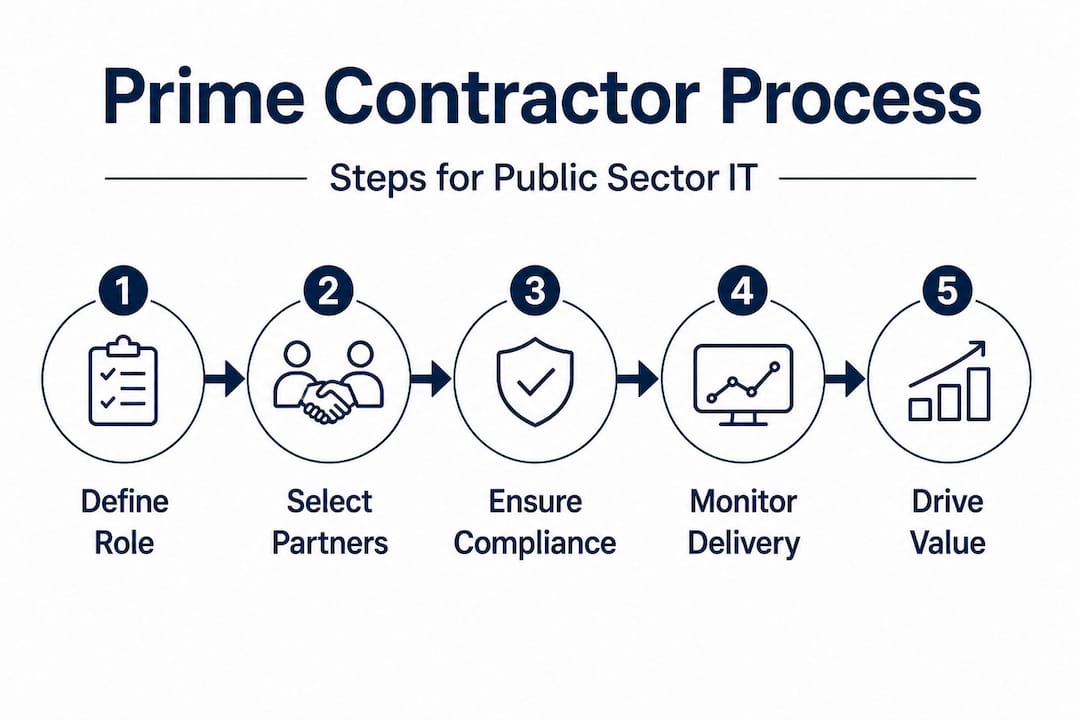
- What defines a prime contractor in public sector IT?
- Strategic partnership: Selecting specialized IT subcontractors
- Compliance essentials: FAR, audit risks, and subcontracting plans
- Best practices: Continuous monitoring and efficient project delivery
- Benefits and tradeoffs: Subcontracting, M&A, and growth for IT primes
- A fresh perspective on prime contracting partnerships
- Prime solutions: Your next steps in IT modernization partnerships
- Frequently asked questions
Key Takeaways
| Point | Details |
|---|---|
| Prime role clarity | Understanding your compliance and oversight responsibilities as a prime is essential for project and audit success. |
| Strategic IT partnerships | Selecting specialized subs at the right time fuels modernization while managing compliance risk. |
| Continuous compliance | Ongoing, proactive monitoring of subs is more effective than one-off reviews for avoiding costly penalties. |
| Growth and risk balance | M&A and subcontracting drive capability and performance but require thoughtful tradeoff management. |
What defines a prime contractor in public sector IT?
Now that we have framed the stakes, it is crucial to clarify the role of the prime contractor, especially in public sector IT modernization. The term gets used loosely, but the legal and operational definition carries serious weight.
A prime contractor is the entity that holds a direct contractual relationship with the government agency. Subcontractors work beneath the prime, executing portions of the scope. The prime, however, retains full accountability to the Contracting Officer (CO) and the agency. That accountability does not transfer downstream, no matter how capable the subcontractor is.
The Federal Acquisition Regulation (FAR) is the rulebook governing how federal contracts are structured, awarded, and performed. Within it, FAR 52.244-2 specifies when primes must obtain CO consent before executing subcontracts. Specifically, consent is required for cost-plus-fixed-fee subcontracts exceeding the simplified acquisition threshold or 5% of the prime contract value, and for all subcontracts when the prime lacks an approved purchasing system. Violating this requirement is not a paperwork issue; it can trigger payment withholds, contract modifications, or worse.
Core responsibilities exclusive to prime contractors include:
- Compliance oversight for all subcontractors on the program
- Subcontracting plan development and management
- Reporting through eSRS (Electronic Subcontracting Reporting System)
- Audit readiness documentation maintained across all tiers
- CPARS ratings that reflect subcontractor performance, not just prime delivery
For IT modernization projects specifically, these obligations intensify. Cloud migrations, cybersecurity implementations, and legacy system re-architecting involve technical complexity that makes oversight harder. Understanding prime contractor roles in this context is foundational before any teaming conversation begins. Primes that treat IT modernization like a standard services contract consistently encounter compliance friction they were not expecting.
Common hurdles include subcontractors with inadequate accounting systems, gaps in certified pricing data, and failure to meet small business participation targets. Each of these risks flows directly to the prime's record. Building a clear compliance framework before the first subcontract is executed is the most effective form of risk mitigation available.
Strategic partnership: Selecting specialized IT subcontractors
Once the foundation of the prime's role is clear, the next challenge is finding and vetting the right IT subcontractors. The sourcing process is more structured than many primes initially realize, and timing matters significantly.
Federal subcontracting opportunities for IT modernization typically peak between 30 and 90 days post-prime award. This is the window when scope is being finalized, teaming arrangements are solidifying, and the CO is watching to see whether the subcontracting plan reflects real commitments. Primes that enter this window unprepared often rush into agreements with subcontractors who have not been properly vetted.
Where do primes find qualified IT subs? Several channels are worth knowing:
- Prime supplier portals: Most large primes maintain formal supplier registration systems where subs can submit qualifications ahead of opportunities.
- SBA SubNet: The Small Business Administration's SubNet database is a public platform where primes post subcontracting opportunities and small businesses can respond.
- GSA partner databases and GWAC (Government-Wide Acquisition Contract) vendor lists: Vehicles like Alliant 2 or SEWP V carry pre-qualified vendors already familiar with federal compliance requirements.
- Industry events and OSDBU (Office of Small and Disadvantaged Business Utilization) matchmaking events: These generate warm relationships with subs before the pressure of a live opportunity.
"Finding a sub after award creates urgency that distorts evaluation. The primes with the strongest partnerships built them before the contract vehicle was activated."
A four-point framework for evaluating IT specialist subcontractors:
- Technical capabilities and certifications. Does the sub have demonstrable experience in the specific domain required, whether that is zero trust architecture, cloud migration, or DevSecOps? Certifications like FedRAMP authorization, CMMC (Cybersecurity Maturity Model Certification) compliance, or DoD cloud experience add verifiable credibility.
- Compliance profile. Does the sub maintain an adequate accounting system per DCAA (Defense Contract Audit Agency) standards? Have they been audited before? Are their billing rates and overhead structures transparent?
- Scalability and capacity. Can the sub handle the workload without introducing risk? A highly capable boutique firm with three engineers may be excellent for a scoped deliverable but problematic for a 12-month high-volume migration.
- Past performance. Has the sub performed on comparable government IT projects? Their CPARS record, if available, offers objective evidence. References from other primes carry significant weight.
Niche domains like zero trust security or AI-enabled analytics create additional layers of risk and reward. These areas command premium pricing and introduce compliance complexity that generalist subs simply cannot manage. Primes pursuing successful IT partnerships in these spaces benefit from subs that own clearly defined scopes rather than providing general staff augmentation.
Pro Tip: Before finalizing any subcontract in a regulated IT domain, request the sub's most recent DCAA pre-award survey or rate audit documentation. If they cannot produce it, that is a signal worth taking seriously before commitments are made.
Compliance essentials: FAR, audit risks, and subcontracting plans
With the right partners identified, the compliance journey becomes central and sometimes daunting. The regulatory framework governing subcontracts in federal IT is layered, and gaps in any layer create downstream risk.
Contracting Officer consent thresholds are the first gate. As noted under FAR 52.244-2, primes without an approved purchasing system must seek CO consent for every subcontract. Even primes with approved systems face consent requirements in specific scenarios.

| Subcontract type | Threshold for CO consent |
|---|---|
| Cost-plus-fixed-fee | Exceeds simplified acquisition threshold (~$250K) or 5% of prime value |
| Time and materials | Required if no approved purchasing system exists |
| Fixed-price (commercial) | Generally not required, exceptions apply |
| All subcontracts, no approved system | Consent required across the board |
Small business subcontracting plans are the second major compliance area. Federal regulations require primes on contracts exceeding $750K to develop and submit a small business subcontracting plan with specific participation goals. The government's overall target is 23% or more of subcontracted dollars flowing to small businesses. Subcategories include SDB (Small Disadvantaged Business), WOSB (Woman-Owned Small Business), HUBZone, and SDVOSB (Service-Disabled Veteran-Owned Small Business) targets.
Reporting is mandatory through eSRS. Primes that miss their small business goals face negative CPARS ratings. CPARS ratings follow your firm for years, directly affecting your ability to win future contracts. Missing eSRS deadlines or submitting inaccurate data is treated the same as missing the goals themselves.
DCAA audit trails add a third layer. Even on fixed-price subcontracts, the DCAA can examine whether pricing was accurate and compliant at award. Defective pricing claims can surface years after contract close. The audit infrastructure in federal IT contracting is more persistent than many primes account for.
Pro Tip: Assign a dedicated compliance lead whose only job is tracking subcontracting plan milestones, eSRS submissions, and CO consent documentation. Spreading this responsibility across a program management office creates accountability gaps.
Primes exploring flexible IT contracting models should build compliance checkpoints directly into their subcontract kickoff process, not as an afterthought at reporting time.
Best practices: Continuous monitoring and efficient project delivery
Ensuring all requirements are met is just the start. Ongoing oversight is where high-performing primes differentiate themselves from those who rely too heavily on pre-award screening.
Continuous monitoring through quarterly CPSR (Contractor Purchasing System Review) check-ins and provisional billing rate reviews prevents payment withholds that stem from subcontractor system deficiencies. A one-time pre-award survey tells you where a sub stood at a point in time. It says nothing about their current accounting system integrity, billing practices, or compliance posture six months into performance.
Key monitoring activities and their consequences if skipped:
| Monitoring activity | If skipped, risk includes |
|---|---|
| Quarterly CPSR review | Unapproved purchasing system, CO consent violations |
| Provisional rate checks | Overbilling disputes, DCAA findings |
| eSRS reporting verification | Negative CPARS, small business goal noncompliance |
| Certified cost data review | Defective pricing liability, post-award audits |
| Sub performance documentation | Weakened past performance evidence for future bids |
A critical and often underappreciated risk involves certified pricing data. DCAA audits trace through all tiers of the subcontract structure, and primes remain liable for defective certified data submitted by subcontractors, even when the prime had no knowledge of the error. This is not a theoretical risk; it is a documented enforcement pattern. Primes that rely on subcontractors to self-certify without conducting their own review are accepting liability they may not realize they hold.
Actionable steps for maintaining audit readiness throughout performance:
- Systemize compliance audits with a recurring calendar, not ad hoc reviews
- Assign a named compliance lead for each subcontract, not just for the program overall
- Use real-time dashboard tracking to monitor sub deliverable milestones and billing rates
- Conduct quarterly reviews of subcontractor accounting system status
- Maintain a master document repository for all CO consent records, eSRS filings, and rate documentation
- Build subcontract termination triggers into agreements for compliance failures
- Verify that subs update their SAM.gov registrations annually
Primes building strategic IT partnerships with high transparency, structured oversight, and real-time data visibility consistently produce better audit outcomes than those relying on manual spot-checks.
Benefits and tradeoffs: Subcontracting, M&A, and growth for IT primes
With best practices in place, prime contractors can maximize the benefits of strategic partnering while understanding the tradeoffs inherent in different models.
The federal IT services market is growing at a measurable rate. IT services revenue grew 9.3% year over year in Q3 2024, driven primarily by modernization priorities around AI, cloud, and cybersecurity. Primes are increasingly using both strategic subcontracting and M&A to fill capability gaps rather than building new competencies in-house.
Why specialized subcontracting and M&A deliver measurable value for IT primes:
- Speed to capability: Bringing in a sub with an existing FedRAMP-authorized cloud platform compresses delivery timelines by months compared to building internal capacity.
- Innovation without overhead: Niche subs often carry specialized tooling, accelerators, and frameworks that primes would otherwise need to develop and maintain.
- Small business goal fulfillment: Partnering with certified SDVOSB, WOSB, or SDB firms simultaneously advances mission and compliance objectives.
- Past performance accumulation: Subs that perform well contribute to the prime's CPARS narrative across multiple competency domains.
- Risk distribution: Clearly scoped subcontracts transfer technical execution risk to the entity with the deepest expertise in that domain.
Tradeoffs, however, are real. Subcontracting relationships built through vehicles like Alliant 2 or SEWP V can accelerate market entry for IT specialists, but they offer less direct control and often carry lower margins than direct prime pursuits. Primes that over-rely on subs for core competencies also risk weakening their own technical depth over time, which creates vulnerability in recompetes.
The optimal model treats specialized subs as extensions of the prime's capability for clearly bounded scopes, not as replacements for program management expertise. Primes that understand this distinction build more sustainable IT partnership strategies and avoid the dependency traps that erode margins and control.
A fresh perspective on prime contracting partnerships
The data and the regulations make one thing clear: compliance is non-negotiable. But there is a more nuanced dimension that the frameworks rarely capture.
The primes that consistently outperform their peers are not simply better at following the rules. They treat compliance infrastructure as a relationship asset. When a specialized sub knows that the prime maintains rigorous audit trails, communicates CO consent requirements clearly, and provides real-time performance visibility, it signals that this is a professional environment worth investing in. That signal attracts better subs, higher-quality technical contributors, and more transparent billing practices.
Conventional wisdom frames compliance as a cost center. The more accurate framing is that compliance readiness is a form of project insurance. An audit trail built during performance costs relatively little. An audit finding discovered after contract close can cost considerably more in legal exposure, rate adjustments, and reputational damage on CPARS.
Real-world IT partnership strategies that work over multiple contract cycles share one consistent characteristic: the prime invested in the subcontractor relationship as a long-term capability, not a transactional arrangement. That means proactive compliance support, shared dashboards, and honest performance conversations, not just contract administration.
The next frontier for prime contractors in public sector IT is not just execution. It is leading on efficiency, traceability, and innovation in ways that agencies can see, measure, and recompete. That requires partners who contribute to that visibility rather than creating opacity.
Prime solutions: Your next steps in IT modernization partnerships
If you are ready to capitalize on the advantages of expert partnerships, practical steps are within reach. Experienced, audit-ready subcontractors accelerate transformation, reduce compliance risk, and contribute measurable outcomes rather than just billable hours. Rutledge & Associates, LLC brings exactly this capability to prime contractors working on public sector IT modernization in Maryland, New York, and Florida. The firm is certified as SDVOSB, woman-owned, and SBA-certified, and owns clearly defined scopes in cloud re-architecting, DevOps pipelines, and compliance automation.
Explore how prime-ready IT partner solutions can fit into your current or upcoming program portfolio. To learn more about capabilities, past outcomes, and how teaming arrangements are structured, visit Rutledge & Associates directly. The path from compliance burden to competitive advantage starts with the right partnership.
Frequently asked questions
When do prime contractors need Contracting Officer consent for subcontracts?
Consent is required under FAR 52.244-2 for cost-plus-fixed-fee subcontracts above the simplified acquisition threshold or 5% of prime contract value, and for all subcontracts when the prime lacks an approved purchasing system.
What percentage of small business participation must primes aim for?
Federal primes must set goals targeting at least 23% small business participation, with mandatory reporting through eSRS on all contracts exceeding $750K.
How soon after award do most IT subcontractor opportunities emerge?
Opportunities typically peak 30 to 90 days after the prime contract award date, making pre-award sourcing preparation critical.
Are prime contractors liable for subcontractor pricing and data errors?
Yes. Primes remain fully liable for defective certified pricing data submitted by subcontractors, even without knowledge of the error, as DCAA audits trace through all contract tiers.
What is the advantage of continuous compliance monitoring over pre-award surveys?
Continuous monitoring through quarterly CPSR reviews and rate checks prevents payment withholds and identifies subcontractor system deficiencies before they become audit findings.