

Managed IT services are defined as ongoing, proactive outsourced IT management in which a third-party provider assumes full responsibility for an organization's infrastructure, security, and applications under performance-based contracts. This model, delivered by Managed Service Providers (MSPs), replaces reactive "break-fix" support with continuous monitoring, predictable subscription pricing, and strategic alignment with organizational goals. For government IT decision-makers, the managed services model offers a direct path to cost predictability, operational continuity, and access to specialized expertise without expanding internal headcount. Understanding what managed IT services include, how they work, and how to structure MSP agreements is the foundation for any serious modernization strategy.
What is managed IT services: core definition and scope
Managed IT services involve a third-party provider assuming ongoing, proactive responsibility for managing infrastructure, security, and applications under formal Service Level Agreements (SLAs). The MSP model shifts the operational burden from internal staff reacting to failures toward a structured, prevention-focused approach. This distinction matters significantly for government agencies, where system downtime can disrupt public services and trigger compliance violations.
The managed IT services definition covers a broad scope of technology functions. Rather than calling a vendor only when something breaks, agencies receive continuous management across their entire IT environment. The MSP becomes an accountable partner, not just a contractor on standby.

This model is also distinct from staff augmentation. An MSP owns a defined scope of outcomes, meaning the agency holds the provider to measurable performance standards rather than simply billing for hours worked.
What do managed IT services include?
The core components of a managed IT services engagement cover the full operational lifecycle of an agency's technology environment. Core managed services components include network management, cybersecurity incident response, help desk support, and cloud environment orchestration managed 24/7 via Remote Monitoring and Management (RMM) software.
The typical service catalog includes:
- Remote Monitoring and Management (RMM): Continuous surveillance of networks, servers, and endpoints to detect anomalies before they become outages.
- Help Desk and End-User Support: Tiered support for agency staff, resolving technical issues without burdening internal IT teams.
- Cybersecurity Management: Threat detection, vulnerability scanning, incident response, and access control enforcement aligned with frameworks like NIST SP 800-53.
- Cloud Services Management: Provisioning, optimization, and governance of cloud and hybrid environments, including platforms like Microsoft Azure and AWS GovCloud.
- Patch Management: Automated deployment of software updates and security patches to reduce exposure windows.
- Data Backup and Disaster Recovery: Scheduled backups, tested recovery procedures, and documented business continuity plans.
- IT Consulting and Strategic Planning: Alignment of technology investments with agency mission objectives and long-term modernization roadmaps.
Managed services create structure across IT complexity through continuous monitoring, standardized configurations, enforced access controls, automated updates, and security monitoring. For government agencies managing legacy systems alongside newer platforms, this structured approach reduces the risk of configuration drift and unpatched vulnerabilities.
Pro Tip: When evaluating MSPs, request a sample RMM dashboard report. The quality and specificity of that report reveals whether the provider monitors proactively or simply responds to alerts after the fact.
How do managed IT services improve cost efficiency vs. traditional IT?
The financial case for managed IT services rests on a straightforward comparison. Traditional IT support, often called the break-fix model, generates unpredictable costs. Agencies pay for emergency repairs, unplanned downtime, and the full salary burden of specialized staff they may only need periodically.
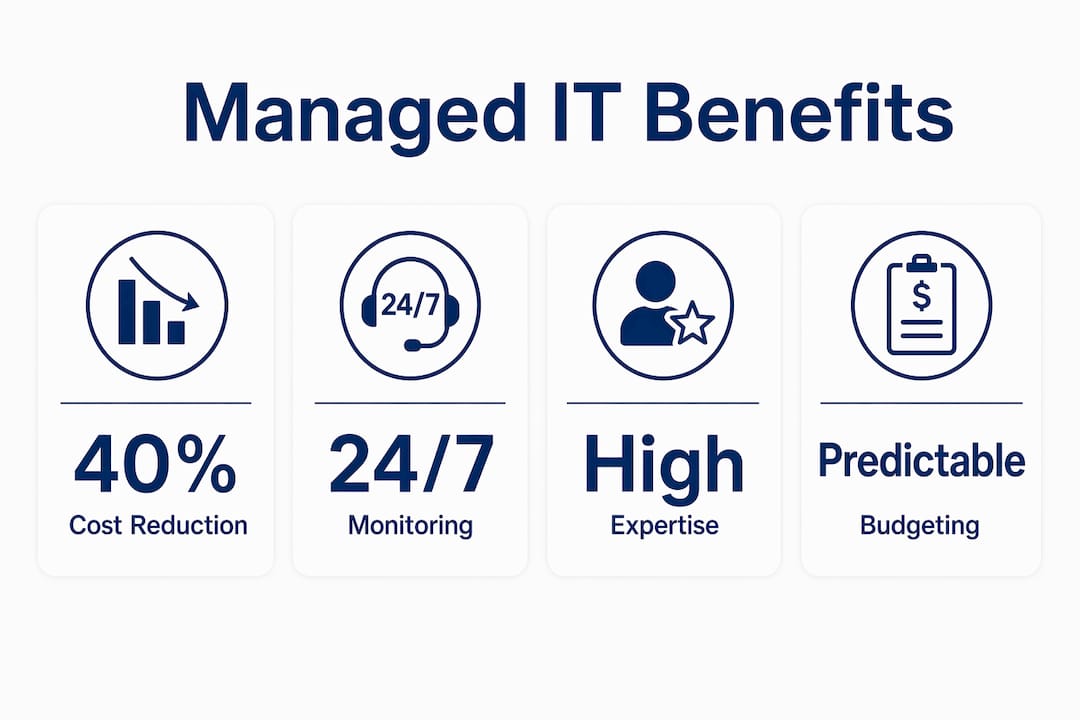
Managed IT services can reduce overall operational IT costs by up to 40% by eliminating downtime and providing predictable monthly subscription pricing. That reduction reflects both direct savings on emergency labor and indirect savings from avoided service disruptions.
The table below compares the two models across the dimensions most relevant to government IT managers:
| Dimension | Traditional Break-Fix IT | Managed IT Services |
|---|---|---|
| Cost structure | Variable, reactive, unpredictable | Fixed monthly subscription |
| Response model | Reactive after failure | Proactive, 24/7 monitoring |
| Expertise access | Limited to internal staff | Broad specialist team on contract |
| Downtime risk | High, unplanned outages common | Reduced through continuous monitoring |
| Budget planning | Difficult, subject to emergency spikes | Predictable, facilitates long-term planning |
| Compliance support | Ad hoc | Structured, audit-ready documentation |
Proactive management also reduces the frequency of costly emergency repairs. Proactive management reduces downtime and unpredictable costs compared to reactive break-fix support. For agencies operating under tight fiscal cycles, the ability to forecast IT expenditures with precision is a material operational advantage.
Access to specialized expertise is another financial lever. Hiring a full-time cybersecurity analyst, cloud architect, and network engineer internally carries significant overhead. An MSP provides all three skill sets within a single contract.
Pro Tip: Define cost-per-incident benchmarks in your current environment before negotiating an MSP contract. That baseline gives you a concrete measure of ROI within the first year of the engagement.
How are managed IT services agreements structured?
The contractual framework governing an MSP relationship determines whether the engagement delivers strategic value or simply replicates reactive support under a new label. An MSP operates as a structured extension of the customer's business with ongoing responsibility and accountability under formal contracts, with SLAs defining key metrics such as uptime, response times, and compliance.
Effective MSP agreements for government agencies typically follow this structure:
- Scope Definition: Clearly enumerate every system, application, and service the MSP will manage. Ambiguity in scope is the primary source of disputes and service gaps.
- SLA Development: Specify measurable performance standards. Examples include 99.9% network uptime, two-hour response times for critical incidents, and monthly patch compliance rates above 95%.
- Onboarding and Ramp-Up: MSP implementations typically take 2–6 weeks to reach full operational capacity, depending on legacy systems and network maturity. This phase includes audit-ready documentation and deployment of monitoring tools.
- Reporting Cadence: Establish monthly or quarterly business reviews with defined metrics. Transparent reporting is what separates a genuine partnership from a vendor relationship.
- Compliance Alignment: Government-specific requirements, including FedRAMP authorization, FISMA compliance, and state-level data protection mandates, must be explicitly addressed in the contract.
Failure to define clear, outcome-based SLAs is the largest pitfall, risking reactive support instead of strategic partnership. Vague language like "timely response" or "best efforts" creates accountability gaps that surface during audits or service failures.
For guidance on structuring these agreements in a public sector context, the government IT teaming agreements guide from Primereadysub provides a practical framework for primes and agency IT managers alike.
Pro Tip: Include a quarterly SLA review clause in every MSP contract. Technology environments change, and SLAs that were accurate at signing can become misaligned within 12 months.
How do managed IT services support government modernization and security?
The role of managed services in government modernization extends well beyond keeping the lights on. MSPs provide the technical depth and continuous operational capacity that most agency IT teams cannot sustain internally, particularly when managing the transition from legacy systems to cloud-native architectures.
MSPs support cloud and hybrid environments through continuous management and optimization, aiding government agencies' modernization and compliance requirements, with security management integrated with regular patching and proactive threat detection. This integration is critical for agencies pursuing FedRAMP-authorized cloud migrations or implementing zero-trust security architectures.
Key modernization and security contributions from MSP partnerships include:
- Hybrid Infrastructure Management: MSPs govern both on-premises systems and cloud platforms simultaneously, reducing the risk of security gaps during phased migrations.
- Continuous Compliance Monitoring: Automated compliance checks against NIST, FISMA, and CMMC frameworks generate audit-ready documentation in real time.
- Threat Detection and Response: 24/7 security operations center (SOC) capabilities provide government agencies with enterprise-grade threat intelligence without building an internal SOC.
- Strategic IT Roadmapping: MSPs align technology investments with agency mission priorities, translating modernization mandates into executable project plans.
- Internal Team Enablement: By absorbing routine operational tasks, MSPs free internal IT staff to focus on policy, governance, and mission-critical program delivery.
Managed services should be viewed as a formal partnership where MSPs share accountability for business outcomes, acting as an extension of internal teams and freeing agency leadership to focus on mission-critical goals. For state and federal agencies under pressure to modernize within constrained budgets, this partnership model is a practical mechanism for accelerating digital transformation without proportional increases in headcount or capital expenditure.
Primereadysub's work with state agencies in Maryland, New York, and Florida demonstrates how strategic IT partnerships translate managed services into measurable outcomes, including reduced processing times, real-time program visibility, and improved audit readiness.
Key takeaways
Managed IT services deliver the greatest value when agencies treat MSP relationships as formal accountability partnerships governed by outcome-based SLAs, not as vendor contracts for on-demand technical labor.
| Point | Details |
|---|---|
| Core definition | Managed IT services are proactive, outsourced IT management under performance-based contracts with a third-party MSP. |
| Cost advantage | Subscription pricing can reduce operational IT costs by up to 40% compared to reactive break-fix models. |
| SLA specificity | Vague SLAs are the leading cause of MSP engagement failures; define uptime, response times, and compliance metrics explicitly. |
| Onboarding timeline | Full operational capacity typically requires 2–6 weeks, with legacy system complexity as the primary variable. |
| Modernization value | MSPs enable cloud migration, continuous compliance monitoring, and real-time threat detection without expanding internal headcount. |
The partnership model is what actually determines outcomes
Most articles on managed IT services focus on the service catalog. That framing misses the more important question: how is the relationship governed?
In my experience working with public sector IT environments, the agencies that extract the most value from MSP engagements are not the ones with the longest service lists. They are the ones that invested time upfront in defining what success looks like, in measurable terms, before the contract was signed. An MSP that monitors your network 24/7 but reports to no one accountable is not a partner. It is a vendor with a dashboard.
The shift toward hybrid cloud environments is accelerating this dynamic. As agencies move workloads to platforms like Azure Government or AWS GovCloud, the operational complexity of managing security, compliance, and performance across distributed environments exceeds what most internal teams can handle alone. MSPs that specialize in government environments bring not just technical capacity but institutional knowledge of frameworks like FedRAMP and FISMA that takes years to develop internally.
The agencies I have seen struggle with MSP engagements share one common pattern: they treated the contract as the endpoint rather than the starting point. The contract defines the floor. The ongoing governance cadence, the monthly reviews, the SLA refinements, those define the ceiling. If you want to explore public sector IT partnership best practices, the operational lessons there apply directly to structuring MSP relationships that hold up under audit pressure.
— Randy
How Primereadysub supports government IT modernization
Primereadysub, operating as Rutledge & Associates, LLC, delivers outcomes-driven IT modernization for state and federal agencies across Maryland, New York, and Florida. As an SDVOSB, woman-owned, and SBA-certified firm, Primereadysub specializes in cloud-native re-architecting, compliance automation, DevOps pipelines, and real-time program dashboards built for audit-ready government environments. The firm owns clearly defined scopes rather than providing staff augmentation, which means prime contractors and agency IT managers get high-value delivery with minimal oversight burden. If your agency is evaluating managed IT services as part of a modernization strategy, explore Primereadysub's public sector offerings to see how outcome-focused IT management translates into measurable operational improvements.
FAQ
What is the managed IT services definition?
Managed IT services are ongoing, proactive IT management delivered by a third-party MSP under performance-based contracts that cover infrastructure, security, applications, and support. The model replaces reactive break-fix support with continuous monitoring and strategic alignment.
How do managed IT services work in government agencies?
An MSP assumes defined responsibility for managing an agency's IT environment, deploying RMM tools, providing 24/7 monitoring, and reporting against SLAs that specify uptime, response times, and compliance metrics. Onboarding typically takes 2–6 weeks depending on legacy system complexity.
What are the main benefits of managed IT services?
The primary benefits include up to 40% reduction in operational IT costs, predictable monthly budgeting, access to specialized expertise, continuous cybersecurity monitoring, and audit-ready compliance documentation. These advantages are particularly significant for budget-constrained government agencies.
What is the role of slas in managed IT services?
SLAs define the measurable performance standards that govern the MSP relationship, including uptime guarantees, incident response times, and compliance reporting frequencies. Outcome-based SLAs are the single most important factor in determining whether an MSP engagement delivers strategic value or defaults to reactive support.
How do managed IT services support IT modernization?
MSPs enable government agencies to adopt cloud and hybrid infrastructures, maintain continuous compliance with frameworks like FISMA and FedRAMP, and free internal teams to focus on mission-critical priorities rather than routine operational tasks.