

Many contract managers assume a teaming agreement is essentially a binding contract. That assumption has cost teams significant opportunities, and in some cases, it has triggered disputes that delayed or derailed federal IT pursuits entirely. Teaming agreements are pre-award instruments with specific legal characteristics, limitations, and compliance requirements that differ substantially from subcontracts or joint ventures. This guide explains exactly what teaming agreements are, how they compare to other partnership structures, what makes them enforceable, and how to apply that knowledge to complex, compliance-driven IT modernization programs in the public sector.
Table of Contents
- What is a teaming agreement?
- Teaming agreements vs. subcontracts and joint ventures
- Essential elements for enforceability and compliance
- Risks, enforceability, and real-world disputes
- Special cases: Small business, MAS CTAs, and compliance carve-outs
- A practitioner's take: What teaming agreements get wrong (and right) in practice-in-practice)
- Partner confidently for your next government IT contract
- Frequently asked questions
Key Takeaways
| Point | Details |
|---|---|
| Pre-award framework | A teaming agreement sets out how primes and subs intend to collaborate on a government contract pursuit before any award is made. |
| Not a contract yet | Teaming agreements are not binding subcontracts—specific, definite terms are needed for enforceability. |
| Choose right structure | Understand if you need a teaming agreement, subcontract, joint venture, or MAS CTA before pursuing government IT work. |
| Compliance is key | Effective teaming agreements address essential IT compliance areas like CUI and CMMC flowdown requirements. |
| Pitfalls and protections | Avoid vague or late-drafted arrangements and ensure all critical performance, exclusivity, and dispute clauses are included. |
What is a teaming agreement?
A teaming agreement is not a contract to perform work. It is an agreement to pursue work together. That distinction matters enormously in government IT, where roles, workshares, and compliance obligations must be clearly established long before a contract is awarded.
A teaming agreement is a pre-award arrangement between a prime contractor and one or more subcontractors to jointly pursue a specific government contract opportunity, outlining roles, responsibilities, and intent to negotiate a subcontract if awarded. The operative phrase is "intent to negotiate." The agreement signals commitment and outlines structure, but it does not obligate either party to perform work unless a contract is actually awarded and a subcontract is subsequently executed.
Primes use teaming agreements to assemble the capabilities needed to win large, complex solicitations. In IT modernization, this often means pairing a large integrator's contracting relationships with a specialty firm's expertise in areas like cloud-native architecture, compliance automation, or real-time data systems. Subs use them to secure a position in the competition and document their expected contribution.
Several myths circulate around teaming agreements that are worth addressing directly:
- Myth: A teaming agreement is a binding subcontract. It is not. It is a pre-award statement of intent.
- Myth: The government is a party to the teaming agreement. The government is not. It is an arrangement between private parties.
- Myth: A teaming agreement guarantees a subcontract if the prime wins. Without enforceable exclusivity terms, that guarantee does not exist.
- Myth: Joint ventures and teaming agreements are interchangeable. They are structurally different, as explained in the next section.
On the regulatory side, FAR Subpart 9.6 authorizes contractor team arrangements, including teaming agreements where a potential prime agrees with prospective subcontractors. The government recognizes their integrity if disclosed in offers, but holds the prime fully responsible for performance. The prime cannot use a teaming agreement to shift accountability to a subcontractor in the eyes of the contracting officer.
Understanding these fundamentals is especially important for primes pursuing IT modernization partnerships in compliance-heavy environments where misaligned expectations early in the process create significant downstream risk.
Teaming agreements vs. subcontracts and joint ventures
These three structures serve different purposes and carry different legal implications. Mixing them up, or using the wrong one for a given opportunity, creates compliance problems and potential disputes.
Teaming agreements differ from subcontracts in a fundamental way: a teaming agreement documents pre-award intent, while a subcontract is a post-award binding performance obligation. A subcontract specifies deliverables, payment, timelines, and performance standards. A teaming agreement specifies anticipated roles and planned workshares, but does not bind either party to perform until a subcontract is negotiated and signed after award.
Joint ventures (JVs) take this further by forming a new legal entity that pursues the contract. In a teaming arrangement, no new entity is created. The prime-sub hierarchy is preserved, and each party retains its own legal identity. This distinction matters significantly for small business program eligibility and affiliation analysis.

For teams operating under the GSA Multiple Award Schedule (MAS), there is a fourth structure worth knowing. GSA MAS Contractor Team Arrangements (CTAs) allow multiple schedule holders to team on orders, with each potentially invoicing the government directly, unlike traditional prime-sub arrangements where only the prime invoices. This mechanism offers more financial autonomy to team members and is specifically suited to schedule-based opportunities.
| Structure | Timing | New entity? | Who invoices? | Government accountability |
|---|---|---|---|---|
| Teaming agreement | Pre-award | No | Prime only | Prime |
| Subcontract | Post-award | No | Prime only | Prime |
| Joint venture | Pre-award | Yes (new entity) | JV entity | JV entity |
| GSA MAS CTA | Pre-award/order | No | Each member | Each member |
This table reflects the four core structures teams use when exploring partnering models in public sector IT. The right choice depends on the vehicle, the opportunity size, and the small business program requirements at play.
Pro Tip: Before drafting any agreement, verify which vehicle the opportunity will be awarded through. A MAS-based pursuit may benefit more from a CTA than a traditional teaming agreement, and getting that decision wrong early affects invoicing, accountability, and compliance obligations for the entire team.
You can also review available MAS CTAs for IT modernization to understand how these structures are applied in state and federal agency pursuits.
Essential elements for enforceability and compliance
A teaming agreement that lacks definite terms is, in legal terms, often just an "agreement to agree." Courts have consistently found that vague language around scope, price, and workshare makes these documents unenforceable. In the government IT context, that vagueness also creates compliance exposure, particularly around controlled unclassified information (CUI) and cybersecurity requirements.
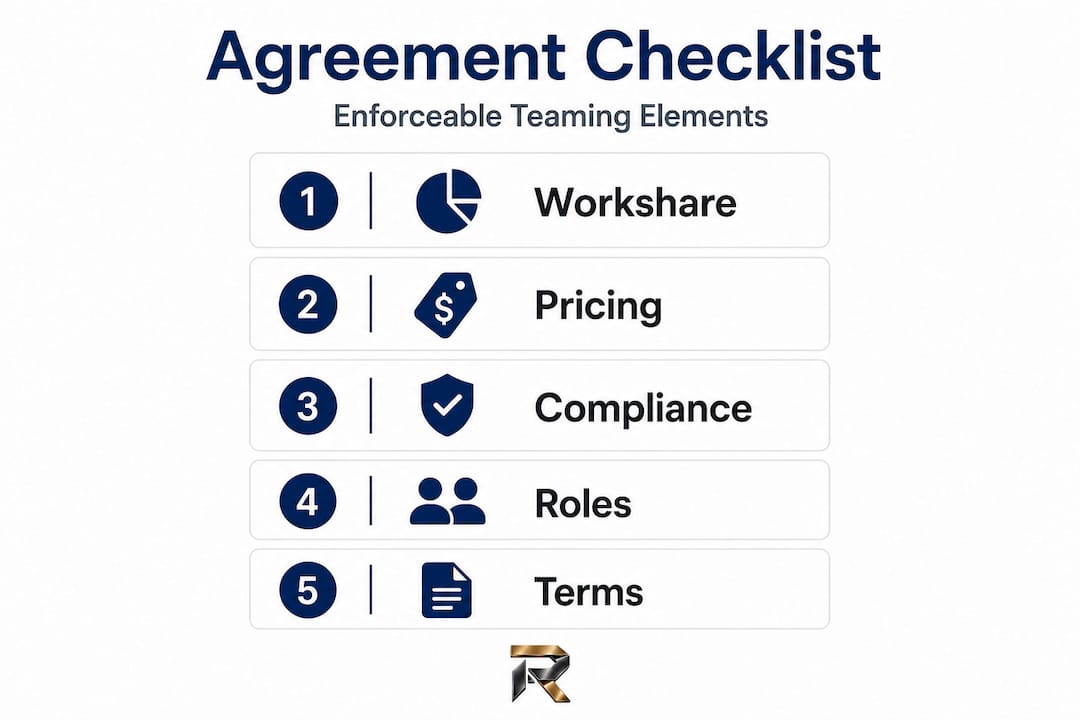
To enhance enforceability, include definite material terms such as specific workshare percentages, pricing methodology, and clearly defined scope. Language that says only "the parties will negotiate in good faith" is frequently insufficient to hold up in court. Narrowing exclusivity provisions also matters, since overbroad exclusivity language can raise antitrust concerns.
For IT modernization work, two compliance areas deserve explicit treatment in the teaming agreement itself: CUI handling and CMMC (Cybersecurity Maturity Model Certification) requirements. These should appear as flowdown clauses, meaning the sub acknowledges the same compliance obligations as the prime. Omitting them creates a situation where the prime has legal exposure that the sub is not contractually bound to share.
Five must-have elements for an enforceable teaming agreement:
- Defined workshare percentages. Specify what percentage of the contract value each party is expected to perform. "Significant work" is too vague.
- Pricing methodology. Agree on how pricing will be structured, whether cost-plus, fixed-price, or time-and-materials, before the proposal is submitted.
- Scope definition. Identify the specific work areas, task orders, or technical domains each party will cover.
- Exclusivity terms. If exclusivity is included, define its boundaries and duration. Overbroad exclusivity can create legal risk.
- Compliance flowdowns. Address CUI, CMMC, and any other regulatory requirements relevant to the specific program.
The table below illustrates the difference between definite and indefinite clause language:
| Clause type | Indefinite (weak) | Definite (strong) |
|---|---|---|
| Workshare | "Sub will perform a meaningful portion of work" | "Sub will perform 35% of total contract value" |
| Pricing | "Parties will agree on pricing prior to award" | "Pricing will follow a firm-fixed-price structure per the RFP" |
| Scope | "Sub will support IT-related tasks" | "Sub is responsible for cloud migration and DevOps pipeline implementation" |
| Compliance | "Sub will follow applicable regulations" | "Sub will comply with CMMC Level 2 and CUI handling per NIST SP 800-171" |
While sources emphasize the strategic importance of structured teaming, quantified benchmarks on success rates are sparse. What is well documented is the pattern of disputes arising from vague language, which reinforces why specificity matters at the drafting stage. Review multi-partner IT teaming best practices for further guidance on managing complexity across large team structures.
Pro Tip: Always consult legal counsel on enforceability before finalizing a teaming agreement. State courts vary significantly in how they interpret these documents, and a clause that holds up in Virginia may not be enforceable under Maryland or New York law.
Risks, enforceability, and real-world disputes
Teaming agreements fail in court more often than practitioners expect. Understanding where enforcement has succeeded and where it has not shapes better drafting decisions.
Enforceability varies by jurisdiction and courts often classify teaming agreements as "agreements to agree" if they lack definite terms such as specific price or scope. The Cyberlock v. Information Experts case is frequently cited here. The court declined to enforce the teaming agreement precisely because it lacked definite terms and required further negotiation to become operational. The agreement looked complete on its surface but did not meet the threshold for a binding contract.
In contrast, exclusivity breaches can yield significant damages, as illustrated in X Tech v. Geotest, where $336,000 was awarded to the aggrieved sub after the prime violated a clear exclusivity provision. The difference in outcome between these two cases comes down to clause specificity.
"Courts have shown they will enforce teaming agreement exclusivity provisions when those terms are clearly and specifically drafted, but they will not rescue vague 'agreements to agree' by reading in obligations the parties never articulated."
Key risks for each party differ in important ways:
Risks for prime contractors:
- Full government accountability regardless of sub performance
- Exposure to damages for exclusivity violations
- Compliance liability if flowdown clauses were not included
Risks for subcontractors:
- Being replaced post-award if exclusivity is not clearly documented
- Performing proposal work without guarantee of a subcontract
- Accepting compliance obligations without adequate flowdown clarity
The "bait and switch" dynamic in teaming is a real pattern, where a sub contributes technical content and past performance to a winning proposal, then finds itself edged out post-award. Strong exclusivity language combined with defined workshares is the primary protection against this. Understanding the prime and sub roles in risk is essential for both sides before drafting begins.
Special cases: Small business, MAS CTAs, and compliance carve-outs
Small business teaming arrangements carry their own regulatory logic. Getting this wrong can trigger affiliation findings that disqualify a company from set-aside eligibility.
Small Business Teaming Arrangements (SBTAs) are exempt from affiliation if properly documented with defined roles and workshares. If the teaming arrangement functions more like a joint venture and roles are blended or indistinct, an affiliation determination becomes a real risk. For mentor-protege joint ventures, the protege must perform at least 40% of the work in certain program structures, a requirement that must be explicitly reflected in the agreement documentation.
GSA MAS CTAs operate differently from traditional teaming in a way that affects how each party contributes and gets paid. Each schedule holder in a CTA can invoice the government directly, which changes the financial dynamic compared to a standard prime-sub arrangement where the prime manages all invoicing. This structure suits IT teams where each partner owns a distinct, separately deliverable scope.
Compliance carve-outs for IT providers should address the following areas at minimum:
- CUI handling: Confirm which party is responsible for CUI under NIST SP 800-171 and how data transfer between team members will be managed
- CMMC requirements: Define what CMMC level the sub must achieve and by what deadline
- Data sovereignty: Specify where data will be stored and processed, particularly for cloud environments
- Incident reporting: Assign responsibility for reporting security incidents within required timeframes
- Third-party audit readiness: Confirm which team members must maintain documentation for compliance reviews
These carve-outs protect both parties and are increasingly expected by contracting officers in IT-intensive awards. Review strategies for IT teaming success and contract-ready teaming for primes for implementation-level guidance.
A practitioner's take: What teaming agreements get wrong (and right) in practice
Most teaming agreements in government IT fail for a simple reason: they are drafted too late and too loosely for the compliance realities of the programs they are meant to support. Contract managers often treat the teaming agreement as an administrative checkpoint rather than a foundational document that shapes how a program will actually run.
CUI and CMMC flowdowns are the most consistently overlooked areas. Prime contractors frequently negotiate these compliance obligations into their prime contract but fail to push them downstream into the teaming agreement. By the time a subcontract is being negotiated post-award, the sub may push back on terms they were never briefed on during the pursuit phase. That friction delays program start and creates legal ambiguity at exactly the moment when execution should begin.
Small subs are particularly exposed to post-award displacement when exclusivity terms are vague or absent. A sub that contributes meaningful technical differentiation to a winning proposal deserves enforceable protections. The work to build those protections in is done during teaming agreement drafting, not after award.
The other consistent failure is the absence of escalation mechanisms. Most agreements say parties will negotiate in good faith, but few specify what happens when good faith negotiations break down. Baking in a tiered escalation process, from technical leads to executives to defined dispute resolution, is not a sign of distrust. It is a sign of operational maturity.
When both parties enter a teaming arrangement with clearly documented performance expectations, well-defined compliance obligations, and specific workshares, the agreement stops being a legal formality and becomes a genuine competitive tool. Teams that get this right submit stronger proposals, execute more smoothly post-award, and build the kind of track record that attracts future partnership opportunities. For contract-ready partnership insights that go beyond basic templates, that foundation starts at the teaming stage.
Partner confidently for your next government IT contract
At Rutledge & Associates, LLC, structuring compliant, outcome-oriented teaming arrangements is a core part of how we engage with prime contractors pursuing government IT modernization work. As an SDVOSB, woman-owned, and SBA-certified firm, we bring defined scope ownership, not staff augmentation, to every partnership. Whether you are building a team for a state agency modernization effort or a federal compliance program, our IT modernization partner for primes services are designed to reduce overhead and increase technical credibility from proposal through performance. Explore how our work in Maryland public sector IT and beyond can strengthen your next pursuit.
Frequently asked questions
Is a teaming agreement legally binding in government contracts?
A teaming agreement is generally not fully binding unless it contains specific, definite terms. Courts often classify vague agreements as unenforceable "agreements to agree," though exclusivity clauses with clear language have been enforced and have resulted in damages awards.
How do you make a teaming agreement enforceable?
Enforceability improves significantly when the agreement includes specific workshare percentages, pricing methodology, and clearly defined scope rather than open-ended "good faith" language. Narrowing exclusivity provisions also reduces antitrust exposure while strengthening enforceability.
What's the difference between a teaming agreement and a subcontract in IT government contracting?
A teaming agreement documents pre-award intent to collaborate, while a subcontract is a binding post-award performance agreement. The teaming agreement sets the stage; the subcontract governs actual execution.
Are small business teaming arrangements treated differently?
Yes. Proper documentation can exempt SBTAs from affiliation findings, but roles and workshares must be clearly defined. In certain mentor-protege joint ventures, the protege is required to perform at least 40% of the contracted work.
Do all team members in a Contractor Team Arrangement (CTA) invoice the government separately?
In a GSA MAS CTA, each schedule holder can invoice the government directly, which is a key difference from traditional prime-sub teaming arrangements where only the prime invoices.