

Most contracting officers assume that a subcontractor with a solid cybersecurity posture and an active SAM.gov registration is ready to perform on a government IT modernization contract. That assumption misses the mark in ways that can delay awards, expose primes to compliance risk, and invite corrective action from agency oversight offices. Contract-ready status is grounded in a formal, affirmative government determination rooted in federal contractor requirements that span financial stability, past performance, ethics, and technical capability, not security frameworks alone.
Table of Contents
- What does contract-ready mean in government IT contracting?
- Key criteria: Responsibility standards and compliance checks
- State agency variations: Contract-ready nuances and edge cases
- Cybersecurity and compliance: IT modernization in contract-ready determination
- A fresh perspective: What most guides miss about contract-ready status
- Partner with a contract-ready IT modernization expert
- Frequently asked questions
Key Takeaways
| Point | Details |
|---|---|
| Responsibility is holistic | Contract-ready status includes financial, performance, ethics, and technical standards—not just IT compliance. |
| Federal and state variations | State rules often add extra requirements beyond federal responsibility standards, so always check local agency guidelines. |
| Prime and subcontractor checks | Both primes and key subcontractors must meet responsibility criteria, with roles for government and prime evaluations. |
| Compliance frameworks matter | Cybersecurity and compliance automation are critical for IT modernization but are only part of the contract-ready equation. |
| Use official records | CPARS, FAPIIS, and SPRS are trusted government sources for evaluating contractor responsibility. |
What does contract-ready mean in government IT contracting?
The phrase "contract-ready" carries real legal weight in the federal acquisition space. It does not simply mean a vendor has no outstanding SAM issues or holds a current cybersecurity certification. Under FAR 9.104-1, contract-ready status refers to the formal determination that a prospective contractor is responsible, meaning the government has affirmatively verified that the firm meets defined standards across multiple performance dimensions before any award is made.
That determination must be made for both prime contractors and key subcontractors. Under FAR 44.2 and DFARS 209.104-4, primes bear initial responsibility for evaluating their subcontractors, but the government retains authority to make its own responsibility determinations when it sees fit. A contracting officer cannot simply accept a prime's word that a given subcontractor is qualified. The process requires documented evidence.
"Responsibility is holistic, covering financial capacity, technical ability, performance history, and ethical standards. It is not a single-point compliance check."
The contract-ready partnership guide elaborates on what this means in practice for primes selecting IT subcontractors on public-sector programs. The table below shows how the FAR's responsibility criteria map to real evaluation categories.
| FAR 9.104-1 criterion | Practical evaluation area |
|---|---|
| Adequate financial resources | Liquidity, bonding capacity, revenue history |
| Ability to comply with delivery schedules | Past project timelines, staffing plans |
| Satisfactory performance record | CPARS ratings, reference checks |
| Satisfactory record of integrity/ethics | FAPIIS entries, debarment/suspension status |
| Necessary technical skills | Certifications, labor categories, tooling |
| Necessary production/technical equipment | Infrastructure, cloud environment readiness |
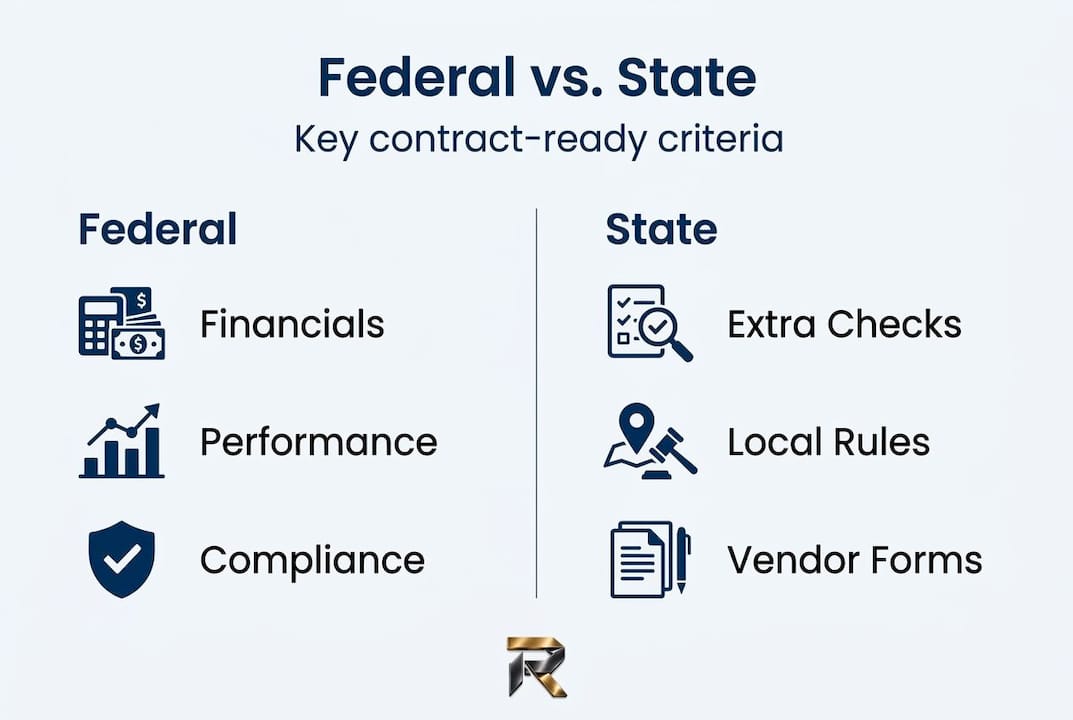
Now that we've redefined contract-ready status, let's break down the government standards underpinning it.
Key criteria: Responsibility standards and compliance checks
With the source of contract-ready standards clear, we can now break down the key criteria contracting officers actually use in evaluations.
The FAR and DFARS establish a layered set of responsibility standards that apply to every significant subcontract on a government program. For IT modernization work specifically, primes must verify that subcontractors meet general responsibility standards before issuing a subcontract, and the government may require its consent for certain subcontracts under FAR 44.2.
For large prime contractors, the government's Contractor Purchasing System Review (CPSR) process goes further. Under FAR Part 44, a CPSR assesses whether the prime's entire subcontracting system, including how it evaluates and monitors subs, meets government standards. A failing CPSR can halt contract awards and trigger remediation requirements that cost months of delay.
Key compliance frameworks for IT subcontractors:
- CMMC (Cybersecurity Maturity Model Certification): Required for defense contracts involving Controlled Unclassified Information. Level 2 requires a third-party assessment.
- FedRAMP: Mandatory for cloud services used by federal agencies. Subcontractors offering cloud solutions must confirm authorization status.
- SPRS (Supplier Performance Risk System): DoD uses SPRS scores to assess cybersecurity posture before award. A current, defensible score is non-negotiable for DoD IT work.
- CPARS (Contractor Performance Assessment Reporting System): Past performance ratings that contracting officers review as part of responsibility determination.
- FAPIIS (Federal Awardee Performance and Integrity Information System): Centralized repository of contractor integrity and performance information, including terminations, administrative agreements, and criminal offenses.
Standard responsibility checks contracting officers apply:
- Verified active SAM.gov registration with no exclusions
- Current tax compliance status, including IRS certification for Treasury-related contracts
- No foreign ownership, control, or influence issues that could affect security clearances
- Acceptable past performance ratings in CPARS for similar scope and scale
- No adverse entries in FAPIIS within the lookback period
- Evidence of adequate staffing and technical capability for the proposed work
Pro Tip: Before presenting a subcontractor to a government contracting officer, run the firm through CPARS, FAPIIS, and SPRS yourself. Document what you find. If a contracting officer later asks for responsibility evidence, you want a paper trail that shows a methodical process, not a rushed review.
The table below compares the primary compliance frameworks and their specific application areas.
| Framework | Applies to | Key requirement | Verified by |
|---|---|---|---|
| CMMC Level 2 | DoD CUI contracts | Third-party assessment | C3PAO |
| FedRAMP | Federal cloud services | Agency authorization | JAB or agency |
| SPRS | DoD IT subcontractors | Self-assessment score | Contracting officer check |
| CPARS | All federal contractors | Past performance ratings | Government PMs |
| FAPIIS | All federal contractors | Integrity and misconduct records | Contracting officer review |
The prime contractor guide outlines how primes should structure their subcontractor vetting process to align with these frameworks, and IT modernization partnerships offers additional context on how technical capability assessments feed into responsibility determinations.
State agency variations: Contract-ready nuances and edge cases
Federal criteria are the bedrock, but state agencies add further nuances and exceptions that matter for contract readiness.
State procurement rules diverge from federal standards in meaningful ways, and contracting officers working on state IT programs must account for those differences when evaluating subcontractors. California's State Contracting Manual limits subcontracting unless the prime provides documented justification and receives agency approval. It also requires competitive selection for subcontractors, meaning a prime cannot simply sole-source a preferred IT vendor without going through a documented selection process.
New York takes a different approach. State agencies require a Vendor Responsibility Questionnaire for subcontractors on contracts valued above $100,000. That questionnaire covers financial history, legal proceedings, tax compliance, and past contract performance. It is a structured, formal document, not a casual reference check.
Typical approval steps for a state IT subcontract (example sequence):
- Prime submits subcontractor identification to the state agency, including scope, value, and qualifications.
- State reviews subcontractor's responsibility questionnaire and verifies SAM or state equivalent registration.
- Agency confirms competitive selection documentation or approves sole-source justification.
- State reviews and provides written consent or conditional approval before work begins.
- Prime monitors subcontractor performance and reports to state agency at defined intervals.
- State may conduct its own review or site visit for contracts above certain thresholds.
Several important edge cases apply in both state and federal contexts. The flexible contracting guide covers how to navigate these scenarios when programs involve hybrid funding or cross-jurisdictional requirements.
Key edge cases to know:
- Conditional CMMC compliance: For DoD programs, a subcontractor may receive conditional approval with a minimum CMMC score of 80%, provided they close out all open Plan of Action and Milestones items within 180 days.
- Small business Certificate of Competency (COC): If a contracting officer determines a small business subcontractor is non-responsible, the small business can appeal to the SBA for a COC, which overrides the non-responsibility finding.
- Foreign ownership restrictions: Subcontractors with significant foreign ownership may face disqualification on classified or sensitive IT programs regardless of cybersecurity certification status.
- No award without current SPRS/CMMC status: For DoD IT contracts, the government will not proceed without a current, verified SPRS score and, where required, CMMC status documentation.
A contracting statistic worth noting: a DoD subcontractor without a current SPRS score is effectively disqualified from consideration before any responsibility review even begins. That is how central cybersecurity posture has become in the initial screening, even if it is not the only criterion that matters. Professional federal contractor services can help primes navigate these pre-qualification requirements for multi-state programs.
Cybersecurity and compliance: IT modernization in contract-ready determination
Cybersecurity remains a hot topic for IT modernization projects, so let's explore how these requirements fit within the wider contract-ready picture.

There is an active debate in the government contracting community about whether cybersecurity should be treated as the primary filter for IT subcontractor readiness, or whether it is simply one dimension of the broader FAR responsibility framework. The answer matters practically. If a prime treats a clean CMMC score as a proxy for overall contract-readiness, it may overlook financial instability, poor past performance, or ethical issues that could surface mid-performance and disrupt the program.
The GovCon community's perspective on CMMC compliance reflects the reality that cybersecurity frameworks are necessary but not sufficient. FAR-based responsibility standards remain the legal foundation, and the government retains oversight regardless of how well a subcontractor has managed its cybersecurity documentation.
For IT modernization specifically, compliance is not a one-time event. Programs run for years, systems evolve, and threat environments change. Subcontractors that treat compliance as a checkbox exercise rather than a continuous operational function create long-term risk for the programs they support.
Steps for building ongoing compliance automation into IT modernization delivery:
- Implement continuous monitoring pipelines that flag configuration drift in real time against NIST 800-53 or equivalent control families.
- Establish automated evidence collection for audit readiness so that compliance artifacts are generated during normal operations, not assembled retroactively.
- Use role-based access control audits on a recurring schedule tied to personnel changes, not just annual reviews.
- Integrate SPRS score maintenance into the project management workflow so updates are triggered by meaningful changes to the security posture, not just contract renewal cycles.
- Build real-time dashboards that give both the prime and the agency visibility into current compliance status across all active subcontract scopes.
Pro Tip: Compliance-as-a-Service (CaaS) models are gaining traction because they shift compliance from a project cost center to an ongoing managed function. For primes evaluating IT subs on complex, long-running modernization programs, a subcontractor that offers CaaS as part of its delivery model reduces oversight burden significantly. It also creates a defensible record for CPSR reviews.
The IT partnership strategies resource goes deeper on how to structure subcontract relationships that maintain compliance continuity across multi-year program cycles. The contractor relationship guide offers complementary insight on how the government evaluates ongoing compliance management as part of the prime-subcontractor relationship.
A fresh perspective: What most guides miss about contract-ready status
Most contract-ready guides focus on checklists: SAM registration, CMMC certification, tax compliance, maybe a FAPIIS check. That framing is useful as far as it goes. But it creates a false sense that contract-readiness is a binary state, either a subcontractor has checked the boxes or it has not.
The FAR does not work that way. Responsibility under FAR 9.104-1 is a judgment call made by the contracting officer, informed by documented evidence but not fully determined by any single checklist. A firm with a perfect CMMC score and an active SAM registration can still be found non-responsible if its financial statements reveal it cannot sustain a multi-year program, or if FAPIIS shows a recent termination for default on a comparable contract.
The implication is significant. Contracting officers and primes evaluating IT subcontractors should not outsource the judgment entirely to automated compliance tools or vendor self-assessments. CPARS, FAPIIS, and SPRS are the authoritative record systems. They carry weight precisely because they are government-generated, not vendor-reported. A subcontractor that presents a polished capability statement but cannot produce clean CPARS ratings from comparable work deserves more scrutiny, not less.
The deeper insight here is that contract-readiness is fundamentally about risk management, not compliance theater. An IT modernization program that brings in a subcontractor with strong compliance documentation but weak financial controls is importing risk at the moment it should be reducing it. The prime contractor roles guide addresses this dynamic directly, offering frameworks for how primes can structure subcontract scopes to limit financial exposure while still accessing specialized technical capability.
The most overlooked element in most guidance is this: the government's responsibility determination does not end at award. Ongoing performance, evolving compliance status, and changes in ownership or financial position all matter throughout the contract. Building that monitoring function into the subcontract management process from day one is what separates programs that run cleanly from those that accumulate corrective action notices.
Partner with a contract-ready IT modernization expert
For contracting officers seeking prime-ready partners, the right provider streamlines the entire evaluation process. Rutledge & Associates, LLC is certified as an SDVOSB, woman-owned, and SBA-certified firm with a documented record of delivering outcomes-driven IT modernization to public-sector agencies. The firm structures its work around clearly defined scopes, continuous compliance automation, and real-time program visibility, exactly the qualities that hold up under FAR 9.104-1 scrutiny.
If you are a prime contractor evaluating IT subcontractors for compliance-heavy modernization programs, visit the prime-ready IT partner page for detailed capability documentation. For agencies in specific markets, the New York IT contracts page outlines active program experience in that state. The full scope of IT modernization services reflects a delivery model built for the oversight demands of government programs.
Frequently asked questions
What is the official standard for contract-ready status?
The official standard is the FAR 9.104-1 criteria for a responsible prospective contractor, which requires an affirmative government determination before award and applies to both primes and key subcontractors.
Do state agencies use different contract-ready rules?
Yes; state agencies often add rules beyond federal standards, such as New York's Vendor Responsibility Questionnaire for subcontracts above $100,000 and California's requirement for competitive subcontractor selection with documented justification.
Is cybersecurity alone enough for contract-ready status?
No; cybersecurity is one important component, but the FAR responsibility standard also requires evaluation of financial capacity, past performance, and ethical standing before a contractor can be deemed responsible.
What records do contracting officers use to check responsibility status?
Contracting officers rely on CPARS, FAPIIS, and SPRS as primary record systems, supplemented by past performance reviews, financial statements, and tax compliance checks depending on the contract type.
Are small businesses treated differently if deemed non-responsible?
Yes; small businesses that receive a non-responsibility determination can appeal to the SBA through the Certificate of Competency process, which can override the contracting officer's finding and allow award to proceed.
Recommended
- Prime contractor guide: Partnering for public sector IT
- Prime contractors: A guide to IT modernization partnerships
- What is a contract-ready partnership? Guide for public sector IT
- Defining Prime Contractor Roles for IT Modernization Success
- Role of Cybersecurity in Contract Bids for UK SMEs
- Why partner with outsourcing providers for global support