

IT consulting is defined as a strategic capability that bridges business priorities and complex technical architectures, directly impacting risk, compliance, and program performance. For government and public sector organizations, the role of IT consultants extends well beyond technical support. These professionals serve as senior advisors who align technology investments with agency mission goals, reduce implementation risk, and accelerate programs that internal teams cannot prioritize alone. In 2026, demand for this expertise continues to grow as agencies face mounting pressure to modernize legacy systems while maintaining regulatory compliance and operational continuity.
What are the key responsibilities of IT consultants?
IT consultant responsibilities span four core functions: technology assessment, strategic planning, cybersecurity risk management, and project execution. Each function addresses a distinct gap that most government agencies cannot fill with operational staff alone.
1. Technology assessment and audit
The first task in most engagements is a structured audit of the client's existing technology environment. Consultants map current systems, identify redundancies, flag security gaps, and document integration dependencies. This baseline assessment informs every decision that follows, from vendor selection to migration sequencing.

2. Strategic IT planning and roadmap development
After the audit, consultants translate findings into a prioritized roadmap. This means defining which systems to modernize first, which to retire, and which to integrate. The roadmap connects technology decisions to budget cycles and program delivery timelines, giving agency leadership a clear picture of cost, risk, and expected outcomes.
3. Cybersecurity risk management
IT consultants add value primarily by managing cybersecurity risks alongside system stability and cost control. In practice, this means designing layered defense architectures, assessing vendor security postures, and ensuring that new systems meet federal and state compliance standards before go-live.
4. Cost control and license consolidation
Agencies frequently carry redundant software licenses and overlapping vendor contracts accumulated over years of ad hoc procurement. Consultants identify these inefficiencies and consolidate contracts, often generating measurable savings within the first engagement quarter.
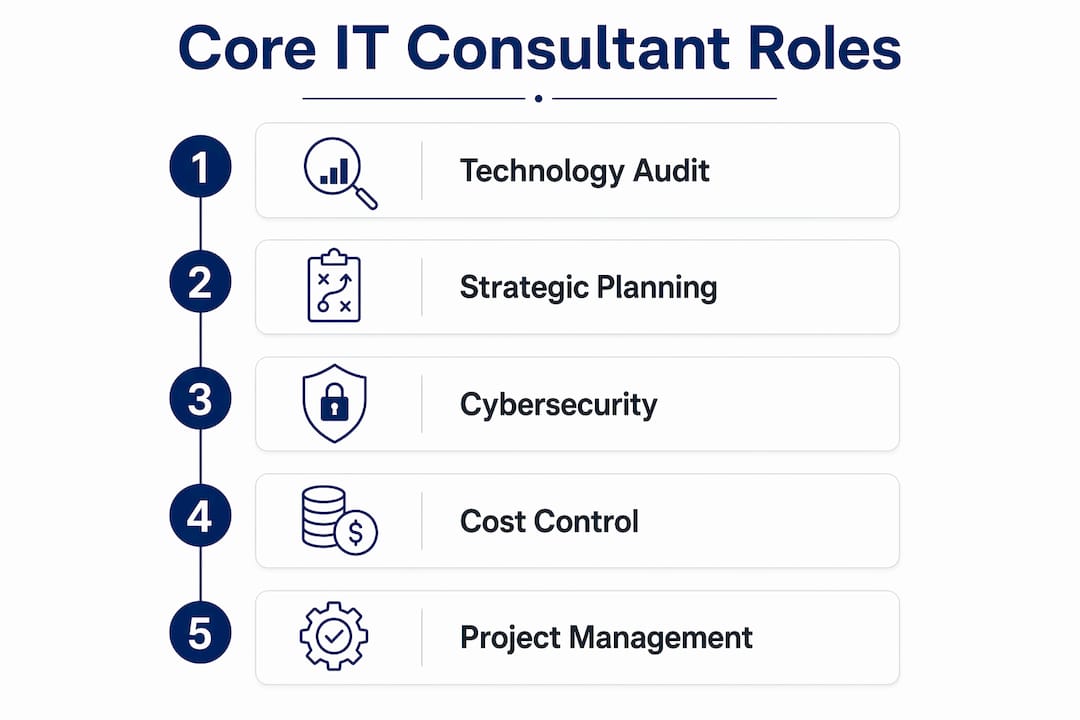
5. Project management and vendor coordination
From solicitation support to go-live, consultants manage vendor relationships, track milestones, and resolve cross-functional blockers that stall delivery. This coordination function is where many government IT programs fail without external support.
Pro Tip: Before signing a consulting contract, ask the firm to define its specific deliverables for the first 30 days. Vague scope is the single most common cause of disengaged consultants and unmet expectations.
How do IT consultants differ from internal IT staff?
The distinction between IT consultants and internal IT staff is not about technical skill. It is about scope, tenure, and perspective. Consultants provide temporary, senior-level expertise to accelerate progress, while full-time IT leadership owns ongoing operations and long-term system management.
| Dimension | IT consultant | Internal IT staff |
|---|---|---|
| Tenure | Fixed engagement, project-scoped | Permanent, ongoing role |
| Focus | Strategic priorities, defined outcomes | Day-to-day operations and maintenance |
| Perspective | External, unbiased, cross-industry | Internal, organization-specific |
| Authority | Advisory and project-based | Operational ownership |
| Cost model | Contracted, outcome-tied | Salary, benefits, overhead |
This distinction matters for public sector leaders who sometimes expect consultants to absorb operational responsibilities. Consultants are most effective when internal teams retain ownership of ongoing operations and the consultant focuses on resolving specific strategic or technical challenges.
Solutions architects, another commonly confused role, focus narrowly on designing technical systems to meet defined requirements. IT consultants operate at a broader level, connecting business objectives, budget constraints, stakeholder needs, and technical design into a single coherent strategy. The scope difference is significant.
External perspective is one of the most underrated benefits of IT consulting. Internal teams develop blind spots over time, particularly around legacy systems they have maintained for years. A consultant entering with no institutional attachment will identify risks and inefficiencies that internal staff have normalized.
Pro Tip: Structure consulting engagements so the consultant works alongside your internal IT lead, not above or around them. This protects institutional knowledge and accelerates knowledge transfer when the engagement ends.
What measurable outcomes do IT consultants deliver in 60-90 days?
Government agencies often ask what they can realistically expect from a consulting engagement in the near term. The answer is specific. Organizations typically see priority clarification and removal of blockers within the first 60 to 90 days. That time frame is not arbitrary. It reflects the natural pace of assessment, stakeholder alignment, and early decision-making.
The following outcomes are realistic within a 90-day window:
-
Technology priority map. The consultant delivers a ranked list of initiatives based on risk, cost, and mission impact. This removes the paralysis that often accompanies large modernization programs with competing stakeholder demands.
-
Blocker identification and resolution. Stalled programs almost always have identifiable blockers: a vendor contract in dispute, a data governance question unresolved, or a security review pending. Consultants surface these early and drive resolution.
-
Stakeholder alignment. Large-scale IT initiatives often fail from misaligned expectations and poor stakeholder management rather than technical issues. A consultant's early work on stakeholder communication directly reduces this risk.
-
Realistic roadmap with defined success measures. Advisory engagement success is measured by whether clients act on recommendations. Implementation success is measured by end-user adoption and system stability. Defining these criteria up front prevents scope drift and sets a clear standard for accountability.
-
Acceleration of stalled initiatives. Consultants fill senior-expertise gaps and resolve cross-functional roadblocks that operational staff cannot prioritize. This is the "gap-fill" function that distinguishes consulting from staff augmentation.
The 60 to 90 day window is also when agencies can assess whether the consulting relationship is working. If a consultant cannot demonstrate progress on at least two of these outcomes within that period, the engagement structure likely needs revision.
How IT consultants support public sector modernization
Public sector IT modernization requires navigation of regulatory compliance, secure system design, and stakeholder coordination. These are precisely the areas where IT consultants add the most concentrated expertise.
Government agencies operate under constraints that private sector organizations do not face at the same scale: FedRAMP authorization requirements, state-specific data residency rules, procurement regulations, and multi-agency governance structures. Consultants who specialize in public sector work understand these constraints and design solutions within them rather than around them.
The specific contributions IT consultants make in government contexts include:
- Regulatory compliance mapping. Consultants translate compliance requirements from frameworks like NIST SP 800-53, FISMA, and state-level security standards into concrete system design decisions. This prevents costly remediation after deployment.
- Cross-agency collaboration management. Many government modernization programs involve multiple agencies with different systems, priorities, and governance structures. Consultants serve as neutral coordinators who keep programs moving without becoming entangled in inter-agency politics.
- Stakeholder communication and governance. Program visibility is a persistent challenge in government IT. Consultants establish reporting structures, audit-ready dashboards, and governance cadences that keep elected officials, agency heads, and program managers aligned.
- Adoption and training support. Technology deployments fail when end users do not adopt the new system. Consultants design change management plans and training programs that address the human side of modernization, not just the technical side.
- Risk mitigation tied to public trust. A failed government IT program is not just a budget problem. It erodes public trust and creates political exposure. Consultants who understand this dynamic prioritize risk mitigation in ways that purely technical staff may not.
"The most effective public sector IT consultants do not just deliver technology. They deliver confidence. Confidence that the system will work, that the data is secure, and that the agency can explain every decision to an auditor or a constituent."
For agencies in states like Maryland, New York, and Florida, where modernization programs are active and compliance requirements are particularly demanding, the importance of IT consultants with public sector specialization is not theoretical. It is a program delivery requirement.
Key takeaways
The role of IT consultants in government is to accelerate modernization, reduce program risk, and align technology investments with agency mission goals through defined, outcome-tied engagements.
| Point | Details |
|---|---|
| Consultants are not internal staff | They provide temporary, senior-level expertise focused on strategic outcomes, not ongoing operations. |
| Early wins matter | Priority clarification and blocker removal within 60 to 90 days signal a productive engagement. |
| Public sector context is distinct | Regulatory compliance, cross-agency governance, and public trust require specialized consulting expertise. |
| Success measures must be defined upfront | Advisory success ties to client action; implementation success ties to adoption and system stability. |
| Perspective is a core asset | External consultants identify risks and inefficiencies that internal teams have normalized over time. |
Why the "accelerant" framing changed how I think about consulting
Most articles describe IT consultants as problem-solvers. That framing is accurate but incomplete. The more useful mental model, based on what I have seen in public sector engagements, is the accelerant. Consultants do not replace internal teams. They remove the friction that keeps those teams stuck in maintenance mode.
The agencies that get the most from consulting engagements are the ones that treat the consultant as a temporary senior partner with a defined exit. They invest in knowledge transfer from day one. They define success measures before the contract is signed. And they resist the temptation to expand scope mid-engagement, which is where most government IT programs lose momentum.
The go-live phase deserves more attention than it typically gets. Common client frustration concentrates at go-live because that is when theoretical plans meet real operational environments. Consultants who anticipate this and build practical usability testing into the deployment plan consistently outperform those who treat go-live as a finish line rather than a stress test.
The consultants worth hiring in 2026 are the ones who challenge your assumptions early, communicate clearly to non-technical stakeholders, and measure their own success by what your agency can do after they leave. That last point is the most important one.
— Randy
Work with a public sector IT modernization partner
Government agencies managing complex modernization programs need more than technical expertise. They need a partner who understands compliance requirements, program governance, and the operational realities of public sector delivery. Primereadysub, operating as Rutledge & Associates, LLC, is an SDVOSB and SBA-certified firm specializing in public sector IT modernization for state agencies and government departments. Their work spans cloud-native re-architecting, compliance automation, DevOps pipelines, and real-time program dashboards. For agencies in Maryland, the firm offers region-specific modernization services designed around state compliance requirements and procurement structures. If your agency is evaluating IT consulting partnerships, reviewing how to select IT partners for public sector success is a practical starting point.
FAQ
What is the primary role of IT consultants in government agencies?
IT consultants serve as strategic advisors who align technology investments with agency mission goals, manage implementation risk, and accelerate modernization programs that internal teams cannot prioritize alone. Their role is defined by outcomes, not ongoing operations.
How do IT consultants differ from full-time IT staff?
Consultants provide temporary, senior-level expertise focused on specific strategic or technical challenges, while internal IT staff own day-to-day operations and long-term system management. The distinction is scope and tenure, not technical skill level.
What should agencies expect in the first 90 days of an IT consulting engagement?
Agencies should expect priority clarification, identification and resolution of program blockers, stakeholder alignment, and a realistic roadmap with defined success measures. Tangible progress on at least two of these outcomes within 90 days signals a productive engagement.
Why do large government IT programs fail even with consultants involved?
Large-scale IT initiatives most often fail from misaligned expectations and poor stakeholder management rather than technical issues. Consultants who prioritize stakeholder communication and governance structures from the start significantly reduce this risk.
How do you measure the success of an IT consulting engagement?
Success criteria depend on engagement type. Advisory engagements succeed when clients act on recommendations. Implementation engagements succeed when end users adopt the new system and it operates with stability. Defining these measures before the contract is signed is the single most important step in engagement design.