

Legacy system modernization is the structured process of upgrading or transforming outdated software and infrastructure so it meets current demands for security, performance, cloud integration, and AI capability. It is not synonymous with replacement. The right approach depends on how severely the existing system blocks business operations, how deep the technical debt runs, and what the organization can realistically absorb in terms of cost and risk.
The urgency is real. Modern enterprises spend around 72% of their IT budgets maintaining legacy systems, with global application maintenance costs exceeding $1.68 trillion annually. That leaves little room for the innovation work that actually moves organizations forward.
Key reasons IT leaders prioritize modernization today:
- Security vulnerabilities accumulate faster than legacy teams can patch them
- New features take significantly longer to ship as technical debt compounds
- Cloud and AI integrations are blocked by outdated APIs and data models
- Talent risk grows as fewer developers know aging technology stacks
- Maintenance costs crowd out investment in new capabilities
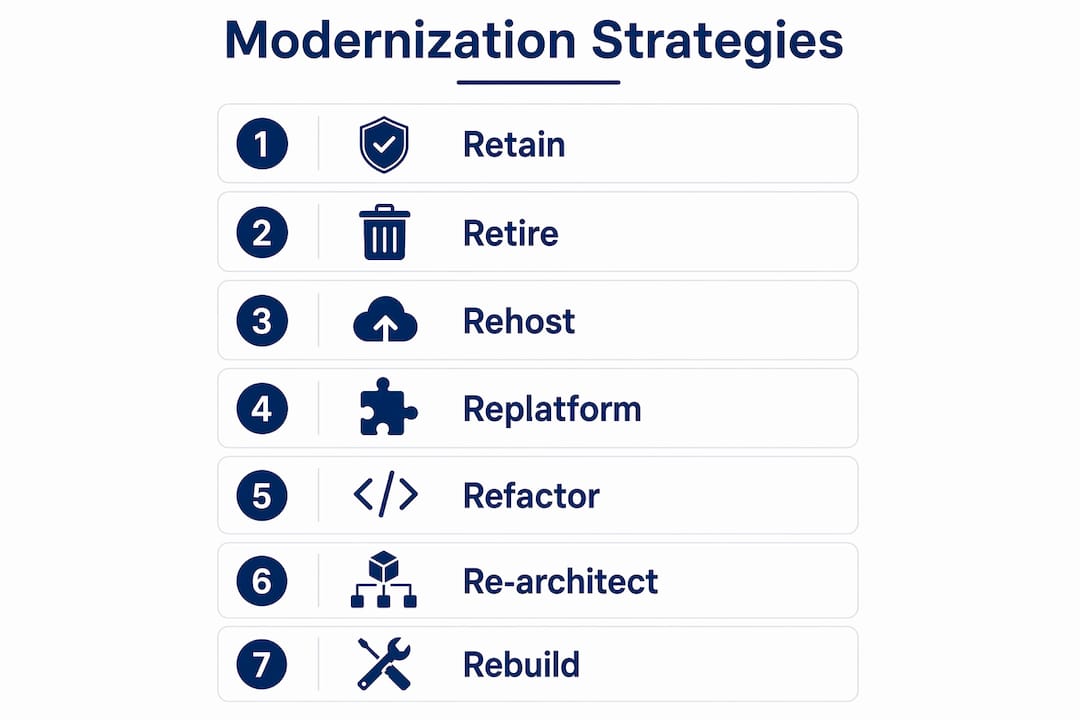
The 7 Rs framework, covering Retain, Retire, Rehost, Replatform, Refactor, Re-architect, and Rebuild/Replace, as commonly used by IT modernization teams, gives IT leaders a structured way to assign the right modernization path to each application rather than applying a single strategy across an entire portfolio.
What are legacy systems, and why do they become a problem?
A legacy system is not simply old software. Age is a signal, not the definition. A ten-year-old application that runs reliably, has automated test coverage, and can be extended without cascading failures is not a legacy problem. A three-year-old system with no test coverage, undocumented API contracts, and a single developer who understands it fully qualifies as one.
72% of enterprises still run mission-critical operations on software built before 2015, illustrating how widespread the problem is across industries. The more useful definition focuses on what the system prevents rather than when it was built.
Common types of legacy systems encountered in enterprises:
- Mainframe applications: Large-scale batch processing systems, often running COBOL or PL/I, that handle high transaction volumes but resist modern integration patterns
- Monolithic codebases: Single-deployment applications where all functionality is tightly coupled, making isolated changes risky and slow
- Client-server applications: Two-tier architectures built for on-premises networks that cannot scale to distributed or cloud environments
- End-of-life platforms: Software running on operating systems or runtimes no longer receiving security patches, such as Windows Server 2008 or Java 7
Signals that a system has crossed into legacy territory:
- Developers avoid large areas of the codebase because changes break unpredictable other things
- New features take significantly longer to ship than in previous years
- The technology stack is so specialized that hiring for it is nearly impossible
- Security patches fall months behind because applying them carries too much risk
- The system cannot connect to modern tools the business depends on
Organizations retain legacy systems despite these challenges for understandable reasons: migration risk, budget constraints, regulatory compliance requirements, and the absence of a clear modernization roadmap. The cost of staying put, however, compounds over time in ways that are easy to underestimate.
Why modernizing legacy systems pays off
The business case for modernization is strongest when you account for what the legacy system costs to keep running, not just what modernization costs to execute. Legacy systems typically cost $50,000–$200,000 annually in developer maintenance and patching alone, before adding infrastructure expenses and the harder-to-quantify cost of delayed feature delivery.
A rebuild investment that significantly cuts maintenance costs can deliver payback in a few years, before accounting for the business value of faster delivery. That math changes the conversation from "can we afford to modernize" to "can we afford not to."
Core benefits of legacy system modernization:
- Reduced security exposure: Patching cycles shorten dramatically on modern, well-tested codebases with active vendor support
- Faster feature delivery: Decoupled architectures allow teams to ship changes independently, without coordinating across the entire system
- Cloud and AI readiness: Modern APIs, containerized workloads, and clean data models unlock integrations that legacy systems physically cannot support
- Lower operational costs: Cloud-native infrastructure typically costs less to run than aging on-premises hardware and software licenses
- Talent retention and hiring: Developers want to work on modern stacks; legacy systems create key-person dependencies that become organizational risks
- Regulatory compliance: Modern systems make audit trails, access controls, and compliance reporting far easier to implement and maintain
Modernization also functions as the technical foundation of broader digital transformation. Organizations that attempt AI adoption or cloud-native architecture without first addressing their legacy systems consistently find that the data and processes they need are locked inside systems that cannot expose them cleanly.
What challenges should you expect during modernization?
Legacy modernization projects fail more often from underestimated complexity than from poor intent. The technical challenges are real, but the organizational and data-related obstacles tend to be the ones that derail timelines and budgets.
Primary challenges and how to approach them:
- Data migration risk: Data accumulated over ten to twenty years in a legacy database is often inconsistent in format, missing relational integrity, and contains business logic encoded in stored procedures that nobody has documented. Silent data corruption is the most dangerous failure mode; validating record counts, checksums, and business rules at every migration stage is the industry standard for catching it before it causes irreversible damage.
- System downtime risk: Mission-critical systems that process transactions around the clock cannot tolerate extended outages. Phased approaches that keep the legacy system running during transition are not optional for these environments.
- Talent scarcity: Finding developers who understand both the legacy technology and the target modern architecture is genuinely difficult. Knowledge transfer sessions, documentation sprints, and pair programming between legacy and modern engineers reduce the risk of losing institutional knowledge.
- Balancing modernization with ongoing delivery: Trying to modernize and add new features simultaneously in the same codebase doubles both risk and timeline. A feature freeze on the legacy system while the modernized version is built in parallel is the more disciplined approach.
- Security exposure during transition: The period when both old and new systems are running simultaneously creates a temporarily expanded attack surface. Access controls, network segmentation, and monitoring need to cover both environments.
Pro Tip: Use feature flags to roll out new functionality to a small percentage of users first, monitor behavior, then expand. This allows rollback without a full deployment and gives teams real-world validation before full cutover.
How the 7 Rs framework guides your modernization strategy
The 7 Rs framework gives IT leaders a structured vocabulary for making application-specific modernization decisions rather than applying a single approach portfolio-wide. Each "R" represents a distinct modernization path with its own cost profile, risk level, and timeline.

| Strategy | What it means | Cost range | Risk | Timeline |
|---|---|---|---|---|
| Retain | Keep as-is, monitor and patch | — | Low | Ongoing |
| Retire | Decommission and stop using | Low cost | Very low risk | Short timeline |
| Rehost | Move to cloud without code changes | Moderate cost | Low risk | Several months |
| Replatform | Minor code changes to use cloud capabilities | Moderate cost | Medium risk | Several months |
| Refactor | Restructure code and architecture without full rebuild | Mid to high cost | Medium-high risk | Several months |
| Re-architect | Redesign core structure, often to microservices | High cost | High risk | Several months to a year |
| Rebuild/Replace | Rewrite from scratch on a modern stack | Very high cost | High risk | Many months to over a year |
Modernization timelines vary considerably depending on project scope and complexity; simpler efforts may take a few months, while large rebuilds can span one to two years or more.
Two execution patterns worth understanding:
The Strangler Fig Pattern is the recommended approach for most refactors and re-architecting efforts. Rather than replacing the legacy system all at once, teams build the new system alongside it and gradually route traffic from old to new, feature by feature. The legacy system shrinks as the new one grows. This approach works particularly well for systems that cannot go offline.
The Big Bang approach involves full replacement at a single cutover date. It is faster and cleaner but carries high risk. It is appropriate only for smaller systems where a parallel running period is not feasible and the rebuild cost stays under roughly $200,000.
Security imperatives in legacy system modernization
Security is not a secondary concern in modernization planning. It is frequently the primary driver. Remediating critical vulnerabilities in legacy systems takes an average of 55 days to address 50% of them, which often exceeds attacker exploitation times and creates significant compliance exposure. For organizations in regulated sectors, that gap represents direct compliance exposure.
The transition period itself introduces additional risk. When legacy and modern systems run simultaneously, the attack surface temporarily expands. Network segmentation, strict access controls, and continuous monitoring across both environments are not optional during this phase.
Observability features like structured logging, service mesh, and circuit breakers should be built into the new architecture from day one. Retrofitting distributed tracing and monitoring after the fact is costly and often requires rewriting significant portions of the pipeline.
Pro Tip: Adopt data validation checkpoints at every migration phase, including record count verification, checksum comparisons, and business rule validation against the source system. Pair each phase with a tested rollback procedure. If you cannot roll back cleanly, the risk profile is too high to proceed without extended parallel running.
Parallel running, where both systems process the same transactions and results are compared, is the gold standard for mission-critical migrations. It catches bugs before cutover and provides a clear rollback path if the new system behaves unexpectedly.
How to decide when and what to modernize
Not every legacy system warrants the same level of investment. The decision framework that works best scores each application across six dimensions, then maps the score to the appropriate R.
Scoring criteria for each application:
- Business criticality: How severely does a failure impact revenue or operations?
- Change frequency: How often does the business need new features from this system?
- Integration demand: How many modern systems need to connect to it?
- Technical debt level: How hard is it to change without breaking other things?
- Talent risk: How difficult is it to hire developers who know the stack?
- Security exposure: How many unpatched vulnerabilities currently exist?
Score each criterion from 1 to 5. A total score of 6–15 suggests Retain or Rehost: the system is stable and modernization cost likely exceeds the benefit. A score of 16–22 points toward Replatform or Refactor, where real problems exist but the core is worth preserving. A score of 23–30 indicates Rebuild, where technical debt is deep enough that refactoring costs more than starting fresh.
Business continuity planning runs parallel to this scoring process. For public sector IT modernization, where systems often support citizen services or compliance reporting, continuity constraints directly influence which R is feasible regardless of the technical score.
When the functionality in question is commodity work, such as HR, basic accounting, or project management, a SaaS replacement often costs less and delivers faster than any modernization path. Build or modernize only when the software is core to competitive differentiation or when standard SaaS cannot accommodate the workflow without significant compromise.
Key steps in planning and executing a modernization project
Successful modernization follows a disciplined sequence. Skipping phases to accelerate delivery is the most common cause of cost overruns and failed migrations.

Phase 1: Discovery and assessment Map the full application portfolio. Document dependencies, data flows, integration points, and known technical debt. Identify which systems are candidates for each R using the scoring framework. This phase often surfaces undocumented dependencies that would have caused failures later.
Phase 2: Prioritization and roadmap Sequence modernization efforts by business impact and risk. High-criticality, high-debt systems that are actively blocking new capabilities should move first. Systems that are stable and low-risk can be retained or scheduled for later phases.
Phase 3: Architecture design Define the target architecture before writing a line of code. Decisions about microservices vs. modular monolith, cloud provider, data storage patterns, and observability tooling made here determine the cost and complexity of every subsequent phase.
Phase 4: Data migration planning Budget two to three times what you initially estimate for data migration. Legacy databases accumulate inconsistencies, missing relationships, and undocumented business logic over years of use. A dedicated data migration workstream with its own validation checkpoints and rollback procedures is not optional for systems with significant data history.
Phase 5: Incremental execution Execute in phases rather than attempting a full cutover. Use the Strangler Fig pattern where possible, feature flags for controlled rollouts, and parallel running for transaction-critical systems. Each phase should have a defined success criterion and a tested rollback path.
Phase 6: Validation and cutover Before decommissioning the legacy system, run both systems in parallel long enough to validate that the new system handles edge cases, peak loads, and error conditions correctly. Cutover only after the parallel running period confirms consistent results.
Phase 7: Decommission and optimize Retire the legacy system, reclaim infrastructure costs, and document lessons learned. Post-modernization, monitor the new system closely for the first 90 days to catch performance issues that did not surface during testing.
Real-world examples of legacy modernization projects
Concrete examples illustrate how the strategies above play out in practice across different sectors and system types.
U.S. federal government mainframe migrations The U.S. Government Accountability Office has documented extensively that federal agencies operate some of the oldest IT systems in any sector, including mainframes running COBOL code written in the 1960s and 1970s. Several agencies have pursued phased rehosting and replatforming strategies, moving batch processing workloads to cloud environments while retaining the core business logic in modernized containers. The approach avoids the risk of a full rebuild while eliminating the infrastructure costs of aging hardware.
Healthcare system EHR modernization Healthcare organizations, as tracked by HIMSS, have undertaken large-scale migrations from on-premises electronic health record systems to cloud-hosted platforms. The data migration challenge in these projects is acute: patient records spanning decades contain inconsistent coding standards, merged and split patient identities, and clinical logic embedded in database triggers. Successful projects used database-first modernization, cleaning and migrating the data layer before rebuilding the application layer on top.
Financial services monolith decomposition Banks and insurance companies with monolithic transaction processing systems have widely adopted the Strangler Fig pattern to decompose those systems into independently deployable services. A common sequence involves extracting the customer identity and authentication layer first, then payment processing, then reporting, with each extraction routed through an API gateway that directs traffic to either the legacy or modern component. This approach allows the institution to continue processing transactions throughout the multi-year migration.
State agency benefits administration State agencies administering benefits programs have modernized client-server applications that could not integrate with federal data exchanges or support mobile access. Government agency modernization projects in this category typically combine replatforming for the core eligibility engine with a full rebuild of the citizen-facing interface, reducing processing times and enabling real-time eligibility verification.
Best practices for successful legacy system modernization
The difference between modernization projects that deliver on their business case and those that stall or fail usually comes down to a handful of consistent practices.
Treat data migration as a first-class workstream. Application code can be rewritten relatively cleanly. Data accumulated over ten to twenty years in a legacy database is messy, with inconsistent formats, missing relationships, and business logic encoded in stored procedures that nobody has documented. Underestimating this is the single most common cause of project overruns.
Build observability in from the start. Structured logging, distributed tracing, and health monitoring should be architectural requirements, not afterthoughts. Retrofitting these capabilities after the system is built is expensive and disruptive.
Freeze features in the legacy system during migration. Trying to add new features to the legacy system while simultaneously building its replacement doubles the risk and the timeline. A disciplined feature freeze, with new development happening only in the modernized environment, keeps the scope manageable.
Maintain a tested rollback plan for every phase. If a phase cannot be rolled back cleanly, the risk profile is too high to proceed without extended parallel running. This discipline forces teams to think carefully about phase boundaries and data consistency before committing to a cutover.
Involve business stakeholders throughout. Modernization projects that are treated as purely technical exercises tend to deliver technically correct systems that do not match how the business actually operates. Regular validation with the people who use the system catches misalignments early, when they are cheap to fix.
Score and sequence the portfolio deliberately. Not every system needs the same level of investment. Using a structured scoring approach to assign each application to the right R prevents over-engineering stable systems and under-investing in high-risk ones.
How modernization affects business operations and continuity
The operational impact of a modernization project extends well beyond the IT department. Business teams that depend on the systems being changed experience disruption during the transition, and the degree of that disruption is directly shaped by how the project is managed.
Phased approaches, particularly the Strangler Fig pattern and parallel running, exist specifically to protect business continuity. When both systems process the same transactions simultaneously, the business continues operating normally while the technical team validates the new system. The cost of phased approaches can be notably higher than direct cutovers, justified for systems requiring continuous availability due to revenue or compliance implications.
Post-modernization, the operational benefits tend to compound. Teams that previously spent the majority of their time on maintenance and patching shift toward building new capabilities. Deployment frequency increases as the codebase becomes easier to change safely. Incident response times drop as observability tooling provides clearer signals about system behavior.
The broader organizational effect is a shift in how IT is perceived internally. A modernized system that ships features reliably and handles incidents transparently builds credibility with business leadership in ways that a stable but opaque legacy system never can. For organizations pursuing IT modernization partnerships to execute these programs, that credibility translates directly into expanded scope and continued investment.
Key Takeaways
Legacy system modernization requires matching the right strategy to each application based on technical debt, business criticality, and risk tolerance, not applying a single approach across the entire portfolio.
| Point | Details |
|---|---|
| Maintenance costs are high | Legacy systems cost $50,000–$200,000 annually in developer time before infrastructure expenses. |
| The 7 Rs framework structures decisions | Each application should be scored and assigned to Retain, Retire, Rehost, Replatform, Refactor, Re-architect, or Rebuild. |
| Security risk is time-sensitive | Remediating critical vulnerabilities in legacy systems can take several weeks, often exceeding attacker exploitation windows. |
| Data migration is the hardest part | Budget two to three times your initial estimate; silent data corruption is the most dangerous failure mode. |
| Phased execution protects continuity | Parallel running and the Strangler Fig pattern allow modernization without taking mission-critical systems offline. |
Primereadysub, operating as Rutledge & Associates, LLC, specializes in exactly this kind of work for public sector organizations. As an SDVOSB, woman-owned, and SBA-certified firm, the team delivers cloud-native re-architecting, compliance automation, DevOps pipelines, and real-time dashboards for state agencies and government departments across Maryland, New York, and Florida. If your agency is weighing a modernization program and needs a partner who owns a clearly defined scope rather than simply augmenting staff, explore what Primereadysub delivers for prime contractors and government clients.