

The most effective posture for mainframe modernization in 2026 is hybrid-first: retain what must stay, modernize what benefits most, and integrate everything through APIs and event streams. The 2026 Arcati survey confirms this is already the dominant industry direction, with the vast majority of organizations pursuing selective, workload-level change rather than wholesale platform exits.
Quick-start checklist:
- Assess first. Run a structured discovery to classify workloads by data gravity, latency requirements, regulatory sensitivity, and coupling depth.
- Pilot one workload. Select a bounded, lower-risk application (a batch reporting job is a common first candidate) and validate your chosen approach end-to-end before scaling.
- Stand up governance. Establish a change approval board, compliance gate, and observability baseline before the first production cutover.
Recommended approach by workload class:
- Latency-sensitive transactional ledgers: retain and modernize in-place with API enablement
- Batch reporting and ETL: rehost or replatform to cloud infrastructure
- Customer-facing APIs: refactor into microservices with a strangler-fig migration pattern
- Legacy batch jobs with no active users: retire or replace with modern SaaS equivalents
Pro Tip: Treat modernization as a portfolio of parallel programs, one per workload class, rather than one large project. Each workload has a different risk profile, and separating them lets you deliver incremental value while containing blast radius if a phase encounters problems.
Key Takeaways
A hybrid-first, workload-by-workload modernization strategy, grounded in data gravity analysis and regulatory sensitivity scoring, consistently delivers better outcomes than wholesale platform migration for US government and regulated enterprise environments.
| Point | Details |
|---|---|
| Hybrid-first is the dominant posture | Fewer than 5% of organizations plan full mainframe decommissioning; most pursue incremental API enablement, replatforming, and selective refactoring. |
| Score workloads before choosing an approach | Use data gravity, regulatory sensitivity, latency SLAs, coupling, and cost-to-change to assign each workload a recommended modernization path. |
| Discovery is a protected investment | A fixed-scope discovery deliverable prevents the scope expansions that cause most program cost overruns and timeline failures. |
| Observability must come before cutover | Unified logging and monitoring across mainframe and cloud tiers is a governance requirement, not an optional enhancement, for regulated environments. |
| Primereadysub for government programs | Primereadysub delivers outcome-owned modernization work packages for government agencies and prime contractors, with SDVOSB and SBA certifications. |
Table of Contents
- What mainframe modernization really means in 2026
- Core modernization approaches and how to choose among them
- How to map your workloads to the right modernization path
- How to build a business case that executives will approve
- Security, compliance, and resilience in US-regulated environments
- Data migration, replication, and integration strategies
- Platform, tooling, and partner selection for modernization programs
- A phased modernization roadmap you can adapt to 90 days
- Workforce, governance, and change management
- A decision framework for US government and regulated enterprises
- Common modernization pitfalls and how to avoid them
- Questions to ask vendors and a 30/60/90-day checklist
- Timeline and cost/ROI considerations
- How to measure success after modernization is complete
- What government modernization programs consistently get wrong
- Primereadysub delivers defined-scope modernization for government agencies
- Sources
What mainframe modernization really means in 2026
Mainframe modernization is the process of updating, integrating, or selectively migrating mainframe-based systems to improve agility, reduce operational cost, and extend the life of critical business logic. The term covers a wide spectrum, from adding REST APIs in front of COBOL programs to full rewrite in cloud-native languages. What it does not mean, at least not in 2026, is a binary choice between keeping everything and moving everything.
The Arcati 2026 Mainframe Trends report shows that fewer than 5% of organizations plan full platform decommissioning. Most are pursuing incremental strategies: replatforming specific workloads, enabling APIs on existing COBOL applications, or refactoring discrete modules. The mainframe market remains strong in banking, insurance, and government, with projected demand through 2031 underpinning the case for selective modernization over wholesale exit.
Three trends are reshaping how organizations approach this work in 2026:
- Hybrid-first architecture. Most enterprises now treat the mainframe as one node in a broader hybrid cloud topology rather than a legacy system to be eliminated. Workloads that benefit from cloud elasticity move; workloads that depend on mainframe throughput and latency stay.
- AI moving to the mainframe. Generative AI and machine learning inference are increasingly being deployed close to transactional data, rather than pulling that data out to a separate analytics tier. For regulated workloads, keeping AI governance co-located with the data reduces latency and simplifies audit trails.
- Workforce demographics. The COBOL developer population is aging, and the pipeline of new mainframe-fluent engineers is thin. This makes AI-assisted code analysis and documentation tools not just useful but operationally necessary for many agencies and enterprises.
Data gravity is the other force shaping decisions. As worldwide data volumes grow, the cost and risk of moving large datasets increases. For many core transactional systems, it is cheaper and safer to push compute to the data than to migrate the data to a new platform.
Core modernization approaches and how to choose among them
IBM's public guidance on mainframe modernization approaches describes the mainstream options as rehost, replatform, refactor, encapsulate, and replace. A broader industry classification, sometimes called the 7 R's framework, adds retain and retire to complete the picture. Each approach carries a different risk profile, cost shape, and staffing requirement.
| Approach | Best for | Risk / disruption | Cost shape | Staffing impact |
|---|---|---|---|---|
| Retain | Latency-critical, tightly coupled transactional cores | Low | Low capex, ongoing MIPS cost | Existing mainframe team |
| Rehost (lift-and-shift) | Batch workloads with no cloud-native dependencies | Low-medium | Lower long-term infra cost | Moderate; mainframe emulation skills needed |
| Replatform | Batch reporting, ETL, non-critical COBOL jobs | Medium | Medium upfront, lower ops | Mixed mainframe and cloud skills |
| Refactor / rehab | Customer-facing APIs, microservices candidates | High | High upfront, lowest long-term | Cloud-native developers, COBOL expertise |
| Replace / repurchase | Commodity functions with mature SaaS alternatives | Medium-high | SaaS licensing replaces custom ops | Change management heavy |
| Encapsulate / API enablement | Any workload where business logic must be preserved but exposed | Low | Low-medium | API gateway and integration skills |
| Retire | Dormant applications with no active users | Very low | Immediate cost reduction | Minimal |
Selecting the right approach depends on four workload signals:
- Latency and transaction volume. If a workload processes thousands of transactions per second with sub-millisecond SLAs, rehosting or retaining is almost always safer than refactoring.
- Regulatory sensitivity. Workloads subject to FedRAMP, FISMA, or HIPAA requirements need a modernization path that preserves auditability and does not introduce new compliance gaps.
- Coupling and interdependencies. Tightly coupled applications that share memory or data structures with other mainframe programs are poor candidates for early refactoring. API enablement is usually the safer first step.
- Cost-to-change. COBOL modernization for a 500,000-line program is a multi-year effort. The business case must justify that investment against the operational savings.
Pro Tip: No single approach fits an entire portfolio. The most effective programs apply two or three approaches simultaneously across different workload classes. A common pattern: encapsulate the transactional core with APIs, replatform batch reporting to cloud, and retire dormant legacy batch jobs in parallel.
How to map your workloads to the right modernization path
Classifying workloads before committing to an approach is the single step most programs skip, and it is the one that causes the most expensive course corrections later. The table below maps common enterprise mainframe workload types to their best-fit approaches.
| Workload type | Recommended approach | Expected disruption | Success metrics |
|---|---|---|---|
| Core ledger / transaction engine | Retain + API enablement | Low | API latency, transaction throughput, audit trail completeness |
| Customer-facing digital APIs | Refactor to microservices | High | Time-to-deploy, error rate, API response time |
| Batch reporting | Rehost or replatform | Low-medium | Job completion time, cost per report, data freshness |
| ETL / data lake feeds | Replatform or replace with cloud-native pipeline | Medium | Pipeline latency, data quality score, cost per GB processed |
| Regulatory audit functions | Retain + modernize in-place | Low | Audit trail completeness, compliance gate pass rate |
| Legacy batch jobs (low usage) | Retire or replace | Very low | Cost eliminated, user impact |
| Third-party integrations | Encapsulate with API façade | Low | Integration uptime, error rate, onboarding time for new consumers |
For US government agencies, the regulatory audit function row deserves particular attention. These workloads often carry FISMA or FedRAMP obligations, and any modernization path that disrupts the immutable audit trail creates immediate compliance exposure. Retaining the core logic while exposing it through a well-governed API layer is the standard pattern for a reason.
A pattern that recurs in regulated US environments: agencies that attempt to refactor their core transaction engine in the first phase consistently encounter scope expansion, data mapping complexity, and compliance re-certification delays that push timelines 12–18 months beyond initial estimates. Agencies that start with API enablement on the same workload, then refactor incrementally, tend to deliver working integrations within 90 days and build institutional confidence for the harder work that follows.
The Arcati 2026 data supports this pattern: incremental modernization through replatforming, refactoring, and API enablement accounts for the overwhelming majority of active programs, while large-scale platform exits remain rare.
How to build a business case that executives will approve
The business case for modernizing legacy systems needs to speak three languages simultaneously: cost, risk, and speed. Executives who approve budgets want to see all three addressed, not just a TCO comparison.
Primary benefit categories to quantify:
- Total cost of ownership (TCO). MIPS costs, software licensing, and specialized mainframe staffing are the most visible line items. Rehosting batch workloads to cloud infrastructure typically reduces infrastructure costs for those specific workloads, though the savings depend heavily on workload size and cloud pricing.
- Agility and time-to-market. Mainframe release cycles measured in weeks or months become a competitive liability when digital channels need daily deployments. Refactored microservices on a CI/CD pipeline can reduce deployment cycle time from weeks to hours.
- Resiliency and recovery. Modern cloud platforms offer multi-region replication and automated failover that mainframe disaster recovery configurations often cannot match at equivalent cost. Shorter recovery time objectives (RTOs) reduce both operational risk and the cost of outages.
- Developer productivity. Recruiting COBOL developers is increasingly difficult and expensive. Modernizing applications to languages with larger talent pools reduces hiring risk and long-term staffing costs.
- Compliance posture. Automated compliance controls, audit dashboards, and real-time reporting reduce the labor cost of audit preparation and lower the risk of findings.
Illustrative ROI sketch for a batch reporting replatform (transparent assumptions):
- Assume a mid-size agency running 200 batch jobs on mainframe infrastructure, with annual MIPS costs attributable to those jobs.
- Replatforming those jobs to a managed cloud service typically reduces the infrastructure cost for that workload class, with the exact savings depending on current MIPS pricing and cloud service selection.
- Add operational savings from reduced mainframe staffing hours for those jobs, faster job completion enabling earlier reporting cycles, and reduced audit preparation time from automated logging.
- Set against upfront migration costs: discovery, development, testing, and validation.
- Most replatform programs for bounded batch workloads reach payback within 18–36 months, with ongoing savings accelerating after the first year.
KPIs to track from day one:
- MIPS consumption (before and after, per workload)
- Time-to-deploy for application changes
- Mean time to recovery (MTTR) for production incidents
- API latency for exposed mainframe services
- Compliance audit preparation time (hours per audit cycle)
- Developer onboarding time for modernized applications
When building the business case, include operational savings from automation, risk reduction from shorter RTOs, and revenue upside from faster time-to-market for digital channels, as the Arcati 2026 materials recommend. A business case that captures only infrastructure cost savings consistently underestimates the full return.
Security, compliance, and resilience in US-regulated environments
Modernizing a regulated mainframe environment without a security and compliance plan is not a technical risk. It is a program-ending risk. US government agencies operating under FISMA, FedRAMP, or HIPAA face re-certification requirements any time a system boundary changes, and a poorly scoped modernization can trigger a full Authority to Operate (ATO) review at the worst possible moment.
Regulatory touchpoints to address before any production change:
- FedRAMP and FISMA. Cloud services used in federal modernization programs must carry FedRAMP authorization at the appropriate impact level (Low, Moderate, or High). Any new cloud component introduced into a FISMA system boundary requires documentation in the System Security Plan (SSP).
- HIPAA. Health data workloads require Business Associate Agreements (BAAs) with any cloud provider handling protected health information, and encryption requirements apply both at rest and in transit.
- SOC 2 and PCI DSS. For financial and payment workloads, vendor compliance certifications are a baseline requirement, not a differentiator.
Architecture patterns that preserve auditability:
- Zero-trust network segmentation between mainframe and cloud tiers, with explicit policy for every service-to-service call
- Encryption at rest using FIPS 140-2 validated modules, and TLS 1.2 or higher for all data in transit
- Immutable audit logs stored in a write-once, read-many configuration, with tamper-evident hashing
- Key management through a dedicated service (such as AWS KMS or IBM Key Protect) rather than application-managed keys
Resilience patterns for production modernization:
- Multi-site replication for any workload where the mainframe previously provided the single source of truth
- Documented rollback plans with tested execution times, not just theoretical procedures
- Disaster recovery validation through scheduled failover tests, not just tabletop exercises
The compliance gap that most modernization programs miss: the observability boundary. When mainframe logs stay in SMF format and cloud logs go to a SIEM in a different schema, the audit trail is technically complete but practically unusable. Unifying log schemas and routing all events through a single observability platform before the first production cutover is the governance decision that pays dividends for years.
For public-sector IT modernization, the security acceptance criteria for any vendor or subcontractor should be written into the statement of work, not left to a post-delivery review.
Data migration, replication, and integration strategies
Data gravity is the concept that large, high-velocity datasets are expensive and risky to move, so compute tends to migrate toward the data rather than the reverse. As worldwide data creation continues to grow, this principle becomes more consequential for mainframe modernization decisions. A core banking ledger with decades of transaction history is not a dataset you migrate lightly.

Replication patterns and their trade-offs:
| Pattern | Latency | Consistency | Best for |
|---|---|---|---|
| Near real-time CDC (Change Data Capture) | Low | High | Dual-run validation, live cutover |
| Batch export / bulk load | High | Point-in-time | Initial data migration, reporting feeds |
| Dual-write | Very low | Requires reconciliation | Zero-downtime cutover with rollback option |
| Event streaming (Kafka, MQ) | Low-medium | Eventual | Integration with downstream analytics and APIs |
Transformation concerns that are consistently underestimated:
- EBCDIC to ASCII character encoding conversion introduces subtle data corruption risks, particularly in packed decimal fields and date formats. Every transformation must be tested against production-representative data, not synthetic test data.
- Record format changes (fixed-length VSAM to variable-length relational rows) require schema mapping documentation that is often absent from legacy systems.
- Schema evolution: when the modernized system needs to change a field that the mainframe still owns, a governance process for coordinating schema changes across both platforms is necessary from day one.
Integration approaches for hybrid operations:
- API façade pattern. Expose existing COBOL business logic through a REST or GraphQL API layer without changing the underlying code. This is the lowest-risk integration path and the fastest to deliver.
- Event streaming. Publish mainframe transaction events to a streaming platform (IBM MQ, Apache Kafka) for consumption by downstream analytics, reporting, and digital channel applications.
- Data pipelines into data lakes. Extract mainframe data through CDC or batch export into a cloud-based data lake for analytics workloads, keeping the transactional system of record on the mainframe.
Observability unification across the hybrid boundary is often the single program-level task that unlocks safe hybrid operations. Without it, incident response in a mixed mainframe-cloud environment becomes a manual, error-prone process.
Platform, tooling, and partner selection for modernization programs
Tooling selection is where many programs make their first avoidable mistake: choosing a platform before completing discovery. The right tooling depends on the workload class, the target architecture, and the compliance posture required.
Criteria for evaluating modernization tooling:
- Certified integrations with your existing mainframe platform (IBM z Systems, Unisys, or others)
- FedRAMP authorization or SOC 2 Type II certification for any cloud component
- Automated code analysis and refactoring support for COBOL, PL/I, or Assembler
- Observability across hybrid stacks (unified metrics, logs, and traces)
- CI/CD pipeline integration for modernized application components
- Vendor-provided migration assessment tools and cost calculators
AWS Mainframe Modernization is one of the major cloud-native options for organizations moving batch and COBOL workloads to AWS infrastructure. It provides managed rehosting and replatforming environments, automated refactoring tools, and integration with the broader AWS ecosystem. The AWS cost calculator can help estimate migration costs and compare scenarios before committing to a path. AWS also offers builder resources for teams evaluating automated refactor and replatform options, though vendor guidance consistently cautions that automated refactoring requires careful validation for transactional fidelity.
IBM z Systems and IBM mainframe modernization capabilities represent the other major ecosystem. IBM's hybrid cloud approach, centered on IBM Z and IBM Cloud, allows organizations to modernize in-place through containerization (zCX), API enablement via IBM API Connect, and integration with Red Hat OpenShift running on-premises. For organizations already running IBM Z infrastructure, this path often carries lower disruption risk because the underlying platform and its compliance certifications remain unchanged.
Partner selection signals that matter more than marketing materials: look for vendors and subcontractors with documented public-sector experience, outcome-based contracting models (fixed-scope deliverables rather than time-and-materials staff augmentation), and specific certifications relevant to your compliance requirements. A partner who cannot name their rollback procedure in the first conversation is a red flag, not a negotiating position.
Strategic IT partnerships built on outcome ownership, where the partner is accountable for a defined deliverable rather than hours billed, consistently outperform staff augmentation models in compliance-heavy government programs. The Camptra Technologies migration tooling approach to workload assessment offers one example of how specialized partner capabilities can accelerate the discovery phase for complex migration scenarios.
Generative AI and automation tools can accelerate code analysis, test generation, and documentation of legacy business logic. They do not, however, replace the need for human oversight and governance. AI-assisted discovery compresses the timeline for understanding what a COBOL program does; it does not validate whether the modernized version does it correctly under production conditions.
A phased modernization roadmap you can adapt to 90 days
A phased approach reduces risk by validating assumptions before committing to production changes. The table below provides a framework with typical durations and acceptance criteria.
| Phase | Duration | Key activities | Acceptance criteria |
|---|---|---|---|
| 1. Assess / Discover | 4–8 weeks | Workload inventory, dependency mapping, compliance baseline, data gravity analysis | Signed workload classification report, risk register, compliance gap list |
| 2. Pilot / Validate | 6 weeks | Select one bounded workload, build target environment, migrate data, run parallel validation | Functional parity confirmed, rollback plan tested, performance SLAs met |
| 3. Incremental migration | 3 months | Apply validated approach to next workload tier, automate testing, expand observability | Each workload passes acceptance criteria before decommissioning mainframe equivalent |
| 4. Production cutover | Per workload | Final data sync, cutover window, parallel run period, decommission trigger | Zero critical defects in parallel run, rollback executed successfully in drill |
| 5. Operate / Optimize | Ongoing | Monitor KPIs, tune performance, retire technical debt, expand automation | KPI targets met, incident response times within SLA |
Phased rollout steps:
- Complete a fixed-scope discovery engagement covering all in-scope mainframe applications, their data dependencies, and their compliance obligations.
- Produce a prioritized workload backlog ranked by modernization value (cost savings + risk reduction + agility gain) against modernization complexity.
- Select the pilot workload: the highest-value, lowest-complexity candidate that is not on the critical path for any regulatory deadline.
- Stand up the target environment with observability, security controls, and CI/CD pipeline before migrating any code or data.
- Run the pilot in parallel with the mainframe equivalent for a defined validation period (typically 2–4 weeks for batch workloads, longer for transactional systems).
- Conduct a governance gate review before each subsequent workload migration, using the pilot's lessons to refine the approach.
Pro Tip: Build the rollback plan before the cutover plan. A rollback procedure that has been tested in a drill is a governance asset; one that exists only in a document is a liability. Regulators and executives both want to see evidence of a tested rollback, not just a written one.
For government IT modernization solutions, the governance gate between phases is where program managers can demonstrate progress to oversight bodies and procurement offices without waiting for a full production cutover.
Workforce, governance, and change management
The technical architecture of a modernization program is usually the easier problem. The harder problem is the workforce gap between the COBOL and mainframe skills that currently operate the system and the cloud-native skills needed to operate the target state.
Common workforce gaps and practical mitigations:
- COBOL expertise. The existing mainframe team understands the business logic embedded in decades of code. Retaining that knowledge through documentation, AI-assisted code analysis, and structured knowledge transfer is as important as any technical migration task.
- Cloud-native skills. Agencies and enterprises often lack the DevOps, Kubernetes, and cloud security skills needed for the target state. Training programs, apprenticeship models, and outcome-owned subcontracting can fill this gap faster than hiring alone.
- Observability and SRE practices. Hybrid operations require site reliability engineering skills that most mainframe teams have not needed before. Building this capability early, during the pilot phase, prevents it from becoming a production incident.
Operating model options:
- Centralized platform team: a single team owns the hybrid infrastructure and provides guardrails for application teams. Works well for agencies with strong central IT governance.
- Distributed product teams with platform guardrails: application teams own their modernization workstreams within a shared platform. Works well for large enterprises with multiple business units.
- Outcome-owned subcontracting: a specialized partner owns a defined modernization work package end-to-end. Works well when internal capacity is limited or when a specific workload requires expertise the agency does not have.
Governance checklist:
- Unified observability platform covering mainframe and cloud tiers before first production cutover
- Compliance gate review at each phase transition, with documented sign-off
- Change approval board with representation from security, operations, and the business
- Runbook and incident response procedures for hybrid operations, tested before go-live
- Shift-left testing: automated tests run at every code commit, not just at release
Pro Tip: AI-assisted development tools can help COBOL developers contribute to modernized codebases by translating business logic into modern languages. The productivity gain is real, but the governance requirement is equally real: every AI-generated translation needs human review before it enters a production pipeline.
A decision framework for US government and regulated enterprises
The decision matrix below gives procurement and IT teams a reproducible method for scoring any workload against five axes and mapping the score to a recommended modernization approach.
Decision matrix axes (score each 1–3, where 3 = highest constraint):
| Axis | Score 1 | Score 2 | Score 3 |
|---|---|---|---|
| Data gravity | Small dataset, easy to move | Medium dataset, manageable migration | Large / high-velocity dataset, costly to move |
| Regulatory sensitivity | Low (internal only) | Moderate (SOC 2, PCI) | High (FedRAMP, FISMA, HIPAA) |
| Latency / transactional SLA | Batch, minutes acceptable | Near-real-time, seconds | Sub-second, high-volume transactional |
| Coupling / interdependencies | Standalone application | Moderate shared data | Tightly coupled, shared memory or data structures |
| Cost-to-change | Small codebase, modern patterns | Medium codebase, some COBOL | Large COBOL codebase, complex business logic |
Score interpretation:
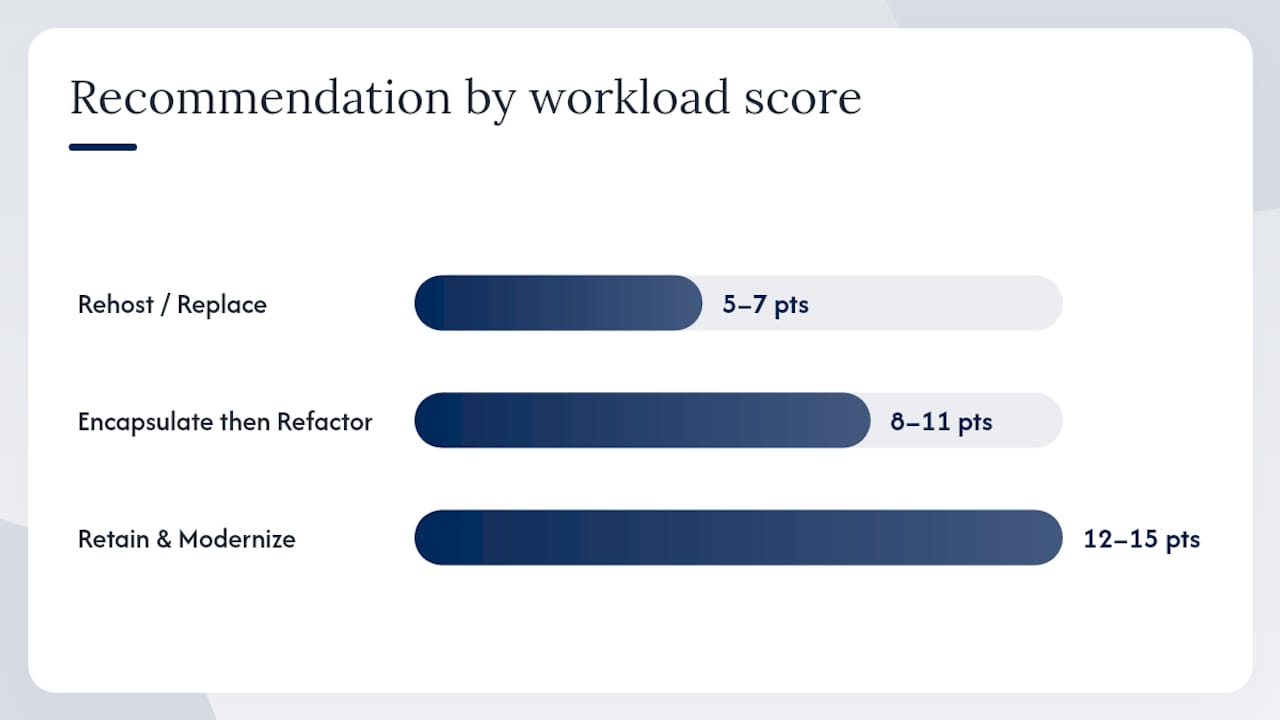
- 5–7: Strong candidate for rehost, replatform, or replace. Lower complexity and regulatory risk make migration feasible within a standard program timeline.
- 8–11: Encapsulate with API enablement first, then evaluate incremental refactoring. Complexity or regulatory sensitivity warrants a staged approach.
- 12–15: Retain and modernize in-place. Data gravity, latency requirements, or regulatory sensitivity make wholesale migration high-risk. Focus on API enablement, observability, and in-place tooling upgrades.
Applied example:
A core banking ledger at a state agency scores: data gravity 3 (decades of transaction history), regulatory sensitivity 3 (FISMA High), latency 3 (sub-second transactional), coupling 3 (shared data with six other systems), cost-to-change 3 (1.2 million lines of COBOL). Total: 15. Recommendation: retain and modernize in-place with API enablement.
A batch regulatory reporting job at the same agency scores: data gravity 1 (output-only, reads from ledger), regulatory sensitivity 2 (SOC 2), latency 1 (nightly batch), coupling 1 (reads only, no writes), cost-to-change 2 (moderate COBOL, well-documented). Total: 7. Recommendation: replatform to cloud-native batch service.
Pro Tip: For any workload scoring 8–11, run a bounded pilot experiment before committing to a full refactor. A four-week pilot that validates functional parity and performance is far cheaper than discovering a critical gap six months into a production migration.
The hybrid IT approach for public sector aligns directly with this framework: keep high-constraint workloads on the platform that handles them best, and move lower-constraint workloads to the environment that reduces cost and increases agility.
Common modernization pitfalls and how to avoid them
Most mainframe modernization programs that fail do not fail because the technology did not work. They fail because the program was scoped, governed, or contracted in ways that made failure predictable from the start.
Top pitfalls:
- Under-scoped discovery. Starting migration before completing a full dependency map is the single most common cause of scope expansion and cost overruns. Every undocumented dependency discovered in production adds weeks and risk.
- Underestimating data mapping complexity. EBCDIC encoding, packed decimal fields, and undocumented data formats in legacy VSAM files routinely take three to five times longer to map than initial estimates suggest.
- Skills shortage mid-program. Assuming that cloud-native skills can be hired or trained fast enough to keep pace with a migration timeline is a planning error. Workforce readiness must be assessed and addressed before the program starts.
- Observability gaps. Deploying a modernized application without unified monitoring across the mainframe and cloud tiers creates a blind spot that makes incident response and compliance reporting unreliable.
- Vendor lock-in. Choosing a modernization platform that uses proprietary runtime environments or data formats can make future migrations more expensive than the original one.
Mitigation patterns:
- Require a fixed-scope discovery deliverable as the first contract milestone, with a signed workload classification report before any migration work begins.
- Use smoke tests and canary releases to validate each migration increment before full traffic cutover.
- Run dual-system validation (mainframe and modernized system processing the same transactions in parallel) for a defined period before decommissioning the mainframe equivalent.
- Include contractual rollback clauses with defined trigger conditions and tested execution procedures.
- Stage decommissioning: keep the mainframe system available in read-only mode for a defined period after cutover, so rollback remains an option without a full re-migration.
Contract clause examples to require from vendors:
- Explicit acceptance criteria for each deliverable, not just milestone dates
- Rollback rights with defined conditions and the vendor's obligation to support execution
- SLAs for the modernized system that match or exceed the mainframe baseline
- Knowledge transfer obligations: documented runbooks, training sessions, and code documentation delivered before final payment
Questions to ask vendors and a 30/60/90-day checklist
Before signing a statement of work with any modernization vendor or subcontractor, the questions below will clarify risk allocation, delivery model, and expected outcomes. A vendor who cannot answer these questions specifically is not ready to own a production modernization program.
30/60/90-day operational checklist:
Days 1–30 (Discover):
- Complete workload inventory covering all in-scope mainframe applications and their data dependencies.
- Establish compliance baseline: identify all regulatory obligations, current certifications, and any ATO or FedRAMP boundaries affected by the program.
- Set up observability infrastructure: unified logging, metrics, and tracing across mainframe and target cloud environment.
- Document data formats, encoding, and schema for all datasets in scope.
- Identify and brief all stakeholders: security, operations, compliance, and the business owners of each workload.
Days 31–60 (Pilot):
- Select and scope the pilot workload using the decision matrix.
- Build the target environment with all security controls and CI/CD pipeline in place.
- Execute data migration for the pilot workload and validate against production-representative test data.
- Run parallel validation: pilot system and mainframe processing the same inputs, outputs compared.
- Test and document the rollback procedure with a timed drill.
Days 61–90 (Govern):
- Conduct governance gate review: present pilot results, KPIs, and lessons learned to the change approval board.
- Refine the workload backlog based on pilot findings.
- Finalize the phased migration plan for the next workload tier.
- Confirm vendor certifications and compliance documentation for any new cloud components.
- Brief executives with the updated business case, incorporating actual pilot cost and performance data.
Top questions to ask vendors:
- What is your specific migration approach for this workload class, and what are the known failure modes?
- Describe your rollback procedure: what triggers it, how long does it take, and have you executed it in a production environment?
- Which FedRAMP-authorized services does your solution use, and at what impact level?
- How do you integrate observability from the mainframe tier into your target monitoring platform?
- What is your staffing model: outcome-owned deliverables or time-and-materials augmentation?
- What knowledge transfer obligations are included in your SOW, and how are they verified?
- How do you handle schema changes and data format transformations for EBCDIC and packed decimal fields?
Red flags in vendor proposals:
- Vague acceptance criteria ("system will perform as expected") with no measurable thresholds
- No mention of a rollback plan or rollback testing
- Time-and-materials pricing with no fixed-scope deliverables
- Compliance certifications listed as "in progress" for services that will be in production scope
- Discovery scoped at fewer than four weeks for any program with more than 20 in-scope applications
For a structured approach to partner selection, the questions above translate directly into evaluation criteria for scoring vendor proposals.
Timeline and cost/ROI considerations
Modernization timelines vary significantly by approach and workload complexity, but some patterns hold across most programs. A bounded replatform of a batch reporting workload can complete in 3–6 months. A full refactor of a core transactional system with millions of lines of COBOL is a multi-year program, often 2–4 years for a large enterprise or agency.
The cost structure differs by approach. Rehosting has lower upfront costs but may not reduce ongoing operational spend significantly if the target platform carries similar licensing costs. Replatforming typically reduces infrastructure costs for the migrated workloads while requiring moderate upfront investment in migration tooling and testing. Refactoring carries the highest upfront cost but delivers the greatest long-term reduction in operational complexity and staffing requirements.
ROI timelines follow a similar pattern. Rehost programs often reach payback in 12–24 months. Replatform programs typically reach payback in 18–36 months. Refactor programs may take 3–5 years to reach payback on a pure cost basis, but the agility and risk-reduction benefits often justify the investment on a total-value basis before the cost payback is reached.
One cost driver that consistently surprises program managers: the compliance re-certification cost. Any change to a FISMA or FedRAMP system boundary triggers documentation, testing, and review obligations that can add months and significant labor cost to a program. Scoping the modernization to minimize boundary changes, or planning for re-certification as an explicit program milestone with its own budget, is a planning discipline that separates experienced programs from first-time ones.
How to measure success after modernization is complete
Defining success metrics before the program starts is not a best practice. It is a governance requirement. Without pre-defined KPIs and baseline measurements, it is impossible to demonstrate that the modernization delivered its promised value, which matters both for program accountability and for building the case for the next phase.
Operational KPIs:
- MIPS consumption per workload. Measure before and after for each migrated workload. This is the most direct measure of infrastructure cost reduction.
- Deployment frequency. How often can the team deploy a change to the modernized application? Weekly deployments replacing monthly mainframe releases is a measurable agility improvement.
- Mean time to recovery (MTTR). How long does it take to restore service after a production incident? Modern cloud platforms with automated failover should reduce MTTR compared to mainframe incident response.
- API latency and error rate. For workloads exposed through API enablement or refactored into microservices, these are the primary performance indicators.
- Compliance audit preparation time. Measure the labor hours required to prepare for an audit cycle before and after modernization. Automated compliance controls and real-time dashboards should reduce this materially.
Business KPIs:
- Time-to-market for new features. How long from business requirement to production deployment? This is the agility metric that resonates most with executives.
- Cost per transaction. For high-volume transactional workloads, the cost per transaction on the modernized platform versus the mainframe baseline is a direct ROI measure.
- Developer onboarding time. How long does it take a new developer to become productive on the modernized application? A reduction here signals that the technical debt has been reduced.
Governance KPIs:
- Compliance gate pass rate at each phase transition
- Rollback drill execution time versus target
- Incident response time for hybrid-stack incidents
- Percentage of workloads with unified observability coverage
Reviewing these KPIs at a regular cadence, monthly during active migration phases and quarterly during steady-state operations, gives the change approval board the data it needs to make informed decisions about the next workload tier. Programs that skip this discipline tend to lose executive support after the first phase, because they cannot demonstrate that the investment delivered what was promised.
What government modernization programs consistently get wrong
The conventional wisdom in mainframe modernization is that the technology is the hard part. After observing multiple government modernization programs, the evidence points in a different direction. The technology is usually the most predictable element. What fails programs is the gap between how the work is scoped and contracted and what the work actually requires.
Government agencies that contract for modernization on a time-and-materials basis, with no fixed-scope deliverables and no acceptance criteria, are not buying modernization. They are buying staff. The vendor's incentive in that model is to extend the engagement, not to deliver a working system. The agencies that achieve the best outcomes are the ones that require outcome-owned work packages: a defined deliverable, measurable acceptance criteria, and a contractual obligation to deliver it.
The second pattern worth noting is the tendency to treat discovery as a cost to minimize rather than an investment to protect. A four-week, fixed-scope discovery that produces a signed workload classification report and a compliance gap list is not overhead. It is the document that prevents a 12-month scope expansion six months into production migration. Programs that skip or compress discovery consistently encounter the problems that discovery would have surfaced.
AI-assisted tools are genuinely useful for accelerating code analysis and documenting legacy business logic. The caution from HyperFRAME Research is worth taking seriously: these tools compress timelines, but they do not replace the governance and validation requirements that regulated environments impose. An AI-generated COBOL translation that passes automated tests but fails under production data conditions is a production incident, not a tool limitation.
Primereadysub delivers defined-scope modernization for government agencies
Government agencies and prime contractors working on legacy system upgrades face a specific problem: they need a partner who owns the outcome, not one who bills hours. Primereadysub (Rutledge & Associates, LLC) delivers defined-scope modernization work packages covering legacy system modernization, cloud-native re-architecting, DevOps and CI/CD pipeline implementation, compliance automation, and real-time analytics dashboards. As an SDVOSB, woman-owned, and SBA-certified firm, Primereadysub is structured to serve as a high-value, low-oversight subcontractor on compliance-heavy programs in Maryland, New York, and Florida.
The firm's model is outcome ownership: a signed statement of work with measurable acceptance criteria, not staff augmentation. For prime contractors managing complex government modernization programs, that distinction reduces oversight burden and shifts delivery risk to a partner with the expertise to carry it.
To discuss a defined-scope engagement or request a capability brief, contact Primereadysub directly.
Sources
The sources below were used in preparing this guide and offer deeper technical and strategic reference for teams building a modernization program.
- Not Nostalgia. Not Hype. Just Data: Mainframe Trends 2026 - Planet Mainframe
- Worldwide data created - Statista