

The role of data in public service is to convert everyday government transactions and measurements into evidence that improves policy decisions, targets resources, and proves results. That conversion runs on established frameworks, not guesswork.
- The ROAMEF cycle (rationale, objectives, appraisal, monitoring, evaluation, feedback) structures how evidence feeds each stage of policymaking.
- The OPEN Government Data Act requires agencies to publish inventories and metadata so data can actually be reused.
- The OECD frames this shift as building a data-driven public sector, where data functions as a strategic asset rather than a byproduct of paperwork.
The Government Accountability Office has found predictive models let agencies move from reacting to fraud and service failures toward preventing them. What follows covers the concrete use cases, the governance guardrails, and the capability building that make this shift durable rather than a one-off pilot.
Key Takeaways
Data functions as public service infrastructure only when governance, capability, and defined-scope modernization work together to turn raw records into decisions.
| Point | Details |
|---|---|
| Data drives prevention, not just reaction | Predictive models let agencies catch fraud and service failures before they escalate. |
| Governance determines sustainability | The five pillars, authority, quality, metadata, privacy, and interoperability, keep analytics gains from fading. |
| Capability requires embedded roles | Chief Data Officers and embedded analysts, not one-off consultants, sustain the ROAMEF evidence cycle. |
| Legacy systems remain the top barrier | Federated architectures and APIs offer a practical workaround without full replacement. |
| Primereadysub owns defined outcomes | Delivers legacy modernization, analytics dashboards, and compliance automation as scoped work packages, not staff augmentation. |
Table of Contents
- Why Data Matters for Public Service
- Concrete Use Cases: How Data Is Applied in Policy and Services
- Tools and Methods Behind Data Analytics in Public Administration
- Data Governance and the Five Pillars of Trustworthy Use
- Building Analytics Capability: People, Process, and the ROAMEF Cycle
- Challenges of Data in Public Service
- How to Measure Impact and Build the Business Case
- Practical Steps to Modernize Systems for Analytics
- How an Outcomes-Focused Modernization Partner Helps
- Frequently Asked Questions
- Sources
Why Data Matters for Public Service
Governments that use data well get four things competitors in the private sector chase constantly: sharper policy targeting, lower cost per outcome, faster fraud detection, and defensible accountability. None of these arrive automatically. They require agencies to treat data as infrastructure, not exhaust.
- Evidence-based policy replaces intuition with measured outcomes, letting agencies test which interventions actually move the needle.
- Targeted service delivery means resources go to the households, businesses, or regions that need them most, instead of blanket distribution.
- Cost efficiency shows up when analytics flags redundant processes or overstaffed workflows before budget season, not after.
- Fraud detection through entity-linkage analysis catches patterns a caseworker reviewing files one at a time would never see.
- Improved accountability comes from data that's public, auditable, and tied to specific program outcomes.
The OECD's data-driven public sector framework treats governance and public trust as the enablers that make all four benefits sustainable rather than temporary wins. Agencies that skip governance tend to see analytics gains evaporate within a budget cycle or two.
Concrete Use Cases: How Data Is Applied in Policy and Services
Data-driven public policy shows up in specific, repeatable applications, not abstract dashboards nobody opens.
- Policy simulation and counterfactuals. Analysts model what would happen under a proposed rule change before it takes effect, using comparison groups to estimate real impact rather than assumed impact.
- Resource allocation and hot-spot analysis. GIS-based mapping directs inspectors, outreach workers, or patrol resources to the census tracts or facilities showing the highest risk signals.
- Fraud detection through entity-linkage. Rather than flagging single suspicious transactions, algorithms connect relationships across claims, vendors, and beneficiaries to surface non-obvious fraud rings. The GAO's work on data use in government points to this exact technique as a driver of the shift from reactive audits to proactive prevention.
- Public health surveillance. Early-warning systems built on case data and lab reporting have reshaped how outbreaks get spotted and contained, a trend documented in research on data's role in public health innovation.
- Program monitoring dashboards. Real-time visualizations let program managers catch service backlogs weeks before they'd surface in a quarterly report.
The Government Analytics Handbook documents how integrating administrative, survey, and external microdata helps agencies diagnose exactly where public spending gets wasted. That integration, not any single tool, is what separates a useful analytics program from a dashboard nobody trusts.
Tools and Methods Behind Data Analytics in Public Administration
Matching the right method to the right question matters more than the brand name on the software license.
- Descriptive analytics and dashboards answer "what happened," giving program managers a live view of caseloads, spending, or service times.
- Geospatial analysis answers "where," mapping need against resource placement.
- Predictive modeling and forecasting answer "what's likely next," powering everything from caseload projections to tax-compliance risk scores.
- Anomaly detection and text analytics flag irregularities in case files or vendor invoices that a manual review would miss.
Governments pull from open-source stacks, commercial analytics platforms such as SAS, GIS tools, and cloud analytics services, depending on scale and existing infrastructure. None of these is inherently superior; the fit depends on the agency's data maturity and staff skills.
Pro Tip: Before choosing between a commercial platform and an open-source build, map the actual question you're answering. A fraud-detection problem calling for entity-linkage across millions of records needs different tooling than a dashboard tracking weekly service volume for one program office.
Data Governance and the Five Pillars of Trustworthy Use
Governance is what keeps analytics from becoming a liability, as detailed in the government affairs board reporting best practices. Five pillars tend to show up across serious data programs:
- Authority and accountability, meaning someone specific owns each dataset's quality and use.
- Data quality, maintained through documented quality action plans rather than ad hoc fixes.
- Metadata and discoverability, so datasets can actually be found and reused across agencies.
- Privacy, confidentiality, and security, protecting individuals while still enabling legitimate analysis.
- Interoperability and standards, letting systems talk to each other without custom integration for every new project.
The Federal Data Strategy's published practices describe exactly this kind of governance: building a data culture, protecting confidential information, and promoting appropriate reuse simultaneously. On the ethics side, agencies need bias-mitigation checks on predictive models, clear accountability when an algorithm informs a decision affecting benefits or enforcement, and genuine public engagement mechanisms rather than a comment period nobody reads. Roughly a fifth of federal data governance failures the OECD examined trace back to skills gaps and public trust deficits rather than technology limits, per its data-driven public sector analysis.
Building Analytics Capability: People, Process, and the ROAMEF Cycle
Capability lives in roles and repeatable processes, not a single hire.
Most mature programs assign a Chief Data Officer to set strategy, embed analytics teams directly inside program offices instead of centralizing them out of reach, and designate data stewards responsible for specific datasets. Analysts support every stage of the ROAMEF evidence cycle, from building the rationale for a policy through monitoring and feeding results back into the next round.
- Prioritize which data assets matter most to current program goals.
- Assign clear ownership and build data quality action plans for those assets.
- Embed analysts inside program teams rather than treating them as an outside service.
- Launch small pilots with defined success metrics before scaling.
Our piece on analytics in compliance for public agencies walks through how this structure plays out inside audit-heavy programs specifically.
Challenges of Data in Public Service
The obstacles are predictable enough that most agencies hit the same five.
- Legacy systems and silos block data sharing between departments; federated architectures and APIs offer a workaround without a full system replacement.
- Data quality gaps undermine trust in any model built on top; a documented data quality action plan catches this early.
- Limited interoperability slows integration projects for months; adopting common metadata standards up front prevents rework later.
- Skills shortages leave good data sitting unanalyzed; embedding analysts inside programs closes this faster than one-off training.
- Public trust concerns grow when data use feels opaque; transparent reporting on how data gets used addresses this directly.
Procurement timelines add a practical layer of friction here too, often stretching analytics projects well past their original pilot window. Our guide to top IT challenges for agencies covers this friction in more depth.
How to Measure Impact and Build the Business Case
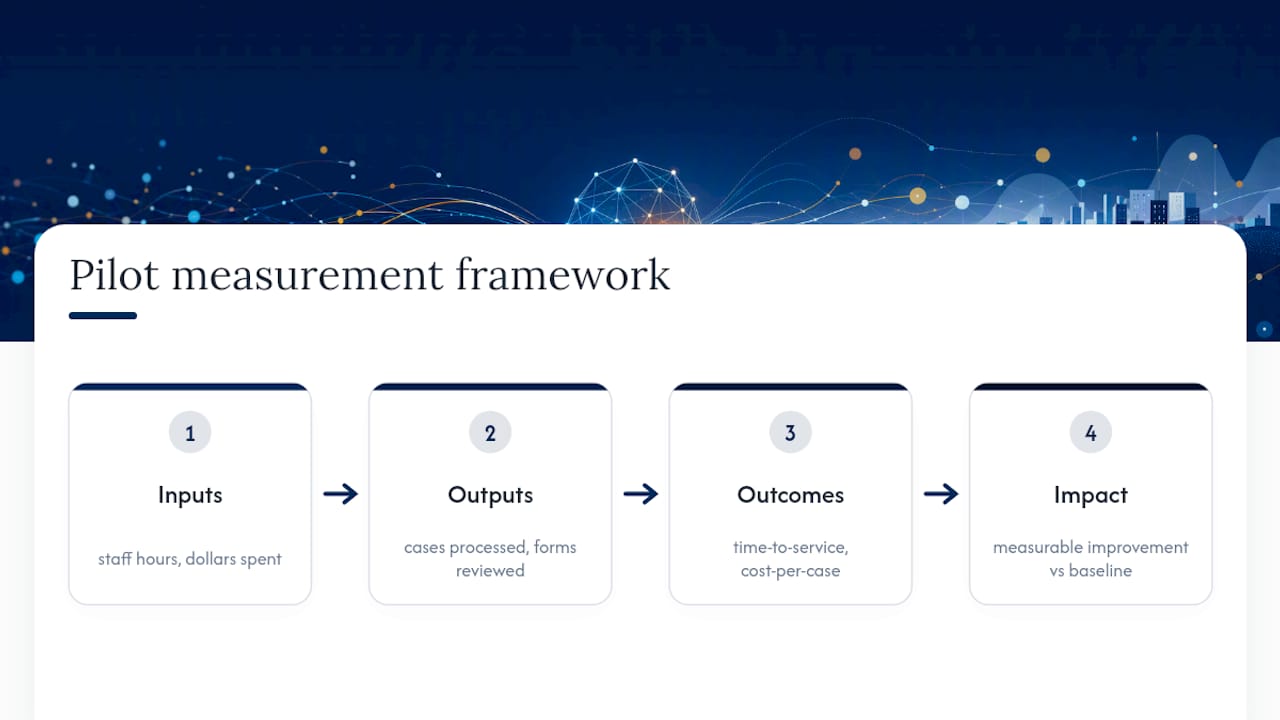
A simple framework separates a credible pilot from an anecdote: inputs (staff hours, dollars spent), outputs (cases processed, forms reviewed), outcomes (time-to-service, cost-per-case), and impact (measurable improvement against a baseline). Structuring a pilot with a treatment group and a comparison group, then tracking pre- and post-intervention indicators, gives decision-makers something firmer than "it seems to be working."
Pro Tip: When presenting results to non-technical leadership, pair one visualization with one plain-language effect size, such as "processing time dropped from 14 days to 9." Skip the confidence intervals in the executive summary; save them for the technical appendix.
Our article on analytics and contract success in government IT shows how this framework ties directly into contract performance reporting.
Practical Steps to Modernize Systems for Analytics
Turning intent into a working analytics program follows a fairly consistent sequence:
- Inventory critical data assets and flag the ones most tied to current policy priorities.
- Build data quality action plans for those priority assets.
- Modernize legacy data pipelines feeding those assets.
- Stand up a focused analytics pilot with a defined success metric.
- Embed the resulting model or dashboard into daily program workflows.
- Operationalize reporting so dashboards get checked routinely, not once at launch.
A short prioritize, pilot, platform, pipeline, protect checklist keeps teams from skipping steps under deadline pressure. Agencies increasingly contract this work as defined-scope modernization packages rather than open-ended staff augmentation, which keeps accountability clear and timelines predictable. Our legacy system modernization guide walks through the technical side of step three in detail.
A Practitioner's View on Sustainable Analytics Capability
Most analytics programs that stall don't fail on the modeling. They fail because nobody secured executive sponsorship before the first pilot lost momentum. The agencies that stick with it treat an early, modest win, a shorter processing time, a caught fraud pattern, as proof worth publicizing internally, then use that proof to fund the next phase before enthusiasm fades.

How an Outcomes-Focused Modernization Partner Helps
Building this capability in-house takes time most agencies don't have during an active compliance cycle. Primereadysub owns defined-scope modernization work packages, legacy system re-architecting, data integration, analytics dashboards, and compliance automation, so agencies get measurable outcomes without adding headcount or managing a vendor's day-to-day work. Programs partnering with Primereadysub have seen reduced processing times, stronger audit readiness, and real-time program visibility that a legacy system simply can't produce. If your agency or prime contractor needs a partner who owns the outcome rather than billing hours, review Primereadysub's modernization services and scope your next work package.
Frequently Asked Questions
What is the role of data in public service? Data converts transactional records, surveys, and open datasets into evidence that shapes policy decisions, targets services to the people who need them, and measures whether programs actually work.
How does data improve citizen services specifically? It lets agencies route resources based on measured need rather than uniform distribution, cutting wait times and catching service gaps through dashboards instead of quarterly reports.
What's the biggest obstacle to data-driven public policy? Legacy systems and organizational silos consistently rank as the top barrier, since they prevent the interoperability that predictive models and dashboards depend on.
Do agencies need a Chief Data Officer to use analytics well? A CDO role helps sustain governance and strategy, but embedded analysts working directly inside program teams tend to drive the day-to-day gains.
Sources
Every use case above depends on data that already exists inside government, plus data agencies choose to collect or publish.
- GAO report on data use in government (GAO-26-107466)
- The Government Analytics Handbook (World Bank)
- OECD: A data-driven public sector
The OPEN Government Data Act implementation guidance is the policy driver behind most of this discoverability, requiring agencies to publish inventories and metadata rather than let datasets sit unused in a departmental server. Our guide to government data warehouses covers how agencies unify these sources technically once they've identified them.