

Public-sector innovation is defined as the purposeful improvement of government services through new ideas, technology, and collaborative methods that deliver measurable gains in public outcomes. This explainer on public-sector innovation covers the full picture: what it means in practice, what stops it, and how agencies can make it stick. The OECD recognizes government innovation as a core function, not an optional upgrade. Agencies in Maryland, New York, and Florida are already proving that intentional improvement built on existing resources outperforms one-off invention every time. This guide gives public-sector leaders the framework to act.
What are the main types of public-sector innovation?
Public-sector innovation covers five distinct categories, each targeting a different layer of how government operates. Knowing the difference helps leaders choose the right approach for the right problem.
- New service innovation introduces a service that citizens have not had access to before. Boston's New Urban Mechanics office, for example, created participatory design programs that gave residents direct input into city planning decisions.
- Administrative process innovation changes how internal work gets done. This includes automating procurement workflows or replacing paper-based approvals with digital routing.
- Technological process innovation upgrades the systems behind service delivery. Migrating a legacy benefits platform to a cloud-native architecture is a clear example.
- Conceptual innovation reframes how a problem is understood. Treating housing instability as a public health issue, rather than a social services issue, changes which agencies respond and how.
- Governance innovation restructures decision-making authority. The UK's Test and Learn methodology, which integrates research early in the policy cycle, is a strong example of governance innovation applied at the program level.
Each category can produce real improvements. The key is matching the type of innovation to the actual gap in service or efficiency.
Pro Tip: Before selecting an innovation type, map the citizen journey for the service in question. The point of highest friction usually reveals whether you need a process fix, a technology fix, or a governance fix.
What barriers commonly slow public-sector innovation?
Structural and cultural barriers are the primary reasons government innovation stalls. Identifying them precisely is the first step toward removing them.
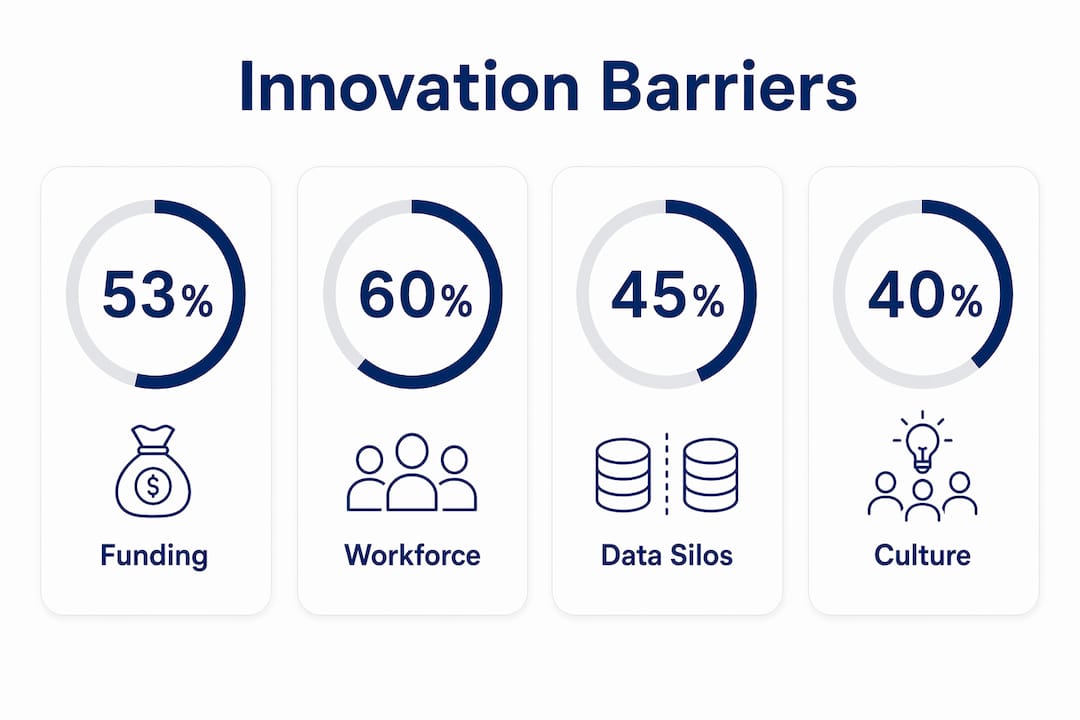
Funding inconsistency tops the list. 53% of federal executives report that budget constraints directly hinder their modernization plans, compared to 33% in the commercial sector. That gap reflects a structural reality: government budgets are annual and siloed, while innovation requires multi-year, cross-agency investment.
Workforce readiness is the second major barrier. Resistance to change is rarely about unwillingness. It is usually about uncertainty. When leaders fail to communicate clearly about what is changing and why, staff default to protecting existing processes. Leadership commitment and transparent communication are the most reliable tools for building workforce buy-in during modernization.
Technology and data fragmentation compound both problems. Consider these common blockers:
- Legacy systems that cannot share data across departments without expensive custom integrations
- Manual data reconciliation consuming significant staff time. More than 4 in 10 federal respondents report that 16% or more of their workload goes to manual data tasks. That is time not spent on service delivery.
- Fragmented data stores that prevent agencies from building a unified view of program performance
- Cultural inertia at the leadership level, where risk aversion is rewarded and experimentation is penalized
Recognizing these barriers as systemic, rather than individual failures, changes how leaders approach solutions.
How can public agencies implement effective innovation strategies?
Sustained government innovation requires more than a pilot program or a new office. It requires embedding innovation into how the organization operates every day.
-
Codify innovation within roles. Assign explicit innovation responsibilities to existing positions rather than creating standalone "innovation teams" that get cut in the next budget cycle. Sustainable innovation survives leadership changes when it lives inside organizational structure, not outside it.
-
Engage the full community ecosystem. Citizens, community organizations, and private-sector partners all hold knowledge that government agencies do not. Structured engagement, through public comment periods, co-design workshops, and advisory panels, produces better-informed solutions.
-
Use challenge-based procurement. Instead of specifying a solution in an RFP, specify the problem. This approach invites vendors and nonprofits to propose methods the agency may not have considered. Public-private partnerships built this way tend to produce more adaptable outcomes.
-
Apply agile methodologies and minimum viable products. Agile delivery, including MVPs and sprint cycles, lets agencies iterate public-sector innovations while managing risk. A benefits portal does not need every feature on day one. Ship the core function, gather user feedback, and build from there.
-
Set innovation KPIs and review them. Metrics like time-to-service, error rates, and citizen satisfaction scores create accountability. Without measurement, innovation efforts drift into activity without outcomes.
Pro Tip: Pair every innovation initiative with a "learning budget." Allocate a fixed percentage of project funds specifically for documenting what worked, what did not, and why. This institutional memory is what prevents agencies from repeating the same failed experiments.
For practical guidance on managing these initiatives, IT project management tips for public-sector teams cover the operational details most leaders encounter mid-project.
What role does technology play in public-sector modernization?
Technology is the enabler of public-sector reform, but it is not the starting point. The starting point is data.

Why data readiness determines AI outcomes
Only 30% of federal leaders feel their data is ready for AI applications. Nearly 60% of commercial leaders say the same about their own data. That gap explains why government AI pilots frequently succeed in isolation and fail to scale. The models are not the problem. The data infrastructure is.
Government AI cannot scale without a connected data fabric and shared ontologies across departments. A data fabric is a unified architecture that makes data from different systems readable and comparable without requiring each system to be replaced. Shared ontologies are agreed-upon definitions for common terms, so that "case closed" means the same thing in the benefits system as it does in the audit system.
Designing for interoperability
Modular, interoperable AI solutions are the only architecture that works in government environments. Agencies operate on hybrid platforms, mixing decades-old mainframes with modern cloud services. Any AI solution that requires a clean, single-source data environment will fail in that context. The design principle is to build AI components that can read from multiple sources, reconcile differences, and produce outputs that any authorized system can consume.
Cybersecurity is a parallel requirement. As agencies connect more systems, the attack surface grows. Cybersecurity best practices for resilient defense apply directly to government environments where data sharing and interoperability are expanding.
Digital transformation principles that hold
The Institute for Government identifies three principles that determine whether digital transformation in public services succeeds or fails. First, clarity of purpose and scope prevents projects from expanding beyond what the technology and the team can deliver. Second, user needs must drive design decisions, not internal preferences or legacy workflows. Third, accessibility cannot be an afterthought. Digital services that exclude low-literacy or low-connectivity users do not count as improvements in public service delivery.
| Technology element | Why it matters | Common failure mode |
|---|---|---|
| Data fabric | Enables AI to read across systems | Built for one department, not shared |
| Shared ontologies | Aligns definitions across agencies | Each agency defines terms differently |
| Modular AI design | Allows expansion without full rebuilds | Monolithic systems that cannot adapt |
| Accessibility standards | Serves all citizens, not just digital-first | Designed for average user, excludes others |
| Cybersecurity integration | Protects expanded data connections | Added after deployment, not built in |
Agencies pursuing IT modernization strategies that actually work consistently apply these principles from the project's first day, not its last.
Key takeaways
Public-sector innovation succeeds when agencies treat it as a structured discipline, not a periodic initiative, grounding every effort in data readiness, clear governance, and measurable outcomes.
| Point | Details |
|---|---|
| Define innovation precisely | Focus on intentional improvement of existing services, not invention for its own sake. |
| Address funding gaps early | 53% of federal modernization plans stall due to budget constraints; multi-year funding commitments are required. |
| Fix data before scaling AI | Only 30% of federal leaders report AI-ready data; build a unified data fabric first. |
| Embed innovation in roles | Codify innovation responsibilities within existing positions so they survive leadership changes. |
| Measure outcomes, not activity | Set KPIs tied to service delivery results, and review them on a fixed schedule. |
What I've learned about innovation that most government guides won't tell you
The most common mistake I see in public-sector innovation is confusing motion with progress. Agencies launch pilot programs, publish innovation strategies, and stand up new offices. Then, two years later, the core service delivery numbers have not moved. The reason is almost always the same: the innovation effort was designed to be visible, not to be effective.
Real change in government happens when a mid-level program manager has both the authority and the budget to try something different, fail quietly, learn from it, and try again. That requires leadership to actively protect experimentation from the normal accountability mechanisms that punish failure. Most leaders say they support this. Very few actually create the conditions for it.
The second thing I have observed is that technology projects in government almost always underestimate the data problem. Teams spend months selecting a platform and weeks on procurement, then discover in month three that the data they need is spread across six systems with incompatible formats. Building a data-ready foundation before selecting technology is not a delay. It is the fastest path to a working system.
The agencies that consistently deliver on modernization share one trait: their leaders treat innovation as an operational discipline with defined processes, not as a cultural aspiration with inspirational posters.
— Randy
How Primereadysub supports public-sector modernization
Primereadysub, operating as Rutledge & Associates, LLC, works directly with state agencies and government departments to address the technology barriers described in this article. As an SDVOSB, woman-owned, and SBA-certified firm, Primereadysub delivers cloud-native re-architecting, compliance automation, DevOps pipelines, and real-time dashboards built for government environments. The firm focuses on defined scopes with measurable outcomes, not open-ended staff augmentation. For agencies in Maryland, New York, and Florida working to close the gap between innovation ambition and operational reality, Primereadysub's modernization services provide the technical depth and compliance expertise that complex government programs require.
FAQ
What is public-sector innovation?
Public-sector innovation is the intentional improvement of government services through new ideas, processes, or technology that produce measurable gains in public outcomes. It focuses on adaptation and building on existing resources, not invention from scratch.
What are the biggest challenges in public-sector innovation?
Funding inconsistency, workforce resistance, and fragmented data are the three most common barriers. Budget constraints affect 53% of federal modernization plans, and manual data reconciliation consumes more than 16% of workload for many federal teams.
How does AI fit into government innovation strategies?
AI can improve government service delivery, but only when the underlying data infrastructure is ready. Only 30% of federal leaders report AI-ready data, making data fabric development the necessary first step before any AI deployment.
What is the Test and Learn methodology?
Test and Learn is a UK Government framework that integrates research and real-world experiments early in the policy cycle. It reduces the risk of large-scale failures by testing assumptions before full program rollout.
How do agencies sustain innovation beyond a single administration?
Codifying innovation responsibilities within existing organizational roles, rather than standalone offices, is the most reliable method. When innovation is embedded in governance structures and tied to measurable KPIs, it survives leadership transitions.