

Public sector IT terminology refers to the specialized vocabulary used in government technology acquisition, cybersecurity compliance, and project management that determines how contracts are written, interpreted, and executed. Mastering this IT vocabulary for government work is not optional. Contracting officers, IT leads, and program managers who misread a term like "CUI" or "GWAC" can trigger compliance failures or lose contract eligibility entirely. Bodies like NIST, the GSA, and the FAR define these terms with legal precision. Getting them right improves procurement outcomes, protects your agency from audit risk, and keeps technology projects on track.
What are the essential public sector IT contract and procurement terms?
Government IT procurement runs on a specific set of contract structures that differ significantly from commercial purchasing. Understanding these structures is the first step toward positioning your agency or firm correctly in any acquisition.
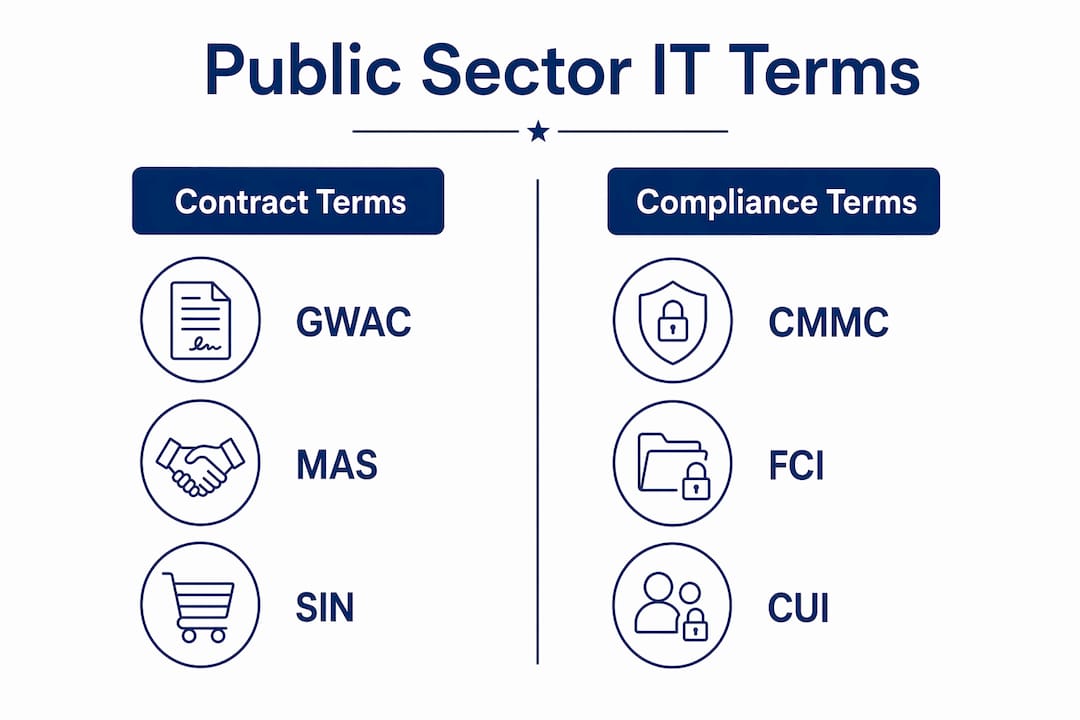
Government-Wide Acquisition Contracts (GWACs) are multi-agency contract vehicles designed for large-scale IT solutions. They allow agencies to purchase technology services without running a full competitive solicitation each time. Multiple Award Schedules (MAS), managed by the GSA, are the most widely used contract vehicle for IT, providing access to cloud, software, hardware, and telecommunications solutions with long-term pre-negotiated pricing for over 1 million commercial products. That scale means agencies can move faster and vendors can reach buyers without starting from scratch on every deal.
Special Item Numbers (SINs) are the classification codes within MAS that organize products and services by category. Knowing the right SIN determines whether your offering appears in the correct procurement search. For example, SIN 518210C is the GSA category for cloud and cloud-related IT services. Precise SIN identification is not administrative detail. It directly affects contract visibility and budget alignment.
Here is a quick reference for the core procurement terms every government IT professional should know:
- GWAC: A pre-competed, multi-agency contract for large IT solutions; examples include NASA SEWP and NIH CIO-SP3.
- MAS: GSA's Multiple Award Schedule, offering pre-negotiated pricing across a broad range of commercial IT products and services.
- SIN: Special Item Number, the category code within MAS that classifies specific products or services for procurement.
- Contract vehicle: Any pre-established agreement that agencies use to purchase goods or services without a new full competition.
- Task order: A specific work order issued against an existing contract vehicle, defining scope, deliverables, and payment terms.
| Term | What it controls |
|---|---|
| GWAC | Access to large-scale IT solutions across multiple agencies |
| MAS | Pre-negotiated pricing for commercial IT products and services |
| SIN | Category classification that determines procurement eligibility |
| Task order | Specific scope and payment within an existing contract |
Pro Tip: Always verify which SIN applies to your service before submitting a GSA Schedule offer. Misclassification under the wrong SIN delays awards and can disqualify proposals.
Which cybersecurity and compliance terms are critical in public sector IT?
Cybersecurity compliance in government IT is built on a precise vocabulary. Using the wrong term in a contract clause or proposal is not just a communication error. It can constitute a compliance failure with legal consequences.
CMMC 2.0 (Cybersecurity Maturity Model Certification) is mandatory for Department of Defense contractors. It operates across three assessment levels. Level 1 requires 17 basic practices, while Level 2 requires 110 practices aligned with NIST SP 800-171. Level 3 involves government-led evaluation for the most sensitive programs. Each level corresponds to the sensitivity of the information a contractor handles.

The distinction between Federal Contract Information (FCI) and Controlled Unclassified Information (CUI) is one of the most consequential in the entire public sector IT glossary. FCI requires baseline cyber hygiene, while CUI triggers the full weight of NIST SP 800-171 and CMMC requirements. Misreading which category applies to your data environment leads directly to compliance failures. Security requirements escalate substantially the moment CUI enters the picture.
FedRAMP (Federal Risk and Authorization Management Program) governs cloud service authorization for federal agencies. A cloud provider must achieve FedRAMP authorization before a federal agency can use its platform. This is not a preference. It is a contractual and regulatory requirement. Understanding FedRAMP status is a prerequisite for any cloud procurement decision.
Key cybersecurity terms every government IT professional must recognize:
- NIST SP 800-171: The NIST publication defining security requirements for protecting CUI in non-federal systems.
- FISMA: Federal Information Security Modernization Act, the law requiring federal agencies to develop and maintain information security programs.
- RMF: Risk Management Framework, the NIST process for authorizing and continuously monitoring federal information systems.
- ATO: Authority to Operate, the formal approval a system must receive before going live in a federal environment.
- POA&M: Plan of Action and Milestones, the document tracking known security weaknesses and remediation timelines.
Pro Tip: Check your contract's data handling clauses before assuming FCI applies. If your work touches any CUI category, your cybersecurity obligations jump to NIST SP 800-171 compliance immediately.
How does federal project management terminology differ from private sector approaches?
Federal project management uses a distinct vocabulary that goes well beyond what a PMP certification covers. Traditional PMP certifications alone are insufficient in government IT contexts because federal acquisition blends technical project management with regulatory and lifecycle requirements.
The FAC-P/PM (Federal Acquisition Certification for Program and Project Managers) is the federal standard for employee competency in IT acquisition project management. Certification spans GS-9 through GS-15 salary grades and covers acquisition methodologies specific to government programs. FAC-P/PM has three levels tied to project complexity, from entry-level oversight to managing major capital investments.
Four federal project management concepts that differ sharply from private sector practice:
- Integrated Master Plan (IMP): A document that ties program events, accomplishments, and criteria to a master schedule. Private sector projects rarely use this structure. Federal programs require it for major acquisitions.
- V-Model (Test and Evaluation): A systems engineering lifecycle model where each development phase has a corresponding test phase. Government IT programs use this to verify requirements at every stage before moving forward.
- Clinger-Cohen Act compliance: Federal IT investments must align with this law, which requires agencies to tie technology spending to measurable mission outcomes. Private sector project managers have no equivalent statutory obligation.
- Earned Value Management (EVM): A performance measurement technique required on many federal contracts that integrates scope, schedule, and cost data. EVM reporting is a contractual deliverable, not an internal management choice.
Pro Tip: If you manage public sector IT projects and hold only a PMP, study FAC-P/PM requirements. Agencies increasingly expect project managers to demonstrate federal acquisition literacy, not just general project management skills.
Why does context matter when reading NIST and government IT definitions?
NIST glossary terms do not carry a single fixed meaning across all government documents. Terms like "Vulnerability" or "Authorization" vary in definition depending on whether the source is FISMA, the Risk Management Framework, or another NIST Special Publication. This is not an oversight. NIST intentionally scopes definitions to the specific publication context.
Practitioners must always reference the specific NIST Special Publication cited in a contract to understand the precise meaning of terms like "system" or "information." A "system" in NIST SP 800-53 carries a different boundary than the same word in NIST SP 800-171. Applying the wrong definition to a contract clause creates scope disputes and audit findings.
"Viewing public sector IT terminology as part of a regulatory lexicon elevates its importance from jargon to binding legal definitions. Ignoring the regulatory lexicon from the Federal Acquisition Regulation legally defines compliance and project scope."
The table below shows how the same term can shift meaning across regulatory contexts:
| Term | NIST SP 800-53 context | NIST SP 800-171 context |
|---|---|---|
| System | Federal information system with defined authorization boundary | Nonfederal system processing, storing, or transmitting CUI |
| Information | Any data within the authorization boundary | Specifically CUI or FCI as defined by contract |
| Authorization | Formal ATO issued by an authorizing official | Implied through CMMC assessment and contract compliance |
The practical implication is direct. When a contract references a NIST publication, that publication's definitions govern. Citing the wrong version or assuming a universal definition creates legal exposure. Always read the specific publication, not a summary or glossary aggregator.
For a detailed IT compliance checklist that maps these definitions to real contract requirements, government IT professionals can use structured reference guides built around specific regulatory contexts.
Key Takeaways
Public sector IT terminology functions as a regulatory lexicon where precise definitions, tied to specific publications and contract clauses, determine compliance, eligibility, and project outcomes.
| Point | Details |
|---|---|
| Contract vehicles matter | GWACs, MAS, and SINs determine vendor eligibility and procurement speed in government IT. |
| FCI vs. CUI is critical | Misidentifying data type triggers the wrong security requirements and causes compliance failures. |
| CMMC 2.0 levels are binding | Each level carries specific practice counts and assessment methods tied to contract obligations. |
| Context governs NIST terms | Always reference the specific NIST Special Publication cited in your contract, not a general glossary. |
| Federal PM differs from PMP | FAC-P/PM, IMP, and EVM are federal-specific requirements that standard project management training does not cover. |
Why terminology mastery is the real competitive edge in government IT
After years of working inside government IT modernization programs, the pattern is consistent. The teams that struggle most are not the ones lacking technical skill. They are the ones that treat terminology as background noise rather than as the operating language of the contract.
I have seen proposals disqualified because a vendor described their offering under the wrong SIN. I have watched compliance reviews stall because a program team conflated FCI with CUI and built the wrong security controls. These are not edge cases. They happen regularly on programs in Maryland, New York, and Florida, where the regulatory environment is dense and contracting officers have little patience for ambiguity.
The uncomfortable truth is that most private sector IT professionals underestimate how much the public sector IT glossary functions as law. The FAR is not a style guide. NIST publications are not suggestions. When a contract clause references NIST SP 800-171, that document's definitions become the legal standard for your work. Getting them wrong is not a communication problem. It is a contract performance problem.
My advice is to treat terminology study the same way you treat technical certification. Build a reference library of the specific NIST Special Publications, FAR clauses, and GSA SIN categories relevant to your contracts. Consult public sector contracting resources that are grounded in current compliance frameworks. And never assume a term means the same thing across two different government documents.
— Randy
Primereadysub: a proven partner for government IT modernization
Primereadysub, operating as Rutledge & Associates, LLC, works directly inside the compliance and procurement frameworks this article covers. Certified as an SDVOSB, woman-owned, and SBA-certified firm, Primereadysub delivers government IT modernization services that align with FAR requirements, NIST standards, and CMMC obligations. The firm specializes in cloud-native re-architecting, compliance automation, and real-time program dashboards for state agencies and government departments across Maryland, New York, and Florida. For prime contractors managing complex, compliance-heavy programs, Primereadysub provides clearly scoped subcontracting with high value and low oversight requirements. Contact Primereadysub to discuss how terminology-aligned modernization support fits your next government IT program.
FAQ
What does GWAC stand for in government IT?
GWAC stands for Government-Wide Acquisition Contract, a pre-competed contract vehicle that allows multiple federal agencies to purchase large-scale IT solutions without running a new full competition each time.
What is the difference between FCI and CUI?
Federal Contract Information (FCI) requires baseline cyber hygiene, while Controlled Unclassified Information (CUI) triggers NIST SP 800-171 and CMMC compliance requirements. The distinction determines which security controls your contract demands.
What is FedRAMP and why does it matter?
FedRAMP is the Federal Risk and Authorization Management Program, which authorizes cloud services for federal use. Agencies cannot legally use a cloud platform in federal environments without a valid FedRAMP authorization.
How does FAC-P/PM differ from a PMP certification?
FAC-P/PM is the federal certification for acquisition project management, covering government-specific frameworks like EVM and the Clinger-Cohen Act. A PMP covers general project management principles and does not address federal acquisition requirements.
Why do NIST term definitions vary across publications?
NIST scopes definitions to the specific Special Publication in which they appear. A term like "system" carries different boundaries in NIST SP 800-53 versus NIST SP 800-171, so always reference the publication cited in your contract for the governing definition.