
Selecting the wrong partnership model for a government IT modernization project doesn't just slow things down — it can trigger compliance failures, cost overruns, and audit findings that take years to resolve. Yet procurement officers routinely face a landscape filled with overlapping structures: public-private partnerships, government-wide acquisition contracts, hybrid arrangements, and traditional task order agreements. Each carries distinct risk profiles, subcontracting rules, and performance expectations. Understanding how these models work, where they differ, and which fits a given modernization context is the clearest path from procurement uncertainty to contract-ready execution.
Table of Contents
- Understanding key public-sector partnership models
- Comparing structuring options: PPP, GWAC, and hybrid approaches
- Evaluating financial and operational impacts
- Best practices for choosing and building effective partnerships
- What most procurement guides miss about partnership models
- Prime-ready IT partnerships for public-sector modernization
- Frequently asked questions
Key Takeaways
| Point | Details |
|---|---|
| Model choice matters | Selecting the right partnership model can significantly affect cost, risk-sharing, and IT modernization success. |
| Subcontracting builds advantage | Strategic subcontracting under primes develops past performance and expands future contract opportunities. |
| Value-for-money is vital | Major projects require rigorous VfM analysis to ensure optimal outcomes for public spending. |
| Hybrid approaches support flexibility | Combining GWACs, PPPs, and traditional contracts delivers the agility needed for modern digital infrastructure. |
| Past performance drives future wins | Showcasing achievements through well-managed partnerships is key to securing future IT modernization contracts. |
Understanding key public-sector partnership models
Effective IT modernization starts with model clarity. Procurement officers who conflate a GWAC task order with a PPP structure, or who treat all subcontracting arrangements as equivalent, tend to discover the difference only after scope disputes or compliance audits surface. Building a working knowledge of the major frameworks is not academic — it directly shapes how costs are allocated, how risks are shared, and how much flexibility an agency retains during execution.
Public-Private Partnerships (PPPs) are long-term contractual arrangements between government agencies and private sector entities to deliver public infrastructure or services. In IT contexts, they often involve shared financing, risk transfer, and operations. Common PPP model structures include:
- Build-Operate-Transfer (BOT): The private party builds and operates a system for a defined period, then transfers ownership to the government.
- Build-Operate-Own (BOO): The private entity retains permanent ownership, which suits commercial digital infrastructure where ongoing private investment is expected.
- Design-Build (DB): The private party designs and builds for a fixed fee, while the government retains operational ownership.
- Design-Build-Finance-Maintain (DBFM): Adds private financing and long-term maintenance responsibilities to the DB model.
- Design-Build-Finance-Maintain-Operate (DBFMO): The most integrated structure, where the private partner handles every phase from design through operations.
These structures matter because they determine who bears technology obsolescence risk, who is responsible for security patching, and who owns the data architecture at project close.
Government-Wide Acquisition Contracts (GWACs) and Multiple-Award Indefinite Delivery, Indefinite Quantity (MA-IDIQ) contracts are the dominant vehicles for federal IT modernization. They allow agencies to issue task orders against pre-competed contract vehicles rather than conducting full and open competitions for every project. This dramatically reduces procurement lead time and creates a competitive pool of pre-vetted vendors.
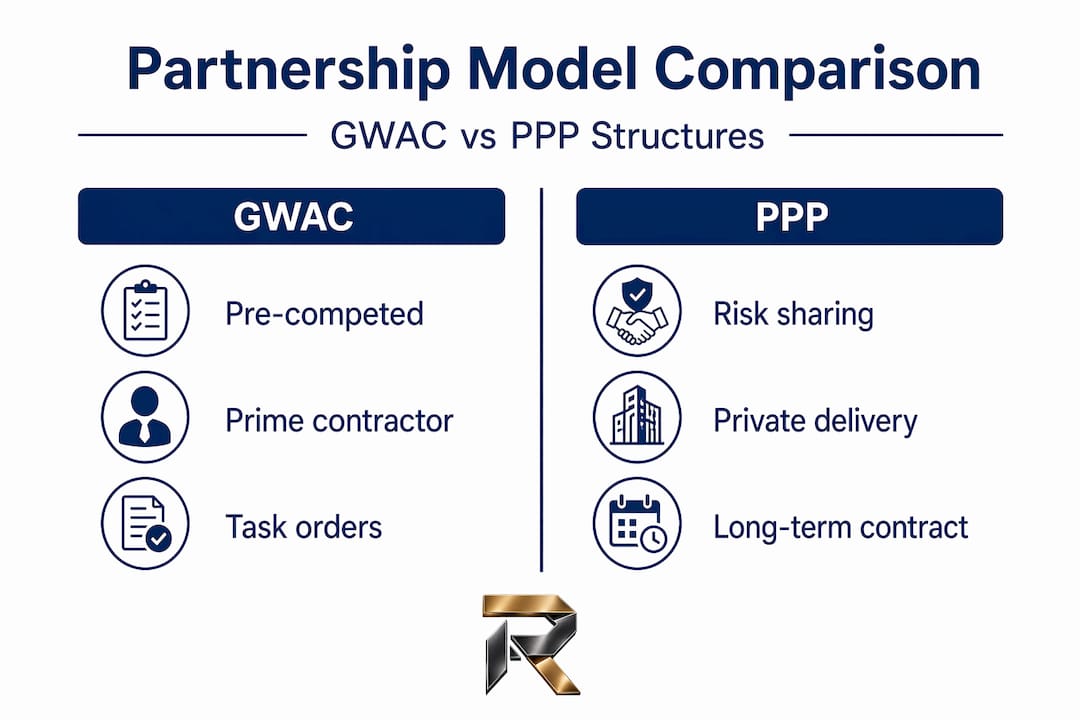
Traditional contracting, by contrast, involves standalone solicitations for each project. This approach offers more customization but demands more procurement resources and takes longer to execute. For agencies managing multiple concurrent modernization efforts, the overhead of traditional contracting quickly becomes prohibitive.
Understanding which model fits which context is the starting point for successful IT partnerships. A thorough partner selection guide should always begin by mapping the procurement model to the operational outcome being sought.
| Model | Risk transfer | Ownership | Best IT use case |
|---|---|---|---|
| BOT | High to private | Returns to government | Data center builds |
| BOO | Full to private | Private retains | SaaS platforms |
| DB | Moderate | Government | Custom software builds |
| DBFMO | Maximum to private | Government or private | End-to-end cloud migration |
| GWAC/MA-IDIQ | Shared | Government | Ongoing IT services |
| Traditional contract | Government bears most | Government | One-time system upgrades |
Comparing structuring options: PPP, GWAC, and hybrid approaches
With foundational knowledge in place, the practical question becomes: which structure actually delivers results for a given IT modernization scenario? Each model has a distinct operational profile.
Federal IT GWACs like Alliant 2, STARS III, and VETS 2 are MA-IDIQ contracts enabling task orders for IT services. Primes frequently subcontract to specialized firms, but they must comply with limitations on subcontracting under FAR 52.219-14. That rule exists specifically to prevent "pass-through" arrangements where a prime adds no meaningful value and simply routes work to subcontractors while collecting a markup.
- Alliant 2 covers a broad spectrum of IT services for large federal agencies, including cloud, cybersecurity, and data analytics.
- STARS III is a small business set-aside vehicle, making it the primary pathway for SDVOSB-certified and other small business primes to compete for federal IT work.
- VETS 2 is specifically reserved for service-disabled veteran-owned small businesses, creating a direct pathway for SDVOSB primes delivering IT modernization.
Hybrid models blend GWAC task orders with elements of traditional contracting or PPP structures. They appear most often when an agency needs both ongoing IT services (well served by a GWAC) and a major infrastructure or platform build (better suited to a BOT or DBFM arrangement). For example, a state agency modernizing a benefits administration system might use a GWAC for cloud migration and security services while using a separate design-build contract for the core application.
As a prime contractor guide perspective confirms, the key to hybrid success is clear scope delineation. Overlapping scopes between contracts create conflicting accountability structures that auditors flag quickly.

Edge cases deserve specific attention. GWACs limit subcontracting to prevent pass-through arrangements. DBFMO structures are not appropriate for sectors needing direct public operational control. Digital infrastructure involving AI platforms requires customized arrangements because standard PPP models do not adequately address model governance, algorithmic accountability, or data sovereignty.
Pro Tip: When evaluating a GWAC versus a PPP for an IT modernization project, map the subcontracting compliance requirements first. A GWAC vehicle with FAR 52.219-14 compliance obligations can disqualify certain teaming arrangements before negotiations even begin.
Building a contract-ready IT partnership requires knowing which vehicle the prime holds before any teaming discussions occur. Agencies that skip this step often find that their preferred partner cannot legally perform the majority of the work under the applicable contract rules.
For flexible IT contracting in state and local government, where federal GWACs may not apply, cooperative purchasing agreements and state-level MA-IDIQ contracts serve a similar function. The structural logic is the same: pre-compete the vendor pool, then issue task orders as needs emerge.
Evaluating financial and operational impacts
After settling on a structural approach, the financial case for each model must be examined rigorously. For major projects, this is not optional. Value for Money (VfM) analysis is required for projects over $750 million or P3s under the Infrastructure Investment and Jobs Act (IIJA), comparing P3 delivery to traditional procurement.
VfM analysis works by building a Public Sector Comparator — a financial model of what the project would cost if delivered entirely through traditional government procurement. That baseline is then compared against the projected cost of each partnership model, adjusted for risk transfer value, financing costs, and the estimated benefit of private sector efficiency. When PPPs produce lower risk-adjusted costs, VfM analysis makes that case with documented evidence.
Empirical benchmarks from real deployments demonstrate what the models can achieve:
- A Sweden spine surgery PPP reduced costs by 11% while increasing patient throughput by 22%, demonstrating that PPP efficiency gains are measurable in service delivery terms, not just capital cost.
- Virginia's Chesapeake Bay program uses a PPP structure that pays for verified pollution reductions, a performance-based model directly applicable to outcome-based IT contracts.
- The Georgia Technology Authority's cloud migration program saved 60% to 70% in infrastructure costs by moving workloads to cloud, illustrating the financial case for modern IT partnership models over legacy on-premises approaches.
"The financial rationale for partnership models in IT modernization is not theoretical. When structured correctly, they consistently outperform traditional procurement on cost, speed, and measurable service outcomes." — Rutledge & Associates, LLC
Key financial tradeoffs procurement officers should anticipate include:
- Financing premium: PPPs with private financing carry higher interest costs than government borrowing. This premium must be offset by efficiency gains to achieve a positive VfM outcome.
- Transaction costs: Negotiating and structuring complex partnership agreements takes time and legal resources. For smaller IT projects, these costs may outweigh the benefits.
- Performance risk allocation: DBFMO structures transfer the most risk to private partners, which typically commands a higher contract price but reduces government exposure to cost overruns.
- Technology refresh cycles: IT assets depreciate faster than physical infrastructure. Contracts must explicitly address who bears the cost of technology refresh every three to five years.
Pro Tip: Build technology refresh cycles into the initial contract rather than treating them as future modifications. Retroactive negotiations for refresh funding are consistently more expensive than proactive provisions built into the base agreement.
Strategic IT partnerships that survive budget cycles and administration changes tend to have explicit performance metrics and financial triggers built into their governance structures. When modernization and compliance objectives align with financial incentives from the outset, partners have concrete reasons to deliver.
Best practices for choosing and building effective partnerships
Structural knowledge and financial analysis only produce results when translated into actionable procurement practice. Procurement officers and contracting officers who consistently achieve successful IT modernization outcomes follow a recognizable pattern.
-
Build past performance through structured subcontracting. Agencies and firms new to GWAC vehicles should start by subcontracting under established primes. This generates documented performance data that strengthens future prime bids. Alliant 2 guidance specifically recommends using Delegation of Procurement Authority (DPA) for task orders and focusing on integral ancillary support in IT GWACs to maintain compliance and build a credible record.
-
Select prime partners based on delivery capacity, not just certifications. A prime's socioeconomic certifications matter for set-aside compliance, but procurement officers should independently verify the prime's technical bench, subcontractor relationships, and history of on-time, on-budget delivery on comparable IT systems.
-
Negotiate task order structures before the procurement cycle opens. Primes with GWAC access often accept pre-solicitation teaming discussions. Using this window to align scope, labor categories, and compliance expectations prevents renegotiation after award, which is consistently slower and more contentious.
-
Audit subcontracting compliance proactively. FAR 52.219-14 limitations on subcontracting are not self-enforcing. Contracting officers who build audit checkpoints into the contract administration plan catch compliance drift before it becomes a corrective action.
-
Define outcomes, not just deliverables. The most resilient IT modernization contracts specify measurable outcomes — processing time reductions, uptime guarantees, audit readiness rates — rather than just deliverable lists. Outcome-focused contracts align partner incentives with agency needs and simplify performance evaluation.
For a detailed breakdown of how these principles apply across GWAC vehicles and partnership types, the IT modernization partnerships resource provides actionable contract-level guidance.
What most procurement guides miss about partnership models
Standard procurement guides treat partnership model selection as a classification exercise. They list the models, define the terms, and leave the reader to match their project to a category. That framing misses the most consequential variable in IT modernization outcomes: the quality and adaptability of the specific partner relationship, not the contract structure itself.
Two agencies can use identical GWAC task order structures for nearly identical cloud migration projects and achieve radically different results. The difference is almost never the contract vehicle. It is whether the prime and subcontracting team have a genuine performance record together, whether scope boundaries are written to prevent scope creep under ambiguity, and whether the technical staff actually understand the legacy systems being replaced.
The over-reliance on "best practice" templates is particularly risky in digital transformation contexts. Traditional PPP frameworks were designed for physical infrastructure — roads, hospitals, water treatment facilities — where the asset being built is relatively stable over a 20- to 30-year contract period. IT infrastructure is fundamentally different. An AI-driven data platform contracted today under a standard DBFMO structure may be technically obsolete before the maintain-and-operate phase even begins.
This is why performance-driven, modular partnership structures are gaining ground over monolithic arrangements. Modular approaches allow agencies to re-compete specific components — say, the analytics layer or the security operations center — as technology evolves, without unwinding the entire contract relationship. This flexibility is not built into traditional PPP models by default; it has to be negotiated explicitly.
The other gap that standard guides consistently undervalue is the role of certified small businesses as specialized delivery partners. Procurement officers often treat SDVOSB, woman-owned, and SBA certifications as checkboxes for set-aside compliance. In practice, the most capable specialized firms in areas like DevOps automation, compliance engineering, and real-time data architecture are frequently small businesses. Treating them as commodities rather than prime contractor insights partners is a consistent source of missed value in IT modernization programs.
The agencies that get IT modernization right tend to ask a different question. Instead of asking "which model should we use," they ask "what outcomes do we need, and which partner structure creates the strongest incentive alignment to deliver them." That reframe changes everything from how RFPs are written to how contractor performance is evaluated.
Prime-ready IT partnerships for public-sector modernization
Procurement officers navigating IT modernization need more than frameworks — they need partners who are already positioned to perform. Rutledge & Associates, LLC brings certified SDVOSB, woman-owned, and SBA status together with demonstrated delivery in cloud migration, compliance automation, and real-time program visibility. The firm operates as a high-value, low-oversight subcontractor for prime contractors engaged in compliance-heavy public sector programs, owning clearly defined scopes rather than providing general staff augmentation. Agencies and primes in Maryland, New York, and Florida can explore how Rutledge & Associates fits their modernization pipeline by reviewing prime-ready partner options or connecting directly with the Maryland IT prime team for state-level engagement.
Frequently asked questions
What is a public-private partnership (PPP) in IT modernization?
A PPP in IT modernization is a long-term contract where government and private entities share risks, costs, and delivery responsibilities for modernizing public-sector IT infrastructure, ranging from cloud migration to full digital platform development.
How do GWACs help federal IT procurement?
GWACs enable agencies to contract a range of IT services efficiently through pre-competed vehicles, with primes managing specialized subcontractors under FAR 52.219-14 compliance rules that prevent pass-through arrangements.
What is Value for Money (VfM) analysis in public contracts?
VfM analysis compares partnership models to traditional delivery to ensure the selected approach delivers the best return and lowest risk; it is required for major projects over $750 million under IIJA.
What are the key risks when structuring IT partnerships?
Key risks include mismatched models, unclear roles, and subcontracting compliance failures, particularly for AI and digital infrastructure projects where standard PPP frameworks do not address model governance or data sovereignty.
How can agencies build past performance for future contracts?
Agencies and firms should start by subcontracting under established primes, track outcomes against defined metrics, and use DPA task orders to build a documented, credible performance record that supports future prime bids.