

IT procurement is defined as the end-to-end process of identifying, sourcing, evaluating, contracting, and managing technology products and services that a public sector organization needs to operate. This covers hardware, software, cloud services, and professional IT services. Modern IT procurement has evolved from transactional buying into a strategic discipline that directly shapes cost control, regulatory compliance, and operational resilience. For government agencies and state departments, a structured IT procurement process is not optional. It is the mechanism that protects public funds, reduces vendor risk, and keeps technology investments aligned with mission outcomes.
What is IT procurement and why does it matter for government agencies?
IT procurement is the structured cycle through which public sector organizations acquire the technology they need, from the first identification of a business need through to ongoing vendor performance management. The process spans hardware such as servers and workstations, software licenses, cloud platforms like Microsoft Azure or AWS GovCloud, and contracted IT professional services. Each category carries distinct evaluation criteria, contract structures, and compliance obligations.
The strategic importance of this process is measurable. Structured procurement can reduce technology costs by up to 30% while improving system reliability. That figure reflects the compounded effect of competitive sourcing, volume licensing negotiations, and eliminating redundant or underused technology. For a state agency managing a multimillion-dollar IT budget, a 30% reduction represents real reallocation capacity toward citizen services.

Public sector organizations also face accountability obligations that private firms do not. Procurement decisions are subject to audit, public records requests, and legislative oversight. A documented, repeatable IT procurement cycle provides the paper trail that satisfies those obligations and protects decision-makers from personal liability.
What are the key steps in the IT procurement process for public sector organizations?
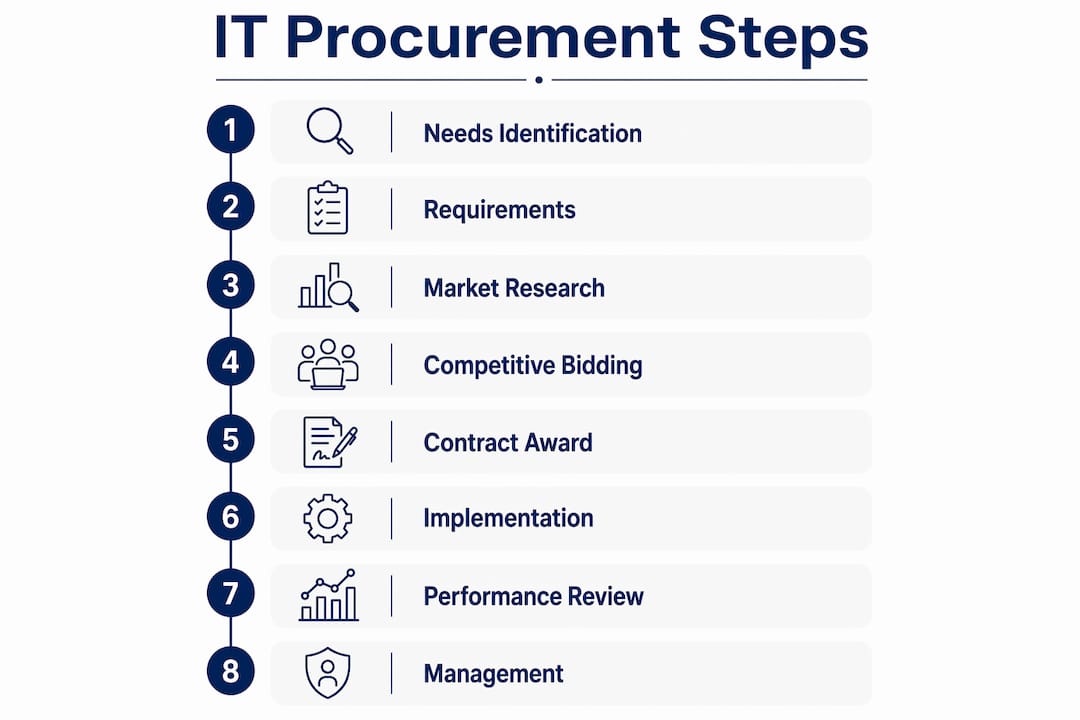
The IT procurement process follows a sequential lifecycle. Each step builds on the previous one, and skipping steps is where most procurement failures originate.
- Needs identification. Define the business problem the technology must solve. Avoid starting with a product in mind.
- Requirements documentation. Specify functional requirements, integration constraints, security standards, and success metrics at six and twelve months post-implementation.
- Market research and vendor shortlisting. Survey the available market. Identify vendors with a proven track record in public sector environments.
- Request for Proposal or Request for Quote. Issue formal solicitation documents that give vendors equal information and allow objective comparison.
- Competitive benchmarking and evaluation. Score vendor responses against predefined criteria. For any IT purchase exceeding $5,000 annually or $10,000 in total contract value, at least three credible vendor options must be evaluated before contract negotiation begins.
- Contract negotiation and approval. Secure favorable terms on pricing, service levels, data ownership, exit clauses, and scaling options.
- Implementation planning and rollout. Coordinate with IT, finance, and end-user departments to execute the transition with minimal disruption.
- Ongoing vendor management. Monitor performance against contract terms, conduct periodic reviews, and document outcomes for future procurement cycles.
Materiality thresholds matter here. Purchases below the $5,000 or $10,000 thresholds can follow a simplified process. This prevents over-engineering routine purchases while preserving rigor for high-value contracts.
Pro Tip: Document your six-month and twelve-month success metrics before issuing any RFP. Vendors who cannot map their solution to your defined outcomes are filtered out early, saving evaluation time and reducing scope creep after contract award.
How does structured IT procurement reduce costs and mitigate risks?
Cost reduction in IT procurement comes from three mechanisms: competitive pressure, licensing discipline, and lifecycle management. When vendors know they are competing against at least two other qualified options, pricing behavior changes. Volume licensing negotiations, particularly for enterprise software from vendors like Microsoft, Oracle, or Salesforce, yield significant discounts when procurement teams arrive with documented usage data and multi-year commitment options.
Risk mitigation operates on a parallel track. Key risk controls include:
- Vendor financial stability checks. A vendor that fails mid-contract creates operational and legal exposure for the agency.
- Security standard verification. ISO 27001 and SOC 2 certifications during vendor evaluation are non-negotiable for public sector environments handling sensitive citizen data. Platforms like IntelliAudit AI provide AI-assisted compliance audits that accelerate this verification step.
- Contract flexibility terms. Licensing agreements must include scaling options and exit provisions. Contracts that lock agencies into fixed capacity for multi-year terms create budget exposure when needs change.
- Shadow IT prevention. Unmanaged technology spend grows when the official procurement process is too slow or complex. Shadow IT is best controlled by making the official process faster and easier, not by adding enforcement layers.
"Procurement without a structured process typically results in vendor advantage and poor contract terms. The agency that arrives unprepared cedes negotiating leverage before the conversation begins." — IT Procurement Best Practices
Data-driven procurement decisions also reduce risk. Agencies that track utilization rates, incident frequency, and vendor response times have objective grounds for contract renewal, renegotiation, or termination. Gut-feel procurement is the single largest driver of vendor lock-in.
What best practices and compliance considerations should public sector teams follow?
Effective IT procurement in the public sector requires coordination across IT, procurement, finance, legal, and end-user departments. Siloed procurement decisions, where IT buys without finance input or procurement acts without IT's technical guidance, produce contracts that are either technically inadequate or financially unsound.
The following comparison illustrates the difference between reactive and structured procurement approaches:
| Practice area | Reactive procurement | Structured procurement |
|---|---|---|
| Vendor selection | Familiarity or convenience | Competitive benchmarking with 3+ options |
| Requirements | Informal or verbal | Documented with success metrics |
| Security review | Post-contract | Embedded in vendor evaluation |
| Contract terms | Vendor-drafted defaults | Negotiated with agency-favorable clauses |
| Performance tracking | Ad hoc complaints | Scheduled reviews against defined KPIs |
Continuous vendor performance reviews are not administrative overhead. They are the mechanism through which agencies improve contract outcomes over successive procurement cycles. An agency that documents vendor performance systematically builds institutional knowledge that strengthens its position in every future negotiation.
Selecting IT partners with verified compliance credentials, particularly ISO 27001 and SOC 2, reduces the security audit burden during each procurement cycle. Agencies that build a pre-qualified vendor list cut evaluation timelines significantly.
Pro Tip: Avoid the "procurement habit" trap. Many agencies default to renewing with incumbent vendors because the process of evaluating alternatives feels burdensome. Schedule a competitive review at least 90 days before any contract renewal date to preserve genuine leverage.
How is modern IT procurement adapting to complex SaaS portfolios?
The scale of technology management has changed fundamentally. The average organization now manages 305 SaaS applications, a figure that reflects years of decentralized purchasing decisions, departmental shadow IT, and vendor proliferation. For public sector agencies, this fragmentation creates audit exposure, redundant licensing costs, and security gaps. Centralized governance is the structural response.
Modern IT procurement strategies address this complexity through several mechanisms:
- Centralized SaaS inventory. Agencies that maintain a live catalog of all licensed applications, mapped to active users and contract renewal dates, can identify redundancy and eliminate waste before renewal cycles.
- Procurement automation. Tools that automate approval workflows, vendor onboarding documentation, and contract tracking reduce processing time and human error. This directly addresses the speed problem that drives shadow IT adoption.
- Lifecycle management discipline. Every technology asset requires a defined path through acquisition, active use, renewal evaluation, and decommissioning. Agencies without lifecycle policies accumulate zombie licenses and unsupported software.
- Vendor consolidation. Reducing the number of vendors serving overlapping functions lowers administrative overhead, simplifies security reviews, and often unlocks volume pricing. A state agency running four separate project management tools across departments can typically consolidate to one platform with better terms than any individual contract.
The table below maps common SaaS governance challenges to procurement responses:
| Challenge | Procurement response |
|---|---|
| Redundant applications | Centralized SaaS inventory with utilization tracking |
| Unmanaged renewals | Automated renewal calendar with 90-day review triggers |
| Shadow IT growth | Faster official procurement process with self-service options |
| Vendor fragmentation | Strategic consolidation with preferred vendor agreements |
| Security gaps | Mandatory compliance verification at onboarding |
Improving contract outcomes in this environment requires procurement teams to think beyond individual transactions. The goal is a managed portfolio, not a collection of isolated purchases.
Key takeaways
Structured IT procurement is the single most effective mechanism public sector agencies have for controlling technology costs, managing vendor risk, and maintaining audit-ready compliance.
| Point | Details |
|---|---|
| Define success metrics early | Document six and twelve-month performance benchmarks before issuing any RFP to prevent scope creep. |
| Apply materiality thresholds | Require competitive benchmarking with three or more vendors for contracts exceeding $5,000 annually or $10,000 total. |
| Embed security audits in evaluation | Verify ISO 27001 and SOC 2 compliance during vendor selection, not after contract award. |
| Centralize SaaS governance | Maintain a live application inventory to eliminate redundant licenses and close security gaps across 300+ applications. |
| Speed prevents shadow IT | A faster, accessible procurement process reduces unmanaged technology spend more effectively than enforcement. |
Why IT procurement discipline separates high-performing agencies from the rest
From where I sit, working alongside public sector agencies on technology modernization, the most consistent differentiator between agencies that control their technology costs and those that do not is procurement discipline. Not budget size. Not staff headcount. Discipline.
The agencies that struggle most are not the ones with the smallest budgets. They are the ones that treat procurement as a formality rather than a strategic function. They renew contracts with incumbent vendors because the evaluation process feels like too much work. They approve departmental software purchases informally because the official process takes too long. Then they wonder why their technology portfolio is fragmented, their audit findings are recurring, and their vendors hold all the leverage.
What I have observed consistently is that the agencies making the most progress are the ones that invest in the front end of the procurement cycle: requirements documentation, competitive benchmarking, and vendor compliance verification. These steps feel slow in the moment. They pay back in every contract negotiation, every audit cycle, and every technology transition that follows.
The shift from transactional buying to strategic procurement is not a technology problem. It is an organizational behavior problem. And it is entirely solvable with the right process and the right partners.
— Randy
How Primereadysub supports public sector IT procurement
Primereadysub, the public-facing brand of Rutledge & Associates, LLC, works directly with state agencies and government departments to bring structure and accountability to technology acquisition and modernization. As an SDVOSB, woman-owned, and SBA-certified firm, Primereadysub delivers outcome-focused IT modernization services that integrate procurement discipline from the first requirements document through to post-implementation performance reviews. Whether your agency is managing a complex SaaS portfolio, preparing for a major infrastructure contract, or working to close recurring audit findings, Primereadysub provides the technical depth and compliance expertise to move from reactive purchasing to strategic technology management. Explore IT modernization solutions built for public sector accountability, or review Maryland-specific services for regional agencies ready to modernize.
FAQ
What is IT procurement in simple terms?
IT procurement is the structured process of identifying, purchasing, and managing technology products and services an organization needs to operate. It covers hardware, software, cloud platforms, and IT professional services from initial needs assessment through ongoing vendor management.
How many steps are in the IT procurement cycle?
The standard IT procurement cycle includes eight steps: needs identification, requirements documentation, market research, formal solicitation, competitive evaluation, contract negotiation, implementation, and ongoing vendor management. Public sector agencies must document each step to satisfy audit and oversight requirements.
Why does competitive benchmarking matter in IT procurement?
Competitive benchmarking with at least three credible vendor options is required for contracts above materiality thresholds and prevents agencies from overpaying or accepting unfavorable contract terms. It also provides documented justification for vendor selection decisions during audits.
What is shadow IT and how does procurement prevent it?
Shadow IT refers to technology purchased or used outside the official procurement process, creating security gaps and untracked spending. Preventing shadow IT is most effective when the official procurement process is made faster and easier to use, reducing the incentive for departments to bypass it.
How does the public sector manage a growing SaaS portfolio?
Public sector agencies manage SaaS complexity through centralized application inventories, automated renewal tracking, and strategic vendor consolidation. With the average organization managing over 300 SaaS applications, governance structures that provide real-time visibility into licensing and usage are no longer optional.