

Improving contract outcomes in government technology procurement is defined as the systematic application of performance-based contracting models, structured negotiation tactics, real-time compliance monitoring, and standardized playbooks to maximize mission success, cost control, and accountability. Contract managers and procurement professionals who understand how to improve contract outcomes gain a measurable edge in an environment where federal policy, budget scrutiny, and technology complexity are all intensifying simultaneously. The 2026 White House directive now mandates fixed-price, performance-based contracts as the default for executive branch agencies, reshaping how public-sector IT deals are structured from the ground up. Tools like contract lifecycle management (CLM) dashboards, BATNA frameworks, and negotiation playbooks are no longer optional. They are the operational standard for agencies that want results.
How do fixed-price, performance-based contracts improve outcomes for government IT projects?
Fixed-price contracting is the model in which a contractor agrees to deliver defined outputs at a set price, placing cost overrun risk on the vendor rather than the agency. This structure directly aligns contractor profit with meeting deliverables and controlling costs, a dynamic that cost-reimbursement models historically fail to replicate. Under cost-reimbursement arrangements, poorly defined deliverables and weak cost control incentives routinely produce budget overruns and schedule slippage on government IT programs.
The 2026 White House order goes further than prior guidance. It mandates fixed-price contracts with performance-based considerations as the procurement default for all executive branch agencies, requiring agencies to review and adjust their 10 largest non-fixed-price contracts within 90 days. This is not a recommendation. It is a binding directive that changes how contract managers must structure new awards and renegotiate existing ones.
The practical benefits of this shift for government IT procurement include:
- Cost predictability. Agencies receive defined deliverables at a locked price, making budget forecasting more reliable across multi-year modernization programs.
- Contractor accountability. Vendors bear the financial consequence of scope creep or inefficiency, creating a direct incentive to perform.
- Cleaner scope definition. Fixed-price contracts require precise statements of work upfront, which reduces ambiguity and downstream disputes.
- Performance incentives. Adding performance-based elements, such as award fees tied to SLA achievement, further motivates quality delivery beyond minimum compliance.
- Audit readiness. Defined deliverables and measurable outcomes produce cleaner audit trails for Inspector General reviews and congressional oversight.
Pro Tip: When transitioning an existing cost-reimbursement contract to a fixed-price structure, map every current deliverable to a measurable output standard before renegotiating. Vague scope language that was tolerable under cost-reimbursement becomes a liability under fixed-price terms.
Agencies implementing flexible contracting models for IT projects report that the discipline required to define scope precisely at award also reduces mid-contract change orders, which are a primary driver of cost growth in government technology programs.
What negotiation strategies enhance contract outcomes in government procurement?
Negotiation preparation is the single most reliable predictor of contract quality. Harvard Business School identifies three tools that prevent aimless bargaining and enable strategic concessions for better contract terms: BATNA (best alternative to a negotiated agreement), walkaway point, and an estimate of the counterparty's zone of possible agreement (ZOPA).
Applying these tools in a government procurement context requires deliberate pre-negotiation analysis. The following sequence reflects research-based best practices for improving contract negotiation in public-sector IT deals:
- Define your BATNA. Identify the best outcome your agency can achieve if this negotiation fails. For IT procurements, this might mean an existing contract extension, an in-house solution, or a competing vendor. A clear BATNA prevents conceding on terms that fall below your actual alternatives.
- Set your walkaway point. Determine the minimum acceptable terms on price, SLA thresholds, data security requirements, and delivery timelines before entering any discussion. Walkaway points must be documented, not improvised at the table.
- Estimate the vendor's ZOPA. Research the vendor's cost structure, competitive position, and prior contract awards through sources like USASpending.gov and FPDS-NG. Understanding where the vendor can realistically move gives you a map of the negotiable space.
- Sequence concessions deliberately. Trade lower-value concessions early to build momentum, then protect high-value terms like performance penalties and data rights. Concession sequencing shapes the vendor's perception of what is achievable.
- Use data to anchor positions. Cite comparable contract awards, market rate benchmarks, and agency-specific performance history to justify your positions. Data-anchored arguments are harder to counter than preference-based ones.
Pro Tip: Negotiators who shape the ZOPA by presenting well-researched market data early in discussions consistently secure better terms than those who respond reactively to vendor proposals. Preparation is leverage.
Strategies for better contract results also require recognizing when a negotiation has reached its productive limit. Continuing to negotiate past the point of mutual value creation produces resentment and damages the working relationship that contract execution depends on.

How can continuous contract performance monitoring improve compliance and outcomes?
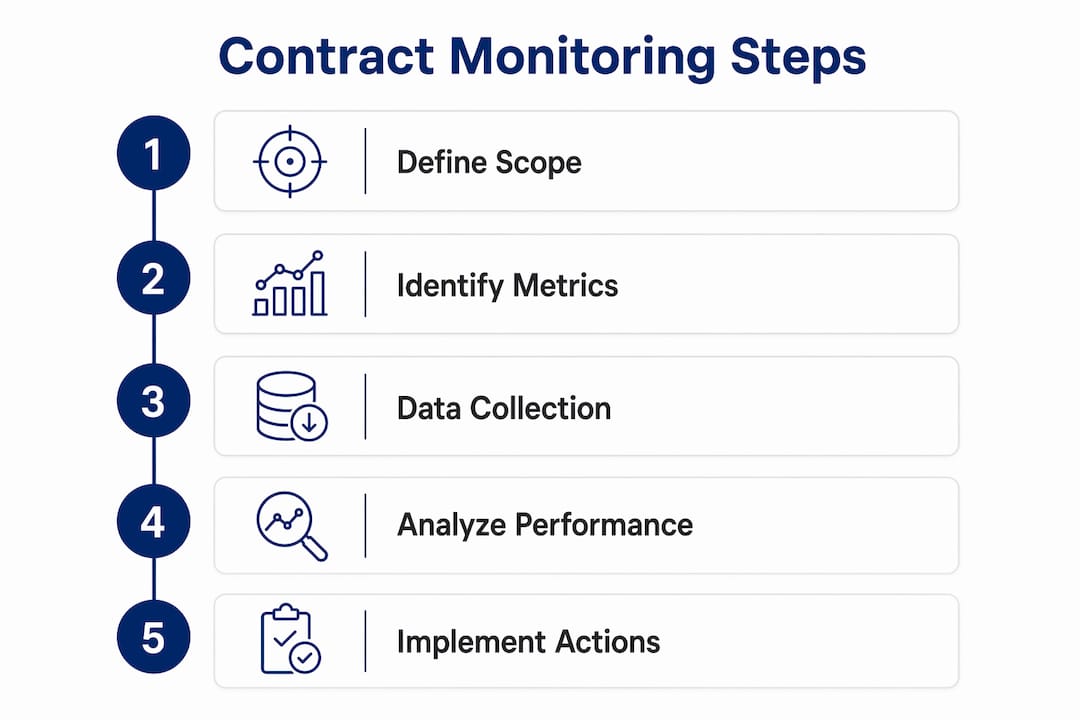
Treating contracts as execution layers rather than filing objects is the foundational shift that separates agencies with strong compliance records from those that discover problems at audit time. Contract lifecycle management (CLM) tools with real-time dashboards and automated alerts replace the periodic review cycle with continuous visibility into SLA performance, obligation status, and risk indicators.
Effective contract performance management requires a clear baseline before monitoring can function. Identifying critical deliverables and translating vague commitments into measurable standards before final signature is the prerequisite step. Securing stakeholder agreement to those metrics in the contract record creates the reference point that all subsequent monitoring is measured against.
The table below outlines the core components of a continuous monitoring framework for government technology contracts:
| Component | Function | Example in Government IT |
|---|---|---|
| CLM dashboard | Centralizes all contract data and tracks obligation status in real time | Displays SLA compliance rates across a cloud migration program |
| Automated alerts | Triggers notifications when KPI thresholds are breached or deadlines approach | Flags a missed security patch delivery 14 days before penalty triggers |
| Named obligation owners | Assigns accountability for each contract requirement to a specific individual | Program manager owns uptime SLA; ISSO owns security compliance milestones |
| Performance baseline | Defines measurable standards for all key deliverables | 99.5% system availability, 4-hour incident response time |
| Escalation workflow | Routes unresolved issues to senior management before they become contractual defaults | Automatic escalation if SLA breach is unresolved after 72 hours |
Automated alerts and AI-driven insights are particularly valuable in large government contract portfolios where a single contracting officer may manage dozens of active agreements. Technology platforms that centralize agreement data and link it to live execution data produce the transparency that both agency leadership and oversight bodies require.
Practitioners who select performance metrics should apply criteria including relevance, completeness, timeliness, simplicity, and cost-effectiveness. Metrics that are available but not decision-useful generate reporting noise without improving outcomes. The "Core-Plus-Tail" reporting approach, developed through Naval Postgraduate School research, addresses this by pairing universal core metrics with category-specific indicators tailored to the contract type.
What role does a negotiation playbook play in sustaining improved contract outcomes?
A contract negotiation playbook is a structured reference document that defines the agency's preferred, acceptable, and walkaway positions for every major clause type, along with guidance notes and escalation protocols. Enforcing reviewer positions through a regularly maintained playbook improves negotiation consistency and produces measurably better outcomes over time.
The three-position structure is the core of any effective playbook:
- Preferred position. The clause language the agency wants in every contract. This is the opening position in any negotiation.
- Acceptable position. The fallback language the agency can live with. This defines the concession boundary for reviewers without requiring senior escalation.
- Walkaway position. The minimum terms below which the agency will not proceed. Any vendor position that falls below this threshold triggers a mandatory escalation to legal counsel or senior procurement leadership.
Beyond clause language, playbooks include escalation rules and clear guidance notes that empower junior reviewers to handle routine negotiations independently while surfacing genuinely complex issues to experienced staff. Integration into contract review workflows, including AI tools that flag deviations automatically, maximizes enforcement without adding manual review burden.
Pro Tip: Schedule quarterly playbook reviews and pull analytics on which clauses generated the most deviations in the prior period. Patterns in deviation data reveal where vendor pressure is concentrated and where your walkaway floors may need recalibration.
The comparison below illustrates the difference between ad hoc contract review and playbook-driven review:
| Dimension | Ad hoc review | Playbook-driven review |
|---|---|---|
| Consistency | Varies by reviewer experience | Standardized across all reviewers |
| Escalation | Informal, often delayed | Defined triggers, automatic routing |
| Training value | Low; knowledge stays with individuals | High; guidance notes transfer institutional knowledge |
| Analytics | None | Tracks deviation patterns and negotiation trends |
| Maintenance | None | Quarterly updates based on outcome data |
Playbook analytics also serve a training function. When deviation patterns show that junior reviewers consistently concede on data rights clauses, that signals a gap in training or guidance note clarity, not just a negotiation failure.
How to integrate these strategies into government agency workflows
Implementing these strategies requires deliberate sequencing rather than parallel deployment. Agencies that attempt to adopt fixed-price contracting, CLM platforms, and negotiation playbooks simultaneously without a phased plan typically see adoption failures in at least one area.
- Train procurement and program staff on fixed-price principles. Begin with the 2026 federal mandate requirements. Staff need to understand not just what fixed-price contracts require but why the shift from cost-reimbursement changes their day-to-day responsibilities in scope definition and performance measurement.
- Establish cross-functional contract performance teams. Assign a contracting officer, program manager, and technical lead to each major IT contract. Shared ownership of performance outcomes prevents the accountability gaps that allow SLA breaches to go unaddressed.
- Select and configure a CLM platform. Evaluate platforms based on dashboard configurability, alert automation, and integration with existing agency financial systems. Contract onboarding practices that load all obligations and KPIs at award, rather than after the fact, are critical to making continuous monitoring functional from day one.
- Build and enforce a negotiation playbook. Develop the three-position structure for the agency's most frequently negotiated clause types first. Pilot it on two or three active procurements before full deployment to identify gaps in guidance notes and escalation logic.
- Schedule regular strategy reviews. Federal procurement policy, market conditions, and technology requirements shift continuously. Quarterly reviews of both the playbook and the performance monitoring framework keep the agency's approach current and prevent institutional drift back toward legacy practices.
Key takeaways
Improving government IT contract outcomes requires fixed-price structures, disciplined negotiation preparation, continuous performance monitoring, and a maintained playbook operating together as an integrated system.
| Point | Details |
|---|---|
| Fixed-price contracting is now mandatory | The 2026 White House directive requires agencies to default to fixed-price, performance-based contracts for IT procurement. |
| BATNA and ZOPA drive negotiation quality | Defining walkaway points and estimating vendor flexibility before negotiations prevents costly concessions on high-value terms. |
| Continuous monitoring replaces periodic reviews | CLM dashboards with named owners and automated alerts detect compliance gaps before they become contractual defaults. |
| Playbooks enforce consistency at scale | Three-position clause structures with escalation protocols standardize outcomes across all reviewers and contract types. |
| Metric selection determines monitoring value | Metrics must meet criteria of relevance, timeliness, and decision-usefulness. Available data that is not actionable produces noise, not insight. |
What I've learned from agency-level contract performance work
The hardest part of improving public-sector contract outcomes is not the strategy. It is the cultural resistance to fixed-price models from program offices that have operated under cost-reimbursement arrangements for years. Program managers who are accustomed to adjusting scope informally mid-contract often experience fixed-price structures as inflexible rather than protective. That perception is understandable, but it is also the primary reason agencies overspend on IT programs.
What I have observed consistently is that leadership buy-in for negotiation playbooks determines whether they function as living tools or become shelf documents. When senior procurement leadership visibly uses playbook analytics in performance reviews and references deviation data in staff discussions, adoption follows. When playbooks are introduced as a compliance exercise without leadership engagement, reviewers treat them as optional.
The balance between rigor and flexibility in government contracts is real, and it deserves honest acknowledgment. Fixed-price contracts work best when scope is genuinely definable upfront. For early-stage research or exploratory IT work, a hybrid approach using time-and-materials for discovery phases and fixed-price for defined delivery phases often produces better outcomes than forcing a fixed-price structure onto inherently uncertain work. The partnership advantages available through specialized subcontractors can also reduce the scope uncertainty that makes fixed-price contracting feel risky to program offices.
The agencies that consistently improve their contract results are not the ones with the most sophisticated tools. They are the ones where procurement and program staff share a common understanding of what the contract is supposed to achieve and hold each other accountable for achieving it.
— Randy
Partner with Primereadysub for outcomes-driven IT modernization
Government agencies navigating the shift to fixed-price, performance-based contracting need more than policy guidance. They need a delivery partner whose scope is defined, whose outcomes are measurable, and whose work holds up under audit scrutiny. Primereadysub, operating as Rutledge & Associates, LLC, is an SDVOSB and SBA-certified firm that specializes in public-sector IT modernization for agencies in Maryland, New York, and Florida. From DevOps pipelines and compliance automation to real-time program dashboards, Primereadysub delivers clearly scoped subcontracting that prime contractors can rely on without high-oversight management. If your agency or prime contract program needs a technology partner aligned with 2026 federal contracting standards, explore what Primereadysub offers at primereadysub.com/primes.
FAQ
What is a performance-based contract in government IT?
A performance-based contract defines specific, measurable outcomes the vendor must deliver rather than specifying how the work is performed. The 2026 White House directive requires executive branch agencies to adopt this model as their procurement default for IT programs.
How does BATNA apply to government contract negotiation?
BATNA, or best alternative to a negotiated agreement, defines the outcome an agency can achieve if a negotiation fails. Harvard Business School identifies BATNA as a foundational tool that prevents agencies from accepting terms worse than their realistic alternatives.
What CLM tools support continuous contract monitoring?
Contract lifecycle management platforms like Conga centralize obligation data, automate SLA alerts, and assign named owners to each contract requirement. These features replace periodic reviews with real-time visibility that supports both compliance and audit readiness.
How often should a negotiation playbook be updated?
Quarterly reviews are the standard recommended practice. Playbook analytics from the prior period identify which clauses generated the most deviations, allowing procurement teams to recalibrate walkaway floors and update guidance notes based on actual negotiation data.
What metrics matter most for government IT contract performance?
Metrics should meet criteria of relevance, timeliness, completeness, and decision-usefulness. The Naval Postgraduate School's "Core-Plus-Tail" framework pairs universal core metrics with contract-specific indicators, avoiding the common error of tracking available data that does not actually inform management decisions.