

Government agencies pour billions into IT modernization each year, yet many projects deliver functional systems without ever moving the needle on mission outcomes. A new database goes live. A portal gets redesigned. But claims processing times stay flat. Audit findings persist. Public-facing services remain slow. The gap between technical delivery and measurable public sector impact is not a technology problem. It is a contracting and governance problem. Outcome-focused partnerships address this directly by tying contractor success to real-world results, not just completed tasks. This guide explains how to structure, govern, and measure those partnerships effectively.
Table of Contents
- What are outcome-focused partnerships in public sector IT?
- Key principles of outcome-based public IT partnerships
- Integrating compliance and security into outcome-driven contracts
- Measuring success: Governance, performance, and payment mechanisms
- What most government leaders miss about outcome-focused partnerships
- How Rutledge & Associates can help your agency succeed
- Frequently asked questions
Key Takeaways
| Point | Details |
|---|---|
| Mission-driven partnering | Tie contracts and project management to real-world mission results, not just deliverables. |
| Adaptive governance needed | Allow for iterative requirement changes and staged pilots to maximize learning and results. |
| Embed compliance by design | Build in contract obligations for security and compliance that stay relevant as standards evolve. |
| Wide performance variance | Expect and plan for large variability in measured success—build robust evaluation into every partnership. |
What are outcome-focused partnerships in public sector IT?
Traditional IT contracts define success through deliverables: a delivered system, a completed migration, a signed acceptance test. Outcome-focused partnerships operate on a fundamentally different logic. Success is defined by whether the agency's mission improved, and payment and evaluation are structured around that standard.
Outcome-Based Contracting for public IT should be structured around staged achievement of measurable mission outcomes rather than the delivery of predefined technical artifacts. That distinction carries enormous practical weight. When a contract specifies artifacts, a vendor can satisfy it by delivering exactly what was written, even if the system never performs as intended in real operational conditions. When a contract specifies outcomes, the vendor is accountable for whether the result actually works.
The Singapore Government Developer Portal: Outcome-Based Procurement defines this model as ICT procurement where agencies state problem statements, desired capabilities, and KPIs without specifying technologies or solutions, enabling staged trials and co-creation. This approach gives vendors the freedom to propose fit-for-purpose solutions while holding them accountable for results.
How outcome-focused partnerships differ from traditional contracts

| Dimension | Traditional contracts | Outcome-focused partnerships |
|---|---|---|
| Success measure | Deliverables completed | Mission KPIs achieved |
| Technology choice | Often prescribed | Vendor-flexible |
| Requirements | Fixed upfront | Iteratively refined |
| Payment triggers | Milestones or hours | Outcome achievement |
| Risk distribution | Agency-heavy | Shared, adaptive |
| Governance model | Compliance-focused | Performance-focused |
Key characteristics that define outcome-focused partnerships include:
- Problem statements over specifications. Agencies describe what problem needs solving, not which tool to use.
- KPI-driven evaluation. Metrics like processing time reduction, error rate decline, or audit compliance percentage replace acceptance criteria checklists.
- Staged pilots and validation. Instead of a single large contract, delivery is structured in phases with go/no-go checkpoints.
- Co-creation. Agencies and vendors collaborate iteratively, refining requirements based on real operational feedback.
- Technology neutrality. No vendor is locked into a particular platform before demonstrating value.
Building successful IT partnerships in this model requires agencies to do harder internal work upfront: defining mission outcomes clearly, establishing baseline metrics, and building internal capacity to evaluate vendor performance against them. That investment pays off significantly in accountability and adaptability throughout delivery.
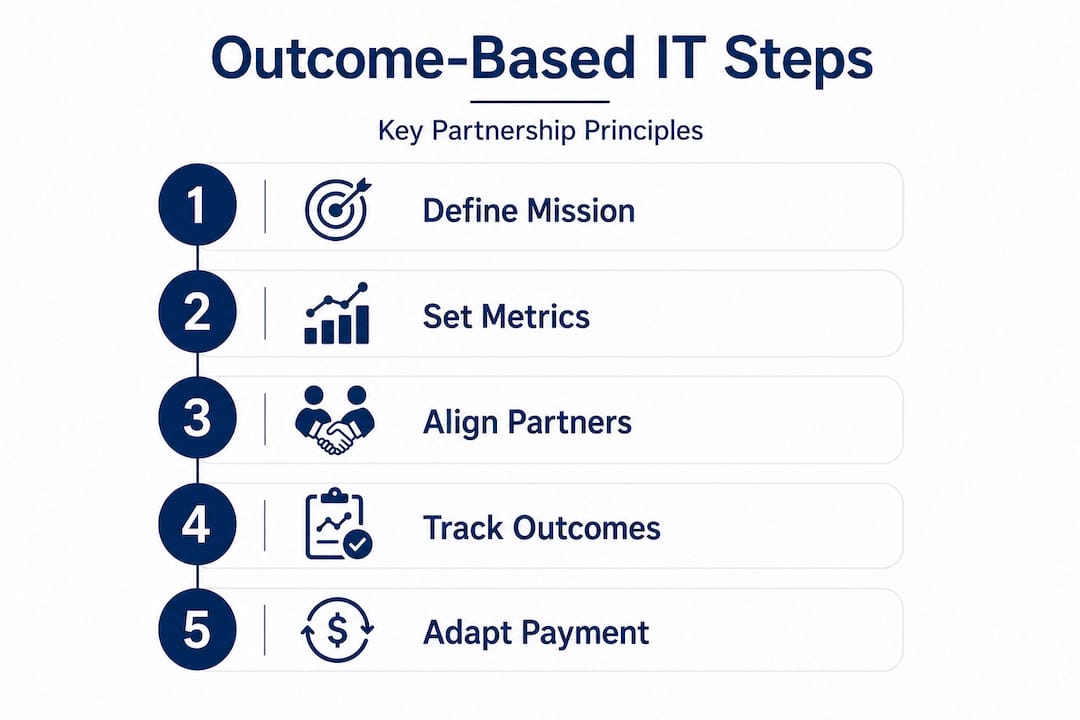
Key principles of outcome-based public IT partnerships
Having defined the concept, it is worth examining the structural principles that make outcome partnerships actually work. These are not theoretical ideals. They are operational disciplines that separate high-performing contracts from those that drift.
-
Define the problem before designing the solution. Agencies should write problem statements that describe current operational gaps, not desired system features. What is the processing time today? What is the target? What does failure look like in operational terms? This framing shapes every downstream decision.
-
Establish quantifiable KPIs at contract start. KPIs must be specific, measurable, and attributable. "Improve user experience" is not a KPI. "Reduce benefit application processing time from 14 days to 5 days within 18 months" is. Every KPI should have a baseline, a target, and a measurement methodology agreed upon before work begins.
-
Structure delivery in staged pilots. Large, monolithic IT contracts have a poor track record in government. Staged pilots allow agencies to validate assumptions before committing to full-scale rollout. Each stage has defined outcomes, and continuation is contingent on achieving them.
-
Build iterative refinement into governance. The Singapore Government Developer Portal emphasizes designing IT partnerships as co-creation and staged learning loops, rather than as one-shot technology prescriptions. This means structured review cycles where requirements evolve based on what has been learned.
-
Maintain technology neutrality. Prescribing specific platforms before validating outcomes limits competition and can anchor contracts to legacy choices. Allow vendors to propose the best-fit solution and evaluate proposals against outcomes, not preferred tools.
-
Enable adaptive governance. Governance structures should be designed to allow requirements to shift as real-world conditions change. This is not scope creep. It is evidence-based adaptation, and it is essential in multi-year modernization programs.
-
Tie payments to validated results. Life Chances Fund Final Report data from public sector outcomes contracts shows performance varies widely by project, with some projects exceeding 100% of targets and others achieving less than 30%. Payment structures must account for this variance with milestone gates and partial payment provisions.
-
Invest in measurement infrastructure. You cannot pay for outcomes you cannot measure. Agencies often underestimate the cost of building the data pipelines, dashboards, and reporting protocols needed to evaluate vendor performance objectively. This infrastructure is not overhead. It is a core contract requirement.
Pro Tip: When designing outcome metrics, build in both leading indicators (early signals like system uptime or data quality scores) and lagging indicators (final results like processing time or audit compliance rates). Leading indicators give you visibility into whether you are on track before the contract period ends. They also enable course correction, which is far less costly than waiting for a final evaluation to discover a problem.
Exploring flexible IT contracting frameworks and understanding prime contractor roles within these structures will further sharpen how agencies build accountability across the vendor hierarchy.
Integrating compliance and security into outcome-driven contracts
One of the most common concerns public sector leaders raise about outcome-based models is whether regulatory compliance can be adequately enforced when contracts are designed around flexibility. The answer is yes, but only if compliance is embedded as a standing obligation from the start, not treated as a separate compliance audit layer.
The DHS/USCIS Performance Work Statement provides a strong operational model. It embeds compliance and security requirements directly into delivery expectations, including explicit responsibility for bringing systems back to compliant operations when standards change or break/fix situations arise. This framing treats compliance not as an endpoint to certify, but as a continuous operational condition to maintain.
Best practices for embedding compliance in outcome contracts
- Write compliance obligations as continuous requirements, not one-time certifications.
- Define "compliance breach" scenarios and specify the partner's obligation and timeline for remediation.
- Require partners to maintain compliance when regulations or security standards shift during the contract period.
- Align security requirements with modern delivery practices. The contract should specify that CI/CD practices and automated testing must satisfy compliance standards at every deployment, not just at the final release.
- Build DevSecOps (Development, Security, and Operations) as a required delivery practice, not an optional approach.
Contract clause summary: compliance and security triggers
| Clause type | Trigger event | Partner obligation | Timeline |
|---|---|---|---|
| Regulatory change | New standard issued | Assess and update affected systems | 30 to 60 days depending on severity |
| Security incident | Breach or vulnerability detected | Notify, contain, remediate, and report | Immediate notification; remediation within defined SLA |
| Break/fix compliance | System change breaks compliance | Restore compliance before re-deployment | Before next production release |
| Audit finding | Agency or third-party audit identifies gap | Provide remediation plan and execute | 15 days for plan; 45 days for closure |
| Regulatory sunset | Old standard replaced | Update systems to new standard before sunset | 90 days before effective date |
Integrating compliance this way requires partners to treat regulatory adherence as part of their ongoing delivery responsibility. This is exactly where specialized firms with depth in modernization and compliance provide disproportionate value. They understand how to wire compliance requirements into DevOps pipelines, automate audit evidence collection, and maintain posture across system updates.
Pro Tip: When drafting compliance clauses, include a provision that requires the partner to document every regulatory or security standard that applies to the system, keep that register current, and notify the agency when new obligations emerge. This creates a shared awareness function that prevents either party from being surprised by a compliance requirement that was known to exist but never formally tracked.
Measuring success: Governance, performance, and payment mechanisms
Even the most carefully designed outcome contract can fail if governance and measurement practices are weak. Translating outcome-focused frameworks into operational practice requires deliberate decisions about how KPIs are measured, how attribution is established, and how payments are structured and validated.
Life Chances Fund data from public sector outcomes partnerships shows an average achievement rate of 87% across measured outcomes, but with significant variation: some projects exceeded 100% of targets while others fell below 30%. This distribution demonstrates that outcome contracts are not a passive risk-transfer mechanism. They require active, adaptive management to perform well.
Comparing payment mechanism models
| Payment model | Trigger | Best use case | Risk profile |
|---|---|---|---|
| Fixed fee | Contract completion | Well-defined, stable scope | Low flexibility; agency bears outcome risk |
| Milestone-based | Stage completion | Phased delivery programs | Moderate; some outcome accountability |
| Outcome-based | KPI achievement | Mission-critical results | Higher accountability; requires robust measurement |
| Mixed model | Milestones plus outcome bonuses | Complex, multi-year modernization | Balanced; most used in high-stakes programs |
The mixed model tends to perform best in complex public sector IT programs because it provides baseline payment security for vendors (encouraging participation) while retaining outcome-based incentives for performance above baseline.
Steps for establishing a robust measurement and payment model
- Define KPIs with baselines, targets, and measurement methodology before contract award.
- Agree on a neutral data source for KPI measurement. Both parties must trust the data.
- Build intermediate output metrics that signal whether outcomes are on track, not just final results.
- Establish a governance board with agency and partner representation to review performance data regularly.
- Define variance thresholds: what level of underperformance triggers a remediation plan versus a payment reduction.
- Include a formal attribution protocol. When outcomes improve, both parties agree on which factors drove the change. This prevents disputes over payment for results the partner did not cause.
- Schedule quarterly payment reviews tied to validated performance data, not invoices.
Exploring strategies for IT partnerships and case studies in strategic partnership success can help agencies pressure-test their measurement frameworks against real-world examples before finalizing contract structures.
What most government leaders miss about outcome-focused partnerships
There is a persistent misconception in government procurement circles that outcome-based contracts are primarily a risk-transfer mechanism. The logic goes: if the vendor only gets paid when outcomes are achieved, then the agency has shifted the delivery risk to the vendor. This framing is not entirely wrong, but it leads agencies to design contracts that are passive on the agency side, expecting outcomes to materialize without sustained engagement. That is where programs fail.
Outcome-focused partnerships require more active management from agencies, not less. The vendor needs real-time access to operational data. They need clear, prompt responses when regulatory conditions change. They need governance structures that make decisions quickly when a pilot reveals that the original problem statement was incomplete. Agencies that treat outcome contracts as a way to disengage from delivery oversight are setting up both parties for poor results.
The second major pitfall is the tendency to specify solutions too early. An agency issues a problem statement, then immediately narrows it by specifying the platform, architecture, or vendor tier structure. This eliminates the co-creation benefit entirely. The flexibility and staged learning that make outcome models powerful get replaced with a lightly rebranded traditional contract.
The third pitfall is measuring easy-to-track indicators instead of true mission outcomes. Processing time for a specific transaction type is measurable. System availability percentage is measurable. These are real KPIs. But some agencies default to measuring whether documentation was submitted on time, or whether a certain number of meetings occurred. That is measuring activity, not outcomes, and it produces the exact problem outcome contracting was designed to solve.
Perhaps the most surprising finding from research on public sector outcomes contracts is this: building the measurement and governance infrastructure is consistently harder, more expensive, and more consequential than selecting the technology. Agencies invest heavily in evaluating platforms and vendors, then underinvest in the data systems and governance protocols needed to know whether those investments worked. The uncomfortable reality is that measurement capability should be treated as a first-order procurement priority.
The practical implication is that agencies should invest in partner selection best practices and internal partnership management skills alongside procurement reform. Procurement policy changes open the door. Partnership management skills determine whether the agency walks through it effectively.
How Rutledge & Associates can help your agency succeed
Outcome-focused IT partnerships work best when agencies have a firm on the other side that brings both technical depth and governance discipline. Rutledge & Associates, LLC specializes in exactly that combination: delivering measurable modernization results in compliance-heavy public sector environments. From DevOps pipeline implementation and compliance automation to real-time program dashboards, the firm owns clearly scoped delivery rather than supplementing headcount. Certified as an SDVOSB and woman-owned business, Rutledge & Associates has the contracting credentials and operational experience to serve as a high-accountability subcontractor on complex programs. Explore Prime-Ready IT Modernization services or learn more about Maryland public sector IT partnership opportunities to take the next step.
Frequently asked questions
How do outcome-focused partnerships differ from traditional IT contracts?
They tie payments and governance to measurable mission results rather than technical deliverables or artifacts, as defined in Outcome-Based Contracting for public IT frameworks.
What are the risks with outcome-based partnership models?
Performance can vary widely across projects, so robust measurement infrastructure and adaptive governance are essential to fairly attribute and reward results.
How can agencies ensure compliance in flexible, outcome-driven contracts?
Contracts should explicitly require partners to restore compliant operations when regulations change or break/fix events occur, aligned with modern CI/CD delivery practices.
Can outcome-focused models be applied to complex, multi-year IT modernization?
Yes. By structuring contracts in staged phases with validated KPIs and iterative refinement, agencies avoid locking into fixed technical prescriptions, as the Singapore Government Developer Portal demonstrates with co-creation-based procurement models.