

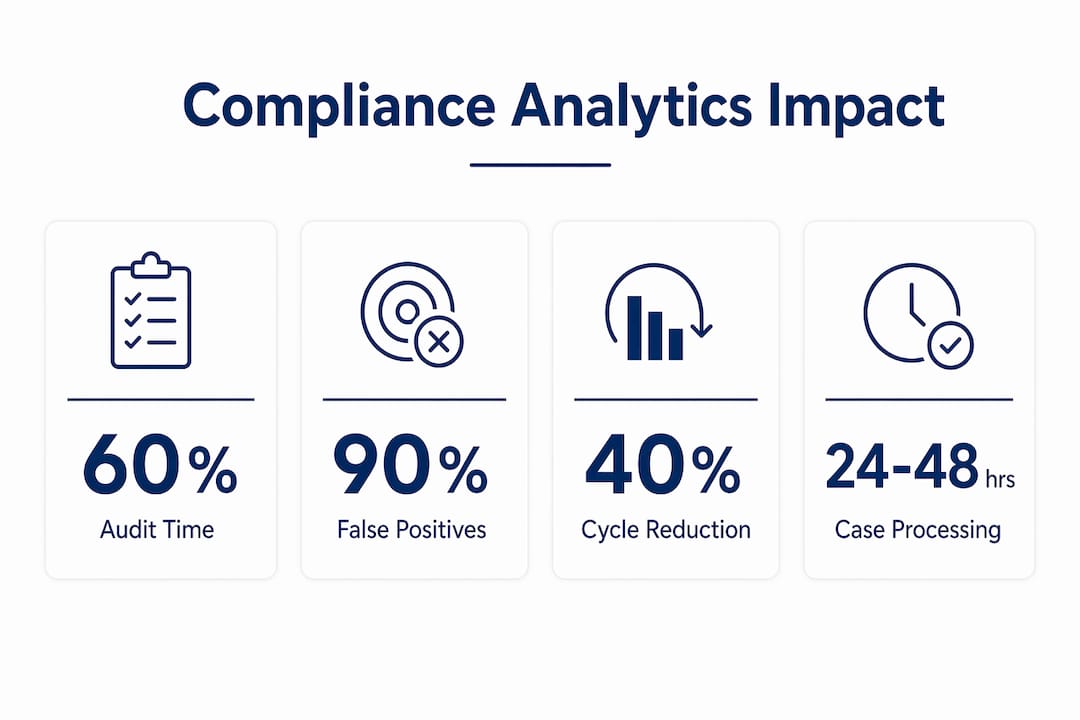
Analytics in regulatory compliance is defined as the systematic use of data collection, processing, and interpretation to verify that an agency meets its legal and regulatory obligations. The role of analytics in compliance has shifted public-sector oversight from reactive, paper-based audits to continuous, data-driven monitoring. Frameworks like GAO standards and COSO internal control principles now assume agencies have the data infrastructure to support real-time reporting. Automation and continuous monitoring can accelerate audit cycles by 40%–60% and cut manual effort by 25%–40%. That scale of efficiency is not achievable through manual review alone.
What is the role of analytics in compliance?
Compliance analytics is the practice of applying statistical analysis, machine learning, and automated monitoring to detect regulatory risk, document control performance, and produce audit-ready evidence. The term "compliance analytics" is the recognized industry label for this discipline. Compliance officers increasingly use it alongside broader data analytics for compliance to describe both the tools and the governance processes involved.
The shift analytics enables is fundamental. Traditional compliance relied on periodic sampling, where auditors reviewed a fraction of transactions after the fact. Analytics replaces sampling with full-population testing, meaning every transaction is checked against control rules in near real time. That change alone reduces the window in which a violation can go undetected.
Regulatory bodies including the Government Accountability Office and the Office of Management and Budget have updated their guidance to reflect this shift. Agencies that align with GAGAS (Generally Accepted Government Auditing Standards) and COSO frameworks are expected to demonstrate continuous control evidence, not just point-in-time snapshots. Analytics provides the mechanism to produce that evidence consistently.

How do AI and machine learning improve compliance monitoring?
Artificial intelligence and machine learning are the technical engines behind modern compliance monitoring analytics. They do not replace compliance judgment. They process data at a volume and speed that human reviewers cannot match, then surface the cases that require human attention.
Key capabilities these technologies provide include:
- Anomaly detection: Machine learning models establish baseline patterns for payroll, procurement, and financial transactions. Any deviation from the baseline triggers a flag for review.
- Risk scoring: AI assigns a risk score to each transaction or vendor record, letting compliance teams prioritize high-risk items first.
- Continuous control monitoring (CCM): CCM frameworks run automated checks against defined control rules every time data moves through a system, rather than waiting for a quarterly audit.
- Interactive dashboards: Real-time visualization tools give compliance officers a live view of control performance across programs, replacing static spreadsheet reports.
- Fraud pattern recognition: Machine learning models trained on historical fraud cases can identify new cases that match known patterns before they escalate.
AI-augmented fraud platforms can process backlogs of 53,000 cases within 24–48 hours. That speed converts a months-long manual review into an overnight operation.
Continuous control monitoring supported by machine learning and interactive dashboards also improves the dependability of payroll and financial audits while reducing material weaknesses. For public agencies managing federal grant funds, reducing material weaknesses directly protects future funding eligibility.
Pro Tip: Build your dashboard around the five or six control metrics your auditors ask for most often. A focused dashboard gets used daily. A dashboard with 40 metrics gets ignored.
What data governance challenges affect compliance analytics?
Data governance maturity is the primary constraint on effective compliance analytics, not the capability of the analytics models themselves. An agency can deploy the most advanced machine learning platform available and still produce unreliable compliance outputs if the underlying data is inconsistent, undocumented, or siloed across legacy systems.
Data governance maturity, specifically KPI ownership and documented data lineage, determines whether analytics outputs are trustworthy enough to present to auditors. Without clear ownership, no one can answer the auditor's question: "Where did this number come from?"
Agencies implementing compliance analytics should address governance in this sequence:
- Assign KPI ownership. Each compliance metric needs a named data steward responsible for its definition, source, and accuracy.
- Document data lineage. Every data element used in a compliance report must trace back to its source system, transformation logic, and update frequency.
- Enforce access controls. Analytics architectures must enforce role-based access to prevent unauthorized modification of compliance data.
- Embed compliance rules into pipelines. Compliance-by-design means validation rules, audit triggers, and reporting logic are built into data pipelines from the start, not added as an afterthought.
- Define human-in-the-loop workflows. Early analytics deployments often generate many false positives. Analysts need a defined process to review, validate, or override AI-generated flags before they reach compliance reports.
The false positive problem is underappreciated. An agency that flags 500 transactions per week but has no process to review them quickly loses confidence in the system. Human-in-the-loop workflows are not a workaround. They are a required design element.
Pro Tip: Treat your first 90 days of continuous monitoring as a calibration period. Expect noise. Use that period to tune thresholds and build analyst confidence in the system before presenting outputs to leadership.
Protecting the data that feeds compliance systems also requires attention to cloud data security practices, particularly as agencies migrate legacy systems to cloud environments where access patterns and data exposure risks differ from on-premise infrastructure.
How does analytics improve audit efficiency and reporting outcomes?
The measurable benefits of compliance analytics show up most clearly in audit preparation and regulatory reporting. Agencies that implement continuous monitoring spend less time assembling evidence packages and more time analyzing what the evidence means.
| Outcome | Impact |
|---|---|
| Audit cycle duration | Reduced by 40%–60% through automated evidence collection |
| Manual review effort | Reduced by 25%–40% through continuous control testing |
| Fraud case processing | 53,000 cases reviewed within 24–48 hours using AI platforms |
| Material weaknesses | Reduced through continuous payroll and financial audit monitoring |
| Audit trail transparency | Improved through embedded compliance checks linked to source data |
Embedded compliance checks create transparent audit trails that let auditors trace outputs directly to source data and policies. That traceability is what converts an analytics output into admissible audit evidence under GAGAS standards.
The reporting improvement is equally significant. Agencies aligned with COSO's control framework can use analytics outputs to demonstrate that controls operated effectively throughout a reporting period, not just at the moment of audit. That continuous evidence record supports clean audit opinions and reduces the likelihood of findings.
Top public agencies treat regulatory rules as machine-readable code for direct ingestion into analytics systems. That approach eliminates manual translation of regulatory requirements into control logic, reducing both error and lag time when regulations change.
Best practices for implementing compliance analytics programs
Agencies that succeed with compliance analytics share a common pattern. They treat analytics as an organizational capability, not a technology purchase. The technology matters, but the governance, training, and process design around it determine whether it produces reliable compliance outcomes.
Proven practices for public-sector agencies include:
- Start with a data governance assessment. Before selecting any analytics tool, map your current data sources, identify gaps in lineage documentation, and assign KPI ownership. This work determines what analytics is actually possible with your current data.
- Engage stakeholders early. Compliance officers, IT teams, program managers, and internal auditors all have requirements that must be reflected in the analytics architecture. Decisions made without their input create rework later.
- Embed compliance requirements into the analytics architecture. Compliance-by-design means regulatory rules are coded into data pipelines, not checked manually after data is extracted. This approach supports contract compliance and broader regulatory obligations simultaneously.
- Use automated workflows with AI agents and dashboards. Automate the routine checks. Reserve analyst time for the exceptions that require judgment.
- Monitor and update models continuously. Regulatory requirements change. Fraud patterns evolve. A model trained on last year's data may miss this year's risk patterns. Build a model review cycle into your compliance calendar.
- Maintain audit trail documentation. Every automated decision or flag must be logged with the rule that triggered it, the data that supported it, and the analyst action taken. This documentation is what auditors examine.
Agencies considering IT modernization strategies that include analytics adoption should also review their existing IT compliance controls to identify where analytics can replace manual processes most quickly.
Analytics and the future of public-sector compliance: a practitioner's view
Working with public-sector agencies on IT modernization and compliance programs has taught me one consistent lesson: the technology is rarely the hard part. The hard part is organizational readiness.
Agencies that struggle with compliance analytics almost always have the same root problem. Their data is fragmented across legacy systems, no one owns the definitions for key metrics, and the compliance team was not involved when the data architecture was designed. When analytics is layered on top of that foundation, it amplifies the existing confusion rather than resolving it.
The agencies that get this right treat data governance as a compliance requirement, not an IT project. They assign named owners to every KPI before they write a single line of analytics code. They define what "clean data" means for each compliance domain and hold program teams accountable for delivering it.
My strongest recommendation for compliance officers is this: do not let a vendor's demo convince you that the model is ready before your data is. A well-governed dataset with a simple rule-based monitoring system will outperform a sophisticated machine learning model fed with inconsistent, undocumented data every time. Build the foundation first. The advanced capabilities will follow naturally once the governance is solid.
The agencies I have seen achieve the most durable compliance improvements are the ones that treat analytics as a continuous practice, not a one-time implementation. They review their models quarterly, update their control rules when regulations change, and invest in analyst training so their teams can interpret outputs critically rather than accept them at face value.
— Randy
How Primereadysub supports public-sector compliance analytics
Public agencies need more than software to make compliance analytics work. They need an implementation partner that understands both the regulatory environment and the technical architecture required to support it. Primereadysub, operating as Rutledge & Associates, LLC, delivers compliance-driven IT modernization for state and local agencies across Maryland, New York, and Florida. The firm builds real-time dashboards, automated reporting pipelines, and compliance-by-design data architectures that produce audit-ready evidence continuously. As an SDVOSB, woman-owned, and SBA-certified firm, Primereadysub brings both technical depth and accountability to complex, compliance-heavy programs where the margin for error is low.
Key takeaways
Analytics in regulatory compliance works because continuous monitoring, governance maturity, and embedded compliance rules together produce audit-ready evidence that manual processes cannot match at scale.
| Point | Details |
|---|---|
| Analytics shifts compliance posture | Continuous monitoring replaces periodic sampling, closing the gap between violations and detection. |
| Governance maturity is the real barrier | KPI ownership and documented data lineage determine whether analytics outputs are audit-ready. |
| AI accelerates fraud review significantly | AI platforms can process tens of thousands of cases within 24–48 hours, far beyond manual capacity. |
| Compliance-by-design reduces audit risk | Embedding regulatory rules into data pipelines from the start creates traceable, defensible audit trails. |
| Human review remains non-negotiable | False positives from early deployments require defined analyst workflows to maintain trust in the system. |
FAQ
What is the role of analytics in compliance?
Analytics in compliance is the use of data processing, statistical analysis, and automated monitoring to verify regulatory adherence, detect anomalies, and produce audit-ready evidence continuously rather than through periodic manual review.
How does data analytics help with regulatory reporting?
Data analytics automates the collection and organization of control evidence, reducing the manual effort required to prepare regulatory reports and enabling agencies to demonstrate continuous compliance rather than point-in-time snapshots.
What is compliance-by-design in analytics systems?
Compliance-by-design means validation rules and audit triggers are built directly into data pipelines from the start, so compliance checks run automatically every time data moves through the system rather than being applied manually after extraction.
Why do early analytics deployments produce false positives?
Machine learning models in new deployments are calibrated against historical data that may not fully reflect current operational patterns. Human-in-the-loop review processes are required to validate AI flags and tune thresholds until the model stabilizes.
What IT compliance controls should agencies review before adopting analytics?
Agencies should assess their existing IT compliance controls for data access management, system logging, and audit trail documentation before deploying analytics, since gaps in these controls will undermine the reliability of any analytics output.