

Contract compliance is the ongoing discipline of ensuring every party to a contract fulfills its obligations, terms, conditions, and applicable laws throughout the entire contract lifecycle. For compliance officers and business professionals operating in public sector environments, this definition carries significant weight. It means contract compliance does not end at signature. It requires continuous monitoring, documented evidence, and structured processes that span obligation tracking, deliverable verification, deadline management, and audit-ready record maintenance. Understanding this discipline is the foundation for managing risk, protecting public funds, and sustaining vendor relationships that hold up under scrutiny.
What is contract compliance and why does it matter?
Contract compliance is defined as the systematic process of verifying that all parties perform as required by the contract, meet deadlines, and maintain documented evidence of performance throughout the contract lifecycle. The industry also refers to this practice as contract lifecycle management compliance, a term that captures its continuous, process-driven nature. It is not a one-time legal review. It is an operational discipline that runs from contract award through closeout.
The importance of contract compliance in public sector contracts is direct and measurable. Government agencies face statutory accountability requirements, meaning non-compliance exposes both the agency and its contractors to financial penalties, contract termination, and reputational damage. For prime contractors managing subcontractors, the stakes extend further because obligations flow down the supply chain and must be verified at every tier.

Three questions frame the compliance officer's job at any stage of a contract: Are parties performing as required? Are deadlines being tracked? Is there documented evidence for issues? These questions, drawn from established compliance monitoring frameworks, give compliance teams a practical lens for continuous oversight rather than reactive firefighting. When all three can be answered affirmatively, the contract is in a defensible compliance posture.
What are the essential elements of a contract compliance process?
Effective contract compliance management relies on a defined set of processes that operate in parallel throughout the contract term. These processes address both internal compliance, meaning the organization's own adherence to its obligations, and external compliance, meaning verification that the other party or subcontractors are performing as required.
The core processes include:
- Obligation tracking: Cataloging every deliverable, milestone, and deadline from the contract and assigning ownership to specific team members.
- Performance monitoring: Measuring actual output against contract performance metrics, including service levels, quality standards, and reporting requirements.
- Renewal and milestone management: Flagging contract renewal windows and critical milestones in advance to prevent lapses or missed options.
- Issue documentation: Recording disputes, deficiencies, and corrective actions in real time with timestamps and supporting evidence.
- Compliance rate measurement: Defining specific rules and denominators to produce meaningful compliance metrics that inform management decisions rather than obscure problems.
Compliance rates require careful construction. A metric labeled "overall compliance" that aggregates dozens of unrelated obligations tells a compliance officer very little. A metric defined as "percentage of invoices paid within 30 days during Q2" is specific, auditable, and useful. The distinction matters because vague metrics create false confidence while specific metrics surface real risk.
Pro Tip: Design contemporaneous evidence workflows from contract inception. Capture payment records, delivery confirmations, and performance reports at the moment they occur and link them directly to the relevant contract obligation. Auditors look for this traceability first, and gaps in the chain are the most common cause of compliance failures, not the contract terms themselves.
How do contract compliance audits function in the public sector?
A public sector contract compliance audit systematically reviews vendor adherence to pricing, service levels, reporting requirements, and regulatory obligations using documentation such as contracts, invoices, and performance reports. The audit concludes with formal findings and corrective actions. This process serves as the primary mechanism by which government agencies verify that contracted outcomes are actually being delivered.
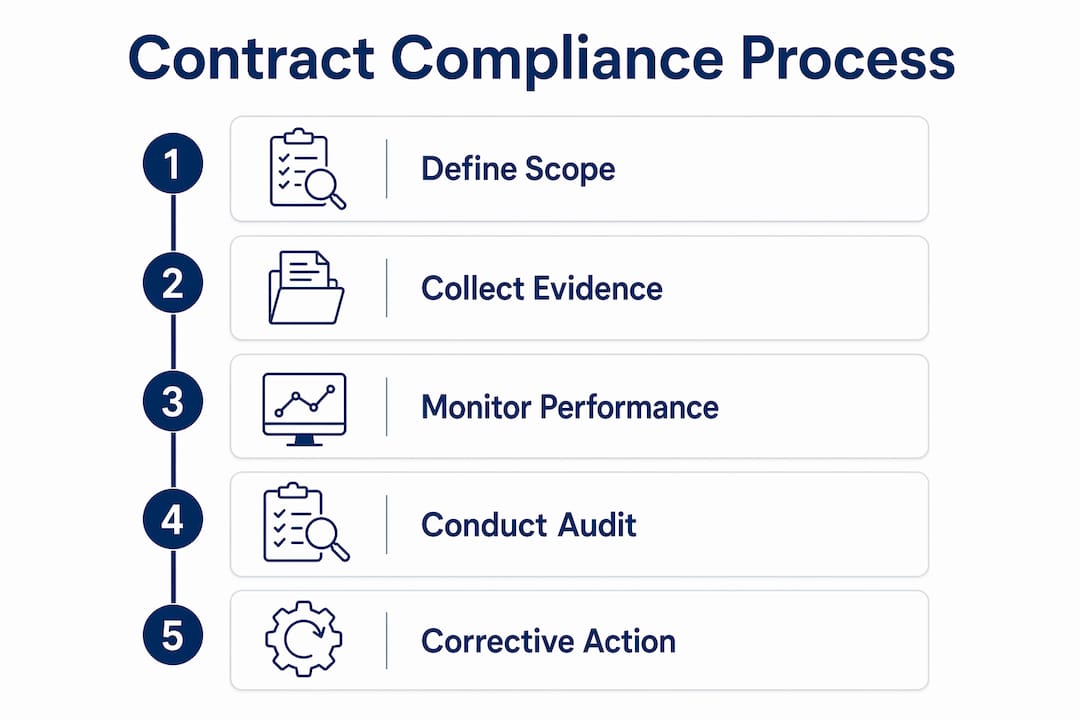
The audit process follows a structured sequence. Auditors define the scope and select the contract period under review. They then collect and examine evidence, including signed contracts, change orders, invoices, delivery records, and correspondence. Findings are categorized by severity, and the contractor receives a formal report with required corrective actions and response deadlines. Follow-up audits typically occur 3 to 6 months after the initial review to validate that issues have been resolved and that improvements are sustained.
The table below summarizes the key components of a public sector compliance audit and their purposes:
| Audit component | Purpose |
|---|---|
| Scope definition | Establishes the contract period, obligations, and parties under review |
| Evidence collection | Gathers contracts, invoices, performance reports, and correspondence |
| Compliance testing | Compares actual performance against contractual and regulatory requirements |
| Findings report | Documents deficiencies, root causes, and required corrective actions |
| Follow-up review | Validates resolution of findings and confirms sustained compliance |
The benefits of regular compliance audits extend beyond catching problems. Audits surface cost recovery opportunities when vendors have overbilled or underdelivered. They strengthen governance by creating a documented record of oversight. They also reduce legal risk by demonstrating that the agency exercised due diligence. For prime contractors, proactive internal audits before a government review can prevent findings that would otherwise damage the relationship or trigger contract remedies. Platforms like IntelliAudit AI offer AI-enhanced audit capabilities that help compliance teams manage evidence collection and findings tracking at scale.
Pro Tip: Schedule corrective action follow-up reviews at contract inception, not after findings emerge. Building the follow-up window into the compliance calendar signals to vendors that accountability is structural, not episodic, and significantly reduces repeat findings.
What are flow-down clauses and why do they matter in government contracting?
Flow-down clauses require prime contractors to pass applicable Federal Acquisition Regulation (FAR) and Defense Federal Acquisition Regulation Supplement (DFARS) clauses down to subcontractors based on contract dollar amount and type. They are the legal mechanism by which the government's compliance requirements extend beyond the prime and reach every tier of the supply chain. Mismanaging flow-downs is one of the most common and consequential compliance failures in public sector contracting.
The applicability of any given clause depends on several factors: the contract's dollar threshold, whether it is a cost-reimbursement or fixed-price vehicle, and whether the clause itself contains specific flow-down instructions. Not every FAR clause flows down to every subcontract. Applying clauses indiscriminately, sometimes called a blanket flow-down, creates legal and operational burdens for subcontractors and complicates audits because auditors must then determine which clauses were actually applicable.
Common flow-down risks and best practices include:
- Risk: Blanket flow-downs. Passing every prime contract clause to every subcontractor regardless of applicability creates confusion, inflates compliance costs, and can expose the prime to disputes when subs push back on inapplicable requirements.
- Risk: Missing required clauses. Failing to flow down a mandatory clause, such as those related to equal opportunity, small business subcontracting, or cybersecurity, creates direct regulatory exposure for the prime.
- Best practice: Conduct a clause-by-clause applicability assessment for each subcontract, documenting the rationale for inclusion or exclusion.
- Best practice: Maintain a flow-down matrix that maps each prime contract clause to its subcontract applicability determination and the responsible reviewer.
- Best practice: Update the matrix at each contract modification because changes to the prime contract can alter flow-down requirements.
For compliance officers managing IT subcontracting arrangements, flow-down documentation is particularly critical. Technology contracts frequently involve cybersecurity clauses under DFARS 252.204-7012 and data rights provisions that carry significant compliance weight and must be correctly scoped before subcontract award.
How do payment spot checks verify compliance in public sub-contracts?
Payment spot checks operationalize compliance by creating recurring, evidence-based verification cycles rather than relying on informal reporting from subcontractors. Under the UK's Procurement Policy Note PPN 021, contracting authorities must conduct payment spot checks at least semiannually on public sub-contracts, with specific requirements for notice, supplier response time, and evidence collection. While PPN 021 is a UK instrument, its methodology reflects a broader principle that applies to public procurement globally: compliance must be verified through structured, documented cycles, not assumed.
The key steps in conducting a payment spot check are:
- Select the sub-contract for review. Identify the sub-contract period and the specific payment obligations to be tested, such as 30-day payment terms passed down the supply chain.
- Notify the supplier. Provide formal written notice of the spot check with a defined response window, giving the supplier time to compile evidence without allowing enough time to reconstruct records.
- Request evidence. Collect invoices, payment records, and any documentation of disputed invoices and their resolution timelines.
- Verify payment terms compliance. Confirm that 30-day payment terms were passed to sub-tiers and that payments were made within those terms.
- Review invoice dispute procedures. Examine how disputed invoices were handled, including whether dispute resolution timelines were followed and whether sub-contractors were notified promptly.
- Document findings and issue a report. Record compliant and non-compliant items, communicate findings to the supplier, and set a deadline for corrective action.
- Follow up on non-compliance. Escalate persistent non-compliance through contract remedies or report to the contracting authority as required.
The transparency value of spot checks is significant. They create a paper trail that demonstrates active oversight of the supply chain, which is increasingly important as government agencies face scrutiny over how public funds flow through prime contractors to smaller suppliers. For compliance officers, spot checks also surface systemic payment issues before they become disputes or audit findings.
Key takeaways
Contract compliance is an operational discipline, not a legal formality, and its effectiveness depends on structured processes, documented evidence, and recurring verification cycles throughout the contract lifecycle.
| Point | Details |
|---|---|
| Compliance is continuous | Monitoring obligations, deadlines, and evidence must occur throughout the contract term, not only at signing. |
| Audit readiness requires traceability | Link every contract obligation to real-time performance records and financial documents before an audit begins. |
| Flow-downs demand precision | Apply FAR and DFARS clauses based on contract type and dollar threshold, and document every applicability decision. |
| Compliance metrics must be specific | Define rates with clear rules and denominators to produce metrics that surface real risk rather than aggregate noise. |
| Spot checks create accountability | Semiannual payment spot checks verify supply chain compliance through evidence, not informal assurances. |
What I've learned managing compliance in public sector contracts
The most persistent misconception I encounter is that contract compliance is primarily a legal function. It is not. Legal teams negotiate and review terms. Compliance officers and program managers are responsible for what happens after the ink dries, and that work is operational, repetitive, and unforgiving of gaps.
The contracts that hold up under audit scrutiny share one characteristic: their compliance workflows were designed at contract inception, not retrofitted after a finding. Teams that build obligation registers, assign ownership, and establish evidence capture procedures on day one rarely face the kind of audit failures that come from reconstructed records. Teams that treat compliance as a periodic check-in almost always find themselves explaining gaps they cannot close.
Flow-down management is where I see the most avoidable risk. Primes that apply blanket flow-downs to every subcontract are not being thorough. They are creating compliance burdens that slow down their subs and generate audit complexity with no corresponding benefit. A precise, documented applicability assessment takes more effort upfront and saves significant time during any government review. For primes working with public sector IT partners, this precision is a competitive differentiator, not just a compliance checkbox.
The broader point is that contract compliance, when managed well, is a trust-building mechanism. Agencies that see consistent, documented compliance from a contractor extend more latitude, move faster on modifications, and return for follow-on work. That outcome is worth the discipline it requires.
— Randy
How Primereadysub supports compliance-ready public sector contracting
Rutledge & Associates, LLC, operating as Primereadysub, is a certified SDVOSB and SBA-certified IT modernization firm built specifically for compliance-heavy public sector programs. The firm delivers clearly scoped subcontracting services, including compliance automation, real-time dashboards, and audit-ready DevOps pipelines, that give prime contractors the documentation and traceability they need to pass government reviews. For primes managing complex contracts in Maryland, New York, and Florida, Primereadysub provides government contract onboarding support and outcome-driven delivery that reduces oversight burden while maintaining full audit readiness from day one.
FAQ
What is the contract compliance definition?
Contract compliance is the ongoing process of verifying that all parties fulfill their contractual obligations, meet deadlines, and maintain documented evidence of performance throughout the contract lifecycle. It encompasses obligation tracking, deliverable verification, regulatory adherence, and audit-ready record maintenance.
What does contract compliance mean for subcontractors?
For subcontractors, contract compliance means meeting the obligations flowed down from the prime contract, including FAR and DFARS clauses applicable to the subcontract's dollar amount and type, and maintaining evidence of performance that can withstand a compliance audit or payment spot check.
How often should contract compliance audits occur in the public sector?
Public sector compliance audits are typically conducted annually or at contract milestones, with follow-up reviews occurring 3 to 6 months after initial findings to validate corrective actions. Payment spot checks under frameworks like PPN 021 occur at least semiannually.
What are the best practices for contract compliance in government contracts?
The most effective practices include building obligation registers at contract award, designing contemporaneous evidence workflows, conducting clause-by-clause flow-down assessments, defining compliance metrics with specific rules and denominators, and scheduling proactive internal audits before government reviews.
Why do contract compliance failures happen most often?
Contract compliance failures most commonly arise from missing or incomplete audit evidence rather than from violations of contract terms. Effective compliance programs capture evidence in real time and link it directly to the contract obligation it supports, creating a traceable record that holds up under scrutiny.