

Government contracts are legally binding agreements between a federal, state, or local agency and a private business for the delivery of goods, services, or construction. The government contracting process is governed by strict federal regulations, primarily the Federal Acquisition Regulation (FAR), which sets uniform rules for how agencies plan, solicit, evaluate, and award contracts. Understanding how government contracts work requires familiarity with key tools like SAM.gov, the Unique Entity ID (UEI), and North American Industry Classification System (NAICS) codes. These are not optional formalities. They are the structural foundation that determines whether a business can legally compete for public-sector work.
How government contracts work: the five lifecycle phases
The federal contract lifecycle consists of five distinct phases: Planning, Solicitation, Evaluation, Award, and Administration. From planning to award typically spans 6 to 24 months, with contract administration extending anywhere from one year to over a decade. Each phase carries specific obligations for both the agency and the contractor.
1. Planning
The agency identifies a need, conducts market research, and determines the acquisition strategy. This phase includes releasing Sources Sought notices and Requests for Information (RFIs) to gauge industry capability. Contractors who respond to these early notices can directly influence how requirements are written and whether a set-aside for small businesses is applied.

2. Solicitation
The agency releases a formal notice inviting bids or proposals. The three primary solicitation document types are the RFI (information gathering), RFQ (pricing quote for simpler purchases), and RFP (full technical and management solution). Each requires a different level of response effort, and submitting the wrong type of response wastes resources and signals inexperience to the Contracting Officer.
3. Evaluation
The agency reviews all submitted proposals against pre-defined criteria. Evaluators score technical approach, management plan, past performance, and price. This phase can last weeks to months depending on the complexity of the acquisition and the number of offerors.
4. Award
The agency selects a winner and issues a contract. Unsuccessful offerors have the right to request a debrief, which is one of the most underused tools in government contracting. Debriefs reveal exactly where a proposal fell short, giving businesses a concrete roadmap for the next competition.
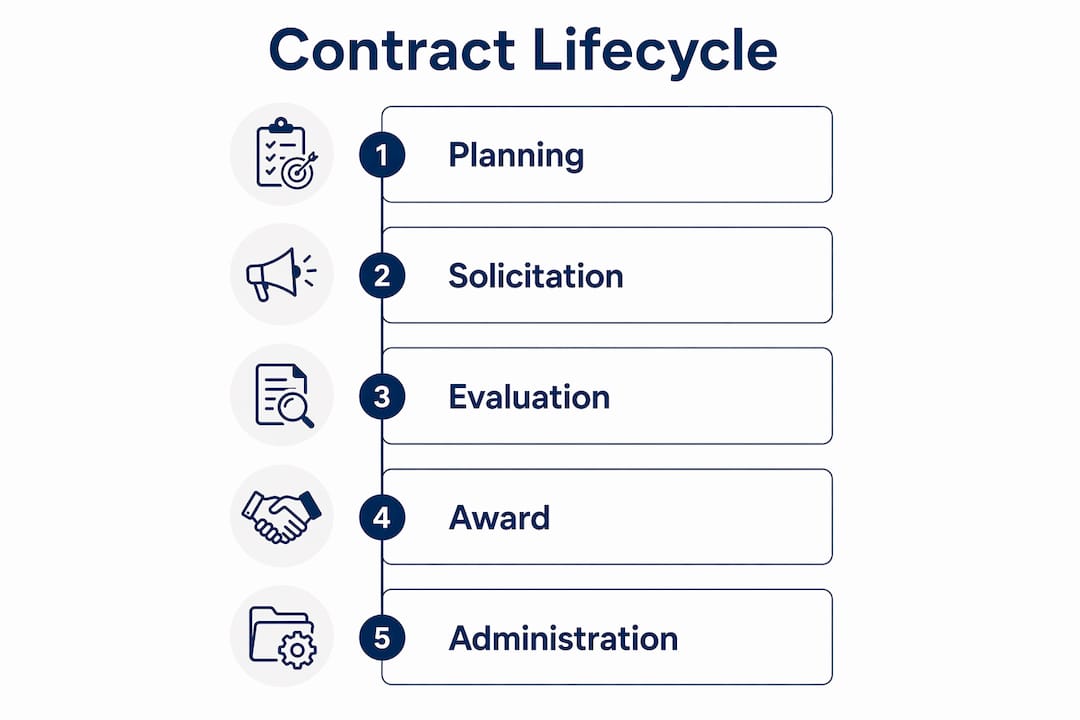
5. Administration
Contract administration involves managing deliverables, tracking milestones, processing modifications, and maintaining Contractor Performance Assessment Reporting System (CPARS) ratings. CPARS scores follow a contractor across every future bid, making consistent performance during administration as strategically important as winning the award in the first place.
Pro Tip: Request a debrief after every award decision, win or lose. Agencies are required to provide one, and the feedback is often more specific and useful than anything a proposal consultant will tell you.
| Phase | Key activity | Who bears primary responsibility |
|---|---|---|
| Planning | Market research, Sources Sought | Government agency |
| Solicitation | RFI, RFQ, or RFP release | Government agency |
| Evaluation | Proposal scoring | Government evaluators |
| Award | Contract issuance, debriefs | Contracting Officer |
| Administration | Deliverables, CPARS, modifications | Contractor and COR |
What are the main government contract types?
Contract type determines who absorbs cost risk and how payment is structured. Choosing the wrong contract type for your cost structure is one of the most common reasons small businesses lose money on government work.
Firm-Fixed-Price (FFP) contracts place all cost risk on the contractor. The government pays a set price regardless of actual costs incurred. A 2026 Executive Order now directs agencies to use fixed-price contracts as the default, requiring written justification for any non-fixed-price contract above specific dollar thresholds. This shift rewards contractors with disciplined cost estimation and penalizes those who underbid to win.
Cost-Reimbursement contracts allow the government to pay actual allowable costs plus a fee. These are used when the scope is genuinely uncertain, such as in research and development programs. The government absorbs more financial risk, but contractors must maintain detailed cost accounting systems that comply with FAR Part 31.
Time-and-Materials (T&M) and Labor-Hour contracts pay based on hours worked at negotiated labor rates plus materials. These carry the least pricing discipline and are increasingly disfavored under the 2026 regulatory environment. Agencies must now justify their use in writing.
Indefinite Delivery, Indefinite Quantity (IDIQ) contracts establish a ceiling value and allow the government to issue individual task orders over time. Vehicles like GSA Schedules and government-wide acquisition contracts (GWACs) operate on this model. Winning an IDIQ vehicle does not guarantee revenue. It only grants eligibility to compete for task orders.
Pro Tip: Before bidding on any contract, map your actual cost structure to the contract type. A T&M contractor forced onto a fixed-price vehicle without adjusting its pricing model will lose money even on a well-executed project.
| Contract type | Cost risk bearer | Best suited for |
|---|---|---|
| Firm-Fixed-Price | Contractor | Well-defined, stable scopes |
| Cost-Reimbursement | Government | R&D, uncertain requirements |
| Time-and-Materials | Shared | Short-term, variable labor needs |
| IDIQ / Task Order | Varies by task order | Recurring, flexible agency needs |
How do businesses find and qualify for government contracts?
Eligibility for government contracts begins with two non-negotiable steps: registering in SAM.gov and obtaining a Unique Entity ID (UEI). SAM.gov replaced the DUNS number system in 2022 and serves as the central database for all federal contractors. Registration must be renewed annually, and a lapsed registration disqualifies a business from receiving contract awards regardless of proposal quality.
Beyond registration, qualifying for the right opportunities requires attention to several factors:
- NAICS codes: Each solicitation is assigned a NAICS code that defines the industry and the applicable small business size standard. Selecting the correct codes in SAM.gov determines which set-aside opportunities a business is eligible to pursue.
- Set-aside programs: The Rule of Two requires agencies to set aside acquisitions above $250,000 for small businesses when at least two qualified small businesses are expected to compete. Additional set-asides exist for 8(a) firms, HUBZone businesses, Service-Disabled Veteran-Owned Small Businesses (SDVOSBs), and Women-Owned Small Businesses (WOSBs).
- Certifications: SBA certifications like 8(a) and HUBZone open access to sole-source awards and restricted competitions. These certifications require annual reporting and compliance with program rules.
- Finding opportunities: Federal contract notices are posted on SAM.gov across several categories: sources sought, pre-solicitation, solicitation, and award notices. Procurement forecasts published by agencies and industry days provide advance visibility into upcoming work.
- Early engagement: Responding to Sources Sought and RFIs before a solicitation is released gives businesses the opportunity to shape requirements and signal capability to the Contracting Officer. This is one of the highest-leverage activities in the entire contracting process.
Businesses pursuing public sector IT partnerships should also evaluate teaming arrangements and subcontracting opportunities, particularly when a prime contractor holds an existing vehicle but lacks a specific technical capability.
What should you know about proposals, compliance, and evaluation?
A government proposal is a compliance document first and a marketing document second. Strict adherence to solicitation instructions is mandatory. A technically superior proposal that violates page limits, uses the wrong font, or omits a required section can be disqualified before evaluators read a single word of the technical approach.
Every solicitation contains two sections that govern proposal preparation: Section L (instructions to offerors) and Section M (evaluation criteria). Reading Section M first tells you exactly how points are allocated. Reading Section L tells you exactly how to structure the response. Ignoring either is a disqualifying mistake.
Key practices for building a competitive proposal:
- Build a compliance matrix: Map every Section L requirement to a specific section of your response. This tool prevents accidental omissions and makes it easier for evaluators to find required content, which directly improves scores.
- Understand the evaluation method: LPTA evaluations award the contract to the lowest-priced technically acceptable offer. Best Value Trade-Off evaluations allow technical superiority to justify a higher price. Your pricing strategy must align with which method applies.
- Document past performance carefully: Past performance references should match the scope, size, and complexity of the work being bid. A reference from a $200,000 contract does not adequately support a bid on a $5 million program.
- Price to win, not to survive: Pricing that is too low signals risk to evaluators. Pricing that is too high loses on LPTA. Use independent government cost estimates (IGCEs) when available to calibrate your price.
- Handle clarifications professionally: If the agency issues clarification requests during evaluation, respond precisely and within the deadline. Clarifications are not an opportunity to revise your technical approach. They are a test of responsiveness and professionalism.
Pro Tip: Use a compliance matrix as a living document throughout proposal development, not just as a final checklist. Update it as each section is drafted so the team can see gaps in real time rather than discovering them the night before submission.
Key takeaways
Government contracts require registration, compliance, and strategic alignment at every phase to compete successfully.
| Point | Details |
|---|---|
| Registration is mandatory | SAM.gov registration and a valid UEI are required before any federal award can be made. |
| Contract type shapes risk | Fixed-price contracts shift cost risk to the contractor; the 2026 Executive Order makes them the agency default. |
| Early engagement pays off | Responding to Sources Sought and RFIs before solicitation release directly influences requirements and set-aside decisions. |
| Compliance drives evaluation | Proposals that violate formatting or content rules are disqualified regardless of technical merit. |
| CPARS ratings compound | Strong performance during contract administration builds the past performance record that wins future awards. |
What experience in government contracting actually teaches you
I have watched businesses with genuinely strong capabilities lose contracts they should have won, and the reason is almost always the same. They treated the solicitation as a pitch rather than a compliance test. Government evaluators are not looking for the most creative response. They are checking boxes against Section M, and if your proposal does not make that job easy for them, you lose.
The 2026 shift toward fixed-price contracts is the most significant regulatory change in federal procurement in years. The fixed-price preference signals that agencies want contractors who can price work with confidence and deliver on that price. Businesses that have been relying on cost-reimbursement vehicles to manage uncertainty will need to build real cost discipline before they can compete effectively in this environment.
The other thing experience teaches is that relationships with Contracting Officers matter more than most guides acknowledge. Not in an improper sense, but in the sense that showing up to industry days, responding thoughtfully to Sources Sought, and asking intelligent questions during pre-proposal conferences puts a name and a track record behind your SAM.gov registration. When evaluators see a familiar, credible name on a proposal, it does not change the score. But it does mean your proposal gets read carefully rather than skimmed.
Use debriefs. Use them every time. The feedback from a single debrief is worth more than months of internal proposal reviews because it tells you exactly what the government thought, not what you hoped they thought.
Explore contracting partnership strategies if you are entering a new agency or vehicle for the first time. Teaming with an established prime is often faster and lower-risk than pursuing a prime award independently.
— Randy
How Primereadysub supports your government contracting goals
Primereadysub, operating as Rutledge & Associates, LLC, is an SDVOSB, woman-owned, and SBA-certified firm specializing in IT modernization for public sector agencies in Maryland, New York, and Florida. For prime contractors managing complex, compliance-heavy programs, Primereadysub delivers clearly scoped subcontracting work in cloud-native re-architecting, DevOps pipelines, compliance automation, and real-time dashboards. The firm provides high-value, low-oversight execution that reduces processing times and strengthens audit readiness without requiring constant management attention. If you are a prime contractor looking for a reliable IT modernization partner, or a business working to position itself for public sector awards, visit Primereadysub to learn how the firm supports outcome-driven government contracting.
FAQ
What is required to bid on a federal government contract?
Businesses must register in SAM.gov, obtain a Unique Entity ID (UEI), and select the correct NAICS codes before submitting any bid. Registration must be renewed annually or the business becomes ineligible for award.
What is the difference between an RFI, RFQ, and RFP?
An RFI gathers market information, an RFQ requests pricing for defined purchases, and an RFP requests a full technical and management proposal. Each requires a different level of response effort and serves a different stage of the procurement process.
How does the Rule of Two affect small businesses?
The Rule of Two requires agencies to set aside contracts above $250,000 for small businesses when at least two qualified small businesses are expected to compete. This creates a significant volume of opportunities restricted to small business offerors.
What is a CPARS rating and why does it matter?
CPARS is the Contractor Performance Assessment Reporting System, which records how well a contractor performed on each completed contract. These ratings are reviewed by evaluators on future bids and directly affect past performance scores.
How long does the government contracting process take?
The time from planning to award typically ranges from 6 to 24 months, depending on contract complexity. Contract administration can extend from one year to over a decade, particularly for large programs with multiple option years.