

Analytics converts static contract documents into structured business intelligence that drives measurable improvements in revenue, risk management, and operational efficiency. For government and public-sector professionals managing technology projects, the role of analytics in contract success is not theoretical. It is the difference between a contract portfolio that leaks revenue and one that performs as intended. Contract lifecycle management (CLM) platforms, AI-powered extraction tools, and real-time dashboards have made it possible to treat every agreement as a living data source rather than a filed document. This guide explains how data analysis for contract management works in practice, which metrics matter most, and how public-sector teams can implement analytics programs that produce results.
How does analytics improve contract financial outcomes?
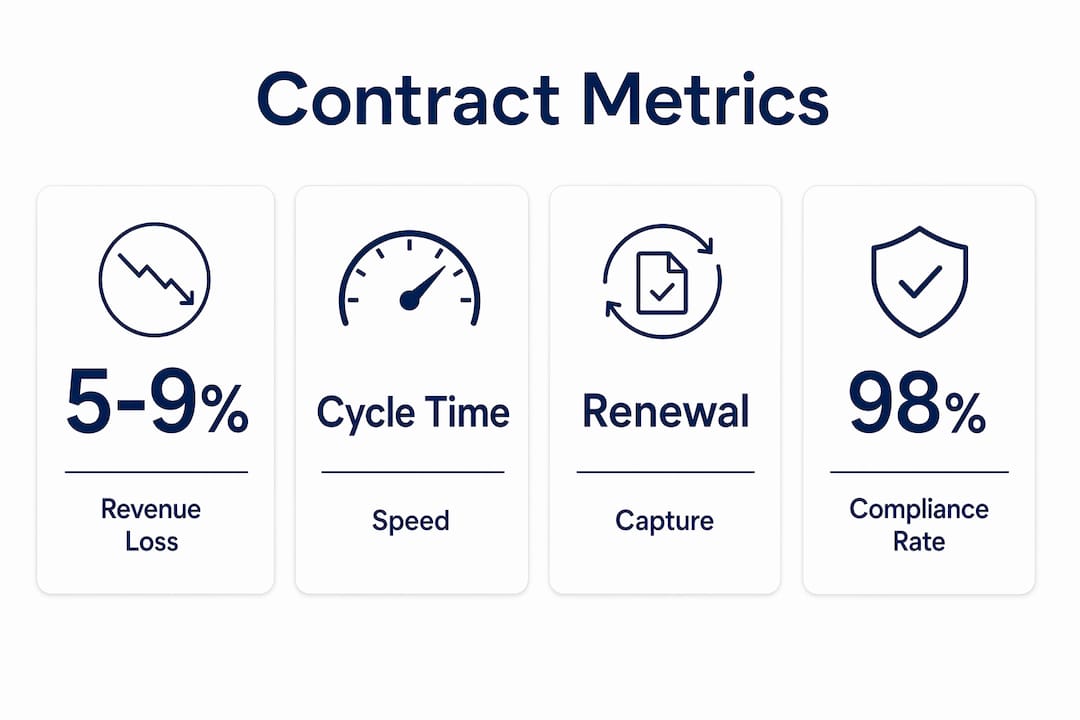
Poor contract management causes organizations to lose 5 to 9 percent of annual revenue. That figure represents missed renewal deadlines, off-contract purchasing, pricing inconsistencies, and untracked obligations that quietly drain budgets. For government agencies operating under fixed appropriations, that kind of revenue leakage is not recoverable at year-end.
Analytics addresses this by converting unstructured contract text into searchable financial data. Once digitized and indexed, a contract portfolio reveals patterns that manual review cannot: vendors charging above agreed rates, clauses that trigger automatic price escalations, and renewal windows that pass unnoticed. Each of these represents a direct financial risk that analytics surfaces before it becomes a loss.
Key financial metrics that analytics tracks include:
- Missed renewal deadlines: Contracts set to auto-renew at unfavorable terms represent recoverable costs when flagged in advance.
- Off-contract buying: Procurement activity outside negotiated agreements inflates costs and undermines vendor accountability.
- Pricing inconsistencies: Variance between contracted rates and invoiced amounts is a common source of overpayment in large IT programs.
- Auto-renewal exposure: Auto-renewal exposure metrics often reveal significantly larger unnoticed contract values set to renew, offering fast revenue recovery opportunities.
Combining contract data with financial system outputs from platforms like SAP or Oracle enables accurate revenue forecasting. When procurement, finance, and legal teams share a single analytics view, budget planning becomes grounded in actual contract commitments rather than estimates.
What contract performance metrics can analytics track?

Contract performance metrics are the quantitative signals that tell a management team whether their contract portfolio is healthy or deteriorating. Modern CLM platforms track cycle times, clause deviation rates, renewal exposure, and compliance pass rates in real time, enabling continuous contract operations rather than quarterly manual audits.
The most operationally significant metrics fall into three categories:
- Cycle time by contract type: How long does a standard IT services agreement take from initiation to execution? Tracking this by contract type and negotiation stage identifies where delays concentrate. Master Services Agreements, for example, average 60-day execution times with 90 percent legal involvement, making them prime candidates for process improvement.
- Clause deviation rate: The percentage of contracts that include non-standard clauses measures legal risk exposure across a portfolio. A rising deviation rate signals that negotiation standards are eroding.
- Renewal capture rate and rebate realization: These metrics confirm whether the financial value negotiated at contract signing is actually being captured during performance.
The following table illustrates how these metrics translate into management decisions:
| Metric | What it measures | Management action |
|---|---|---|
| Cycle time | Speed from initiation to execution | Identify bottlenecks by stage |
| Clause deviation rate | Non-standard clause frequency | Tighten playbook compliance |
| Renewal capture rate | Renewals executed on favorable terms | Improve renewal alert timing |
| Compliance pass rate | Obligations met on schedule | Assign ownership to at-risk items |
| Auto-renewal exposure | Contracts renewing without review | Trigger proactive renegotiation |
Good measurement shifts leadership conversations from vague concerns to precise, data-driven decisions. That shift changes which work gets prioritized and which risks get addressed before they escalate.
How does AI-powered analytics transform legal and procurement roles?
Nearly 90 percent of business professionals report that contracts are too complex to understand without systematic, AI-driven analysis. This statistic explains why legal teams in large government programs spend most of their time on document review rather than strategic counsel. AI changes that equation by automating the extraction and classification work that consumes legal capacity.
AI-powered contract analytics platforms accomplish several tasks that manual review cannot scale to match:
- Metadata extraction: AI identifies parties, dates, obligations, payment terms, and termination clauses across thousands of contracts simultaneously.
- Non-standard clause flagging: Deviations from approved playbook language are surfaced automatically, with risk severity scores assigned to each.
- Automated alerts: Renewal windows, compliance deadlines, and escalation triggers generate notifications before they become missed obligations.
- Negotiation support: Advanced analytics tools generate actual language amendments for identified issues, reducing the time between problem identification and contract correction.
The result is a shift in how legal teams operate. Analytics enables legal teams to move from gatekeepers to strategic business partners by identifying recurring bottlenecks and accelerating deal velocity. Instead of reviewing every contract from scratch, attorneys focus on genuinely ambiguous situations while automation handles the routine.
Pro Tip: Confidence-based risk classification reduces manual bottlenecks by scoring risks with both severity and confidence levels, automating approvals for clear-cut cases and escalating only the contracts that genuinely require attorney judgment.
Integration with ERP systems like SAP, CRM platforms like Salesforce, and procurement tools creates a connected workflow where contract data flows automatically into financial reporting, vendor management, and compliance tracking. That integration eliminates the manual data transfers that introduce errors and delays in government IT programs.
What steps can public sector professionals take to implement analytics?
Implementing contract analytics in a government technology environment requires a structured approach. The complexity of public-sector contracts, combined with compliance requirements from frameworks like FAR, DFARS, and state procurement codes, means that tool selection and program design matter as much as the technology itself.
- Select a platform trained on enterprise-scale contract data. AI platforms trained on millions of contracts achieve high-accuracy extraction and contextual understanding beyond simple keyword matching. Platforms like Sirion and Ironclad are built for this scale. Generic document tools are not.
- Start with a focused KPI set with named owners. Measuring a few meaningful metrics with clear ownership changes behavior and produces measurable improvements. Assign a specific person to each KPI at program launch, not a team or department.
- Use dashboards to identify cycle time bottlenecks. Real-time visibility into where contracts stall, whether in legal review, procurement approval, or vendor signature, allows targeted process corrections. Explore contract onboarding practices that reduce time-to-execution for government teams.
- Integrate contract data with vendor management workflows. Analytics dashboards that connect contract terms to vendor performance data support proactive relationship management and compliance tracking across the IT supply chain.
- Review and adjust KPIs quarterly. Organizational priorities shift, and so do contract portfolios. A KPI that was relevant during a system migration may not apply during steady-state operations. Quarterly reviews keep the measurement program aligned with current program goals.
Pro Tip: When launching a contract analytics program, resist the urge to measure everything at once. Three well-owned KPIs with consistent reporting produce more organizational change than fifteen metrics that no one monitors.
For public-sector primes managing subcontractor relationships, contract-ready IT subcontracting practices reduce onboarding friction and improve compliance documentation from day one.
How does analytics specifically impact government technology contracts?
Government technology contracts carry compliance burdens that commercial agreements do not. FAR clauses, cybersecurity requirements under CMMC, audit obligations, and reporting mandates create a contract environment where missing a single obligation can trigger corrective action plans or contract termination. Analytics addresses this by automating the monitoring work that would otherwise require dedicated compliance staff.
The comparison below illustrates the difference between manual and analytics-driven contract management in a public-sector IT context:
| Capability | Manual approach | Analytics-driven approach |
|---|---|---|
| Compliance monitoring | Periodic manual review | Continuous automated alerts |
| Renewal management | Calendar reminders | Real-time exposure dashboards |
| Risk identification | Post-incident discovery | Proactive clause-level scoring |
| Vendor performance | Quarterly reports | Live contract-to-performance data |
| Audit readiness | Document retrieval on request | Pre-built audit trails and reports |
High contract volume and complexity in government programs make AI the only practical path to timely insights. A state agency managing hundreds of IT vendor agreements cannot rely on manual review to catch every non-compliant clause or missed obligation. Contract analytics platforms visualize contract timelines, renewal windows, and risk flags to prevent missed renewals and manage vendor relationships proactively.
Analytics also supports strategic IT partner selection. When contract data reveals which vendor relationships consistently produce on-time delivery, favorable pricing, and clean compliance records, procurement decisions become evidence-based rather than relationship-based. For strategic IT partnerships in modernization programs, that distinction matters significantly. Combining generative AI with specialized contract data models enables context-aware analytics that improve decision-making at every stage of the contract lifecycle.
Key takeaways
Analytics transforms contract portfolios from passive document archives into active management tools that protect revenue, reduce risk, and accelerate execution.
| Point | Details |
|---|---|
| Revenue protection | Analytics identifies the 5 to 9 percent annual revenue loss caused by poor contract management. |
| KPI ownership | Assigning named owners to a focused set of metrics drives measurable contract performance improvements. |
| AI-powered legal efficiency | AI extracts metadata, flags non-standard clauses, and drafts amendments, freeing legal teams for strategic work. |
| Public-sector compliance | Automated monitoring replaces periodic manual review, keeping government IT contracts audit-ready continuously. |
| Implementation discipline | Starting with three well-owned KPIs and quarterly reviews produces more change than broad, unmanaged measurement programs. |
Why contracts as data sources change everything
I have worked with government IT programs where the contract portfolio was treated as a filing obligation rather than a management tool. The contracts existed, they were signed, and they were stored. What happened between signature and closeout was largely invisible to leadership. That invisibility is where programs lose money, miss obligations, and make vendor decisions based on memory rather than evidence.
The shift I find most significant is not the technology itself. It is the organizational change that follows when leadership can see contract performance in real time. When a program manager can pull up renewal exposure on a dashboard before a budget meeting, the conversation changes. When a contracting officer can see that clause deviation rates have risen 15 percent over two quarters, that is a signal worth acting on before it becomes a compliance finding.
The resistance I encounter most often is the belief that analytics requires a large, expensive implementation before it produces value. That is not accurate. Starting with a focused measurement program on a single contract category, with three KPIs and one dashboard, produces visible results within a quarter. Those results build the internal case for broader adoption.
Generative AI is expanding what is possible here. The ability to not only identify a problematic clause but also draft corrective contract language automatically compresses the time between risk identification and resolution from weeks to hours. For government programs operating under tight timelines and fixed budgets, that compression is a genuine operational advantage.
The teams that treat their contracts as dynamic datasets will consistently outperform those that do not. That is not a prediction. It is already observable in programs that have made the shift.
— Randy
How Primereadysub supports analytics-driven contract success
Primereadysub, operating as Rutledge & Associates, LLC, delivers outcomes-focused IT modernization services built for the compliance and performance demands of public-sector technology programs. The firm's capabilities include real-time analytics dashboards, compliance automation, and contract-ready subcontracting designed to give prime contractors clear visibility into program performance from day one. As an SDVOSB and SBA-certified partner, Primereadysub operates with defined scopes and low oversight requirements, making it a practical fit for complex, compliance-heavy programs in Maryland, New York, and Florida. Explore the firm's prime-ready IT modernization capabilities and learn how analytics-driven contract management supports measurable outcomes in government technology projects.
FAQ
What is the role of analytics in contract success?
Analytics converts contract documents into structured data that reveals financial risks, compliance gaps, and performance trends. This enables contract teams to make evidence-based decisions that improve outcomes across the contract lifecycle.
How much revenue does poor contract management cost organizations?
Poor contract management causes organizations to lose between 5 and 9 percent of annual revenue through missed renewals, off-contract buying, and pricing inconsistencies. For government agencies, this loss directly affects program budgets and taxpayer value.
Which contract performance metrics matter most for government IT programs?
Cycle time, clause deviation rate, renewal capture rate, and compliance pass rate are the four metrics that most directly reflect contract health in government technology programs. Tracking these with named KPI owners produces the fastest operational improvements.
How does AI improve contract analytics for public-sector teams?
AI extracts metadata, scores clause-level risk, generates automated alerts, and drafts corrective contract language at a scale that manual review cannot match. Platforms trained on millions of enterprise contracts deliver extraction accuracy that generic document tools cannot replicate.
How should a government team start a contract analytics program?
Start with a focused set of three to five KPIs, assign a named owner to each, and build a single dashboard for one contract category. Quarterly reviews keep the program aligned with current program priorities and build the internal evidence needed for broader adoption.