

Contract onboarding in the public sector carries stakes that private organizations rarely face. Missed metadata, incomplete compliance documentation, or a premature workflow trigger can delay a program by weeks and expose your agency to audit findings. Understanding how to streamline contract onboarding, technically referred to as Contract Lifecycle Management (CLM) onboarding, requires more than adopting a new tool. It demands deliberate preparation, process-aware automation, and a verification layer that keeps compliance visible at every stage.
Table of Contents
- Key takeaways
- How to streamline contract onboarding: preparation that makes everything else work
- Executing onboarding with automation and workflow triggers
- Verification and metrics: confirming onboarding quality over time
- Common pitfalls that undermine efficient contract onboarding
- My take on automation, compliance, and where teams go wrong
- How Primereadysub supports your contract onboarding goals
- FAQ
Key takeaways
| Point | Details |
|---|---|
| Standardize metadata first | Define CLIN/SLIN structures and document templates before any automation is introduced. |
| Gate onboarding on contract status | Only trigger downstream tasks when a contract reaches fully executed status to prevent processing errors. |
| Collect compliance documents upfront | Preboarding document checks block incomplete submissions before they stall workflows mid-process. |
| Maintain a full audit chain | Combine e-signature logs and versioned document repositories to produce exportable audit evidence. |
| Measure to improve | Track SLA adherence and bottleneck frequency to identify where the process breaks down over time. |
How to streamline contract onboarding: preparation that makes everything else work
Most onboarding failures trace back to decisions made before the first task is ever assigned. Public sector contract teams that skip foundational setup end up paying for it through manual rework, delayed approvals, and compliance gaps that surface during audits.
Standardize contract metadata and line-item structures. In federal and state contracting, the Contract Line Item Number (CLIN) and Sub-Line Item Number (SLIN) frameworks define how work is scoped, priced, and tracked. When these structures are inconsistent across contracts, every downstream team, including finance, program management, and legal, must translate the contract into a format they can use. Consistent CLIN/SLIN structures reduce this translation burden significantly. Standardized templates that can be copied and adapted cut manual data entry and prevent structural mismatches before they compound.
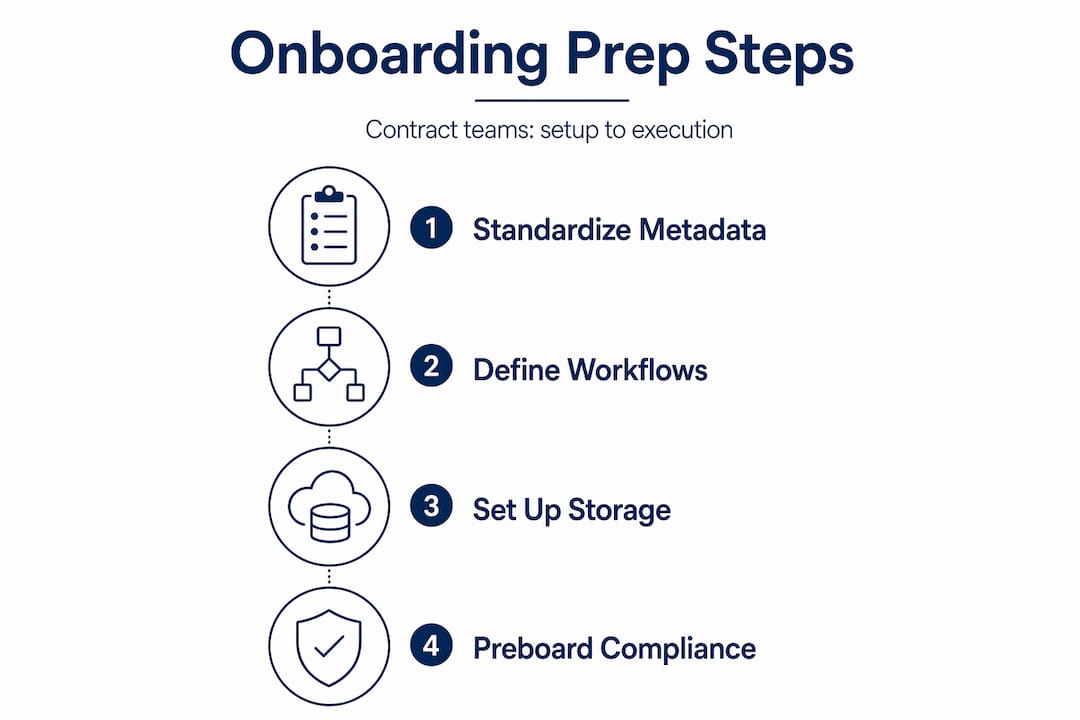
Define procure-to-pay workflows with approval routing. Ad hoc approval chains are one of the most reliable sources of delay in government contract processes. Approval routing through defined chains before contract finalization removes the guesswork about who reviews what and when. Define each approver role, assign SLA windows to every step, and configure escalation rules for tasks that go unaddressed.
Set up audit-ready document storage. Your document repository needs to do more than store files. It needs to support version control, access permission logs, and time-stamped records. When you add an e-signature provider, verify that audit trail exports from both systems are compatible and can be consolidated for a single review. Many teams discover this gap only during an audit, which is exactly the wrong time.
Collect compliance documents during preboarding. Contractor classification verification, insurance certificates, SAM.gov registration, and security clearance status should all be gathered before onboarding begins. This creates a gatekeeping layer that blocks incomplete contractors from advancing to execution-phase tasks. The result is fewer mid-process stops and less back-and-forth with contractors after work has already started.
| Preparation Component | Why It Matters |
|---|---|
| CLIN/SLIN templates | Reduces rework when finance and PM teams interpret contract data |
| Approval routing map | Eliminates informal handoffs that create delays |
| Document repository setup | Produces version history and access logs for audit purposes |
| Preboarding compliance checklist | Prevents incomplete contractor records from entering the workflow |
| E-signature audit export test | Confirms that signature records meet evidentiary standards |
Pro Tip: Run a pilot test of your audit trail export process before you go live. Simulate a contract lifecycle from signature to archive and verify that every access event and document version is captured. Discovering gaps during a live audit is far more costly than finding them in a controlled test.
Executing onboarding with automation and workflow triggers
With preparation complete, execution becomes a matter of sequencing and consistency. The goal is to move every contract from award to program kickoff without relying on individual team members to remember what comes next.
-
Trigger workflows only on fully executed contracts. Automation tools that monitor contract signature status should be configured to act only when the "completed" state is confirmed, not on intermediate states like "sent" or "delivered." Premature workflow triggers create a cascade of problems, including task assignments sent to teams before legal review is finished and financial commitments recorded against contracts that were never finalized.
-
Use parallel task routing for internal approvals. Sequential approval chains work for some decisions, but many internal tasks in contract onboarding can proceed at the same time. IT provisioning, program office notification, and financial system setup do not all depend on each other. Route them in parallel to cut days off the average onboarding timeline without sacrificing oversight.
-
Automate contractor engagement from day one. As soon as a contract reaches fully executed status, send a structured welcome communication with intake form links, point-of-contact assignments, and scheduling instructions for the kickoff meeting. This eliminates the informal email chains that otherwise consume contracting officer time and leave contractors uncertain about next steps.
-
Manage metadata and version control throughout. Contract modifications, option year exercises, and administrative changes all need to be captured in the same structured format as the original award. Purpose-built GovCon systems handle this by linking modifications to the parent contract record and maintaining traceable version histories. Avoid tools that treat modifications as separate documents with no structural relationship to the base contract.
-
Build exception handling into every workflow. Automation without exception paths is a liability. Define what happens when a contractor does not return a required form within three days. Define what happens when an approver is unavailable. Escalation steps for stalled signatures and unresponsive contractors should be part of the workflow design, not an afterthought.
Pro Tip: Do not automate everything at once. Start with the two or three highest-volume, most repetitive tasks in your onboarding sequence. Measure the impact, refine the logic, and then expand. Teams that attempt full automation in a single deployment typically spend months untangling exceptions that were never anticipated.
Verification and metrics: confirming onboarding quality over time
Completing onboarding is not the same as completing it correctly. Verification is the discipline that separates organizations that assume compliance from those that can prove it.

Maintain a complete audit trail from two sources. Your e-signature provider produces a log of who signed, when, and from what location. Your document repository produces a version history and access record. Together, these combined audit logs create the evidence chain that auditors and inspectors general require. Treat this chain as a compliance deliverable, not a byproduct of your tools.
Monitor compliance status through dashboards. Real-time visibility into which contracts have outstanding compliance items, which contractors have overdue certifications, and which onboarding tasks are past their SLA targets is not a luxury in public sector contracting. It is a risk management function. Configure automated reminders for expiring documents and build security requirements into your dashboards so compliance gaps are surfaced before they become audit findings.
Conduct periodic reassessments of contractor security and compliance status.
Annual reviews of contractor security posture and contractual security requirements are a recognized best practice. Critical Security Controls guidance advises maintaining inventories of service providers along with their contractual security obligations and scheduling reassessments at defined intervals. Onboarding is the entry point, but compliance must be monitored throughout the contract period of performance.
| Metric to Track | What It Reveals |
|---|---|
| Time from award to kickoff | Overall onboarding cycle time and where delays concentrate |
| Approval routing SLA adherence | Whether defined approval windows are being respected |
| Compliance document completion rate | How effectively preboarding is collecting required items |
| Audit trail export success rate | Whether the evidence chain is consistently complete |
| Exception frequency by workflow step | Which automation triggers are most prone to failure |
Pro Tip: Review your onboarding workflow data quarterly, not just during audits. Teams that wait for an audit to discover SLA violations or missing compliance documents are always in reactive mode. Quarterly reviews let you make small corrections before problems accumulate.
Common pitfalls that undermine efficient contract onboarding
Even well-designed processes break down at predictable points. Recognizing these failure modes before they occur is far more efficient than recovering from them afterward.
-
Inconsistent structured data entering the system. When contracts arrive with non-standard line-item structures or missing metadata fields, every team that touches the contract downstream must compensate manually. Most public-sector onboarding delays originate here. A template enforcement policy at the drafting stage is the most direct solution.
-
Triggering onboarding steps on incomplete contracts. Sending task assignments, access credentials, or welcome packets before a contract is fully executed creates confusion that is difficult to walk back. Teams receive instructions for work that may not yet be authorized. This is a workflow design error, not a technology limitation.
-
Weak audit trail capture. Relying solely on an e-signature provider's logs without a corresponding document repository version history leaves gaps. Access events, document edits, and approval timestamps that occur outside the signature tool will not appear in its log. Both systems need to be configured to capture their respective records.
-
Skipping exception handling in automation design. Automation without escalation paths turns a workflow gate into a bottleneck. If no rule exists for what happens when a task goes unaddressed, the process stalls silently. Escalation rules are not optional.
-
Treating compliance as a final step. Organizations that append compliance review to the end of onboarding consistently face delays and audit findings. Embedding security and compliance as inputs at the beginning of the workflow, rather than checkboxes at the end, is what separates contract onboarding best practices from common practice.
My take on automation, compliance, and where teams go wrong
I've seen more than a few public sector organizations invest in contract management automation and walk away disappointed. The common thread is not bad software. It's a process design problem that automation made faster to encounter.
What I've learned is that automation amplifies whatever is already in your process. If your metadata is inconsistent, automation will inconsistently populate your downstream systems at speed. If your approval chain has an unresolved ambiguity, automation will route to it repeatedly and stall every time. The technology is not the fix. It's the accelerant.
The teams that genuinely improve contract management outcomes treat compliance as a baseline, not a constraint imposed at the end. They design onboarding workflows where a contractor cannot advance to execution tasks until compliance documents are verified. They build exception handling before the first live contract runs through the system. And they measure cycle time from award to kickoff, because that number tells you everything about where friction actually lives.
My honest advice: start with a workflow map, not a software selection. Understand where your current process loses time and where compliance gaps appear. Then automate the parts you understand well and leave room to adjust. Iterative pilots, reviewed with real workflow data, will outperform any big-bang deployment every time. The goal is smoother contract onboarding built on a foundation that auditors can trust, not just a faster version of a broken process.
— Randy
How Primereadysub supports your contract onboarding goals
Government agencies and prime contractors working through complex, compliance-heavy programs need more than general IT support. Primereadysub, operating as Rutledge & Associates, LLC, brings purpose-built expertise in public sector contract onboarding workflows, compliance automation, and real-time program visibility. As an SDVOSB, woman-owned, and SBA-certified firm, Primereadysub delivers defined-scope outcomes, including audit-ready document management, automated approval routing, and dashboard-driven compliance monitoring. Their work across Maryland, New York, and Florida demonstrates a consistent record of reducing processing times while maintaining the audit trail integrity that government programs require. Explore how Primereadysub serves as a Prime-Ready IT modernization partner for agencies and primes looking to improve contract management outcomes. For subcontracting-specific support, the public sector primes page outlines specialized engagement models.
FAQ
What is the first step to streamline contract onboarding?
Standardize your contract metadata and line-item structures before implementing any automation. Inconsistent data entering the system creates manual rework for every team downstream and is the leading cause of onboarding delays in public sector organizations.
When should automated onboarding workflows be triggered?
Automated workflows should only trigger when a contract reaches fully executed status. Acting on intermediate signature states like "sent" or "delivered" causes premature task assignments and creates compliance exposure if the contract is later modified or voided.
How do you maintain audit readiness during contract onboarding?
Audit readiness requires combining e-signature provider logs with document repository version histories to produce a complete evidence chain. Both systems must be configured to capture access events, approval timestamps, and document edits, and the combined output should be exportable in a format auditors can review.
What compliance documents should be collected during preboarding?
Collect contractor classification records, SAM.gov registration confirmation, insurance certificates, and any required security clearance documentation before onboarding tasks begin. Gathering these items upfront creates a gatekeeping layer that prevents incomplete contractor records from advancing to execution-phase workflows.
How often should contract onboarding workflows be reassessed?
Quarterly workflow data reviews allow teams to identify recurring bottlenecks, SLA violations, and exception frequency before they accumulate into audit findings. Annual reassessments of contractor security posture and contractual security requirements are also a recognized best practice under Critical Security Controls guidance.