

Forming a public sector IT partnership without a structured foundation is one of the most common and costly mistakes prime contractors make. The pressure to win work quickly often pushes primes toward informal handshake arrangements that collapse under the weight of compliance requirements, scope disputes, or audit scrutiny. Understanding contract-ready partnerships how to build them correctly, from regulatory grounding through operational execution, is no longer optional for primes competing on federal, state, or local government contracts. Sales-focused partnerships fail at a rate of 80 to 90%, and the GovCon space is no exception when structure is absent.
Table of Contents
- Key takeaways
- Prerequisites for contract-ready partnerships in public sector IT
- Step-by-step process to establish contract-ready partnerships
- Common pitfalls and compliance risks to avoid
- Managing partnerships through the contract lifecycle
- My perspective on why structure wins in GovCon partnerships
- How Primereadysub supports prime-ready partnerships
- FAQ
Key takeaways
| Point | Details |
|---|---|
| Start with regulatory literacy | Know SBA, FAR, CMMC 2.0, and DFARS requirements before approaching any potential partner. |
| Write opportunity-specific agreements | Every teaming agreement must reference a specific solicitation and define clear work-share percentages. |
| Address cybersecurity requirements explicitly | CMMC 2.0 and CUI handling obligations must appear as written clauses, not verbal commitments. |
| Avoid generic templates | All partnership contracts require customization and qualified legal review before execution. |
| Manage partnerships after award | Transitioning teaming agreements into formal subcontracts with performance tracking prevents compliance failures post-award. |
Prerequisites for contract-ready partnerships in public sector IT
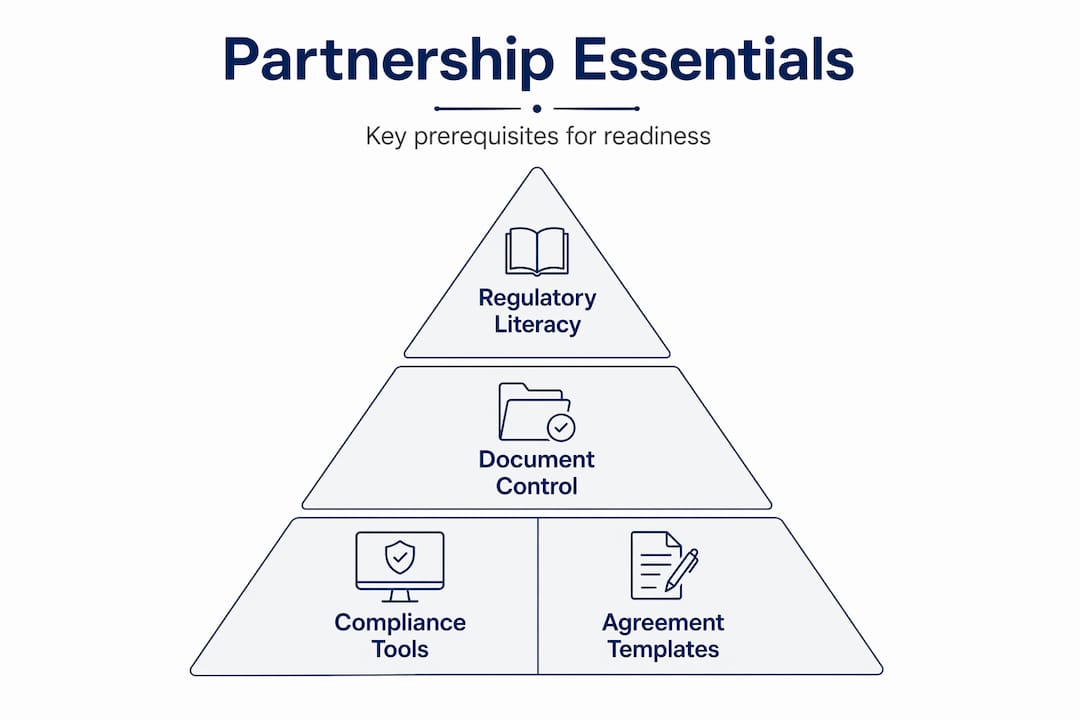
Before initiating any outreach to a potential subcontractor or teaming partner, a prime contractor needs to have its own house in order. The most frequent point of failure is not the agreement itself. It is the absence of internal readiness that makes even a well-drafted agreement difficult to execute.
Regulatory literacy comes first. Primes operating in the federal space must understand the Federal Acquisition Regulation (FAR), the Defense Federal Acquisition Regulation Supplement (DFARS), and SBA regulations at 13 CFR Part 121. For contracts involving controlled unclassified information, CMMC 2.0 compliance applies to every partner touching that data, not just the prime. State and local government contracts may follow analogous frameworks, so the specific procurement rules for each opportunity must be reviewed before teaming discussions begin.
Internal capability assessment is the second prerequisite. A prime that has not mapped its own technical and operational gaps cannot accurately define what it needs from a partner. This gap analysis should cover:
- Technical delivery areas where the prime lacks depth (cloud architecture, security operations, data analytics)
- Certifications the prime holds versus certifications required by the solicitation
- Past performance records relevant to the specific opportunity
- Financial capacity to fund the project during invoice processing cycles
Documentation and tools must be in place before any partnership discussion advances. At minimum, primes should have a mutual non-disclosure agreement ready, a secure document-sharing environment, and internal templates for teaming agreements. These templates are starting points only. Templates require customization and legal review before signing, a step many primes skip in the rush to respond to a solicitation.
| Prerequisite | Why it matters |
|---|---|
| Regulatory knowledge (FAR, SBA, CMMC 2.0) | Shapes what must appear in the teaming agreement |
| Gap analysis | Determines what capabilities the partner must bring |
| Partner goal definition | Prevents role ambiguity and scope disputes |
| Legal and financial registrations | SAM.gov registration, SBA certifications, bonding capacity |
| Documentation readiness | Enables faster, cleaner partner onboarding |
Pro Tip: Run a mock compliance checklist against your last two solicitations before approaching partners. If your internal processes could not meet those requirements independently, document the gaps and make them explicit in your partner search criteria.
Step-by-step process to establish contract-ready partnerships
Once prerequisites are satisfied, the process of building a contract-ready partnership becomes structured rather than reactive. The following steps reflect established best practices for government IT teaming arrangements.
-
Identify and evaluate potential partners. Partner evaluation should cover technical capability relative to the specific opportunity, financial stability including the ability to sustain operations during slow payment cycles, past performance in comparable government IT work, and organizational culture. A technically capable partner with poor documentation practices will create compliance problems on a government program.
-
Tie the teaming agreement to a specific solicitation. This is where many primes make a critical structural error. A teaming agreement must reference a specific solicitation number and define each party's role and work-share percentage. Teaming agreements must specify work-share percentages tied to the solicitation to avoid triggering SBA affiliation rules that could disqualify a small business prime.
-
Draft the core agreement clauses. A defensible teaming agreement for public sector IT work must address:
- Work scope and deliverables assigned to each party
- Intellectual property retention, with joint development handled separately
- Flow-down compliance obligations from the prime to the sub
- CUI handling procedures and CMMC certification levels
- Incident reporting requirements and timelines
-
Address cybersecurity compliance explicitly. The teaming agreement should define CUI boundaries, specify each partner's CMMC certification level, and establish incident reporting obligations. Treating cybersecurity as an afterthought until contract performance begins is a pattern that leads directly to contract termination or audit findings.
-
Negotiate termination and dispute resolution terms. Industry guidance recommends a 30-day written notice with opportunity to cure before termination for cause. Dispute resolution clauses should specify mediation before litigation and define the governing jurisdiction.
-
Review affiliation risk. The SBA's ostensible subcontractor rule requires the prime to perform at least 50% of personnel costs on service contracts or 50% of the contract value on supply contracts. Agreements that effectively hand the project to the subcontractor expose the prime to affiliation findings that can void the award entirely.
Pro Tip: Before finalizing any teaming agreement, have legal counsel map each clause against the specific solicitation's terms and conditions. Clauses that work in one procurement context can create compliance problems in another.
| Agreement element | Common mistake | Correct approach |
|---|---|---|
| Work-share percentages | Leaving percentages vague | Tie specific percentages to solicitation number |
| IP rights | Treating all IP as jointly owned | Retain pre-existing IP; address joint development separately |
| Cybersecurity obligations | Mentioning CMMC without specifics | Define CUI boundary, certification level, and incident reporting |
| Termination clause | Allowing immediate termination | Require 30-day notice with cure period |
| Role definition | Broad descriptions like "IT support" | Scope-specific deliverables with measurable outputs |
Common pitfalls and compliance risks to avoid
Understanding what goes wrong in GovCon partnerships is as useful as knowing what goes right. The following failure patterns appear consistently across both small and large prime contractors.
-
Vague scope language. Open-ended descriptions like "provide IT support as needed" are unenforceable and invite disagreements during performance. Every deliverable assigned to a subcontractor should be tied to a specific contract line item or statement of work section.
-
Ignoring SBA affiliation rules. Many primes believe that as long as they are listed as the prime on the award, affiliation rules do not apply to their teaming arrangement. This is incorrect. The ostensible subcontractor rule looks at the substance of the relationship, not the label. A prime that is functionally dependent on the subcontractor for core contract performance can lose its small business status retroactively.
-
Treating cybersecurity as a verbal commitment. On any contract involving federal data systems or CUI, CMMC and CUI handling requirements must appear as written clauses with specific obligations. Partners who verbally agree to maintain compliance but have no written documentation of their certification level or incident procedures leave the prime legally exposed.
-
Using unmodified generic templates. A template pulled from an online source captures general legal concepts but does not account for the specific regulatory environment, the solicitation's terms, or the risk profile of the specific technology work being performed. Generic templates must be customized with legal counsel before signing.
-
Skipping partner due diligence. Financial instability in a subcontractor becomes the prime's performance problem. A partner that cannot sustain operations through a 60-day invoice cycle will begin cutting corners on deliverables. References, financial statements, and past performance verification are not optional steps.
Thin letter agreements fail when disputes arise. Robust teaming agreements govern the partnership from proposal through performance, providing the documentation necessary to resolve conflicts without litigation and to satisfy contracting officer inquiries during audit.
Managing partnerships through the contract lifecycle
Winning the award is not the end of partnership management. It is the beginning of a more demanding phase where the teaming agreement transitions into a formal subcontract and performance accountability begins.
-
Convert the teaming agreement into a subcontract promptly. The teaming agreement is a pre-award instrument. After award, the formal subcontract governs the relationship. This document must incorporate all applicable flow-down clauses from the prime contract, including FAR provisions on labor standards, reporting, and data rights.
-
Track and report subcontracting performance accurately. Most federal contracts above certain thresholds require subcontracting plans and periodic reporting through tools like the Electronic Subcontracting Reporting System (eSRS). Missed reporting cycles create compliance findings that follow the prime into future competitions. Effective guidance on managing multi-partner IT projects covers these reporting structures in detail.
-
Maintain cybersecurity certification currency. CMMC 2.0 certifications have defined validity periods. A subcontractor that was certified at proposal time may fall out of compliance during a multi-year program. The prime bears responsibility for ensuring partner certifications remain current, which requires a formal tracking mechanism.
-
Resolve partner performance issues proactively. When a subcontractor begins missing milestones, the instinct is often to absorb the work internally to protect the delivery schedule. This creates two problems: it shifts work-share percentages in ways that may violate the subcontracting plan, and it masks performance issues that should be documented and addressed through the dispute resolution process in the subcontract.
-
Conduct periodic partnership audits. Quarterly reviews of subcontractor performance against the statement of work, financial tracking, and compliance status prevent small issues from becoming material findings during a formal government audit.
Pro Tip: Build a partnership performance scorecard at the start of every subcontract relationship. Track delivery accuracy, compliance status, and communication responsiveness monthly. This documentation is invaluable during past performance evaluations and dispute resolution.
My perspective on why structure wins in GovCon partnerships

I have watched primes win competitive awards on the strength of their teaming arrangements and then lose the program through the dysfunction of those same relationships. The pattern is predictable. The partnership was assembled to win, not to perform.
What I have found consistently is that primes who treat partnership formation with the same rigor they apply to proposal writing close the gap between award and successful delivery significantly. Lack of a standardized operational methodology is the primary driver of partnership failure, not technical mismatch or poor intent.
The GovCon environment does not forgive informal arrangements. A handshake on work-share, a verbal agreement on data handling, a generic template signed under deadline pressure: these are not relationship shortcuts. They are liability exposures waiting to materialize during a contracting officer inquiry or an inspector general review. Primes who invest in partnership management capabilities, including designated partnership leads, documented processes, and periodic compliance audits, consistently outperform those who treat partnership agreements as administrative paperwork rather than strategic instruments.
The contractors who build durable public sector practices are the ones who recognize that the agreement is not the finish line. It is the foundation on which delivery, compliance, and reputation are built.
— Randy
How Primereadysub supports prime-ready partnerships
Prime contractors navigating complex public sector IT modernization programs need more than a subcontractor willing to fill hours. They need a partner with documented scopes, certified compliance posture, and a track record of delivering outcomes under government oversight conditions. Primereadysub, operating as Rutledge & Associates, LLC, is SBA-certified, SDVOSB-designated, and woman-owned, with direct experience in DevOps pipeline delivery, compliance automation, and real-time program visibility for state and federal agencies.
For primes working in Maryland, New York, and Florida, Primereadysub provides prime-ready IT modernization support with defined deliverable scopes, low-oversight subcontracting, and built-in audit readiness. Explore Primereadysub's full capabilities to see how the firm positions itself as a contract-ready partner from day one.
FAQ
What is a contract-ready partnership in government IT?
A contract-ready partnership is a teaming arrangement where both the prime and subcontractor have documented compliance posture, defined work scopes, and signed agreements that satisfy regulatory requirements before contract award. It is structured to withstand government audit from the first day of performance.
How do I avoid SBA affiliation issues in a teaming agreement?
Specify work-share percentages tied to the solicitation number, and confirm the prime will perform at least 50% of personnel costs on service contracts. The SBA's ostensible subcontractor rule evaluates the substance of the relationship, not just how it is labeled.
What clauses must appear in a government IT teaming agreement?
At minimum, the agreement should address scope and work-share percentages, intellectual property retention, CUI handling procedures, CMMC certification requirements, incident reporting timelines, and termination provisions with a cure period.
When does a teaming agreement convert to a subcontract?
The conversion happens after contract award. The teaming agreement governs the pre-award phase, while the formal subcontract incorporates all applicable prime contract flow-down clauses and governs performance, payment, and dispute resolution.
How do we maintain cybersecurity compliance across a partnership?
Build a tracking mechanism that monitors each partner's CMMC certification validity, define CUI boundaries in the subcontract, and establish written incident reporting obligations with specific timelines. Verbal commitments are not sufficient for government compliance purposes.