

A government data warehouse is a centralized, secure, analytics-optimized repository that consolidates structured historical data from siloed operational systems, giving agencies a single auditable source of truth for reporting, cross-program analysis, and performance management. Unlike a transactional database that records live events, a warehouse is built specifically for analytical queries — pulling together years of program data so executives, auditors, and analysts can ask consistent questions and get consistent answers.
For a U.S. agency managing multiple programs, the immediate benefits are concrete:
- Single source of truth: One governed repository replaces the competing spreadsheets and system-specific extracts that produce conflicting numbers across reports.
- Faster executive reporting: Automated pipelines replace manual aggregation cycles, cutting report preparation from days to hours.
- Audit-ready metrics: Standardized, lineage-tracked data supports legislative inquiries, federal audits, and FOIA requests without emergency data pulls.
- Reduced manual effort: Automating data pipelines and dashboards replaces recurring labor costs with reproducible ETL/ELT and governed semantic layers.
- Cross-program insight: Analysts can join data across benefit programs, case management systems, and financial records in a single query.
A warehouse is not the right tool for every situation. Agencies that run only one or two systems with simple reporting needs may not yet need one. The investment pays off most clearly when an agency manages three or more separate program systems, faces frequent legislative information requests, or struggles with conflicting numbers across reports.
Table of Contents
- What a government data warehouse actually does — and what it doesn't
- Core components and architecture of a government data warehouse
- Why government agencies need a data warehouse
- Security, compliance, and governance requirements for government warehouses
- Deployment options and how to evaluate them
- What government data warehouse projects actually cost — and where they go wrong
- How to get a government data warehouse initiative started
- Research-backed guidance on hybrid architectures and FedRAMP readiness
- Key Takeaways
- Why the technology is rarely the hardest part
- Primereadysub delivers defined-scope data modernization for government agencies
- Useful sources and further reading
What a government data warehouse actually does — and what it doesn't
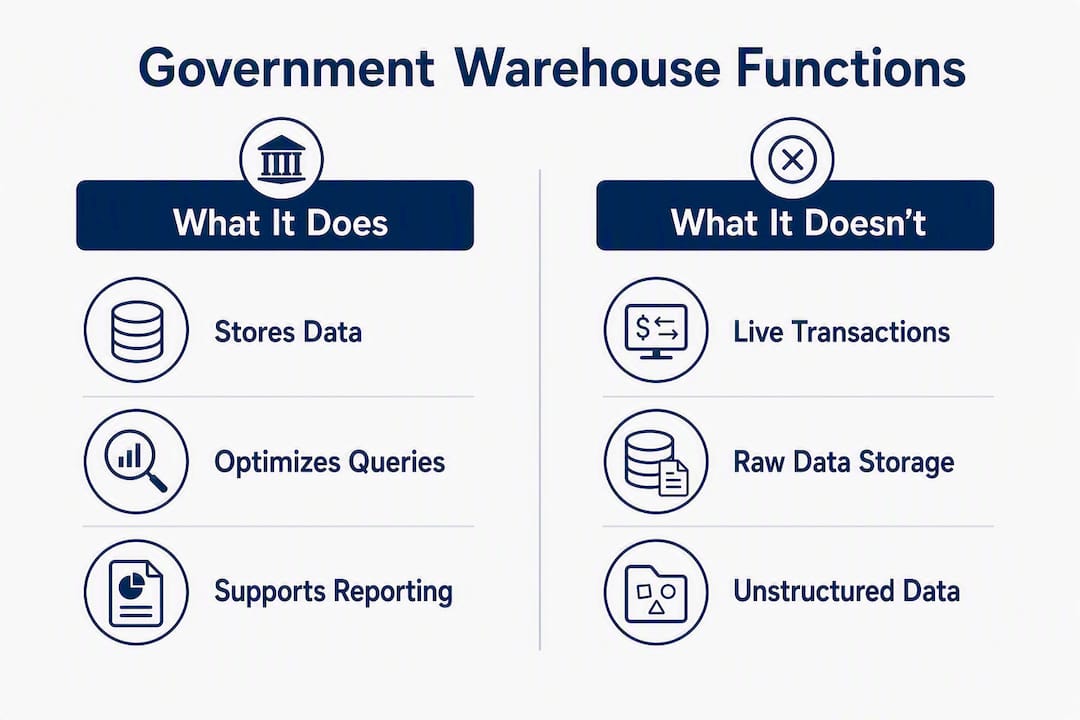
A data warehouse stores integrated, historical data pulled from various operational systems and optimizes it for analytical query performance, including time-series analysis, trend reporting, and consistent cross-program metrics. The key word is historical: a warehouse accumulates records over time, making it possible to compare this quarter's caseload against the same quarter three years ago.

How it differs from an operational database
An operational or transactional database (OLTP) is designed for speed on individual transactions: creating a case record, updating a payment status, or logging a service event. It is optimized for writes and point lookups, not for aggregating millions of rows across years. Running complex analytical queries against an OLTP system degrades performance for the staff who depend on it daily. A warehouse separates those workloads entirely.
How it differs from a data lake
A data lake stores raw, often unstructured data in its native format — log files, sensor streams, documents, and semi-structured JSON alongside structured records. It is well suited for data science, machine learning, and exploratory analysis. A warehouse, by contrast, applies structure, standardization, and governance before data is available for query. Modern federal agencies increasingly use hybrid architectures: a data lake for raw and unstructured data, and a warehouse or lakehouse layer for curated, governed datasets used for BI and audit-ready reporting.
The lakehouse pattern merges elements of both: open table formats (such as Delta Lake or Apache Iceberg) sit on object storage and support both SQL analytics and ML workloads. Several federal and state agencies are adopting this layered approach as cloud platforms mature.
When to choose warehouse-only vs. lake + warehouse
- Warehouse-only fits agencies whose primary need is governed, auditable metrics for reporting and compliance, with limited exploratory or ML requirements.
- Lake + warehouse fits agencies that need both audit-ready BI and the ability to run data science on raw program data.
Pro Tip: Governance and audit requirements are the deciding factor. If your agency faces regular legislative audits or federal oversight, the curated, lineage-tracked warehouse layer is non-negotiable regardless of whether you also run a lake.
Core components and architecture of a government data warehouse
A government data warehouse is not a single product — it is a layered architecture. Understanding each layer helps agency architects map existing systems to the gaps they need to fill.
The standard component stack looks like this:
- Source systems: OLTP databases, case management platforms, financial systems, HR systems, and external data feeds (federal grants, census data).
- Ingestion layer (ETL/ELT): Pipelines that extract data from sources, apply transformations, and load it into the warehouse. ETL transforms data before loading; ELT loads raw data first and transforms inside the warehouse engine, which is increasingly common on cloud platforms with sufficient compute.
- Staging area: A temporary landing zone where raw extracted data sits before transformation and quality checks. Keeps source data intact for reprocessing.
- Curated schema (storage layer): The governed, structured layer where data is organized into dimensional models. Star schemas (a central fact table surrounded by dimension tables) remain the most common pattern for government reporting because they are easy for BI tools to query and easy for auditors to understand. Snowflake schemas normalize dimensions further, reducing redundancy at the cost of query complexity.
- Storage tiers: Columnar storage formats (used by most modern cloud warehouses) compress data efficiently and accelerate aggregate queries. Partitioning by date or program code speeds up the time-range queries that dominate government reporting.
- Semantic layer: A governed metadata layer that maps physical table columns to business-friendly names and enforces consistent metric definitions. This is where "active cases" gets a single, agreed-upon definition rather than five competing ones.
- BI and visualization layer: Tools that connect to the semantic layer and produce dashboards, scheduled reports, and ad hoc queries for analysts and executives.
- Monitoring and metadata: Data lineage tracking, data quality rules, pipeline health monitoring, and a data catalog that documents what each dataset contains and who owns it.
Ingestion patterns and when to use them
Batch ingestion (nightly or weekly loads) suits most government reporting workloads and is the simplest to govern. Micro-batch and near-real-time ingestion (using tools like Apache Kafka or cloud-native streaming services) are appropriate for fraud detection or operational dashboards that need data fresher than 24 hours. Most agencies start with batch and add streaming selectively.
Warehouse design choices include enterprise data warehouses (EDW), operational data stores (ODS), data marts, cloud data warehouses, and logical data warehouses, each with different tradeoffs for reporting latency, governance, and cost. Data marts — subject-area subsets of the main warehouse — are common in government for separating financial data from case management data while maintaining a shared dimensional model.
Platform examples that agencies evaluate for this architecture include Snowflake (cloud-native, strong separation of storage and compute), Amazon Redshift (AWS GovCloud-available, mature ecosystem), Google BigQuery (serverless, consumption-based pricing), Microsoft Azure Synapse Analytics (integrated with Azure Government, broad Microsoft ecosystem), and Teradata (enterprise-grade, long-standing in large federal deployments). Each fits different agency constraints, which the deployment section covers in more detail.
Why government agencies need a data warehouse
The clearest signal that an agency needs a data warehouse is the moment a program director cannot answer a straightforward question — "How many active cases did we close last quarter?" — without emailing four different system owners and waiting two days for reconciled spreadsheets. That scenario is common, and it carries real cost.
A government data warehouse transforms disparate operational data into a unified source of truth for both near-term operational decisions and long-range policy planning. The use cases that drive the most value in U.S. agencies include:
- Consolidated executive dashboards: Program directors and agency heads get a single, real-time view of KPIs without waiting for manual report cycles.
- Mandatory federal and state reporting: Agencies with federal grant obligations (Title IV, SNAP, Medicaid) must produce standardized reports on schedule. A warehouse with pre-built report logic eliminates the scramble before each submission deadline.
- Audit-ready records: When a legislative auditor or inspector general requests data, a governed warehouse produces a documented, reproducible extract rather than an ad hoc pull.
- Fraud detection: Cross-program joins — matching benefit recipients across multiple programs — surface anomalies that no single system can detect alone.
- Policy evaluation: Longitudinal data enables analysts to measure whether a program change in year one produced the intended outcome by year three.
- Cross-program KPI tracking: Agencies managing housing, employment, and health programs simultaneously can track client journeys across systems.
State-level feasibility studies show that centralized warehouses can reduce fraud, conserve dollars, and improve cross-agency analysis, but they require complementary components — BI tools, master data management (MDM), and data quality management — to meet state objectives. The warehouse alone does not deliver value; the governed pipeline around it does.
The analytics role in compliance for public agencies is particularly pronounced when agencies face overlapping federal oversight requirements. A warehouse that tracks audit trails and enforces consistent metric definitions reduces the risk of contradictory figures appearing in separate federal submissions.
Security, compliance, and governance requirements for government warehouses
Security and governance are not features to add after the warehouse is built. They are architectural requirements that shape every design decision, from where data is hosted to how individual columns are masked for different user roles.

FedRAMP and GovCloud
FedRAMP authorization establishes a baseline of security controls that cloud platforms must meet before federal agencies can use them for government data. FedRAMP Moderate covers most civilian agency workloads. FedRAMP High is required for systems handling sensitive data — law enforcement records, certain health data, or data classified at the Controlled Unclassified Information (CUI) level. Choosing a FedRAMP-authorized platform can materially shorten the ATO process for analytics workloads that handle sensitive PII or compliance-heavy program data, because the agency inherits a large portion of the required controls rather than documenting them from scratch.
GovCloud environments (AWS GovCloud, Azure Government, Google Cloud for Government) provide physically isolated infrastructure with U.S.-person access controls, satisfying additional requirements for ITAR and export-controlled data.
Essential security controls checklist
- Encryption at rest (AES-256 or equivalent) and in transit (TLS 1.2 minimum).
- Role-based access control (RBAC) with least-privilege principles enforced at the schema and table level.
- Fine-grained row- and column-level security for datasets containing PII or sensitive program data.
- Comprehensive audit logging: who queried what, when, and what data was returned.
- Data lineage tracking from source system to report output.
- Retention and deletion policies aligned with agency records schedules and applicable federal regulations.
- Network controls: private endpoints, VPC isolation, and IP allowlisting where required.
- Vulnerability management and patch cadence for warehouse infrastructure components.
Governance requirements
Tools alone are not enough: successful government data platforms require governance, clear data ownership, standardized metadata, and role-based access controls to deliver usable executive insights. Governance items that agencies must establish before going to production include:
- A designated data owner or steward for each subject area (finance, case management, HR).
- A data dictionary that defines every metric, dimension, and identifier in business terms.
- Standardized canonical identifiers (a single client ID that works across all source systems).
- A metadata catalog that documents data lineage, update frequency, and data classification.
- A change management process for schema changes that notifies downstream report owners.
FOIA implications
The Freedom of Information Act requires agencies to respond to public records requests. A warehouse with well-documented lineage and access controls makes FOIA responses faster and more defensible — the agency can produce a documented extract with a clear chain of custody rather than a manual pull from multiple systems. Agencies should design their data classification scheme with FOIA exemptions in mind, tagging records that are exempt from disclosure at the row or column level.
Pro Tip: Embed governance policy as code wherever possible. Define RBAC rules, data masking policies, and retention schedules in version-controlled configuration files rather than manual database settings. This makes policies auditable, reproducible, and easier to enforce consistently across environments.
Deployment options and how to evaluate them
The right deployment model depends on the agency's security authority, existing infrastructure, data sensitivity, and long-term operational capacity. Three primary models are in use across U.S. government agencies.
Cloud (public cloud + GovCloud)
Cloud-hosted warehouses offer elastic compute, consumption-based pricing, and managed infrastructure. For agencies whose data sensitivity requires FedRAMP Moderate or High, GovCloud regions provide the necessary isolation. Cloud deployments are the fastest path to production for agencies that do not have existing on-premises data center capacity or the staff to manage warehouse infrastructure.
On-premises
On-prem deployments give agencies full physical control over hardware and data. They suit environments with classified data requirements that cannot be met by any cloud authorization level, or agencies with existing data center investments and the operational staff to maintain them. The tradeoff is higher capital cost, longer procurement cycles, and limited elasticity.
Managed DWaaS (Data Warehouse as a Service)
Managed DWaaS options offload infrastructure operations to a vendor or managed service provider. The agency focuses on data modeling, governance, and analytics rather than patching and scaling hardware. This model suits agencies that want cloud economics without building internal cloud operations expertise. Serverless and managed service patterns are increasingly viable for government workloads as FedRAMP-authorized managed services expand.
Comparison dimensions for platform evaluation
| Dimension | What to evaluate |
|---|---|
| Deployment model | Cloud (public/GovCloud), on-prem, managed DWaaS, or hybrid |
| Primary use case | High-concurrency BI, large-scale batch analytics, near-real-time reporting |
| Security and compliance | FedRAMP authorization level, encryption standards, audit logging, RBAC granularity |
| Scalability and performance | Compute/storage separation, auto-scaling, query concurrency limits |
| Integration and ETL/ELT ecosystem | Native connectors, support for agency source systems, pipeline tooling |
| Pricing model | Consumption-based vs. fixed licensing; storage costs at scale |
Platform orientation
Snowflake's separation of storage and compute makes it well suited for variable workloads where query concurrency spikes around reporting deadlines. Amazon Redshift, available in AWS GovCloud, has a mature ecosystem and strong integration with other AWS services commonly used in federal environments. Google BigQuery's serverless model eliminates cluster management entirely, which appeals to agencies with limited DBA capacity. Microsoft Azure Synapse integrates tightly with Azure Government and the broader Microsoft 365 ecosystem that many state and local agencies already use. Teradata remains a strong choice for large federal agencies with existing Teradata investments and high-volume, complex analytical workloads. Cloud decision frameworks for government can help agencies map these platform characteristics to their specific authority-to-operate requirements.
What government data warehouse projects actually cost — and where they go wrong
Budget and timeline expectations for a government data warehouse vary widely based on data volume, source system complexity, and governance maturity. Understanding the primary cost drivers prevents the most common planning failures.
Primary cost drivers
- Data volume and retention: Storing five years of case records across ten programs costs significantly more than storing two years across three. Cloud storage pricing scales with volume; on-prem requires upfront hardware.
- Ingestion complexity: Connecting to modern REST APIs is straightforward. Extracting from 1980s-era COBOL mainframes or proprietary state financial systems requires custom connectors and significant testing effort.
- Security and compliance controls: FedRAMP authorization, audit logging infrastructure, and fine-grained access controls add both implementation time and ongoing operational cost.
- Tool licensing vs. consumption pricing: Fixed-license platforms (Teradata, some on-prem options) have predictable costs but limited elasticity. Consumption-based cloud platforms (BigQuery, Snowflake) can surprise agencies with cost spikes during heavy query periods without proper governance controls.
- Governance and metadata work: This is consistently underestimated. Building a data dictionary, establishing canonical identifiers, and documenting lineage for ten source systems takes months of analyst and architect time.
Typical implementation phases and timeline
- Assessment (4–8 weeks): Inventory source systems, document data flows, assess governance maturity, and define priority reports.
- Pilot/proof of concept (6–10 weeks): Build ETL/ELT for one high-value report, demonstrate the semantic layer, and validate with stakeholders.
- Build (3–6 months): Expand to additional source systems, implement security controls, build out the data catalog, and develop the core report library.
- Validate and audit (4–6 weeks): Reconcile warehouse outputs against source systems, conduct security review, and complete ATO documentation if required.
- Production and continuous improvement (ongoing): Operate, monitor, and expand scope iteratively.
Common pitfalls
- The data swamp: Ingesting data without metadata, lineage, or data dictionaries destroys trust. Without explicit data dictionaries, canonical identifiers, and lineage, users lose confidence and revert to spreadsheets.
- Skipping governance: Treating the warehouse as a technical project rather than an organizational one. Technology without governance produces a well-engineered repository that nobody trusts.
- Underestimating legacy integration: State financial systems, legacy case management platforms, and federal data feeds each have their own extraction challenges. Legacy system modernization patterns address these integration complexities directly.
- Weak change management: Analysts and program staff who are not trained on the new system will continue using their old spreadsheets, undermining the single-source-of-truth goal.
- Scope creep in the pilot: Trying to load all source systems in the first phase delays the first demonstrable win and exhausts stakeholder patience.
How to get a government data warehouse initiative started
The first actions determine whether the project builds momentum or stalls in committee. The following checklist reflects the governance-first approach that separates successful programs from abandoned ones.
Ordered first actions
- Appoint a data owner or Chief Data Officer (CDO). Someone must be accountable for data quality and governance decisions. Without a named owner, every cross-agency data conflict becomes a political negotiation.
- Inventory source systems. Document every system that holds program data: what it contains, how it is structured, who owns it, and how it can be extracted.
- Define priority reports and metrics. Identify the three to five reports that consume the most manual effort or produce the most conflicting numbers. These become the pilot scope.
- Agree on canonical identifiers. Establish a single client ID, case ID, and program code that will be used across all source systems in the warehouse. This is the hardest governance problem and the most important one to solve early.
- Select a pilot use case. Choose one high-value report that can be automated end-to-end in the pilot phase. A successful demo builds executive support for the full program.
- Map compliance requirements. Determine the required FedRAMP authorization level, applicable federal data standards, and FOIA classification requirements before selecting a platform.
Next steps after the pilot
- Prototype ETL/ELT pipelines for the pilot use case and validate outputs against source systems.
- Implement basic metadata and lineage tooling from the start — retrofitting it later costs more than building it in.
- Schedule regular leadership demo cycles (every four to six weeks) to maintain visibility and surface changing requirements early.
Staffing considerations
Most agencies do not have the full skill set in-house: data architects, ETL developers, governance analysts, and cloud security engineers are all required. Outcomes-based IT partnerships — where a modernization partner owns a defined scope rather than providing staff augmentation — give agencies access to a full delivery team without the overhead of managing individual contractors across multiple disciplines. The data analytics fundamentals that underpin a warehouse initiative are well documented, but applying them in a compliance-heavy government environment requires practitioners who have done it before.
Research-backed guidance on hybrid architectures and FedRAMP readiness
The evidence from both federal and state programs points consistently toward three conclusions: hybrid architectures are the pragmatic default, governance determines success more than technology, and FedRAMP authorization level is a critical early decision.
Hybrid lake + warehouse as the default pattern
Data warehouses remain essential for governed metrics, regulatory reporting, and executive dashboards, while lakes and lakehouses suit raw exploratory analysis and ML workloads. Most mature government organizations run both: a lake for raw and experimental data, a warehouse for curated, trusted metrics. This pattern preserves raw data fidelity — important for reprocessing when business rules change — while providing a structured, high-performance layer for the reporting and audit workloads that drive daily agency operations.
Public-sector data strategies recommend strategic alignment, rigorous data integration, governance, and continuous improvement as the foundations for long-term value. Agencies that treat the warehouse as a one-time technology deployment rather than an ongoing data management program consistently underperform those that invest in governance infrastructure.
Governance as the non-technical determinant of success
Governance — metadata, ownership, and RBAC — determines whether a warehouse becomes a trusted asset or a wasted investment. The largest barrier to a successful government warehouse is organizational: agencies must reframe data as an enterprise asset, establish cross-agency governance, and enforce standardization before full integration. Without that foundation, integration projects stall regardless of the platform selected.
FedRAMP and ATO implications
For federal and compliance-heavy state programs, the distinction between FedRAMP Moderate and FedRAMP High matters operationally. Platforms with FedRAMP High authorization enable agencies to inherit a larger set of security controls, which directly accelerates the Authority to Operate (ATO) approval process. Choosing a non-authorized platform means documenting every control from scratch — a process that can add six to twelve months to a project timeline. Hybrid IT approaches for public sector programs that combine FedRAMP-authorized cloud services with on-prem components for the most sensitive data are a common and defensible architecture.
Recommended next steps for architects
- Perform a governance maturity assessment before selecting a platform. Technology choices made before governance gaps are understood tend to be reversed.
- Map data classification (PII, CUI, public) to hosting choices. Not all agency data requires FedRAMP High; over-classifying drives unnecessary cost.
- Pilot with FedRAMP Moderate or High-enabled services if the workload involves sensitive program data, and document the inherited controls as part of the ATO package.
- Engage sector-specific analytics guidance to understand how peer agencies in adjacent domains have structured their data programs.
Pro Tip: Run a governance maturity assessment as the first deliverable, before any platform procurement. Agencies that skip this step frequently select a platform that fits their current technical environment but cannot support the governance model they need six months later.
Key Takeaways
A government data warehouse delivers its full value only when governance, security architecture, and a defined pilot scope are established before the first data pipeline is built.
| Point | Details |
|---|---|
| Core purpose | A warehouse consolidates historical program data into a governed, analytics-optimized repository for reporting and audits. |
| Governance first | Data ownership, canonical identifiers, and metadata must be defined before ingestion begins, or the warehouse becomes a data swamp. |
| Hybrid architecture | Most mature agencies run a lake for raw data and a warehouse for curated, audit-ready metrics — not one or the other. |
| FedRAMP authorization | Selecting a FedRAMP Moderate or High-authorized platform shortens the ATO process and reduces the security documentation burden. |
| Primereadysub's role | Primereadysub delivers defined-scope modernization work packages — legacy integration, compliance automation, and analytics dashboards — as an outcomes-owned partner rather than staff augmentation. |
Why the technology is rarely the hardest part
The conventional wisdom on government data warehouse projects focuses heavily on platform selection: which cloud provider, which authorization level, which schema design. That framing is understandable — platforms are concrete, procurable, and easy to evaluate in a vendor briefing. But the agencies that struggle most with these projects are not struggling because they chose the wrong platform. They are struggling because they started building before they resolved who owns the data.
The organizational challenge is more stubborn than any technical one. A warehouse that ingests data from five program offices requires those five offices to agree on a shared client identifier, a shared definition of "active case," and a shared understanding of who can query what. Those agreements require authority, patience, and often a sponsor at the deputy secretary level who can break ties. No amount of Snowflake or Azure Synapse resolves a governance dispute between program offices.
The second underestimated factor is change management. Analysts who have spent years building their own Excel-based reporting systems will not abandon them simply because a new warehouse exists. They need to see that the warehouse produces numbers they trust, that it is faster than their current process, and that leadership is using it. The pilot use case is not just a technical proof of concept — it is a trust-building exercise. Choosing the right pilot (high visibility, high pain, fast to demonstrate) determines whether the broader program gets funded.
The agencies that succeed treat the warehouse as a program, not a project. They appoint a data steward, fund ongoing governance work, and plan for the warehouse to evolve as programs change. That mindset shift — from "we are building a system" to "we are managing an enterprise data asset" — is what separates the programs that deliver sustained value from the ones that produce a well-engineered repository that nobody uses three years later.
Primereadysub delivers defined-scope data modernization for government agencies
For agencies ready to move from planning to production, the gap between a well-designed architecture and a working, compliant warehouse is almost always execution capacity: the combination of legacy integration expertise, governance discipline, and security engineering that most agency teams cannot staff entirely in-house.
Primereadysub, operating as Rutledge & Associates, LLC, delivers exactly that combination as an outcomes-owned work package. The firm handles legacy system modernization, cloud-native re-architecture, compliance automation, ETL/ELT pipeline development, and real-time analytics dashboards — with a defined scope and measurable deliverables rather than open-ended staff augmentation. Certified as an SDVOSB, woman-owned, and SBA-certified small business, Primereadysub works primarily with state agencies and prime contractors on compliance-heavy programs in Maryland, New York, and Florida.
For a program director or CIO evaluating a data warehouse initiative, the practical next step is a capability briefing: a focused conversation about your agency's source systems, compliance requirements, and priority reporting needs, mapped to a defined scope of work. Request a briefing at primereadysub.com to see how an outcomes-focused partner can accelerate your path from assessment to production.
Useful sources and further reading
The following references provide authoritative technical and policy depth for U.S. government professionals planning or evaluating a data warehouse program.
- NextGov — Helping DoD Break Down Data Silos: Examines the metadata and lineage failures that undermine large-scale federal data integration efforts, with recommendations for DoD and civilian agencies.