

Hybrid IT is defined as a deliberate combination of on-premises infrastructure and cloud services, designed to deliver cost-effective, compliant, and resilient operations. For public-sector IT leaders, this model addresses a problem that neither pure cloud nor legacy on-premises environments can solve alone: how to modernize without sacrificing regulatory control or operational continuity. Gartner predicts 90% of organizations will run hybrid cloud by 2027, driven by regulatory, latency, legacy, and AI workload constraints. That figure signals a structural shift in how government agencies and public institutions think about infrastructure. The question is no longer whether to adopt hybrid IT, but how to do it well.
Why adopt hybrid IT: the core drivers for public-sector organizations
The reasons to choose hybrid IT in government environments are grounded in operational reality, not technology trends. Public agencies face a specific set of constraints that make a blended model not just attractive, but necessary.
1. Regulatory compliance and data sovereignty
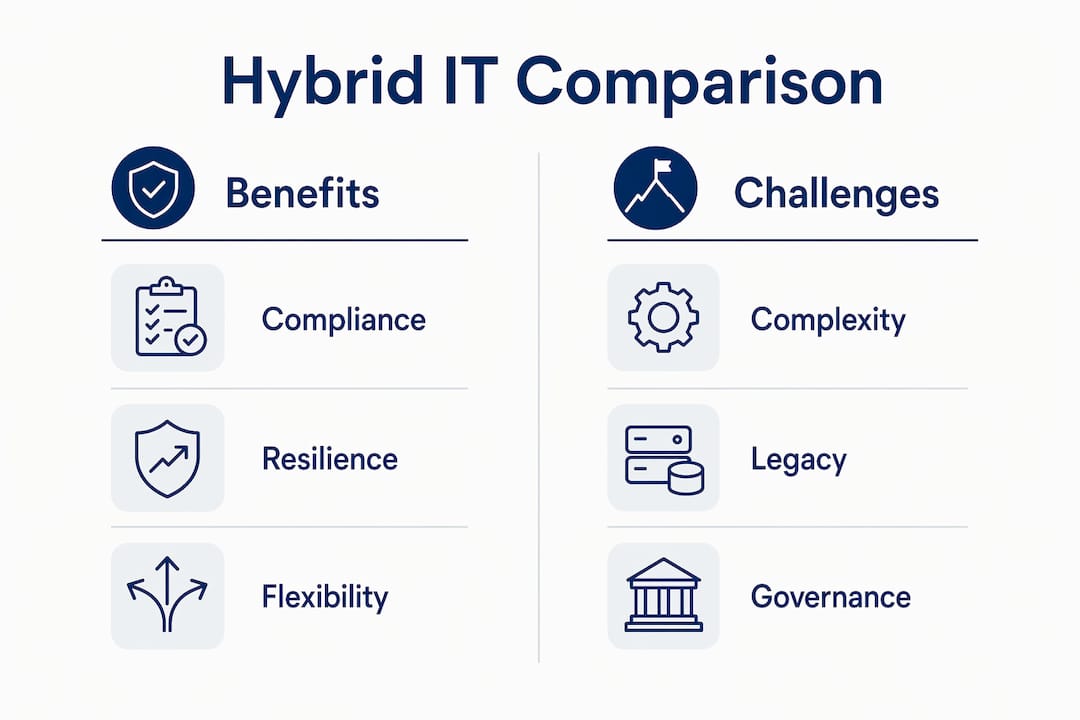
Government agencies operate under strict data governance requirements, including HIPAA for health data and frameworks like FedRAMP for federal systems. Hybrid IT supports compliance by keeping sensitive data on-premises while using cloud for less regulated tasks. This separation is not a workaround. It is a deliberate architectural decision that allows agencies to meet audit requirements without sacrificing the agility that cloud services provide for non-sensitive workloads.

2. Legacy system dependencies
Most state and local agencies run applications that were built decades ago and cannot be migrated to cloud without significant re-engineering. Hybrid IT allows these systems to remain on-premises while new services are built cloud-native alongside them. This coexistence is what makes modernization feasible within constrained budgets and timelines.
3. Cost predictability and optimization
Hybrid IT delivers cost predictability for steady-state workloads on-premises while leveraging cloud elasticity for variable demand. Payroll processing, case management, and benefits administration run at predictable volumes and belong on-premises. Seasonal tax filing spikes or emergency response workloads are ideal candidates for cloud bursting. This split reduces capital expenditure without exposing agencies to the cost volatility that comes with running everything in the cloud.
- Steady-state workloads: on-premises for cost predictability
- Variable or seasonal workloads: cloud for elastic scaling
- Sensitive data: on-premises for compliance and sovereignty
- Development and testing environments: cloud for speed and flexibility
4. Business continuity
60% of organizations are moving away from single-cloud models, with 31% implementing hybrid setups to balance cost, performance, and compliance. That movement reflects hard lessons learned from outages and vendor dependency. Distributing workloads across environments means no single failure point can take down critical public services.
Pro Tip: Before selecting workloads for cloud migration, map each application against three criteria: data sensitivity, latency tolerance, and cost profile. Applications that fail any one criterion are strong candidates to remain on-premises.
How does hybrid IT improve operational resilience?
Resilience in hybrid IT is not simply about uptime. It is about the ability to sustain critical operations when one environment fails, degrades, or becomes unavailable.
Hybrid IT enhances resilience by distributing workloads across cloud and on-premises environments, eliminating single points of failure and minimizing downtime. When a cloud provider experiences an outage, agencies with hybrid architectures can fail over to on-premises systems. When on-premises hardware fails, cloud environments absorb the load. This bidirectional failover capability is something neither a pure cloud nor a pure on-premises model can offer.
"The strategic value of hybrid IT is found in workload placement according to performance and data sensitivity, enabling innovation balanced with stability and compliance." — What Is Hybrid IT?
Vendor lock-in is a related risk that hybrid IT directly mitigates. Agencies that commit entirely to a single cloud provider, whether AWS GovCloud, Microsoft Azure Government, or Google Cloud, become dependent on that vendor's pricing, availability, and policy decisions. A hybrid model preserves negotiating leverage and architectural flexibility.
| Resilience factor | Pure cloud | Pure on-premises | Hybrid IT |
|---|---|---|---|
| Failover capability | Limited to provider | None across vendors | Bidirectional |
| Vendor lock-in risk | High | Low | Managed |
| Disaster recovery options | Provider-dependent | Self-managed only | Distributed |
| Compliance control | Shared responsibility | Full control | Configurable |
Pro Tip: Test failover scenarios at least twice per year. Many agencies discover gaps in their recovery procedures only during actual incidents, when the cost of discovery is highest.
What are the challenges of adopting hybrid IT?
Hybrid IT is not without complexity, and public-sector leaders who underestimate the operational demands of managing multiple platforms often find that costs exceed projections.
Many organizations underestimate total cost of ownership due to duplicated capabilities and management overhead in hybrid IT without mature FinOps practices. Running two environments means two sets of monitoring tools, two security frameworks, two vendor relationships, and two teams with distinct skill sets. Without deliberate governance, these costs compound quickly and erode the financial case for hybrid adoption.
The following challenges are the most common obstacles organizations encounter:
-
Architectural complexity. Integrating on-premises systems with cloud platforms requires careful network design, identity management, and data synchronization. Without performance contracts and policy-based routing, hybrid environments risk hidden cross-domain latency that degrades user experience and increases costs.
-
Governance gaps. Many agencies lack a unified policy framework that spans both environments. Security policies, access controls, and compliance monitoring must be consistent across on-premises and cloud, or gaps become vulnerabilities.
-
Skill requirements. Hybrid IT demands staff who understand both traditional infrastructure and cloud-native architectures. This skill combination is rare in public-sector IT teams and often requires training investment or external partnership.
-
FinOps maturity. Effective hybrid IT cost management requires mature FinOps practices to govern workload placement. Without them, duplicated resources and management overhead increase expenses beyond what a single-platform setup would cost.
The most effective mitigation strategy is incremental modernization. The strangler fig pattern allows legacy systems to be phased out gradually, maintaining operational stability while modernizing incrementally. Rather than attempting a full migration, agencies build new capabilities alongside existing systems and redirect traffic progressively. This approach reduces risk, preserves continuity, and gives teams time to build the skills hybrid environments demand.
How can public-sector organizations implement hybrid IT effectively?
Effective implementation of hybrid IT solutions in government environments requires a structured approach to workload placement, governance, and partnership.
Workload placement criteria
Every application should be evaluated against three dimensions before placement decisions are made:
- Sensitivity: Does the data require on-premises control for compliance or sovereignty reasons?
- Latency: Does the application require sub-millisecond response times that cloud connectivity cannot reliably guarantee?
- Cost profile: Is the workload steady-state (favoring on-premises capital investment) or variable (favoring cloud operational expenditure)?
Hybrid IT enables workload placement based on sensitivity, latency, cost, and compliance considerations. This framework turns placement decisions from guesswork into a repeatable, auditable process.
Governance essentials
Identity-first security is the foundation of hybrid IT governance. Every user, device, and service must authenticate through a unified identity provider, whether Microsoft Entra ID or a comparable platform, regardless of which environment they are accessing. Policy enforcement must be consistent, and visibility must span both environments through a single monitoring and logging framework.
Cloud bursting, the practice of automatically scaling workloads into cloud environments during demand spikes, requires pre-negotiated capacity agreements and tested automation pipelines. Agencies that set up cloud bursting without testing it under realistic load conditions often discover configuration failures during the moments they can least afford them.
Strategic partnerships
Public-sector IT modernization is rarely a solo effort. Agencies that partner with firms holding deep experience in compliance-heavy environments move faster and make fewer costly architectural mistakes. The right partner brings not just technical capability but also knowledge of procurement vehicles, contract structures, and regulatory frameworks specific to government IT.
| Implementation area | Key action | Expected outcome |
|---|---|---|
| Workload placement | Apply sensitivity, latency, and cost criteria | Optimized resource allocation |
| Identity governance | Deploy unified identity provider | Consistent access control |
| Cost management | Implement FinOps discipline | Reduced overhead and waste |
| Modernization approach | Apply strangler fig pattern | Stable, incremental progress |
| Partnership model | Engage compliance-experienced partners | Faster delivery, fewer errors |
Understanding flexible contracting models is equally important. Hybrid IT programs that lock agencies into rigid scopes often fail to adapt as workload requirements evolve. Contracts should include provisions for workload reassignment, capacity adjustment, and governance updates as the environment matures.
Key takeaways
Hybrid IT succeeds in the public sector when workload placement, governance discipline, and incremental modernization work together as a unified operating model rather than separate technical decisions.
| Point | Details |
|---|---|
| Compliance drives placement | Keep sensitive data on-premises to meet HIPAA, FedRAMP, and sovereignty requirements. |
| Resilience requires distribution | Distributing workloads across environments eliminates single points of failure and enables failover. |
| Governance prevents cost overruns | Mature FinOps and unified policy frameworks prevent duplicated costs and security gaps. |
| Incremental modernization reduces risk | The strangler fig pattern phases out legacy systems gradually without disrupting operations. |
| Partnership accelerates outcomes | Compliance-experienced partners reduce architectural errors and speed up delivery timelines. |
The case for pragmatism over ideology in hybrid IT
Public-sector IT leaders are under pressure from two directions at once. Budget offices push for cloud adoption as a cost-reduction strategy. Security and compliance teams push back with concerns about data sovereignty and audit readiness. Hybrid IT is often positioned as the compromise, but that framing undersells it.
From my perspective, the agencies that get the most from hybrid IT are not the ones that treat it as a middle ground. They are the ones that treat it as a deliberate operating model with its own discipline. The difference shows up in outcomes. Agencies that approach hybrid IT with a clear workload classification framework, a unified governance layer, and a phased modernization roadmap consistently outperform those that adopt it reactively in response to a failed cloud migration or a compliance audit finding.
The misconception I encounter most often is that hybrid IT is a temporary state on the way to full cloud adoption. Gartner's 90% hybrid adoption projection suggests otherwise. For most public-sector organizations, hybrid IT is not a transition phase. It is the destination. The agencies that accept this early invest in the governance and skills that make it work long-term, rather than treating every on-premises component as technical debt to be eliminated.
The future of public-sector IT is not cloud-first or on-premises-first. It is workload-first, with placement decisions driven by data, not ideology.
— Randy
How Primereadysub supports public-sector hybrid IT adoption
Primereadysub, operating as Rutledge & Associates, LLC, specializes in modernizing legacy government IT systems through cloud-native re-architecting, compliance automation, and real-time analytics. As an SDVOSB, woman-owned, and SBA-certified firm, Primereadysub brings both technical depth and procurement experience to hybrid IT programs in Maryland, New York, and Florida. Their outcome-focused model means agencies get defined deliverables, not staff augmentation. For prime contractors and state agencies ready to move from legacy infrastructure to a governed hybrid IT model, Primereadysub provides the architectural discipline and compliance expertise that complex public-sector programs require. Explore their Maryland-specific modernization support for regionally tailored guidance.
FAQ
What is hybrid IT?
Hybrid IT is an infrastructure model that combines on-premises systems with public or private cloud services, allowing organizations to place workloads based on compliance, cost, and performance requirements.
Why adopt hybrid IT instead of going fully cloud?
Full cloud adoption creates vendor dependency, compliance risks for sensitive data, and cost volatility for steady-state workloads. Hybrid IT preserves control where it matters while using cloud elasticity where it adds value.
What are the main benefits of hybrid IT for government agencies?
The primary benefits of hybrid IT for public-sector organizations include regulatory compliance through data sovereignty, cost optimization by matching workloads to the right environment, and operational resilience through distributed failover capability.
How does hybrid IT handle compliance requirements like HIPAA or FedRAMP?
Hybrid IT keeps regulated data and applications on-premises under full agency control while routing non-sensitive workloads to cloud environments, satisfying both compliance mandates and operational efficiency goals.
What is the strangler fig pattern in hybrid IT modernization?
The strangler fig pattern is an incremental modernization approach where new capabilities are built alongside legacy systems and traffic is redirected progressively, allowing agencies to phase out outdated infrastructure without disrupting active operations.