

Serverless computing is defined as a cloud execution model where agencies deploy and run applications without provisioning or managing servers. The cloud provider handles all infrastructure, scaling, and availability automatically. For government IT professionals asking what is serverless for government, the answer centers on three outcomes: reduced operational overhead, pay-per-use cost control, and the ability to meet compliance frameworks like FedRAMP without building dedicated server capacity. This model aligns directly with federal cloud-first mandates and supports the kind of agile, auditable application delivery that public-sector modernization demands.
What is serverless for government, and how does it work?
Serverless computing in government runs on two primary models: Function as a Service (FaaS) and Backend as a Service (BaaS). FaaS, the more common model, lets agencies write discrete units of code called functions. These functions execute only when triggered by an event, such as a form submission, a database update, or an API call. BaaS offloads backend capabilities like authentication, storage, and messaging to managed cloud services, reducing the amount of custom code agencies must write and maintain.
The execution model is stateless by design. Each function invocation runs independently, processes its task, and terminates. Serverless scales from zero to peak within milliseconds using pay-per-invocation pricing. That characteristic maps directly onto NIST cloud computing's definition of rapid elasticity and measured service, two properties that government procurement offices increasingly require in cloud contracts.
Compliance is the defining constraint for government serverless adoption. AWS Lambda, Azure Functions, and comparable core serverless services hold FedRAMP High authorization, which covers Controlled Unclassified Information (CUI) and ITAR-regulated data. That authorization does not eliminate agency responsibility. The Department of Defense's shared responsibility model makes clear that cloud providers secure the underlying infrastructure, while Mission Owners must configure encryption, logging, and access controls correctly.
Key operational components in a government serverless environment include:
- Event triggers: HTTP requests, scheduled jobs, message queues, and database change streams initiate function execution.
- Stateless execution: Functions do not retain data between invocations. Persistent state lives in managed databases or object storage.
- Auto-scaling: The cloud provider allocates compute resources per invocation with no manual intervention required.
- Integrated logging: Services like AWS CloudTrail and Azure Monitor capture invocation records for audit trails.
Pro Tip: Map every function to a specific compliance control before deployment. Documenting which FedRAMP control a function satisfies makes Authority to Operate (ATO) reviews significantly faster.
What are the key benefits of serverless for government agencies?
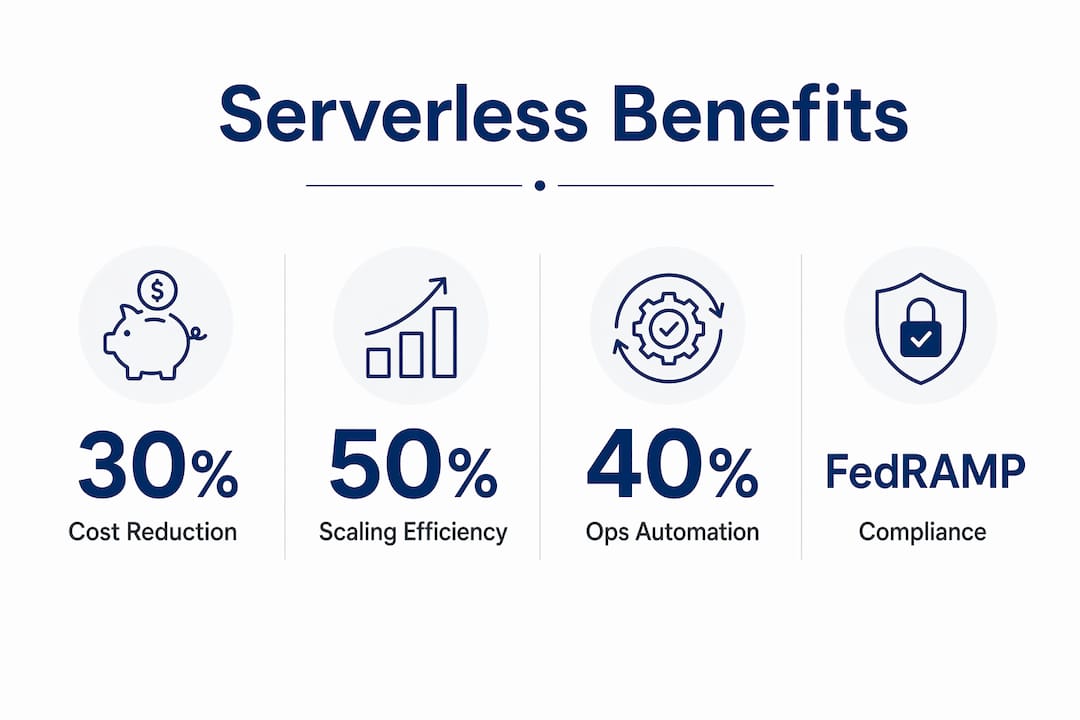
The cost model is the most immediate benefit. Traditional government IT budgets fund servers that sit idle during off-peak hours. Serverless billing charges only for actual compute time consumed. For agencies with variable workloads, such as tax filing portals or benefits enrollment systems, that shift can eliminate substantial wasted spend.

Serverless automates IT functions that previously required dedicated operations staff, freeing personnel for mission-critical work. That operational efficiency gain accelerates modernization timelines aligned with cloud-first federal initiatives. Agencies that have moved batch processing and data ingestion pipelines to serverless report faster deployment cycles because developers focus on application logic rather than patching operating systems.
The security posture improves as well. FedRAMP-authorized serverless services come with pre-built controls for encryption, network segmentation, and identity management. Agencies using FIPS 140-3 cryptographic modules in AWS GovCloud and commercial U.S. regions can satisfy HIPAA and IRS Publication 1075 requirements without building custom encryption layers.
Core benefits for government IT decision-makers:
- Pay-per-use pricing eliminates idle server costs and aligns IT spending with actual workload demand.
- Rapid deployment reduces time from code commit to production, supporting agile delivery within compliance guardrails.
- Reduced maintenance burden removes OS patching, capacity planning, and hardware lifecycle management from agency workloads.
- Built-in compliance controls from FedRAMP-authorized services reduce the effort required to achieve and maintain ATO status.
- Event-driven scalability handles traffic spikes, such as open enrollment periods or emergency response surges, without pre-provisioning resources.
What are best practices and security considerations for serverless in government?
Phased deployment is the most reliable path to production for government serverless programs. Multi-account strategies enforce separation of duties by isolating development, staging, and production environments in distinct cloud accounts. Starting with a pilot group validates data flows and access controls before the architecture scales across organizational units. That approach supports a defense-in-depth posture without requiring a full-scale rollout before risks are understood.
Security responsibilities that agencies must own directly include:
- Data classification: Agencies must categorize all data processed by serverless functions according to FISMA and NIST SP 800-60 guidelines before deployment.
- Least-privilege access: Every function should carry only the permissions it needs. Agencies must enforce least-privilege policies and multi-factor authentication alongside cloud provider safeguards.
- Encryption in transit and at rest: FIPS 140-3 validated modules must protect data at every layer. Agencies configure this. The cloud provider does not do it automatically.
- Continuous monitoring: Integrate AWS Security Hub, Azure Defender, or equivalent tools to generate real-time alerts on anomalous function behavior.
- Zero trust identity management: Apply identity-based access controls at the function level, not just at the network perimeter. Every invocation should authenticate and authorize independently.
- Audit logging: Enable detailed invocation logs and retain them per agency records management requirements. These logs are the primary evidence trail during compliance audits.
Mission Owners remain accountable for the cybersecurity and correct configuration of their deployed serverless applications, regardless of what the cloud provider manages. That accountability does not transfer with the infrastructure.
Pro Tip: Run a tabletop exercise simulating a misconfigured function before your ATO review. Identifying gaps in logging and access controls in a test scenario is far less costly than discovering them during an audit.
Partnering with a firm that specializes in government IT modernization accelerates compliant adoption. Agencies that attempt serverless rollouts without experienced cloud architects frequently underestimate the configuration work required to satisfy FedRAMP High controls.
How are government agencies using serverless computing today?
Real-world government serverless deployments cluster around four use cases: analytics aggregation, public safety workflows, health and human services data processing, and compliance dashboards.
Multi-account analytics is one of the most mature patterns. Lambda functions, Amazon Aurora Serverless, and Amazon Quick Suite can gather infrastructure data across hundreds of AWS accounts, producing unified visibility without collapsing security boundaries between organizational units. That architecture gives CIOs a single compliance dashboard while preserving the account-level isolation that auditors require.
| Use Case | Architecture Components | Compliance Benefit |
|---|---|---|
| Multi-account analytics | Lambda, Aurora Serverless, Quick Suite | Unified visibility across isolated accounts |
| Public safety event processing | FaaS triggers, message queues, API Gateway | Real-time response with full audit trail |
| Health and human services data ingestion | Serverless ETL, encrypted object storage | HIPAA and IRS Pub. 1075 alignment |
| Compliance monitoring dashboards | CloudWatch, Security Hub, serverless reporting | Continuous ATO evidence collection |
AWS GovCloud and commercial AWS U.S. regions provide the regulated environments that state and local agencies need for these workloads. Network segmentation controls and integrated security services handle the infrastructure layer. Agencies configure the application layer to meet their specific regulatory requirements.
Health and human services agencies present a particularly strong case for serverless. Benefits enrollment systems experience dramatic traffic variation between open enrollment windows and off-peak periods. Serverless handles that variation without agencies paying for idle compute capacity year-round. The IT modernization solutions that deliver the most value in this space combine serverless data ingestion with real-time dashboards that give program managers immediate visibility into processing status and compliance posture.
Key Takeaways
Serverless computing gives government agencies a direct path to compliant, cost-controlled application delivery by shifting infrastructure management to FedRAMP-authorized cloud providers while keeping security configuration responsibility with the agency.
| Point | Details |
|---|---|
| FedRAMP authorization is the baseline | AWS Lambda and Azure Functions hold FedRAMP High authorization, covering CUI and ITAR workloads. |
| Agencies own security configuration | Cloud providers secure infrastructure; agencies must configure encryption, logging, and access controls. |
| Phased multi-account deployment reduces risk | Starting with a pilot group validates controls before scaling across organizational units. |
| Pay-per-use pricing cuts idle server costs | Agencies pay only for actual compute time, aligning IT spend with real workload demand. |
| Compliance dashboards are a proven use case | Lambda, Aurora Serverless, and monitoring tools deliver unified visibility across hundreds of accounts. |
Why serverless changes the modernization calculus for government
Working with government IT programs across Maryland, New York, and Florida, I have watched serverless shift the modernization conversation in a way that traditional lift-and-shift cloud migrations never did. Legacy migrations move the problem. Serverless re-architects it.
The agencies that succeed with serverless share one trait: they treat security configuration as a first-class engineering task, not an afterthought. The teams that struggle are the ones that assume FedRAMP authorization on the cloud provider's side means their application is automatically compliant. It does not. Every function needs its own access policy, its own logging configuration, and its own place in the agency's data classification scheme.
The other pattern I have observed is that phased rollouts consistently outperform big-bang deployments. A pilot covering one data pipeline or one public-facing form teaches an agency more about its actual security posture than any architecture review. The gaps that surface in a pilot are manageable. The gaps that surface after a full rollout are not.
Serverless also changes the staffing conversation. Agencies that free their developers from infrastructure management consistently redeploy that capacity toward mission-critical features. That is not a theoretical benefit. It shows up in delivery timelines and in audit readiness, because developers who are not patching servers are writing the compliance controls that auditors actually review.
— Randy
How Primereadysub supports secure serverless adoption
Government IT programs that need to move from legacy infrastructure to compliant serverless architectures benefit from a partner with direct public-sector experience. Primereadysub delivers cloud-native modernization services built specifically for state and federal agencies, including multi-account governance, FedRAMP-aligned security configuration, and real-time compliance dashboards. As an SDVOSB, woman-owned, and SBA-certified firm, Primereadysub operates with clearly defined scopes and low oversight requirements, making it a practical subcontracting partner for prime contractors managing complex, compliance-heavy programs. Agencies in Maryland, New York, and Florida can engage regional modernization services tailored to their specific regulatory environment and program goals.
FAQ
What is serverless computing in government?
Serverless computing in government is a cloud model where agencies deploy applications without managing servers. The cloud provider handles infrastructure, scaling, and availability while the agency focuses on application logic and compliance configuration.
Is serverless computing FedRAMP compliant?
Core serverless services including AWS Lambda and Azure Functions hold FedRAMP High authorization. Agencies must still configure encryption, access controls, and logging correctly to maintain compliance for their specific workloads.
What are the main benefits of serverless for public sector agencies?
The primary benefits are pay-per-use cost control, automatic scaling for variable workloads, reduced maintenance burden, and access to pre-authorized security controls that support faster ATO approvals.
How does the shared responsibility model apply to government serverless deployments?
The cloud provider secures the underlying infrastructure. The agency, as Mission Owner, is responsible for configuring its hosted applications, enabling encryption, managing access controls, and maintaining audit logs per FedRAMP and DoD directives.
What government workloads are best suited for serverless architecture?
Benefits enrollment systems, multi-account analytics pipelines, public safety event processing, and compliance monitoring dashboards are the most proven government serverless use cases, particularly where workload volume varies significantly over time.