

AI for case management applies machine learning (ML), natural language processing (NLP), and rules-based automation to the administrative and information-retrieval layers of case workflows, so caseworkers spend less time on documentation and more time on the decisions that require professional judgment. The recommendation is direct: use AI to augment intake triage, document parsing, and risk flagging, while keeping human decision-makers in authority over eligibility determinations and clinical judgments, in compliance with HIPAA and the NIST AI Risk Management Framework.
- Who benefits: Frontline caseworkers (less documentation burden), supervisors (real-time risk dashboards), and administrators (throughput and audit visibility).
- Primary guardrail: Human-in-the-loop design with audit logs, confidence thresholds, and HIPAA-compliant data governance at every decision point.
- Recommended next step: A focused 8–14 week pilot with defined KPIs, a 90-day monitoring window, and a delivery partner such as Rutledge & Associates, LLC to own the defined scope.
Key Takeaways
AI for case management delivers measurable operational gains when human decision authority, audit-grade logging, and HIPAA-compliant data governance are built into the system from the start, not added after deployment.
| Point | Details |
|---|---|
| Start with a narrow pilot | An 8–14 week pilot on one defined workflow (e.g., intake triage) reduces risk and produces credible baseline-to-outcome data. |
| Preserve human decision authority | Eligibility, clinical, and placement decisions require human sign-off by law; AI prepares the evidence package, not the determination. |
| Measure before you deploy | Collect 4 weeks of baseline KPIs (time to disposition, throughput, appeal rate) before any AI goes live, or the impact data will be unusable. |
| Use extractive summarization | Returning unaltered document fragments with source links avoids hallucination and keeps caseworker decisions verifiable in appeals. |
| Rutledge & Associates, LLC | Delivers defined-scope AI modernization work packages for government agencies, covering data integration, compliance automation, and NIST AI RMF documentation. |
Table of Contents
- What does AI for case management actually include?
- What concrete benefits can healthcare and social services agencies expect?
- How does AI connect to your existing systems and daily workflows?
- What risks and guardrails should you plan for?
- How do you plan, pilot, and scale an AI-enabled case management project?
- How do you measure whether AI is actually improving case management?
- What does the evidence actually show, and where are the gaps?
- What ethical considerations are specific to case management AI?
- How do you engage caseworkers, administrators, and clients effectively?
- What compliance requirements go beyond HIPAA?
- What pitfalls derail AI adoption in case management, and how do you avoid them?
- The case for cautious optimism, and where to start
- How Rutledge & Associates, LLC structures AI modernization for case management agencies
- Sources
What does AI for case management actually include?
The phrase "AI for case management" covers a cluster of distinct technologies. Understanding which one solves which problem prevents agencies from buying a capability they cannot use.
- Machine learning for risk stratification: Supervised models score incoming cases by predicted risk level, enabling triage queues that surface high-priority clients before a caseworker reads a single document.
- NLP for document parsing: Named-entity recognition and extraction pull diagnosis codes, medication mentions, eligibility criteria, and key dates from unstructured clinical notes or uploaded PDFs.
- Retrieval and embedding search: Vector-based search surfaces relevant policy citations or prior case notes when a caseworker opens a new record, without requiring exact keyword matches.
- Rules engines and robotic process automation (RPA): Deterministic logic handles repetitive, low-ambiguity steps such as form routing, deadline notifications, and status updates.
- Extractive summarization: Rather than generating a new narrative, the system returns unaltered document fragments linked to the source record. Qualitative CHI research with caseworkers found this approach is strongly preferred over open-ended generative chat because it preserves verifiability and avoids hallucination.
Governance elements accompany each layer: confidence scores on ML outputs, provenance metadata on retrieved fragments, and immutable audit logs on every AI-assisted action. These are not optional add-ons; they are what makes the system defensible in an audit or appeal.
What concrete benefits can healthcare and social services agencies expect?
Practical use cases cluster around four workflow zones where administrative overhead is highest.
- Intake triage and eligibility pre-screening: ML models pre-score incoming applications against eligibility criteria, routing straightforward cases to automated checklists and complex ones to senior caseworkers.
- Automated documentation and transcription: AI transcription of client encounters, combined with NLP extraction, can reduce documentation time substantially. Pilot programs in healthcare settings have reported 30–50% reductions in documentation time, though results vary with data quality and integration depth.
- Risk flagging and prioritization: Predictive models flag clients whose case data patterns correlate with deterioration or non-engagement, enabling proactive outreach before a crisis.
- Referral coordination: NLP-assisted matching surfaces community resources aligned to a client's documented needs, reducing the manual lookup burden on caseworkers.
- Fidelity monitoring and coaching: Tools such as Lyssn analyze recorded motivational interviewing sessions to provide supervisors with objective fidelity scores, replacing time-intensive manual review.
- Backlog reduction: Automated status updates and deadline tracking keep cases moving through defined workflow stages without requiring caseworker intervention for routine milestones.
The most credible published outcome comes from a state Medicaid eligibility copilot: mean time to disposition decreased substantially, daily caseworker dispositions increased markedly, and the appeal rate declined. Human decision authority was preserved throughout. These gains are real, but they depend on data readiness, EHR integration, and governance infrastructure being in place before deployment.
A systematic review of AI-assisted social work case management identified ML and NLP as the most common techniques across reviewed studies, with seven of eight included studies reporting positive outcomes. The evidence base is promising but still early-stage, which reinforces the case for rigorous pilot measurement rather than broad rollout.
How does AI connect to your existing systems and daily workflows?
A typical intelligent case management deployment follows a five-stage data flow.
- Ingestion: Case documents, EHR exports, and form submissions enter a secure ingestion layer with automatic PII redaction applied before any model sees the data.
- Indexing and embeddings: Redacted documents are chunked, embedded, and stored in a vector index alongside structured metadata (case ID, date, document type).
- Retrieval and ML scoring: When a caseworker opens a record, the system retrieves relevant fragments and runs the case through risk-scoring models, returning ranked results with confidence scores.
- Caseworker UI with evidence links: The caseworker sees a summary panel with direct links to the source document fragments, not a free-form AI narrative. This is the extractive pattern recommended by CHI research.
- Audit logging: Every retrieval, score, and caseworker action is written to an immutable log with timestamps and user IDs.
Key integration points include EHRs and document repositories, the agency's existing case management platform, identity and access management (IAM) for role-based access control, and a reporting layer for operational dashboards. For analytics and compliance in public agencies, the reporting layer is often where governance boards first see evidence that the system is performing within defined parameters.
Security and compliance checklist:
- Data minimization: ingest only fields required for the defined AI task
- Encryption in transit (TLS 1.2+) and at rest (AES-256)
- Role-based access control with least-privilege defaults
- Business Associate Agreement (BAA) executed before any PHI enters a vendor-hosted environment
- Retention and deletion schedules mapped to HIPAA and state data retention rules
- Audit log integrity controls (append-only, tamper-evident)
On hosting, on-premises or private-cloud deployment gives agencies the tightest data control and is often required for the most sensitive PHI. Vendor-hosted solutions reduce infrastructure burden but require rigorous BAA review and data residency confirmation.
What risks and guardrails should you plan for?
The risks in AI-assisted case management are not hypothetical. They have appeared in early deployments and are well-documented.
- Hallucination and factual errors: Open-ended generative models can produce plausible-sounding but incorrect case summaries. The mitigation is architectural: use extractive summarization, not generative narrative, for case-file work.
- Biased training data: If historical case data reflects systemic disparities in service access or outcomes, ML models trained on that data will replicate those disparities. Continuous fairness testing across demographic subgroups is required, not optional.
- Privacy and HIPAA exposure: PHI in training data, in model outputs, or in logs creates compliance liability. Data minimization and strict access controls are the primary controls.
- Over-automation of high-stakes decisions: Eligibility determinations and clinical judgments are legally and ethically required to involve a human decision-maker. CMSA guidance is explicit: AI should relieve administrative burden, not replace professional judgment.
- Auditability gaps: If the system cannot explain why it flagged a case or surfaced a particular document, caseworkers cannot defend their decisions in appeals or audits.
- Legacy integration failures: Connecting AI tooling to aging case management platforms often surfaces undocumented data schemas and inconsistent record formats that were not visible before the project started.
Pro Tip: Write the human-decision point into the system flow diagram before any code is written. If there is a path through the workflow where a case can be acted on without a caseworker reviewing the AI output, close that path in the design, not after go-live.
Regulatory boundaries matter here. Federal and most state regulations require human decision-making for Medicaid eligibility, child welfare placement, and clinical treatment decisions. AI can prepare the evidence package; it cannot sign the determination. Mapping the NIST AI RMF functions (Govern, Map, Measure, Manage) to project deliverables from week one creates the documentation trail governance boards need to approve deployment. For a broader view of AI error modes that clinical and legal reviewers should understand, ChartInsight's analysis of AI mistakes is a useful reference.
How do you plan, pilot, and scale an AI-enabled case management project?
A structured sequence reduces the risk of stalled pilots and wasted procurement spend.
- Stakeholder mapping (Week 1–2): Identify caseworkers, supervisors, compliance officers, IT leads, and client advocates who will be affected. Document their concerns and success criteria.
- Risk classification and legal check (Week 1–2): Classify the AI use case by risk level (administrative vs. decision-support vs. decision-making). Confirm which decisions require human authority under applicable law.
- Data inventory (Week 2–3): Audit available case data for completeness, consistency, and PHI scope. Identify gaps that would undermine model accuracy.
- Scope definition (Week 3–4): Define the exact workflow step the AI will support. Narrow scope is the single strongest predictor of pilot success. Consult IT procurement guidance for contracting considerations.
- Design: retrieval architecture and evidence linking (Week 4–6): Build extractive retrieval with source-fragment links. Avoid open-ended generative features in the initial scope.
- Build: audit logging and access controls (Week 5–8): Implement append-only audit logs and role-based access before any test data enters the system.
- Pilot (Week 8–14): Run with a defined cohort (minimum 200–300 cases for meaningful signal). Monitor confidence scores, caseworker override rates, and accuracy on a blind review sample weekly.
- 90-day post-deployment monitoring: Track primary KPIs against baseline. Set rollback criteria in advance (e.g., accuracy below threshold, override rate above threshold, any HIPAA incident).
- Scale: training, change management, and governance review: Train all affected staff before expanding. Update runbooks for exception handling. Conduct a governance review before each expansion phase.
Pro Tip: Treat the AI system as a product with a named owner and a defined success metric from day one. Research on scaled public-sector deployments consistently shows that pilots with clear ownership and operational metrics scale; those framed as experiments stall.
Rutledge & Associates, LLC structures engagements as defined-scope work packages aligned to this sequence, covering data integration, compliance automation, NIST AI RMF documentation, and audit-grade logging, with clear deliverables at each governance gate.
How do you measure whether AI is actually improving case management?
Measurement starts before deployment. Agencies that skip baseline collection cannot demonstrate impact.
| KPI | Definition | Measurement Method |
|---|---|---|
| Mean time to disposition | Calendar days from case open to final decision | Case management system timestamps; compare pre/post cohorts |
| Caseworker daily throughput | Dispositions completed per caseworker per day | Aggregate from system logs; normalize for case complexity |
| Documentation turnaround | Hours from client encounter to completed case note | Timestamp delta; compare AI-assisted vs. manual cohorts |
| Automated extraction accuracy | % of extracted fields matching ground-truth review | Blind review sample of 50–100 cases per evaluation cycle |
| Appeal rate | Appeals filed as % of total dispositions | Administrative records; track monthly |
| Client wait time | Days from referral to first service contact | Case management system; track by service type |
Where possible, use a stepped-wedge design: roll out to one team or region first, keep another as a control, then switch. This gives a comparison group without denying the tool to anyone long-term. A 90-day monitoring window after each expansion phase is the minimum for detecting drift in model accuracy or fairness metrics.
Pro Tip: Build the logging schema before the pilot starts. Retrofitting consistent timestamps and case-complexity flags into an existing system mid-study is far harder than designing them in from the beginning.
What does the evidence actually show, and where are the gaps?
The strongest published evidence comes from a state Medicaid eligibility copilot that reached production with full NIST AI RMF documentation. The system preserved human decision authority at every eligibility determination. That combination of governance rigor and measured operational gain is the model other agencies should study.
The broader evidence base is thinner. A systematic review screened 11,022 studies and found only eight that met inclusion criteria for AI-assisted case management in social work. Seven reported positive outcomes, but the field is early-stage. Administrators should treat vendor claims of dramatic efficiency gains with appropriate skepticism unless the vendor can point to published or auditable outcome data.
OECD analysis identifies the systemic barriers that keep government AI at pilot stage: skills gaps, poor data governance, unclear operational guidance, and weak measurement. These are organizational problems, not technology problems.
Rutledge & Associates, LLC addresses exactly these barriers through defined-scope modernization work: cloud re-architecture, compliance automation, and outcome-focused pilot delivery for state and local agencies.
What ethical considerations are specific to case management AI?
Case management AI operates on some of the most sensitive personal data in existence: health records, child welfare histories, disability determinations, and income documentation. The ethical stakes are correspondingly high.
Algorithmic bias is the most consequential risk. If a risk-scoring model was trained on historical data that reflects unequal access to services, it will systematically score certain demographic groups as higher risk, potentially triggering more intensive surveillance or fewer resources. Agencies must test model outputs across race, ethnicity, language, age, and disability status before deployment and on a recurring basis afterward.
Transparency toward clients matters as much as transparency toward auditors. When an AI system influences a caseworker's recommendation, clients arguably have an interest in knowing that. Several state-level AI transparency bills and the EU AI Act's high-risk classification for social benefit systems are pushing this expectation toward a legal requirement. Agencies should document their disclosure approach in their governance plan now, before regulation mandates it.
Consent and data use boundaries deserve explicit policy. Data collected for one program purpose should not silently flow into an AI model serving a different program without legal authorization. This is both an ethical principle and, in many jurisdictions, a statutory requirement under state privacy laws that go beyond HIPAA.
How do you engage caseworkers, administrators, and clients effectively?
Technology adoption in case management fails more often from poor stakeholder engagement than from technical problems. The pattern is consistent: a system is built without frontline input, caseworkers find it adds steps rather than removing them, and adoption collapses.

Caseworkers should be involved in use-case selection, not just training. Their knowledge of where documentation burden is highest and where AI errors would be most harmful is irreplaceable. Structured workshops in weeks 1–2 of the project, before any design decisions are locked, surface this knowledge at the point where it can actually change the architecture.
Supervisors need a different conversation. Their concern is typically accountability: if AI influences a decision that is later appealed, who is responsible? The answer must be documented in policy before go-live. Supervisors also need dashboard access that shows AI performance metrics, not just case metrics, so they can spot model drift without waiting for a formal audit.
Client communication requires plain-language disclosure. Clients do not need a technical explanation of embedding search, but they do need to know that an automated system is helping prepare their case and that a human will make the final decision. This disclosure should appear in intake paperwork and be available in all primary languages served by the agency.
Staff training is not a one-time event. Initial training before go-live should cover how to read confidence scores, how to override AI suggestions, and how to report anomalies. Refresher training at 90 days, after the first monitoring review, addresses the questions that only arise once staff have used the system in real cases.
What compliance requirements go beyond HIPAA?
HIPAA is the floor, not the ceiling. Agencies deploying AI in case management typically face a layered compliance environment.
42 CFR Part 2 governs substance use disorder records and imposes stricter consent and disclosure requirements than HIPAA. Any AI system that ingests SUD-related documentation must be scoped and access-controlled separately from general case data.
State privacy laws vary significantly. California's CPRA, Virginia's CDPA, and a growing number of state-level health data privacy laws impose consent, deletion, and data-use limitation requirements that may exceed HIPAA's minimum standards. Agencies operating across state lines need jurisdiction-specific legal review.
State and local AI governance policies are proliferating. Several states now require algorithmic impact assessments before deploying AI in public benefit programs. Some require public disclosure of AI use in government decision-making. Procurement teams should check current state AI policy before finalizing vendor contracts.
Section 504 of the Rehabilitation Act and the ADA require that AI-assisted systems do not discriminate against people with disabilities in the delivery of federally funded services. Fairness testing must include disability status as a protected characteristic.
For agencies operating internationally or with data subjects in the EU, GDPR-compliant AI frameworks add requirements around lawful basis for processing, data subject rights, and automated decision-making restrictions under Article 22. Engaging compliance counsel with jurisdiction-specific expertise is not optional for multi-state or federally funded programs.
What pitfalls derail AI adoption in case management, and how do you avoid them?
The most common failure modes are organizational, not technical.
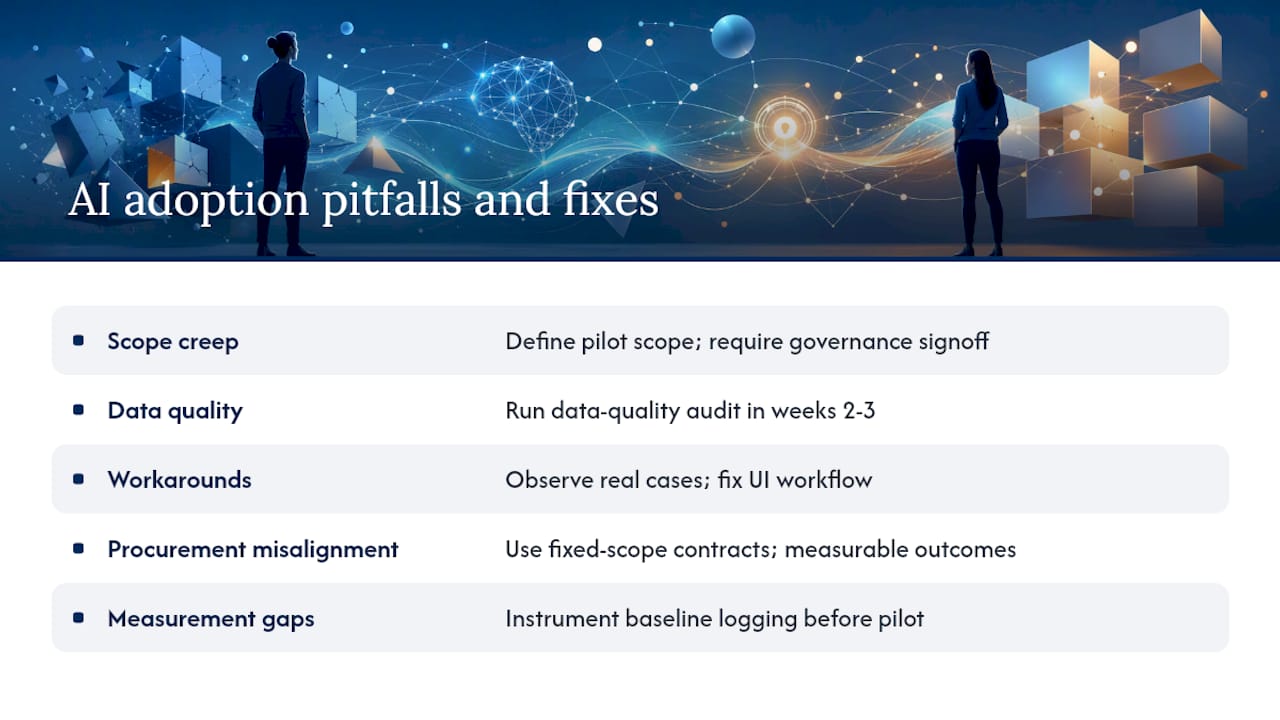
Scope creep in the pilot phase is the leading cause of stalled projects. A pilot that starts as "AI-assisted intake triage" expands to include documentation, risk scoring, and referral matching before the first use case is validated. Each expansion adds integration complexity and delays the measurement that would justify continued investment. Fix: define the pilot scope in writing and require a governance sign-off to change it.
Data quality surprises derail timelines. Case management systems often contain years of inconsistently structured records, missing fields, and duplicate entries that were never visible until an AI ingestion pipeline tried to process them. Fix: run a data quality audit in weeks 2–3 of the project, before any model work begins. Top IT challenges for agencies consistently list legacy data quality as a primary barrier.
Caseworker workarounds signal a usability failure. If staff are copying AI outputs into a separate document rather than using the system's interface, the workflow integration is broken. Fix: observe caseworkers using the system in real cases during the pilot, not just in training scenarios.
Procurement misalignment occurs when the contract structure does not match the delivery model. Staff augmentation contracts for AI work produce unclear accountability and no defined deliverable. Defined-scope work packages with measurable outcomes are the appropriate contracting model for AI modernization in government. Strategic IT sourcing guidance covers when and how to structure these engagements.
Measurement gaps make it impossible to demonstrate value. Without pre-deployment baseline data on time-to-disposition, throughput, and accuracy, there is no credible before-and-after comparison. Fix: instrument the baseline logging schema before the pilot starts, not after.
The case for cautious optimism, and where to start
The evidence for AI in case management is genuinely promising, but the gap between a promising pilot and a scaled operational system is where most agencies struggle. That is not a marginal improvement; it is a material change in service capacity.
The right posture is augmentation, not automation. AI handles the retrieval, the scoring, and the documentation. Caseworkers handle the judgment. That boundary is not a limitation of current technology; it is the correct design for systems that affect people's access to healthcare, housing, and social services.
The practical next steps are narrow and specific: identify one high-burden administrative task, collect baseline metrics for four weeks, design the human-decision boundary explicitly, engage compliance counsel on jurisdiction-specific requirements, and run an 8–14 week pilot with a defined-scope delivery partner. The agencies that scale successfully treat this as product delivery with clear ownership and measurable outcomes, not as an experiment.
How Rutledge & Associates, LLC structures AI modernization for case management agencies
Agencies that have tried to build AI case management tooling through staff augmentation contracts consistently report the same outcome: unclear accountability, no defined deliverable, and a pilot that never reaches production. Rutledge & Associates, LLC takes a different approach. As an SDVOSB, woman-owned, SBA-certified modernization partner, the firm delivers defined-scope work packages with measurable outcomes: data integration and EHR connectors, compliance automation and BAA/HIPAA mapping, NIST AI RMF-aligned documentation, audit-grade logging, and DevOps/CI/CD pipelines for model deployment. Each engagement begins with a scoped assessment, produces governance artifacts at defined milestones, and ends with a system the agency owns and can operate. For administrators ready to move from evaluation to execution, the next step is a scoped pilot engagement or governance review. Contact Rutledge & Associates, LLC to define the scope and timeline for your agency's first AI-assisted case management pilot.
Sources
- State Medicaid Eligibility AI Case Study. 42% Faster Dispositions | Rockmere
- Governing with artificial intelligence — implementation challenges that hinder the strategic use of AI in government | OECD
- Artificial Intelligence-Assisted Case Management in Social Work Services: A Systematic Review
- Govt. Considerations for Adding AI Into Human Services | GovTech
This article is general information, not a substitute for advice from a qualified doctor. Consult a qualified healthcare professional about your own circumstances before acting on anything here.