

Process automation in government delivers measurable capacity gains, faster processing times, lower error rates, and audit-ready documentation — and the first action is to map one high-volume, rule-based process and build a pilot scope of work around it. Agencies that start narrow and measure carefully consistently outperform those that launch broad transformation programs without a baseline.
Quick wins achievable in the first 90 days:
- Automate invoice matching and routing in accounts payable
- Deploy a bot to pull and reconcile data across two or more legacy systems
- Automate employee onboarding document collection and verification
- Set up automated alerts for IT system anomalies or compliance thresholds
- Reduce citizen intake processing time with automated form validation
Pilot launch checklist:
- Convene a core team: program sponsor, process subject-matter expert (SME), IT lead, and a change management lead
- Pull 90 days of process data to establish a baseline (volume, cycle time, error rate)
- Apply the Eliminate, Optimize, Automate (EOA) framework before selecting a candidate
- Draft a pilot statement of work (SOW) with defined acceptance criteria and success metrics
- Schedule a 30-day checkpoint to assess bot performance against the baseline
Pro Tip: Volunteer the pilot team rather than assigning it. Agencies that use willing participants as their first automation cohort see materially higher adoption rates — those participants become internal advocates when the program scales.
Table of Contents
- What is process automation in government, and which type fits your agency?
- High-impact automation use cases agencies are running today
- How to start: a practical assessment and pilot selection plan
- What technology architecture should your agency evaluate?
- How to run a durable automation program: governance, roles, and procurement
- How to measure the impact of your automation program
- Federal resources and playbooks worth using
- Rutledge & Associates' practical automation playbook
- Key Takeaways
- Why the conventional wisdom on government automation gets the sequencing wrong
- Primereadysub brings outcome-owned automation delivery to public agencies
- Useful sources and federal references
What is process automation in government, and which type fits your agency?
Process automation in government refers to using software to execute repetitive, rule-based tasks that staff currently perform manually. Three distinct types matter for public-sector planning.
Robotic Process Automation (RPA) uses software bots to mimic human interactions with existing applications: logging in, copying data, filling forms, and generating reports. It requires no changes to underlying systems, which makes it particularly useful for agencies with aging legacy infrastructure.
Intelligent Automation (IA) layers machine learning and natural language processing on top of RPA. Where RPA follows fixed rules, IA can interpret unstructured inputs like scanned documents or free-text fields, making it suitable for citizen intake, benefits adjudication, and document classification.
Agentic Process Automation is the emerging next stage: context-aware, AI-driven systems that handle dynamic workflows requiring data-driven decisions across multiple steps. Industry guidance recommends building a strong data foundation and proving value on small, high-impact tasks before deploying agentic approaches at scale.
- Choose RPA when the process is fully rule-based, the inputs are structured, and the agency needs a fast, low-disruption deployment
- Choose IA when inputs are semi-structured (PDFs, emails, scanned forms) or when classification decisions are needed
- Choose agentic automation when the workflow requires multi-step reasoning, real-time data synthesis, or adaptive decision logic
Pro Tip: Whatever the automation type, build human-in-the-loop checkpoints for consequential decisions. Partial automation — routing roughly 70% of cases automatically while flagging exceptions for human review — often delivers meaningful capacity gains without the compliance risk of fully autonomous decisions.
High-impact automation use cases agencies are running today
The strongest candidates for automation share three traits: high transaction volume, clearly defined rules, and structured or semi-structured data. The use cases below consistently meet those criteria across federal, state, and local agencies.
- Procurement and acquisition support: — Automation handles vendor data validation, SAM.gov eligibility checks, and contract document assembly, freeing contracting officers for higher-judgment work.
Statistic: Pilots that combined staff involvement, visible metrics, and scenario-based training reduced unemployment claims processing times by 70–80%, a result driven as much by change management as by the technology itself.
How to start: a practical assessment and pilot selection plan
Most agencies stall not because they lack interest in automation, but because they cannot agree on where to begin. A structured assessment removes that ambiguity.
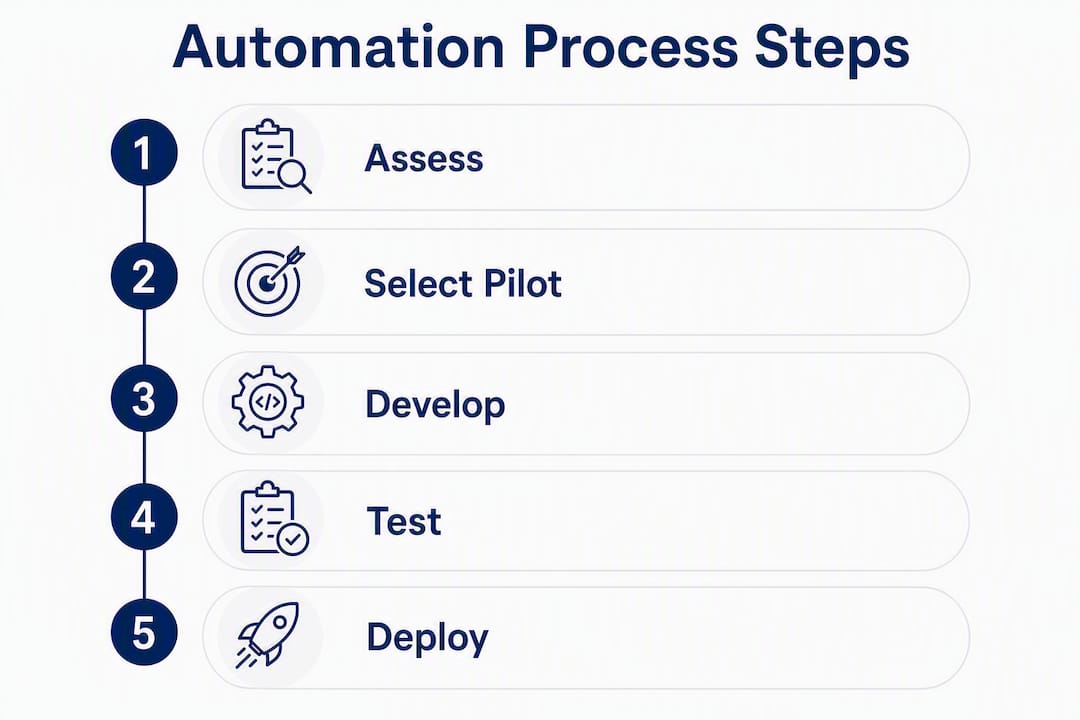
Step-by-step starter plan:
- Inventory candidate processes. Survey department heads and frontline staff for processes that are repetitive, rule-driven, and time-consuming. Aim for 10–20 candidates in the first intake cycle.
- Apply the EOA framework. Before automating anything, ask whether the process can be eliminated or simplified. The GSA's EOA methodology evaluates candidates on process structure, multi-application usage, rule reliance, human error risk, and transaction volume.
- Map the current-state process. Document each step, decision point, system touched, and exception type. This mapping becomes the baseline for measuring impact.
- Run a data check. Confirm that the data inputs are accessible, structured, and of sufficient quality. A process with clean, consistent data is far easier to automate than one with ad hoc formats.
- Score candidates on impact and feasibility. Use a simple matrix: rate each process on potential time savings (impact) and ease of automation (feasibility). The upper-right quadrant of that matrix is your pilot shortlist.
- Draft a pilot SOW. Define scope, success metrics, timeline, and acceptance criteria before any vendor or internal team begins development.
- Staff the pilot. At minimum: a program sponsor, a process SME, an IT integration lead, and a change management lead.
Prioritization criteria for your first pilot:
- Transaction volume above a meaningful threshold (daily or weekly recurrence)
- Fewer than five exception types that require human judgment
- Data inputs that are already digital and consistently formatted
- A process owner who is willing to participate and champion the effort
- Measurable baseline data available (cycle time, error rate, cost per transaction)
A realistic timeline runs 90–180 days from intake to a production-ready pilot: roughly 30 days for assessment and mapping, 30–60 days for development and testing, and 30 days for monitored production before a go/no-go decision on scaling. For practical IT project management guidance specific to public agencies, the approach of defining acceptance criteria before development begins consistently reduces scope creep.
What technology architecture should your agency evaluate?

Architecture decisions made early in a program are difficult and expensive to reverse. Agencies need to evaluate deployment models, integration patterns, and security posture before selecting a platform.
Deployment models:
- FedRAMP-authorized cloud: The preferred path for federal agencies and many state programs handling sensitive data. Platforms with FedRAMP authorization carry pre-validated security controls, which accelerates Authority to Operate (ATO) timelines.
- On-premises: Appropriate when data classification requirements prohibit cloud hosting or when network connectivity is constrained. Higher infrastructure cost and longer deployment cycles.
- Hybrid orchestration: A common middle path where the orchestration layer runs on-premises while bots execute in a cloud environment. Useful for agencies mid-way through hybrid IT modernization.
Integration approaches for legacy systems:
- API-first: The most maintainable approach when source systems expose APIs. Changes to the underlying system do not break the automation.
- Pre-built connectors: Platforms like UiPath, Automation Anywhere, and Blue Prism each offer libraries of pre-built connectors for common government applications (ERP, case management, HRIS). These reduce integration development time substantially.
- Screen-scraping: A last resort for systems with no API and no connector. Fragile and maintenance-intensive; use only when no other integration path exists and plan to replace it when the source system is modernized.
A systematic review of AI and e-government projects found that legacy integration was cited as a top obstacle in 85% of cases studied, and skills gaps appeared in 92%. Both findings point to the same conclusion: integration scope and staffing must be resolved before platform selection, not after.
Security and compliance checklist:
- Confirm FedRAMP authorization status for any cloud-hosted platform
- Map data flows to FISMA control families before development begins
- Apply role-based access controls to bot credentials and orchestration consoles
- Log all bot actions to a tamper-evident audit trail
- Define data retention and disposal rules for any PII the bot touches
Pro Tip: Scope each automation to extract only the specific data fields that use case requires. A use-case-by-use-case data approach keeps pilots moving without triggering a full data modernization program and limits your security exposure to only what the bot actually needs.
How to run a durable automation program: governance, roles, and procurement

Technology is the easier half of an automation program. Governance is where most government initiatives either hold together or quietly collapse.
Core roles every program needs:
- Program sponsor: Senior leader with budget authority and the political capital to remove organizational blockers
- CoE lead: Manages the pipeline of automation candidates, enforces standards, and tracks portfolio-level metrics
- Process SME: Owns the current-state process documentation and validates that the bot handles exceptions correctly
- Data engineer: Ensures source data quality and manages integration pipelines
- Change management lead: Coordinates workforce communication, training, and adoption tracking
Governance checklist:
- Establish an intake process with defined evaluation criteria (EOA framework is a solid starting point)
- Require security and privacy review before any bot accesses production data
- Define exception-handling protocols: what the bot does when it encounters an unrecognized input
- Set operational and maintenance (O&M) funding as a line item from day one, not an afterthought
- Schedule quarterly portfolio reviews to retire underperforming automations and prioritize new candidates
Center of Excellence (CoE) models: A centralized CoE works well for agencies with a defined automation team and a portfolio of 10 or more bots. A federated model, where each department maintains a trained automation lead who reports to a central standards body, scales better across large agencies with diverse mission areas. Either model requires clear IT delivery model definitions so that vendors and internal teams understand who owns what.
Procurement tips:
- Write SOW language that specifies outcomes (cycle time reduction, error rate target) rather than hours or deliverables
- Structure pilots as modular, time-boxed contracts with a defined go/no-go decision point before scaling
- Include O&M funding and continuous improvement provisions in the base contract, not as optional add-ons
- Reference the GSA EOA Playbook validation criteria in your SOW evaluation rubric
How to measure the impact of your automation program
Measurement without a baseline is guesswork. Before any bot goes live, document the current-state metrics for every process in scope.
Core KPIs to track:
- Cycle time per transaction: How long does the process take today, end to end?
- Error rate: What percentage of transactions require rework or correction?
- Cost per transaction: Staff hours multiplied by fully loaded labor rate
- Backlog volume: How many transactions are waiting at any point in time?
- Employee time reallocated: Hours freed from repetitive tasks and redirected to higher-value work
| Phase | Typical Duration | Key Milestone |
|---|---|---|
| Discovery and assessment | 4–6 weeks | Candidate shortlist and baseline data confirmed |
| Pilot development and testing | 6–10 weeks | Bot passes user acceptance testing (UAT) |
| Monitored production | 4–6 weeks | Bot meets acceptance criteria in live environment |
| Scale decision | 2–4 weeks | Go/no-go based on pilot KPIs |
| Optimization and expansion | Ongoing | Portfolio review, new candidates added quarterly |
Well-executed automation can free 60–70% of employee time from repetitive activities, according to cited productivity analyses. That figure assumes strong change management; without it, adoption stalls and the time savings never materialize.
Cost factors to track from day one:
- Platform licensing (per-bot or consumption-based)
- Development and integration labor
- Infrastructure (cloud hosting, on-premises servers)
- Ongoing monitoring and maintenance
- Retraining costs when source systems change
The Productivity Parity framework recommends that agencies quantify how savings will be used: returned to taxpayers, reinvested in service capacity, or held in reserve. Publishing that projection publicly builds accountability and makes the program easier to defend in budget cycles.
Federal resources and playbooks worth using
Agencies do not need to build their automation governance frameworks from scratch. Several authoritative federal resources provide templates, use-case inventories, and community support.
- GSA Federal Automation Community of Practice (CoP): With more than 1,700 members, the CoP maintains a Federal Automation Use Case Inventory containing thousands of documented use cases. Joining gives your team access to peer-tested templates and maturity guidance without reinventing the wheel.
- GSA EOA Playbook: The Elimination, Optimization, and Automation handbook provides intake criteria, validation checklists, and lessons learned from federal implementation efforts. The intake and validation sections are directly usable as SOW evaluation rubrics.
- Digital.gov RPA Community: Hosts the federal RPA Playbook and connects practitioners across agencies for peer exchange on tools, governance, and workforce strategies.
Using federal templates for procurement documentation and security review checklists can cut weeks from an ATO process and reduce the legal review burden on contracting officers.
Rutledge & Associates' practical automation playbook
The approach that consistently produces results in public-sector automation programs is narrow scope, defined outcomes, and early measurement. The following reflects Rutledge & Associates' delivery model, drawn from work on compliance-heavy government modernization programs.
Anonymized case summary: A state agency processing a high volume of benefits eligibility determinations was spending the majority of staff time on data entry and cross-system reconciliation. A defined-scope pilot automated data extraction from three source systems, applied eligibility rules, and routed exceptions to a human review queue. Within 60 days of production launch, the agency had measurable cycle time reduction and a documented audit trail for every transaction the bot touched.
Pilot SOW checklist (outcomes-focused):
- Define the process scope in terms of transaction types and exception categories, not system features
- Specify acceptance criteria: target cycle time, error rate threshold, and exception routing accuracy
- Require a baseline measurement report before development begins
- Include a 30-day monitored production period before final acceptance
- Fund O&M and a quarterly optimization review in the base contract
Common pitfalls and how to avoid them:
- Automating a broken process: Bots amplify whatever the process does, including its flaws. Map and fix the process logic before automating it.
- Skipping the data check: Inconsistent or incomplete source data is the most common cause of bot failures in production.
- Underestimating change management: Long-tenured staff and union contexts require transparent communication and scenario-based training. Assign a change lead before the pilot begins, not after.
- No O&M plan: Automations break when source systems change. Budget for maintenance from day one.
Pro Tip: Write the SOW around outcomes and acceptance criteria, not technology specifications. An outcomes-focused SOW gives the vendor accountability for results and gives the agency a clear basis for acceptance or rejection, which is far more useful in a government contracting context than a list of technical deliverables.
Key Takeaways
Process automation in government delivers the most durable results when agencies start with a narrow, measurable pilot, govern it with defined roles and intake criteria, and fund operations and maintenance from the beginning.
| Point | Details |
|---|---|
| Start with EOA, not automation | Apply the GSA Eliminate, Optimize, Automate framework before selecting any process for a bot. |
| Baseline first, always | Measure cycle time, error rate, and cost per transaction before development begins — without it, ROI claims are unverifiable. |
| Governance determines durability | A CoE with defined intake, security review, and O&M funding outlasts any individual pilot. |
| Change management is not optional | Pilots with staff involvement and scenario-based training reduced processing times by 70–80% in documented cases. |
| Primereadysub delivers outcome-owned pilots | Rutledge & Associates scopes automation as defined work packages with acceptance criteria, not staff augmentation. |
Why the conventional wisdom on government automation gets the sequencing wrong
Most guidance on automating public services leads with technology selection: pick a platform, stand up a Center of Excellence, then find processes to automate. That sequence is backwards, and it explains why so many government automation programs stall after the first pilot.
The more defensible sequence starts with the process, not the platform. A process that is poorly understood, inconsistently executed, or dependent on undocumented exceptions will produce an unreliable bot regardless of which platform runs it. The technology is the easy part. The hard part is getting a clear, documented, agreed-upon picture of what the process actually does today, including every exception that staff handle informally.
The second thing most guidance underweights is the workforce dimension. Digital transformations fail at a high rate when change management is weak. In government, that risk is amplified by long-tenured workforces, collective bargaining agreements, and a legitimate concern among staff that automation threatens their roles. Transparent communication about what the bot will and will not do, combined with visible metrics showing that staff time is being redirected rather than eliminated, is what converts skeptics into advocates.
The third gap is measurement. Agencies that cannot show a documented baseline before their pilot launches cannot credibly claim savings afterward. That matters for budget justification, for public accountability, and for the internal credibility of the automation program itself.
The practical implication: spend the first 30 days of any automation initiative on process mapping and baseline data collection, not on platform demos. The platform decision will be better informed, the pilot will be more defensible, and the results will be measurable.
Primereadysub brings outcome-owned automation delivery to public agencies
Agencies that have mapped a candidate process and need a partner to own the delivery, not just provide staff, have a direct path forward with Primereadysub. Rutledge & Associates delivers defined-scope automation and modernization packages for government agencies and prime contractors in Maryland, New York, and Florida. The firm takes accountability for outcomes: cycle time targets, error rate thresholds, and audit-ready documentation are written into the acceptance criteria, not left as aspirational goals.
For agencies evaluating a first pilot or scaling an existing program, Primereadysub offers a scoped pilot SOW with baseline measurement, development, monitored production, and an O&M handover, all structured for public-sector contracting realities including FedRAMP-aware delivery and FISMA-aligned security controls. As an SDVOSB, woman-owned, and SBA-certified firm, the company qualifies under multiple set-aside vehicles. Contact Primereadysub to request a pilot scope assessment and see what a defined-outcome engagement looks like in practice.
Useful sources and federal references
- Federal EOA Playbook (GSA): Intake criteria, validation checklists, and lessons learned from federal EOA implementation; directly usable as a SOW evaluation rubric.
- Federal Automation Community of Practice (GSA): More than 1,700 members, a Federal Automation Use Case Inventory with thousands of documented cases, and peer-tested governance templates.
- Digital.gov RPA Community: Hosts the federal RPA Playbook and connects practitioners across agencies for tool, governance, and workforce guidance.
- Agentic Process Automation in the Public Sector (StateTech Magazine): Explains the shift from rules-based RPA to agentic automation and the data prerequisites for each stage.