

Automation in public contracts is defined as the integration of AI and digital tools to replace manual procurement tasks with consistent, auditable, and rules-based digital processes. The role of automation in public contracts has moved from pilot programs to federal policy, with the GSA's Transform office launching in May 2026 to accelerate AI adoption across contracting workflows. Agencies that have made this shift report faster compliance reviews, fewer processing errors, and stronger audit readiness. This guide breaks down how automated processes in government contracts work, where they deliver the most value, and what procurement officers must get right before deploying them.
How does automation improve efficiency in public procurement?
Automation cuts the administrative load that consumes most of a procurement officer's day. Bid intake, eligibility filtering, and document routing are tasks that AI handles faster and more consistently than manual review. The result is a procurement cycle that moves at the speed of policy, not paperwork.
The most measurable gain is in compliance review timelines. Specialized AI agents can cut federal procurement compliance review timelines from weeks to minutes by cross-referencing dense proposals against the Federal Acquisition Regulation (FAR) and executive orders. That shift frees contracting officers to focus on vendor relationships and program strategy rather than clause-by-clause document review.

Transitioning from paper-based bids to digital automated systems enables automatic timestamping and centralized searchable logs, which simplifies audits and public records requests. State and municipal modernization programs report increased consistency and transparency when AI handles mandatory clause identification. The practical effect is that a records request that once took days to fulfill can be answered in minutes.
Key efficiency benefits of automation in procurement include:
- Bid intake and filtering: AI screens submissions for completeness and eligibility before human review begins.
- Centralized document records: All contracts, amendments, and correspondence live in one searchable system.
- Automated compliance flags: The system alerts officers when a clause is missing or a vendor's certifications have lapsed.
- Faster approval routing: Digital workflows eliminate the delays caused by physical signatures and interoffice mail.
- Audit trail generation: Every action is timestamped and logged without additional staff effort.
Pro Tip: Standardize your procurement workflows before deploying any automation tool. AI applied to a broken process produces faster broken results. Map your current steps, remove redundant approvals, and document your data fields first.
How does automation support compliance and transparency?
Compliance in public contracting is not a one-time check. It is a continuous obligation that spans the full contract lifecycle, from solicitation through close out. Automation handles that obligation at a scale and consistency no manual team can match.
Multi-agent AI systems coordinate regulatory review across multiple domains simultaneously, cross-referencing FAR requirements, executive orders, and agency-specific policies in a single pass. Proof-of-concept testing in 2026 validates that these architectures provide precise regulatory citations, reducing the risk of human oversight gaps. That precision matters because a missed clause in a federal contract can trigger a protest or an audit finding.
Continuous procurement monitoring with intelligent alerts detects anomalies such as unusually low bids or delivery delays in real time. This capability improves risk management and ensures equal treatment across vendors. An officer no longer needs to manually scan contract performance reports catching a problem; the system surfaces it automatically.
Transparency improves because every automated action creates a record. Centralized, searchable audit trails give oversight bodies and the public access to procurement data without requiring agencies to compile reports by hand. The comparison below shows how manual and automated compliance workflows differ in practice.
| Workflow element | Manual process | Automated process |
|---|---|---|
| Compliance review | Officer reads clauses line by line | AI cross-references FAR and flags gaps instantly |
| Anomaly detection | Periodic manual spot checks | Continuous real-time monitoring with alerts |
| Audit trail | Paper files or scattered spreadsheets | Centralized, timestamped, searchable digital log |
| Policy updates | Manual re-review of affected contracts | Automated re-flagging when rules change |
| Vendor certification tracking | Staff-maintained spreadsheets | System alerts when certifications lapse |
Responsible AI governance and explainability are critical to maintaining public trust in automated government contracting. Black-box AI models that cannot explain their decisions create accountability gaps that undermine the transparency automation is meant to provide.
Pro Tip: Require explainable AI outputs in any procurement automation contract. Every flag or recommendation the system generates should include a citation to the specific regulation or data point that triggered it. This is the standard that keeps human oversight meaningful.
What are the main challenges of automation in public contracts?
Automation does not fix a disorganized procurement operation. It scales whatever conditions it finds. That reality makes preparation the most important phase of any implementation.
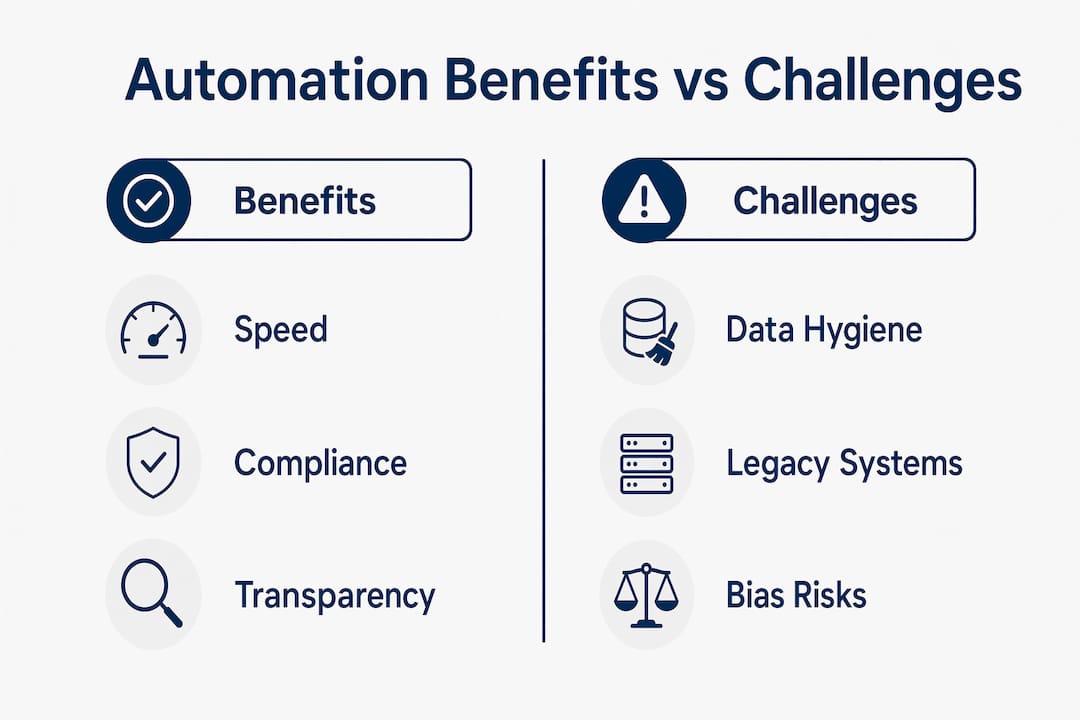
Data hygiene and legacy system fragmentation are the largest hidden costs in automation deployment. Fragmented and unstructured procurement data must be cleaned and standardized before AI can deliver value. Agencies that skip this step find that their automated systems produce unreliable outputs because the underlying data is inconsistent or incomplete.
AI models learn from historical procurement data, which means they can inherit and amplify existing biases in supplier access and award patterns. Agencies must continuously monitor algorithms to uphold fairness and align with public policy goals. A system that consistently disadvantages small or minority-owned vendors is a legal and reputational liability, regardless of how efficient it is.
Successful AI adoption requires stable partnerships between procurement and IT teams to translate policy into machine-readable standards and govern automation tools effectively. Procurement officers understand the regulatory requirements; IT teams understand the system architecture. Neither group can implement automation well without the other.
Best practices for implementation success:
- Audit your data first. Identify gaps, duplicates, and inconsistencies in existing contract records before connecting any AI tool.
- Standardize workflows. Document every procurement step and eliminate redundant approvals before automation begins.
- Define governance roles. Assign clear ownership for algorithm monitoring, bias review, and system updates.
- Require explainability. Specify in vendor contracts that AI outputs must include traceable regulatory citations.
- Train procurement staff. Officers need enough algorithmic literacy to evaluate AI recommendations critically, not just accept them.
- Plan for post-award gaps. Many platforms handle solicitation well but lack strong vendor performance tracking. Evaluate the full contract lifecycle before selecting a tool.
Pro Tip: Treat your first automation deployment as a pilot, not a full rollout. Choose one procurement category, measure outcomes against your baseline, and use that data to build the case for broader adoption.
What does the future of automation in public procurement look like?
The near-term future of automation in procurement is defined by two parallel trends: expanding capability and tightening governance. Both are already visible in federal and municipal programs operating in 2026.
The GSA's Transform office, launched in may 2026, is accelerating AI and automation solutions for contracting officers, providing advanced tools for better outcomes and workforce optimization. This initiative aligns with federal mandates for procurement consolidation without disrupting legacy programs. The practical effect is that contracting officers at the federal level now have institutional support for adopting AI tools that previously required agency-by-agency justification.
AI copilots are the dominant deployment model. These systems assist procurement officers rather than replace them, handling document review, compliance flagging, and reporting while leaving final decisions to qualified humans. Human-in-the-loop AI systems combine multi-agent architectures with human oversight to maintain compliance accuracy and ultimate decision accountability. That model satisfies both efficiency goals and the accountability requirements of public contracting law.
Contract management platforms with native e-signature and end-to-end lifecycle tracking prevent stalled approvals caused by personnel changes and support post-award vendor management. Platforms that consolidate contracts, deliverables, and communications in one system improve operational continuity across staff transitions. The agencies that will gain the most from automation are those that select platforms covering the full contract lifecycle, from solicitation through closeout, rather than point solutions that address only one phase.
Emerging applications include dynamic risk reporting, accessibility tools for small and local vendors, and real-time dashboards that give program managers visibility into contract performance without waiting for quarterly reports. Understanding IT procurement fundamentals is the foundation every agency needs before selecting and deploying these more advanced capabilities.
Key Takeaways
Automation in public contracts delivers measurable gains in speed, compliance, and transparency only when agencies invest in data quality, governance, and staff training before deployment.
| Point | Details |
|---|---|
| Compliance review speed | AI agents reduce FAR compliance review from weeks to minutes with precise regulatory citations. |
| Data quality is prerequisite | Clean and standardize procurement data before deploying any automation tool to avoid unreliable outputs. |
| Explainable AI is non-negotiable | Every AI recommendation must cite the specific regulation or data point that triggered it. |
| Governance requires collaboration | Procurement and IT teams must jointly own algorithm monitoring, bias review, and system updates. |
| Full lifecycle coverage matters | Select platforms that handle solicitation, award, and post-award tracking rather than single-phase tools. |
Why governance determines whether automation succeeds or fails
Having worked closely with public sector modernization programs, I've seen the same pattern repeat. An agency invests in a capable automation platform, deploys it quickly, and then spends the next year managing the fallout from data it didn't clean, workflows it didn't standardize, and staff it didn't train. The technology was fine. The preparation wasn't.
The agencies that get automation right treat it as an organizational capability, not a software purchase. They assign governance roles before go-live. They require explainable outputs from day one. They build algorithmic literacy into their procurement training programs so officers can evaluate AI recommendations rather than simply accept them. That approach takes longer upfront and pays back far more over time.
The transparency gains are real and significant. Centralized audit trails and real-time monitoring give oversight bodies and the public access to procurement data that previously required weeks of manual compilation. That shift builds public trust in ways that no policy statement can. Automation, governed well, is one of the most powerful tools available for demonstrating that government contracting is fair, consistent, and accountable.
The risk is not that automation will replace procurement officers. The risk is that agencies will deploy it without the governance structures needed to keep it honest. Prioritize explainability, invest in your data, and build the cross-functional partnerships that make AI tools governable. That is the work that determines whether automation becomes a force multiplier or a liability.
— Randy
Primereadysub: a public sector automation partner
Government agencies navigating procurement modernization need more than software. They need a partner who understands compliance obligations, legacy system constraints, and the governance requirements that make automation trustworthy in a public sector context. Primereadysub is an SDVOSB and SBA-certified IT modernization firm that specializes in exactly this work, delivering compliance automation, real-time dashboards, and DevOps pipelines for state and federal agencies. For agencies in Maryland, Primereadysub offers dedicated modernization solutions built around the specific regulatory and operational requirements of Maryland public contracting. The focus is always on defined outcomes, audit readiness, and measurable efficiency gains.
FAQ
What is the role of automation in public contracts?
Automation in public contracts replaces manual procurement tasks with AI-driven digital processes that handle compliance checks, document routing, and audit trail generation. The result is faster cycle times, fewer errors, and stronger accountability across the full contract lifecycle.
How does automation improve compliance in government contracting?
AI agents cross-reference proposals against FAR requirements and executive orders, flagging gaps and generating regulatory citations in minutes rather than weeks. Continuous monitoring also detects anomalies like low bids or lapsed vendor certifications in real time.
What are the biggest challenges of implementing automation in public procurement?
Data hygiene and legacy system fragmentation are the most common obstacles. AI applied to unclean or inconsistent data produces unreliable outputs, making workflow standardization and data cleanup the critical first steps before any deployment.
Does automation replace procurement officers?
Automation does not replace procurement officers. It functions as a force multiplier, handling routine document review and compliance flagging so officers can focus on vendor strategy, risk management, and complex decision-making that requires human judgment.
What should agencies look for in a contract management platform?
Agencies should prioritize platforms that cover the full contract lifecycle, including solicitation, award, e-signature with signing order enforcement, and post-award vendor performance tracking. Platforms that consolidate contracts, deliverables, and communications in one system prevent approval delays caused by staff changes.