

Automation in government contracting is defined as the use of technology to replace manual processes across compliance tracking, financial reporting, subcontractor oversight, and audit evidence generation. The benefits of automation for primes are measurable and well-documented: reduced cost overruns, faster audit cycles, and stronger compliance posture under frameworks like FAR, DFARS, and CMMC. Federal agencies now factor AI maturity into best-value award decisions, which means automation is no longer a back-office efficiency play. It is a front-line competitive requirement for prime contractors managing complex public sector programs.
How do the benefits of automation for primes show up in project financials?
Operational transparency is the first place automation pays off for prime contractors. Cloud-based automated ERP systems improve project visibility, reduce cost overruns by 10%, and deliver 126% ROI over three years for government contractors. That level of return reflects the compounding effect of earlier issue detection, faster financial close cycles, and the elimination of costly on-premises infrastructure.

The financial mechanics are specific. One total economic impact study found that automated ERP infrastructure saved $1.67 million by eliminating on-premises systems and cut monthly close times by 30%. Those are not marginal improvements. A 30% reduction in close time means project managers get accurate financial data weeks earlier each month, which directly affects their ability to catch budget drift before it becomes a contract problem.
Automation also changes how primes respond to scope changes and task order modifications. Manual processes create a lag between a change event and its financial reflection in reporting. Automated systems capture changes in real time, giving program managers the data they need to make decisions before overruns compound.
Pro Tip: Set automated threshold alerts in your ERP at 80% of budget consumption per task order. That early warning gives your team time to act before a cost overrun becomes a contract compliance issue.
| Metric | Manual process | Automated process |
|---|---|---|
| Monthly financial close time | 3–5 weeks | Reduced by 30% |
| Cost overrun rate | Baseline | Reduced by 10% |
| Infrastructure overhead | On-premises hardware costs | Eliminated via cloud migration |
| Issue detection speed | Lagging indicators | Real-time alerts |
| Three-year ROI | Marginal | 126% documented |
How does automation improve audit readiness and compliance accuracy?
Audit readiness is the single most time-consuming compliance burden for prime contractors, and automation changes its fundamental structure. The traditional model requires periodic scrambles to assemble evidence before an audit. The automated model produces system-generated evidence continuously, through logs, configuration exports, and automated ticket tagging that builds an auditor-accepted packet as a byproduct of normal operations.
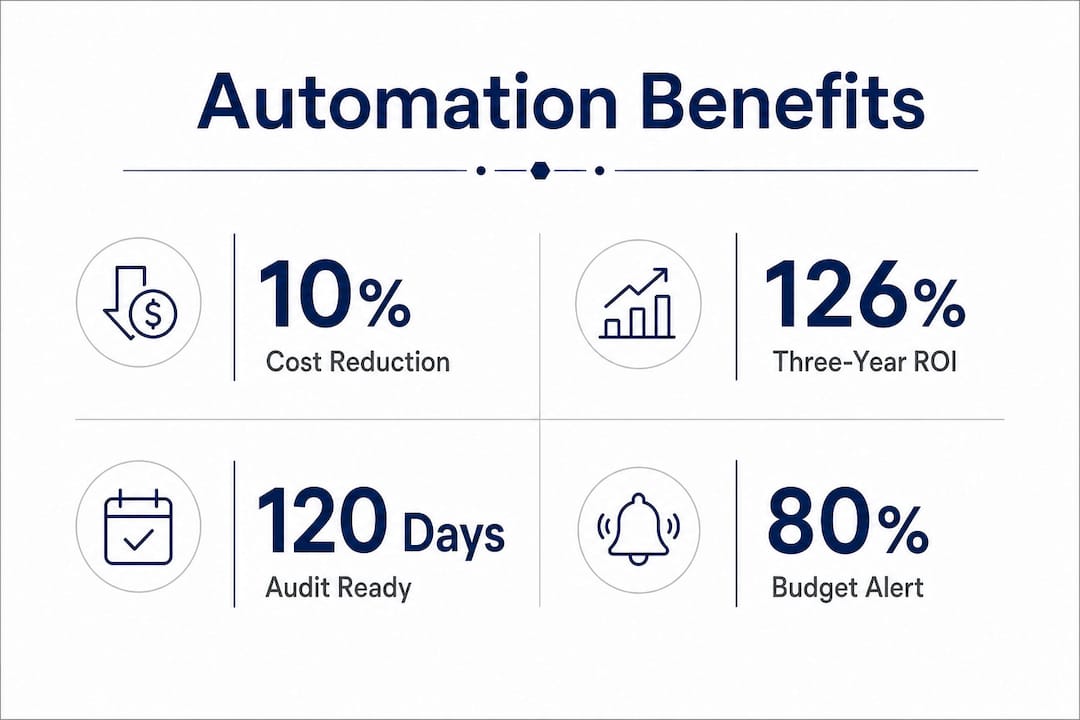
Contractors can move from manual compliance to audit-ready status in 120 days by adopting this evidence generation model without pausing program delivery. That timeline is achievable because automation does not require a wholesale IT overhaul. It requires connecting existing source systems to evidence collection workflows. The result is normalized controls, traceable evidence, and a repeatable cadence for compliance metrics.
AI-powered regulatory tracking allows primes to monitor FAR and DFARS updates in real time, reducing the lag between a mandate change and its execution in internal policy. That lag is where compliance failures originate. A new clause published in the Federal Register on a Monday should trigger a policy review flag by Tuesday, not by the next quarterly compliance meeting.
Compliance automation also addresses emerging mandates like GSAR 552.239-7001, which requires reporting AI-related security incidents within 72 hours. Meeting a 72-hour window manually, across a distributed program team, is operationally unreliable. Automated monitoring and alerting make that window achievable.
Key practices for building a continuous audit-ready posture:
- Connect source system logs directly to evidence collection workflows rather than relying on manual exports.
- Use automated ticket tagging to map control activities to specific FAR and DFARS clauses.
- Schedule automated compliance metric reports on a weekly cadence, not a quarterly one.
- Assign ownership of each control to a named individual with automated reminders for evidence refresh.
- Maintain a live audit packet that auditors can access on demand, not one assembled under deadline pressure.
Pro Tip: Do not wait for a DCAA notification to test your audit packet. Run a quarterly internal audit simulation using your automated evidence repository. Gaps found internally cost far less to fix than gaps found by auditors.
How does automation help primes manage subcontractor compliance risk?
Subcontractor compliance is the fastest-growing liability exposure for prime contractors in 2026. Under CMMC Phase 2, primes must actively verify and document subcontractor compliance. Flow-down clauses in contracts are legally insufficient on their own. The prime bears liability if a subcontractor fails a CMMC assessment and the prime cannot demonstrate active oversight.
The False Claims Act dimension makes this concrete. A prime that relies solely on subcontractor self-assessments, without automated verification, faces liability exposure if those assessments prove inaccurate. Automating subcontractor oversight eliminates that single point of failure by replacing self-reported status with system-verified data.
Automated tools track subcontractor certifications, flag expiring credentials, and generate risk scores based on assessment history and control maturity. That data feeds directly into the prime's program risk register, giving project managers a real-time view of supply chain compliance status rather than a quarterly spreadsheet update.
Best practices for automated subcontractor compliance management:
- Require subcontractors to maintain active Plans of Action and Milestones (POA&Ms) as a contract condition, not a suggestion. Active POA&M maintenance from subcontractors directly reduces prime audit risk.
- Use automated certification tracking to monitor SAM.gov registrations, CMMC assessment status, and Buy American compliance documentation.
- Integrate subcontractor risk scores into your program dashboard so project managers see supply chain compliance alongside schedule and budget data.
- Set automated alerts for certification expirations at 90, 60, and 30 days before the expiration date.
- Document every verification action with a timestamped audit trail. That trail is your defense against False Claims Act exposure.
How does automation support policy modernization and data quality in prime contracts?
Data quality is the foundation that determines whether automation produces reliable outputs or amplifies existing errors. Integrated digital environments connecting ERP, CRM, and project portfolio management systems establish the data foundation necessary for reliable AI outputs and automation success. A prime running disconnected systems produces fragmented data that no automation layer can fully correct.
AI tools now perform policy comparison against evolving regulations, flagging where internal procedures diverge from current FAR or DFARS language. That function previously required a compliance attorney review on a periodic basis. Automated policy comparison runs continuously, which means primes catch regulatory drift weeks or months earlier than manual review cycles allow.
Billing accuracy is a direct beneficiary of integrated automation. Automated RFP requirement extraction identifies buried contract clauses more consistently than manual methods, reducing the risk of billing errors that trigger audit findings. When contract requirements are mapped to traceable rows in an automated compliance matrix, billing teams can verify that every invoice line ties to a specific contract obligation.
| Process area | Manual approach | Integrated automation |
|---|---|---|
| Policy review | Periodic attorney review | Continuous AI-driven comparison against FAR/DFARS |
| Billing accuracy | Manual cross-reference to contract | Automated clause-to-invoice traceability |
| Data consistency | Siloed ERP, CRM, and PPM systems | Single integrated data environment |
| Error detection | Post-audit finding | Pre-submission automated flag |
| Regulatory lag | Weeks to months | Real-time alert on mandate changes |
Key Takeaways
Automation delivers the most durable competitive advantage for prime contractors when it is applied across financial reporting, audit evidence generation, subcontractor oversight, and policy compliance simultaneously.
| Point | Details |
|---|---|
| Financial ROI is documented | Automated ERP systems reduce cost overruns by 10% and deliver 126% ROI over three years. |
| Audit readiness is continuous | System-generated evidence from logs and automated ticketing replaces periodic manual assembly. |
| Subcontractor liability requires active oversight | Flow-down clauses alone do not satisfy CMMC Phase 2; primes must verify and document compliance directly. |
| Data integration precedes reliable automation | Connected ERP, CRM, and PPM systems are the prerequisite for accurate AI outputs and defensible audit data. |
| Regulatory tracking must be real-time | AI-powered FAR/DFARS monitoring closes the lag between mandate changes and internal policy execution. |
Why I think most primes are still underestimating automation's compliance value
Federal agencies now factor AI maturity into best-value awards, favoring contractors with better data integrity and higher transparency even when they are not the lowest-cost bidder. That shift is real, and most primes I observe are still treating automation as an internal efficiency project rather than a proposal differentiator.
The most common mistake is deploying automation in one function, usually financial reporting, while leaving compliance tracking and subcontractor oversight on manual processes. That creates a false sense of security. A prime with excellent ERP automation but manual CMMC subcontractor verification is still exposed to False Claims Act liability on the compliance side.
The second mistake is waiting for a full toolchain overhaul before starting. The 120-day path to audit-ready status works precisely because it does not require replacing every system at once. Start with evidence generation from your existing source logs. Connect your current ticketing system to control mapping. Build the audit packet incrementally. The IT modernization partnerships that work best are the ones that scope automation in phases, not the ones that promise a complete transformation in a single contract period.
Primes that treat compliance automation as a competitive asset, not just a cost center, are the ones winning best-value awards in 2026. That is not a prediction. It is already the pattern in federal procurement data.
— Randy
Primereadysub: automation-ready IT modernization for public sector primes
Prime contractors managing compliance-heavy programs in Maryland, New York, and Florida need a subcontracting partner who owns a defined scope and delivers without heavy oversight. Primereadysub provides cloud-native re-architecting, DevOps pipelines, compliance automation, and real-time dashboards built specifically for government IT modernization. The firm is SDVOSB, woman-owned, and SBA-certified, which supports your small business subcontracting goals while delivering outcomes-driven delivery on complex programs. If your program needs prime-ready IT modernization support that aligns with the compliance and audit standards described here, Primereadysub is structured to fit directly into your existing contract vehicle.
FAQ
What are the main benefits of automation for primes in government contracts?
The primary benefits include a 10% reduction in cost overruns, 126% three-year ROI from automated ERP systems, continuous audit readiness through system-generated evidence, and real-time FAR/DFARS compliance tracking. These outcomes apply directly to prime contractors managing public sector programs under compliance-heavy frameworks.
How does automation reduce audit risk for prime contractors?
Automation replaces manual evidence assembly with continuous log-based evidence generation, allowing primes to reach audit-ready status in as few as 120 days without pausing program delivery. Automated ticket tagging and configuration exports build auditor-accepted packets as a byproduct of normal operations.
What is the prime's liability under CMMC Phase 2 for subcontractor compliance?
Under CMMC Phase 2, primes must actively verify and document subcontractor compliance. Flow-down clauses alone are legally insufficient, and reliance on subcontractor self-assessments without independent verification creates False Claims Act exposure for the prime.
How do integrated data systems affect automation success?
Connected ERP, CRM, and project portfolio management systems establish the data foundation that makes AI outputs reliable and audit-defensible. Disconnected systems produce fragmented data that automation cannot correct, which undermines both compliance accuracy and financial reporting integrity.
Why do federal agencies favor AI-mature prime contractors?
Federal agencies favor AI-mature contractors in best-value evaluations because they demonstrate lower program risk, stronger data integrity, and higher operational transparency. This preference holds even when AI-mature primes are not the lowest-cost bidder, making automation a direct factor in contract award outcomes.