

Government agencies managing complex technology contracts often face a choice that carries real consequences: engage prime contractors as partners, or try to manage every layer of the procurement chain independently. The question of why partner with primes is not theoretical. It shapes how well a program performs, how risk gets distributed, and whether modernization goals are actually met on schedule. This article breaks down the strategic logic behind prime partnerships, examines the regulatory pressures reshaping federal contracting, and offers concrete guidance for contract managers and decision-makers who want to make these relationships work.
Table of Contents
- Key takeaways
- Why partner with primes: the strategic foundation
- Key benefits of partnering with primes
- Regulatory and contractual challenges in prime partnerships
- Best practices for maximizing value in prime partnerships
- Partnering with primes vs. other procurement options
- My perspective on prime partnerships in government technology
- How Primereadysub supports prime-ready IT modernization
- FAQ
Key takeaways
| Point | Details |
|---|---|
| Primes reduce program risk | Prime contractors absorb regulatory and delivery risk, protecting agencies from cost overruns and compliance failures. |
| Access to larger contracts | Partnering with primes opens doors to large federal technology contracts that agencies cannot effectively manage independently. |
| Fixed-price shifts are reshaping deals | A federal move toward fixed-price contracting affects how prime partnerships are structured and priced. |
| Due diligence protects partners | Vetting a prime's payment history and compliance record before signing protects subcontractors from cash flow disruption. |
| Transparency drives success | Early prototyping and clear intellectual property agreements are the two factors most predictive of a healthy prime relationship. |
Why partner with primes: the strategic foundation
A prime contractor holds the direct contractual relationship with the government agency. That position comes with responsibilities most agencies prefer not to manage themselves at the operational level. Primes are accountable for regulatory compliance, delivery timelines, budget performance, and the integration of any subcontractors brought into the program.
The prime contractor's role in federal technology programs goes well beyond contract administration. Primes provide:
- Regulatory compliance management: They understand FAR, DFARS, and agency-specific acquisition regulations, and they ensure the entire contractor team operates within those boundaries.
- Risk absorption: Fixed-price and performance-based contracts transfer financial exposure to the prime, not the agency.
- Subcontractor integration: Primes identify and manage partners with specialized capabilities, filling technical gaps without agencies having to manage multiple separate contracts.
- Institutional credibility: A prime's track record with an agency builds trust that takes years to establish. That credibility reduces the friction agencies experience during program execution.
- Scale and depth: Primes act as delivery engines for complex, high-risk programs because of their organizational depth and mastery of regulatory compliance.
The distinction between a prime and a subcontractor is meaningful. A prime carries the legal obligation and financial accountability for program outcomes. A subcontractor delivers a defined scope within that structure. For agencies, partnering with primes means working with an entity that has full-spectrum accountability. That accountability structure is precisely what makes prime partnerships attractive for high-stakes technology programs.
Key benefits of partnering with primes
The benefits of partnering with primes extend across three dimensions: access, risk management, and execution quality. Understanding each dimension separately helps decision-makers evaluate where prime partnerships add the most value for their specific programs.

Access to federal contract vehicles. Large, multi-year government IT contracts typically require bonding capacity, past performance records, and compliance infrastructure that smaller or newer entrants cannot provide alone. Primes already hold these qualifications, and partnering with primes gives agencies access to those contract vehicles without rebuilding the qualification pipeline from scratch.
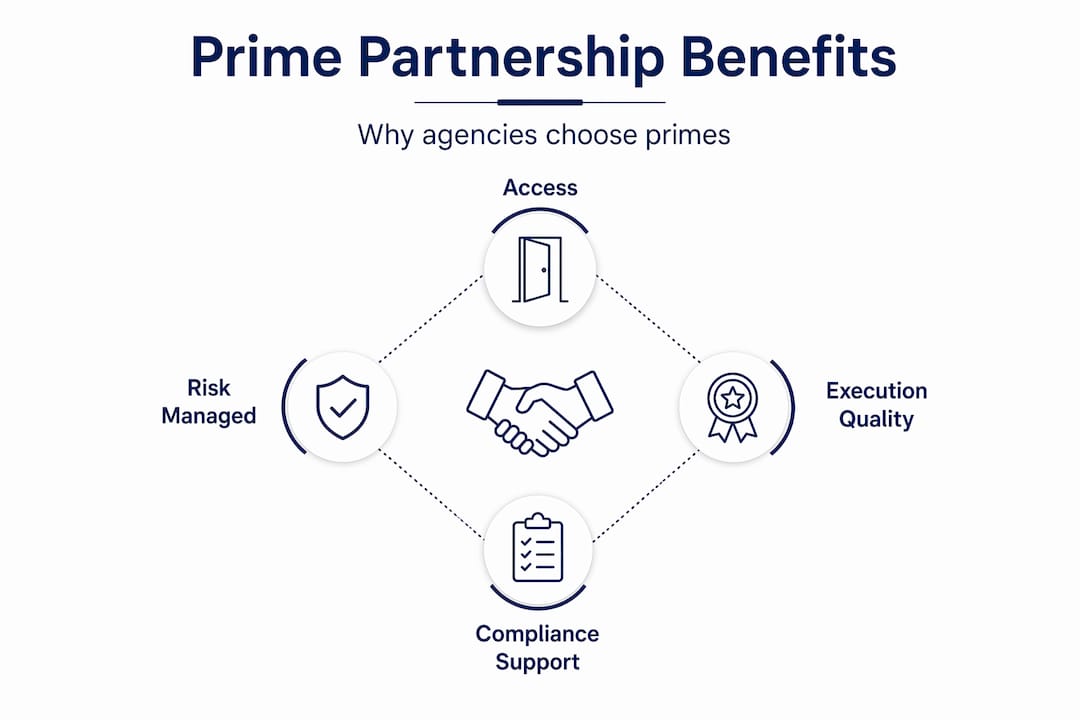
Risk mitigation at scale. When agencies work through primes on performance-based contracts, the prime assumes financial and delivery risk. That shifts the agency's role from risk bearer to outcomes monitor. For contract managers overseeing multiple simultaneous programs, that is a meaningful operational relief.
Innovation through partner ecosystems. Primes frequently bring specialized subcontractors into programs. Those partners often include firms with agile development capabilities, cloud expertise, or sector-specific domain knowledge that the prime itself does not maintain internally. The result is a combination of the prime's compliance rigor and the subcontractor's technical speed.
Research on partner ecosystems makes the performance case clearly. Effective partner management increases annual revenue by 20 to 30 percent, makes deal closure 53 percent more likely, and improves customer retention by 15 to 25 percent. Those figures apply directly to prime-sub ecosystems managing government programs.
- Integrated project management: Primes maintain program management offices, status reporting cadences, and escalation protocols.
- Compliance flow-down: Regulatory requirements cascade from the agency through the prime to subcontractors in a structured, auditable chain.
- Resource scalability: Primes can bring additional capacity online quickly through their subcontractor networks without agencies renegotiating contract vehicles.
Pro Tip: When evaluating the advantages of prime partnerships, ask prospective primes for a sample compliance flow-down matrix from a comparable program. That document reveals how systematically they manage regulatory requirements across their subcontractor team.
Regulatory and contractual challenges in prime partnerships
The federal procurement environment is shifting in ways that directly affect prime partnership dynamics. The most significant change is the move toward fixed-price, performance-based contracting. Roughly $120 billion previously allocated to cost-reimbursement consulting contracts in FY 2024 is now subject to this transition. That is not a marginal adjustment. It is a structural change that reshapes how primes price their work and how subcontractors are compensated within those programs.
The practical implications for contract managers and their prime partners are significant. Agencies and their prime partners must now navigate:
-
Conservative pricing behavior. Fixed-price contracts shift financial risk to contractors, resulting in more conservative bidding and careful contract management. Primes will build in larger pricing buffers, which can affect program cost estimates.
-
Tighter scope definitions. When the prime bears financial risk on a fixed-price basis, scope ambiguity becomes a liability. Agencies should expect primes to push for precise requirements documentation before contract execution.
-
Payment cycle awareness. Federal payment cycles typically range from 30 to 60 days post-invoice, and that timing creates cash flow challenges for subcontractors. Contract managers should verify that primes have strong payment timeliness records before authorizing team structures that depend on small firm participation.
-
Intellectual property clarification. In technology programs, ownership of code, data models, and system architecture must be established in writing before work begins. Primes sometimes assume broad IP rights by default, which can create disputes downstream.
-
Compliance flow-down due diligence. Verify that the prime's subcontracting plan includes specific compliance requirements passed down to each partner, not just generic references to FAR clauses.
Pro Tip: Request the prime's most recent audit findings or past performance evaluation before finalizing a partnership structure. Agencies that skip this step often discover compliance gaps after program kickoff, when corrections are significantly more expensive.
Best practices for maximizing value in prime partnerships
Success with prime partnerships does not happen automatically. It requires deliberate management practices from both the agency and the prime throughout the contract lifecycle. The reasons to partner with primes are compelling, but realizing those benefits depends on how the partnership is structured and managed from day one.
- Establish communication protocols early. Define escalation paths, reporting cadences, and decision authority matrices before the program begins. Ambiguity in governance structures is the leading cause of performance disputes in prime-sub programs.
- Evaluate past performance systematically. Use the Federal Procurement Data System and agency-specific past performance databases to assess how the prime has performed on comparable programs. Focus on schedule adherence, compliance findings, and subcontractor satisfaction data.
- Leverage partner relationship management tools. Modern partner management platforms reduce administrative overhead and increase partner engagement, which is particularly valuable in multi-year technology programs with rotating team members.
- Prioritize early demonstrations. Establishing early prototypes and user engagement within prime-sub contracts builds transparency and prevents subcontractors from becoming invisible suppliers disconnected from agency mission outcomes.
- Protect intellectual property from day one. Successful prime partnerships depend on transparency and clear IP agreements before the first sprint, not after the first deliverable.
- Balance compliance with agility. Primes bring regulatory rigor. Specialized subcontractors bring technical speed. The agency's role is to hold both in productive tension rather than letting compliance requirements suppress delivery velocity.
Pro Tip: Build a 90-day partnership health check into the contract structure. Agencies that formalize early-stage reviews catch misalignments in scope interpretation, staffing quality, and reporting accuracy before they become program-threatening issues.
Partnering with primes vs. other procurement options
Contract managers often weigh the value of collaborating with primes against two alternatives: direct agency contracting and open subcontracting arrangements. Each approach carries different risk profiles, compliance burdens, and access implications.
| Factor | Prime partnership | Direct agency contracting | Open subcontracting |
|---|---|---|---|
| Risk allocation | Prime absorbs delivery and financial risk | Agency bears full risk | Distributed, often unclear |
| Compliance burden | Prime manages flow-down | Agency manages all compliance | Variable by structure |
| Contract access | Large federal vehicles available | Limited by agency capacity | Dependent on prime relationship |
| Project control | Agency defines outcomes; prime manages execution | Agency controls everything | Agency has limited visibility |
| Innovation access | Primes bring subcontractor ecosystems | Agency sources directly | Dependent on prime choices |
| Administrative load | Reduced for agency | High | Moderate |
The advantages of prime partnerships are clearest on complex, multi-year technology programs where compliance requirements are heavy and delivery risk is high. Direct agency contracting works well for narrowly scoped, low-risk procurements. Open subcontracting arrangements introduce coordination complexity that often erodes any cost savings they generate.
For technology modernization programs specifically, the prime partnership model consistently outperforms the alternatives on the dimensions agencies care about most: schedule predictability, compliance confidence, and mission alignment.
My perspective on prime partnerships in government technology
I've spent years working at the intersection of government technology procurement and prime contractor relationships, and one pattern stands out consistently. Agencies that treat prime partnerships as administrative arrangements rather than strategic relationships almost always underperform. The value of collaborating with primes is real, but it requires active management to materialize.
What I've learned is that the biggest risk in these partnerships is not technical. It is organizational. Primes are large, complex institutions with their own internal priorities, approval chains, and bandwidth constraints. A subcontractor or agency team that assumes the prime will proactively surface their contributions will be disappointed. The organizations that succeed are the ones that invest in visibility early, deliver concrete results quickly, and communicate those results in terms that matter to the prime's program managers.
I've also seen how quickly IP ambiguity can derail an otherwise functional partnership. The time to negotiate IP terms is before the statement of work is finalized, not after the first deliverable is disputed. Agencies that build clear IP provisions into the prime contract structure protect both their mission interests and the incentives of the subcontractors doing the technical work.
The uncomfortable truth is that patience matters more than most decision-makers expect. Trust inside a prime organization builds slowly. Agencies and subcontractors that demonstrate consistent delivery, clear communication, and regulatory discipline over multiple program cycles gain access to higher-value opportunities that their competitors cannot reach. That trajectory is worth understanding before signing the first agreement.
— Randy
How Primereadysub supports prime-ready IT modernization
Government agencies and prime contractors managing complex technology modernization programs can benefit from working with a partner built specifically for this environment. Rutledge & Associates, LLC, operating as Primereadysub, delivers outcome-focused IT modernization services including DevOps pipelines, compliance automation, and real-time audit dashboards across public sector programs in Maryland, New York, and Florida. As a certified SDVOSB, woman-owned, and SBA-certified firm, Primereadysub brings the compliance credentials primes need without the management overhead they cannot afford. For agencies exploring how prime-ready partners can accelerate technology program outcomes, the public sector partnership capabilities page outlines specific service models and past performance examples relevant to state and federal programs.
FAQ
What does a prime contractor do in a government technology program?
A prime contractor holds the direct contractual relationship with the agency, manages regulatory compliance, and integrates subcontractors to deliver the full program scope. They absorb delivery and financial risk on behalf of the government.
Why choose a prime partner over direct contracting for IT modernization?
Prime partnerships reduce the agency's administrative burden, provide access to established federal contract vehicles, and transfer delivery risk to an entity with proven compliance infrastructure. Direct contracting requires agencies to manage all of that internally.
How do fixed-price contracts affect prime partnerships?
Fixed-price contracting shifts financial risk to the prime, which leads to more conservative pricing and tighter scope requirements. Agencies should expect primes to push for precise requirements documentation before program start.
What due diligence should agencies conduct before selecting a prime partner?
Agencies should review the prime's past performance records, audit findings, and payment timeliness data from prior programs. Payment cycle practices are particularly important when the program involves small business subcontractors.
How do agencies protect intellectual property in prime partnerships?
IP terms should be negotiated and documented in the contract before work begins. Agencies that establish ownership rights for government-developed technology upfront avoid the disputes that arise when deliverables are produced under ambiguous terms.