

DevOps for prime contractors is defined as the practice of unifying software development, IT operations, and security compliance into automated pipelines built to meet federal project standards. The role of DevOps for primes goes well beyond faster code releases. It is the operational backbone that lets prime contractors deliver against strict government timelines, satisfy FedRAMP authorization requirements, and maintain continuous compliance without drowning project teams in manual documentation. Frameworks like NIST 800-53, NIST 800-171, and continuous Authority to Operate (cATO) are not optional checkboxes. They are the conditions under which federal software ships, and DevOps is the mechanism that makes meeting them repeatable.
How does DevOps enhance project efficiency and compliance for primes?
DevOps improves federal project efficiency by replacing manual security gates with automated, policy-driven workflows that run at every code commit. The benefits of DevOps in government contracts are most visible in CI/CD pipeline automation, where builds, tests, security scans, and compliance checks run without human intervention. That automation removes the bottleneck that has historically made federal software delivery slow and unpredictable.
The compliance side is equally direct. DevSecOps, the security-integrated variant of DevOps, embeds controls into the pipeline rather than bolting them on after development ends. Policy-as-code tools enforce STIG configurations, NIST controls, and vulnerability thresholds at build time. When a build fails a control, the pipeline stops and logs the failure automatically. No security officer has to chase a developer for a scan report.

The cost of skipping this automation is measurable. Poorly architected pipelines caused a 47-hour release delay and blocked 68% of deployments in a civilian agency modernization project. That figure represents weeks of lost delivery capacity on a single program. Rebuilding the pipeline with deterministic automation cut release cycles from 7 hours to 4, with zero manual security review required.
Key DevOps practices that drive efficiency for primes include:
- CI/CD automation: Every commit triggers build, test, and scan stages without human initiation.
- Policy-as-code enforcement: Security and compliance rules are written as versioned code, not manual checklists.
- Software Bill of Materials (SBOM) generation: Dependency inventories are produced automatically at build time, satisfying EO 14028 attestation requirements.
- Continuous monitoring dashboards: Real-time views replace periodic assessment packages for agency security officers.
- Vulnerability scoring workflows: Findings are ranked by risk and routed to the right team, not dumped into a flat list.
Pro Tip: Treat every failed pipeline gate as a compliance artifact. Log the failure, the rule it violated, and the resolution. That log becomes part of your authorization evidence package without any extra work.
What unique challenges do primes face implementing DevOps in government environments?
Public sector DevOps is not a direct translation of private-sector practice. Government environments impose constraints that most commercial DevOps tooling was never designed to handle. Primes who underestimate these differences spend months reworking pipelines after contract award.
The four most common barriers primes encounter are:
-
Legacy system debt. Federal agencies frequently run systems built on decades-old architectures. Integrating a modern CI/CD pipeline with a COBOL-based mainframe or a 15-year-old Oracle database requires custom adapters, phased migration plans, and tolerance for partial automation during transition periods.
-
Rigid procurement cycles. Government acquisition timelines move slowly. A tool approved for use on one contract may not be on the approved products list for another. Primes must plan for procurement delays when selecting DevOps tooling and avoid dependencies on commercial SaaS products that cannot be procured through GSA schedules or agency-specific vehicles.
-
GovCloud and air-gapped deployment requirements. Government workloads often require FedRAMP authorization, air-gapped environments, and on-premises deployments. A CI/CD tool that runs perfectly in AWS commercial regions may be disqualified entirely if it cannot operate in AWS GovCloud or a classified network. Primes must vet every tool in the pipeline against these constraints before committing to an architecture.
-
Authorization package complexity. The traditional Authority to Operate process requires extensive documentation assembled by hand. That documentation burden slows delivery and consumes senior engineer time. Primes who have not automated evidence collection find themselves spending weeks preparing for each assessment cycle rather than shipping features.
These challenges are structural, not incidental. Successful public-sector DevOps adapts core automation principles while addressing unique security, procurement, and deployment constraints that simply do not exist in private industry. Primes who recognize this distinction early build pipelines that survive the full contract lifecycle.
Which DevOps strategies are most effective for primes managing federal projects?
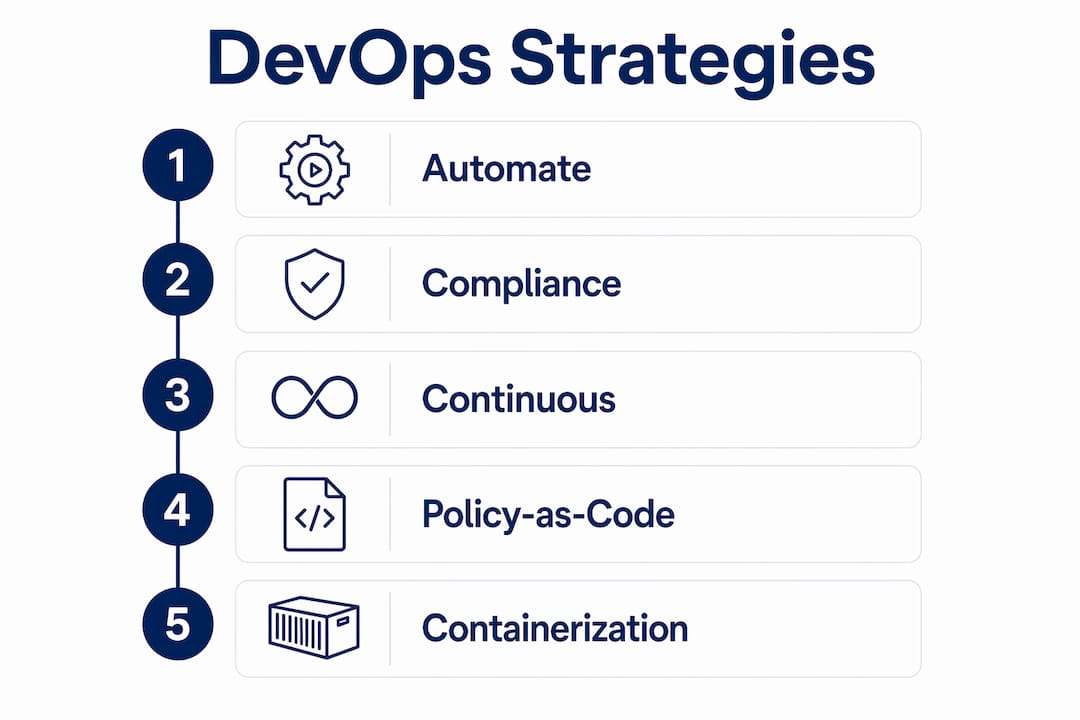
The most effective DevOps strategies for primes managing federal projects center on one principle: compliance evidence must be a byproduct of normal pipeline operation, not a separate workstream assembled before each audit.
Automated evidence generation
Compliance evidence collected at build time continuously reduces audit preparation from weeks to hours. Every commit produces SBOMs, scan logs, dependency graphs, and configuration snapshots. Those artifacts are stored centrally and mapped to specific NIST 800-53 controls automatically. When an auditor requests evidence for a control, the system retrieves it in minutes.
Continuous Authorization to Operate
The shift to cATO requires pipelines to provide real-time dashboards for agency security officers instead of periodic assessment packages. That shift is architectural. The pipeline must be designed from day one to produce continuous monitoring data, not retrofitted after the initial ATO is granted. Primes who build for cATO from the start avoid the expensive rework that comes with retrofitting.
Policy-as-code versus manual security gates
| Approach | Speed | Auditability | Scalability |
|---|---|---|---|
| Manual security gates | Slow, review-dependent | Inconsistent, paper-based | Does not scale across programs |
| Policy-as-code enforcement | Runs at every commit | Versioned, reproducible | Applies uniformly across all pipelines |
Policy-as-code wins on every dimension that matters for federal delivery. Infrastructure as code (IaC), policy as code, and continuous compliance validation enable versioning, auditability, and automated governance enforcement. These are not optional enhancements. They are foundational for any government DevOps program that expects to survive a DCSA or IG audit.
Containerization and IaC
Container-based deployments paired with IaC give primes reproducible, auditable environments. Every environment configuration is stored in version control. Drift from the approved baseline triggers an automated alert. That combination satisfies STIG hardening requirements and makes environment consistency provable, not assumed.
Pro Tip: Build your authorization engineering mindset into sprint planning. Assign a compliance artifact owner for each sprint who confirms that scan logs, SBOM outputs, and policy check results are stored and mapped to controls before the sprint closes.
How can prime contractors select and work effectively with DevOps partners?
Partner selection is the decision that most determines whether a federal DevOps program succeeds or stalls. A partner with strong commercial DevOps credentials but no government experience will cost primes time and credibility when FedRAMP or cATO requirements surface mid-program.
Primes should evaluate DevOps partners against these criteria:
- Government compliance fluency. The partner must demonstrate direct experience with FedRAMP, NIST 800-53, NIST 800-171, STIG hardening, and EO 14028 attestation. Ask for specific examples, not general familiarity.
- Air-gapped and GovCloud capability. Confirm that the partner's tooling runs in the target deployment environment. A partner who has only worked in commercial cloud cannot reliably architect for classified or air-gapped networks.
- Outcome ownership. The best IT partners for public sector success own a defined scope and deliver measurable results. Staff augmentation arrangements shift risk back to the prime. Outcome-based subcontracting keeps accountability with the partner.
- Automated compliance tooling. Automated compliance data collection tools capture SBOMs, scan results, dependency graphs, and configs centrally without requiring changes to individual pipelines. A partner who relies on manual documentation is a liability in a cATO environment.
- Certification and small business status. SDVOSB, woman-owned, and SBA-certified partners often satisfy set-aside requirements while bringing specialized expertise. That combination adds contract value beyond technical delivery.
Primes who apply these criteria reduce the risk of mid-program partner replacement, which is one of the most disruptive and costly events in a federal IT program.
Key Takeaways
DevOps for primes is the practice of embedding automated compliance, security, and delivery into federal pipelines from day one, not as an afterthought before each audit cycle.
| Point | Details |
|---|---|
| Automate compliance evidence | Collect SBOMs, scan logs, and configs at build time so audits take hours, not weeks. |
| Build for cATO from the start | Design pipelines to produce continuous monitoring data rather than retrofitting after initial ATO. |
| Use policy-as-code over manual gates | Versioned, automated policy enforcement scales across programs and satisfies audit requirements consistently. |
| Vet partners on government experience | Confirm FedRAMP fluency, air-gapped capability, and outcome ownership before signing a subcontract. |
| Address legacy debt early | Plan phased migration for aging systems so modern pipelines can integrate without blocking delivery. |
Authorization engineering is the mindset primes cannot afford to skip
Most primes I work with arrive at DevOps integration thinking the hard part is the tooling. It is not. The hard part is the mindset shift from document-focused compliance to what the field now calls authorization engineering. Manual writing for auditors is a reliable sign of a nonfunctional DevOps pipeline. If your team is assembling evidence packages by hand before each assessment, the pipeline is not doing its job.
The primes I have seen succeed treat every pipeline stage as a compliance instrument. The build stage produces the SBOM. The scan stage produces the vulnerability log. The deployment stage produces the configuration snapshot. None of that requires extra effort if the pipeline is designed correctly from the start. The ones who struggle are the ones who bolt compliance onto a pipeline that was built purely for speed.
The emerging shift to continuous ATO is accelerating this change. Agency security officers increasingly expect a live dashboard, not a quarterly PDF. Primes who cannot provide that will lose competitive position on recompetes. The cultural change required is real. Developers need to understand that a failed policy gate is not a blocker. It is a data point that protects the program. That reframe takes time, but it is the difference between a DevOps program that survives a DCSA review and one that does not.
— Randy
Primereadysub brings DevOps expertise built for federal primes
Rutledge & Associates, LLC operates as Primereadysub, a certified SDVOSB, woman-owned, and SBA-certified digital systems firm focused on IT modernization for government agencies. The firm builds DevOps pipelines, compliance automation systems, and real-time dashboards for prime contractors working on complex, compliance-heavy federal programs in Maryland, New York, and Florida. Primereadysub owns clearly defined scopes rather than providing staff augmentation, which means primes get measurable outcomes with low oversight burden. For primes looking to integrate DevOps practices that satisfy FedRAMP, NIST, and cATO requirements, Primereadysub's modernization services offer a direct path from legacy infrastructure to audit-ready, automated delivery.
FAQ
What is the role of DevOps for primes in federal contracts?
DevOps for primes is the practice of integrating automated development, operations, and security compliance into pipelines that meet federal standards like FedRAMP, NIST 800-53, and continuous ATO. It replaces manual security reviews and documentation with automated, auditable workflows.
How does DevSecOps differ from standard DevOps for government primes?
DevSecOps embeds security controls directly into the CI/CD pipeline rather than treating security as a separate review phase. For government primes, this means policy-as-code enforcement, automated SBOM generation, and continuous vulnerability scoring run at every commit.
What is continuous Authority to Operate (cATO)?
Continuous ATO is a durable authorization model where pipelines produce real-time compliance dashboards for agency security officers instead of periodic assessment packages. It replaces point-in-time certifications with ongoing, automated evidence collection.
Why do government DevOps implementations fail more often than commercial ones?
Government DevOps programs fail most often because teams apply commercial tooling to environments that require FedRAMP authorization, air-gapped deployments, or GovCloud compatibility. Tools that cannot operate in those environments are disqualified, and pipelines built around them require full rework.
How should primes evaluate a DevOps subcontractor for a federal program?
Primes should confirm that a subcontractor has direct experience with NIST 800-53, FedRAMP, and STIG hardening, and that their tooling runs in the target deployment environment. Outcome-based partners who own a defined scope reduce risk more than staff augmentation arrangements.