

DevOps in contract management is defined as the application of continuous integration, automation pipelines, and data-driven workflows to the full contract lifecycle, from drafting and obligation tracking to renewal and audit. For government project managers, the benefits of DevOps in contracts are measurable and immediate: processing time drops by 40 to 60%, financial errors fall sharply, and compliance signals shift from quarterly reviews to real-time monitoring. Agencies managing over 100 contracts annually report ROI of 300 to 500% in the first year alone. That figure reflects not just efficiency gains but the elimination of costly missed renewals, which IACCM research estimates at 2 to 5% of contract value per occurrence. This article explains the mechanisms behind those outcomes and the specific practices government teams need to replicate them.
How does DevOps improve contract lifecycle efficiency and automation?
Contract automation with DevOps reduces manual effort by replacing sequential, human-dependent review steps with continuous, logic-aware pipelines. The result is not incremental improvement. AI-driven document review processes up to 250,000 contract documents per week at 99% accuracy, cutting manual review time by 97%. One documented case study recorded $330 million in savings over 22 months from this approach alone. That scale of impact is achievable because automation removes the bottlenecks that slow government procurement: redundant approvals, inconsistent clause checking, and delayed version updates.
Continuous integration, a core DevOps practice, enables contract updates to move from weeks to hours. When a regulatory change requires a clause amendment across dozens of active contracts, a CI pipeline can propagate that change, flag affected documents, and route them for approval in a single automated sequence. Without CI, the same task requires manual identification, individual edits, and separate review cycles for each contract. The difference in cycle time is not marginal. It is structural.

The table below illustrates the contrast between manual and automated contract workflows across key performance dimensions.
| Workflow dimension | Manual process | DevOps-automated process |
|---|---|---|
| Contract processing time | Days to weeks | Hours |
| Document review accuracy | Variable, human-dependent | 99% with AI pipelines |
| Clause update propagation | Individual edits per contract | Automated across all affected documents |
| Audit trail creation | Manual logging, often incomplete | Immutable event logs, auto-generated |
| Renewal tracking | Calendar reminders, prone to gaps | Hourly obligation scans with escalation alerts |
Pro Tip: Prioritize the highest-volume, highest-risk contract flows for automation first. Procurement frameworks like MSAs and SOWs with recurring amendments generate the most manual effort and deliver the fastest measurable ROI when automated.
What role do DevOps practices play in enhancing compliance and risk management?
Treating contracts as living data products is the foundational shift that DevOps brings to compliance. Continuous compliance signals replace episodic reviews, giving legal and procurement teams real-time visibility into obligation status rather than a snapshot taken at quarterly intervals. This matters in government contracting because regulatory requirements change, and the cost of a missed obligation is not just financial. It carries reputational and legal consequences that manual review cycles cannot reliably prevent.
DevOps practices in contract workflow deliver compliance improvements through several specific mechanisms:
- Automated obligation tracking. Tools like Tonkean Contracts Hub use agentic AI workflows to monitor renewals, pricing terms, and compliance requirements continuously, removing the dependency on human memory or calendar systems.
- Machine-readable SLAs. When SLAs include measurable delivery metrics such as deployment frequency, lead time, failure rate, and mean time to recovery, they become enforceable data points rather than narrative commitments. Living SLAs with quarterly reviews prevent disputes and close performance gaps before they escalate.
- Immutable event logs. A contract lifecycle engine with event-sourced obligation history records every status change with a timestamp and actor ID. This creates an audit trail that satisfies federal and state audit requirements without additional manual documentation.
- Feature-flagged integrations. When downstream systems go offline for maintenance, feature flags preserve contract lifecycle operations, preventing compliance stalls that would otherwise require manual intervention.
Pro Tip: Implement version control and provenance tracking from day one. Every contract amendment should carry a record of who changed what, when, and under which authority. This practice alone resolves the majority of post-award disputes in government programs.
How can DevOps-driven contract management reduce operational costs and errors?
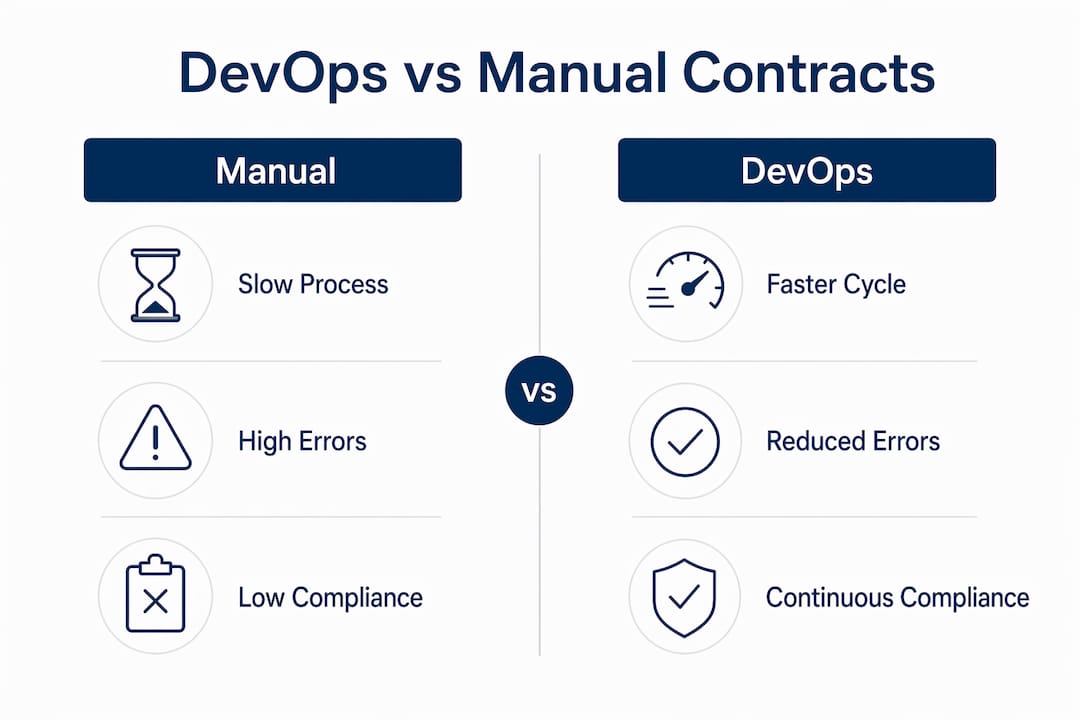
The cost reduction case for DevOps in contract management rests on a specific mechanism: business-logic-aware pipelines that catch errors at the point of entry rather than during post-execution audits. Pipeline automation produces an 80% reduction in financial processing errors during contract and procurement workflows. That reduction translates directly into avoided rework, reduced legal exposure, and lower administrative overhead across the contract portfolio.
The following practices drive the most significant cost savings in government contract programs:
-
Adopt a parent-child contract data model. Structure MSAs as parent documents with SOWs, task orders, and rate cards as child records. Parent-child hierarchies with version and approval history prevent orphaned contracts, which are active obligations that no longer have a traceable parent agreement. Orphaned contracts are a leading source of unauthorized commitments in government programs.
-
Automate renewal monitoring with hourly obligation scans. Missed renewals cost 2 to 5% of contract value according to IACCM research. An automated scan running every hour, with escalation alerts to designated owners, eliminates the gap that calendar-based systems leave when staff turn over or workloads spike.
-
Gate contract activations on compliance checks. Before any new SOW or amendment becomes active, require automated validation against the parent MSA terms, applicable regulations, and budget authority. This prevents unauthorized scope creep, which is one of the most common audit findings in federal and state contract programs.
-
Use analytics dashboards for portfolio-level visibility. Real-time dashboards that surface contract status, obligation health, and upcoming renewals give project managers the data-driven contract oversight needed to intervene before problems become findings.
-
Standardize clause libraries with automated insertion. Approved clause libraries integrated into the drafting pipeline reduce the risk of non-standard language entering contracts. This practice cuts legal review cycles and reduces the probability of clauses that create unintended financial exposure.
What are the key considerations when integrating DevOps into government contract workflows?
The technical capability to automate contract workflows exists today. The harder challenge is organizational. Legal, procurement, and technology teams in government agencies operate under different mandates, timelines, and risk tolerances. Successful DevOps integration in contract management requires deliberate alignment across all three groups before any pipeline is built.
The table below compares two common integration approaches and their trade-offs for government environments.
| Integration approach | Description | Best suited for | Key risk |
|---|---|---|---|
| Monolithic system replacement | Replace legacy contract system with a single new platform | Agencies with uniform contract types and stable requirements | High implementation risk, long timelines, vendor lock-in |
| Modular orchestration | Add automation layers and APIs to existing systems incrementally | Agencies with mixed legacy environments and compliance constraints | Requires strong API governance and integration testing |
Modular orchestration is the preferred approach for most government agencies. It preserves existing investments in legacy systems while adding automation capabilities incrementally. Each module, whether obligation tracking, SLA monitoring, or clause validation, can be deployed, tested, and validated independently. This reduces the risk of a single failed implementation disrupting the entire contract portfolio.
Legacy system interoperability is the most common technical barrier. Many government contract systems were built before modern API standards and do not expose data in machine-readable formats. The solution is a data translation layer that converts legacy outputs into structured formats compatible with DevOps pipelines. This layer requires upfront investment but pays back quickly through the contract onboarding efficiency gains it enables downstream.
Cross-team governance is equally critical. Assign a contract data owner who sits at the intersection of legal, procurement, and IT. This role is responsible for maintaining the data model, approving schema changes, and resolving conflicts between business logic and technical constraints. Without this role, automation projects stall when teams disagree on how obligations should be structured or tracked.
Key takeaways
DevOps in contract management delivers measurable improvements in speed, accuracy, and compliance when agencies combine automation pipelines, structured data models, and cross-team governance.
| Point | Details |
|---|---|
| Automation cuts processing time | DevOps pipelines reduce contract processing time by 40 to 60%, with ROI of 300 to 500% in year one. |
| AI review accuracy reaches 99% | AI-driven document review processes 250,000 contracts per week, cutting manual review time by 97%. |
| Pipeline automation reduces errors | Business-logic-aware pipelines produce an 80% reduction in financial processing errors. |
| Living SLAs prevent disputes | SLAs with measurable metrics and quarterly reviews close performance gaps before they escalate. |
| Modular integration reduces risk | Incremental automation layers on legacy systems outperform monolithic replacements in government environments. |
Why government agencies should move on DevOps contracts now, not later
I have worked with enough government IT programs to recognize a pattern: agencies that treat contract management as an administrative function rather than a data function consistently underperform on audit readiness and program delivery. The contracts are there. The obligations are documented. But the data is locked in PDFs, email threads, and spreadsheets that no pipeline can read.
The shift DevOps demands is not primarily technical. It is conceptual. When you start treating a contract as a structured data product with versioned records, machine-readable SLAs, and event-sourced obligation history, the compliance and efficiency gains follow almost automatically. The technology to do this, from tools like Tonkean Contracts Hub to AWS-based AI pipelines, is mature and proven. What most agencies lack is the governance model to deploy it.
The agencies I have seen succeed share one characteristic: they appointed a contract data owner before they wrote a single line of automation code. That person resolved the definitional conflicts between legal and procurement that would have stalled the project for months. They also set the data standards that made every downstream automation reliable.
My honest advice is to start with your highest-volume contract type, map every obligation and milestone in that type to a structured data field, and build one automated scan before you build anything else. The results from that single scan will make the case for everything that follows better than any business case document ever will.
— Randy
How Primereadysub accelerates DevOps contract benefits for government teams
Government agencies that want to move from manual contract workflows to automated, audit-ready systems need a partner with both the technical depth and the public sector experience to execute without disruption. Primereadysub, operating as Rutledge & Associates, LLC, delivers exactly that. As an SDVOSB, woman-owned, and SBA-certified firm, Primereadysub builds DevOps pipelines, compliance automation layers, and real-time dashboards tailored to state and federal contract environments. The firm owns clearly defined scopes, which means prime contractors get outcome-focused IT modernization without the overhead of managing staff augmentation. For agencies in Maryland, New York, and Florida, Primereadysub provides the specialized capability to turn contract data into a compliance asset.
FAQ
What are the primary benefits of DevOps in contracts?
The primary benefits are a 40 to 60% reduction in contract processing time, an 80% drop in financial processing errors, and real-time compliance monitoring through automated obligation tracking. Organizations managing over 100 contracts annually report ROI of 300 to 500% in the first year.
How does DevOps improve contract compliance for government agencies?
DevOps replaces episodic compliance reviews with continuous, machine-readable signals by treating contracts as structured data products with immutable event logs and automated obligation scans. This approach satisfies federal and state audit requirements without additional manual documentation.
What is a living SLA and why does it matter in DevOps contracts?
A living SLA is a service-level agreement that includes measurable delivery metrics such as deployment frequency, lead time, and mean time to recovery, and is reviewed and updated quarterly. Living SLAs prevent performance disputes by making vendor accountability a data-driven process rather than a narrative one.
What is the best integration approach for legacy government contract systems?
Modular orchestration, which adds automation layers and APIs to existing systems incrementally, outperforms full system replacement for most government agencies. It reduces implementation risk, preserves existing investments, and allows each automation module to be validated independently before broader deployment.
How do parent-child contract data models prevent orphaned contracts?
A parent-child model structures MSAs as parent documents with SOWs and task orders as child records, each carrying version and approval history. This hierarchy ensures every active obligation traces back to an authorized parent agreement, eliminating the unauthorized commitments that orphaned contracts create.