

Automation is the operational engine that produces the continuous, machine-readable evidence, faster feedback loops, and standardized platforms required for continuous software delivery and ongoing authorization in federal programs. Three outcomes define its practical value for government teams:
- Speed to capability: Automated CI/CD pipelines compress release cycles from months to days, letting programs respond to mission requirements without waiting for the next waterfall release window.
- Auditable control evidence: Every pipeline run generates artifacts — SBOMs, scan results, signed container images — that serve as real-time evidence for authorizing officials under the NIST Risk Management Framework.
- Lower cognitive load: The Creator→Curator shift documented by the ATARC DevSecOps working group moves developers from writing infrastructure from scratch to curating platform-managed environments, freeing capacity for mission logic.
NIST RMF, continuous ATO (cATO), and platform engineering are the three governance and technical frameworks this article uses throughout.
Table of Contents
- What does "automation in delivery" actually mean for federal programs?
- Which core automation practices actually enable continuous delivery in government?
- How does automation unlock cATO, continuous monitoring, and control inheritance?
- How should you structure procurements and SOWs for automation work?
- Key Takeaways
- Why the conventional wisdom on government automation is incomplete
- Primereadysub accelerates your path from legacy ATO to cATO
- Useful sources for program teams and contracting officers
What does "automation in delivery" actually mean for federal programs?
For federal and DoD programs, automation in software delivery means CI/CD pipelines, deployment orchestration, infrastructure as code (IaC), automated test suites, Software Bill of Materials (SBOM) generation, and compliance-as-code. It does not mean parcel routing, fleet management, or last-mile logistics — that is a separate discipline entirely.
The DoD Software Modernization and Acquisition Guide (SWE Guide, July 2025) explicitly recommends moving away from large-batch waterfall delivery toward continuous, automated pipelines and platform engineering as the baseline for modern program execution. That guidance gives this definition its policy grounding. See IT delivery model examples for government modernization for how these models translate into practice.
Pro Tip: When briefing stakeholders who associate "automation" with robotics or logistics, anchor the conversation to the DoD SWE Guide by name. It reframes the discussion around software delivery policy, not technology novelty.
Which core automation practices actually enable continuous delivery in government?
The following capabilities are the technical building blocks programs must implement or acquire to make automated delivery and cATO-readiness operational:
- Platform engineering / production-as-a-service — A centralized platform team owns the pipeline, runtime environment, and shared controls, so application teams inherit those controls rather than re-implement them per application.
These practices combine to convert build output into control evidence. A working example in the MedVault repository demonstrates a CI/CD pipeline that emits OSCAL Assessment Results, SBOM outputs, and signed artifacts on every commit, showing end-to-end RMF execution at pipeline speed.
How does automation unlock cATO, continuous monitoring, and control inheritance?
The short answer: continuous evidence from instrumented pipelines, combined with continuous monitoring dashboards, sustains ongoing authorization without the periodic re-documentation that makes traditional ATOs so expensive. The Federal News Network commentary on overcoming ATO bureaucracy documents that over 80% of ATO time is spent queuing, not doing substantive security work — a structural problem automation directly addresses.
The pathway from initial ATO to cATO follows a clear sequence:
- Obtain initial ATO using standard RMF steps (categorize, select, implement, assess, authorize, monitor).
- Map all common and inherited controls from the platform and cloud service provider — these do not need to be re-assessed for each application.
- Instrument the CI/CD pipeline to generate NIST SP 800-53 Rev 5 mapped evidence: SAST outputs map to SA-11, container scanning maps to SI-3, and configuration enforcement maps to CM-6/CM-7.
- Feed pipeline artifacts into a continuous monitoring dashboard accessible to the authorizing official (AO).
- Maintain OSCAL-formatted or machine-readable evidence packages so the AO can review authorization status without waiting for a manual evidence collection cycle.
The table below maps pipeline artifacts to their corresponding RMF control families, based on the Federal DevSecOps Compliance Guide:
| Pipeline Artifact | NIST SP 800-53 Rev 5 Control | Authorization Role |
|---|---|---|
| SAST scan results | SA-11 (Developer Testing) | Code-level control evidence |
| Container image scan | SI-3 (Malicious Code Protection) | Runtime integrity evidence |
| IaC configuration scan | CM-6, CM-7 (Configuration Settings) | Baseline configuration evidence |
| SBOM | SR-3 (Supply Chain) | Component provenance evidence |
| Signed artifacts | SI-7 (Software Integrity) | Chain-of-custody evidence |
| Continuous monitoring feed | CA-7 (Continuous Monitoring) | AO dashboard input |
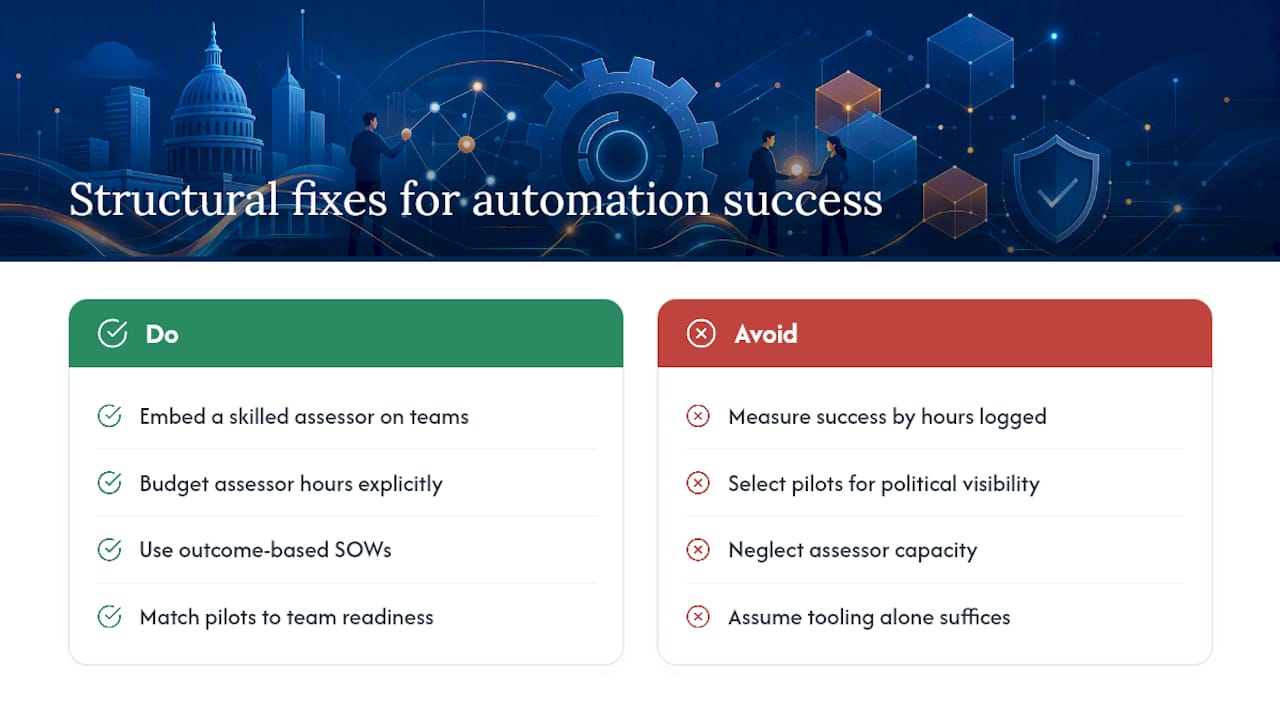
Budget for assessor hours as a dedicated line item. Assessor capacity is the rate-limiting factor for moving from one-off ATOs to continuous authorization — a lesson Kessel Run learned by embedding technically skilled assessors directly into program teams rather than routing work through a centralized queue.
How should you structure procurements and SOWs for automation work?
Outcome-based statements of work outperform staff augmentation contracts for automation programs because they tie payment to evidence delivery, not hours logged. Consolidating tooling into unified platforms reduces "accidental architecture" — the sprawl of point solutions that creates human middleware and slows remediation.
| Procurement Element | Staff Augmentation Approach | Outcome-Based Approach |
|---|---|---|
| Payment trigger | Hours worked | Defined deliverable accepted |
| Evidence accountability | Unclear | Vendor-owned per SOW |
| Assessor hours | Ad hoc | Budgeted line item |
| OSCAL outputs | Optional | Acceptance criterion |
| Pipeline SLAs | None | Defined run-time and availability |
Key contract clauses to include:
- Evidence availability SLAs tied to pipeline run completion.
- Artifact retention requirements specifying OSCAL or machine-readable formats.
- Assessor-hour line items with defined minimum capacity per sprint.
- Acceptance criteria linked to deployment frequency and MTTR targets.
When evaluating vendors, prioritize demonstrable cATO pipeline experience, OSCAL-ready outputs, and a track record of delivering defined outcomes rather than filling seats. See DevOps contracting considerations for government agencies for additional clause language.
Key Takeaways
Automation in government software delivery is not a tool choice — it is a program design decision that determines whether continuous authorization is achievable at all.
| Point | Details |
|---|---|
| Pipeline artifacts are ATO evidence | Map every scan output to its NIST SP 800-53 Rev 5 control family before the first pipeline run. |
| Assessor hours must be budgeted | Assessor capacity is the rate-limiting factor for cATO; include it as a SOW line item from day one. |
| Control inheritance multiplies ROI | A shared platform that carries inherited controls reduces each application's residual control set and speeds authorization. |
| Outcome SOWs outperform staff augmentation | Tie payment to evidence delivery, OSCAL outputs, and KPI targets — not hours logged. |
| Primereadysub delivers defined-scope packages | Rutledge & Associates provides platform engineering, compliance automation, and assessor-hour bundles as owned deliverables for federal and state programs. |
Why the conventional wisdom on government automation is incomplete
Most commentary on automation in federal IT focuses on the technology — which pipeline tool, which scanning product, which cloud platform. That framing misses the actual constraint. The technology is largely solved. What stalls programs is the organizational and contractual design around the technology: assessors who are not budgeted, SOWs that pay for hours instead of evidence, and pilot selections driven by political visibility rather than team readiness.
The Kessel Run lesson that deserves more attention is not the pipeline architecture. It is that embedding a technically skilled assessor inside the team — someone who can read a SAST report and map it to SA-11 without a two-week translation cycle — is what actually compresses authorization time. Programs that invest in tooling without investing in assessor capacity are building a fast car with no driver.
The contracting implication is direct: outcome-based SOWs with defined acceptance criteria and assessor-hour line items are not procurement preferences. They are the structural conditions under which automation delivers its promised returns. Any program that procures automation capability through staff augmentation and then measures success by hours logged will get exactly what it paid for — activity, not outcomes.
Primereadysub accelerates your path from legacy ATO to cATO
Federal programs that need to move from a legacy ATO process to continuous authorization in a defined timeframe have a concrete alternative to assembling a team from scratch. Primereadysub (Rutledge & Associates) delivers platform engineering sprints, pipeline instrumentation, compliance automation packages, and embedded assessor support as owned work packages — not headcount. The firm's SDVOSB and SBA certifications make it a straightforward fit for small business set-aside vehicles, and its public-sector delivery record in Maryland, New York, and Florida means the team has navigated real state and federal compliance environments.

The next step is a scoped capability brief: a short engagement that maps your program's current control inheritance, identifies the highest-value pipeline instrumentation targets, and produces a draft SOW with assessor-hour line items and OSCAL-output acceptance criteria. Request a capability brief to start that conversation.
Useful sources for program teams and contracting officers
- ATARC DevSecOps working group — The new logic of innovation (v4)
- Overcoming bureaucracy to expedite software development cycles
- Software Modernization and Acquisition Guide (SWE Guide) — July 2025
- Platform engineering pushes government to 'Production as a Service' | GovCIO Media & Research
- Federal DevSecOps Compliance Guide: CI/CD Pipeline Security Controls
- joserodriguezthe1/medvault-ato
- Agencies shift from fragmented IT systems to unified platforms | GovCIO Media & Research