

Prime contractors managing federal IT modernization contracts rarely succeed by operating in isolation. Even the most capable firms recognize that mission-critical programs demand specialized expertise, niche compliance knowledge, and the kind of operational flexibility that only a well-chosen subcontractor network can provide. Federal subcontracting has become a strategic necessity, not a formality, for primes seeking to deliver on complex, compliance-heavy government technology contracts. This article examines the strategic, regulatory, and operational dimensions of prime-sub partnerships, offering a practical framework for building relationships that reduce risk and consistently drive outcomes.
Table of Contents
- Strategic advantages of subcontracting for IT modernization
- Meeting compliance and small business goals through subcontracting
- Building effective prime-sub relationships for risk mitigation and growth
- Navigating challenges: Pitfalls and how to avoid them
- Putting it into action: A framework for successful subcontracting partnerships
- A smarter path: What most primes overlook about IT subs
- Find your ideal IT modernization subcontracting partners
- Frequently asked questions
Key Takeaways
| Point | Details |
|---|---|
| Specialized expertise access | Subcontracting provides primes with specialized IT and compliance skills essential for complex modernization. |
| Compliance made easier | Working with subs helps primes surpass small business goals and regulatory hurdles like FAR 52.219-9. |
| Risk mitigation | Well-defined teaming mitigates risk on complex federal IT projects and fosters stronger long-term relationships. |
| Enabling rapid scaling | Subs allow primes to quickly scale capacity for short timeframes and large federal awards. |
| Elevated innovation | The best primes harness subs not just for compliance, but as innovation partners and sources of future growth. |
Strategic advantages of subcontracting for IT modernization
The idea that a prime contractor can internalize every capability required for a large-scale federal IT modernization program is, in practice, rarely realistic. Government IT programs today span cloud migration, cybersecurity compliance, DevOps automation, real-time analytics, and more. Each domain carries its own certification requirements, toolchains, and talent profiles.
Firms like Lockheed Martin rely on subs for specialized engineering, logistics, and IT support precisely because no single organization can maintain deep expertise across every technical domain at scale. Subcontracting is not a fallback position. It is a deliberate architecture for program delivery.
The specific advantages that high-performing primes extract from subcontracting relationships include:
- Specialized compliance expertise: Niche knowledge in frameworks like CMMC, FedRAMP, and StateRAMP is difficult to build organically and even harder to maintain. Subs who operate exclusively in these domains bring certifications and audit-ready documentation from day one.
- Faster ramp-up: After a large contract award, primes face immediate pressure to staff and deliver. Rapid scaling after large awards through subs who bring trained teams and established processes is consistently faster than internal hiring.
- Cost and operational flexibility: Subcontracting allows primes to match workforce levels to contract phases, avoiding the overhead of maintaining large bench capacity between awards.
- Access to cleared and credentialed personnel: Cleared IT talent with active federal investigation backgrounds is a scarce resource. Subs who maintain cleared pipelines provide a significant competitive edge.
- Innovation at the delivery layer: Subs who specialize in specific technical domains often bring proven methodologies and toolsets that accelerate delivery beyond what generalist primes can offer independently.
Federal IT spending is projected to approach $100 billion by 2026, and primes are increasingly turning to specialized subcontractors to manage compliance-heavy components of modernization programs, particularly cloud migration, DevSecOps, and data governance services.
For primes evaluating how to structure their partnering for public sector IT, the evidence is consistent: subs are not overhead. They are delivery infrastructure.
Pro Tip: Build relationships with qualified subcontractors before the RFP drops. Last-minute teaming rarely produces competitive proposals. Firms that maintain active sub relationships can build stronger win themes and more credible technical approaches from the earliest stages of a pursuit.
Developing a portfolio of strategic IT partnerships across compliance, cloud, and automation domains positions primes to respond rapidly to new opportunities without compromising on quality or compliance integrity.
Meeting compliance and small business goals through subcontracting
Beyond strategic value, subcontracting carries a direct regulatory dimension that primes cannot ignore. The Federal Acquisition Regulation imposes specific requirements on large businesses holding contracts above defined thresholds. FAR 52.219-9 mandates that large prime contractors develop and execute small business subcontracting plans with clearly stated participation goals across multiple business categories.

These categories include small businesses, small disadvantaged businesses, women-owned small businesses, HUBZone firms, service-disabled veteran-owned businesses, and veteran-owned small businesses. Meeting these goals is not optional. It is a contractual requirement that agencies evaluate both at award and through ongoing reporting obligations.
Federal subcontracting also carries significant dollar volume. Of $791.6 billion in federal obligations in fiscal year 2023, a substantial share flowed through subcontracted work, much of it directed toward small business categories. This makes subcontracting both a legal necessity and a financial channel of considerable scale.
The following table illustrates how compliance requirements and small business participation goals typically align across common government contract types:
| Contract type | FAR 52.219-9 threshold | Common SB category goals |
|---|---|---|
| IDIQ (large business prime) | Over $750,000 | Small, SDB, WOSB, SDVOSB |
| GWAC task orders | Per agency guidance | HUBZone, VOSB, WOSB |
| Fixed-price IT delivery | Over $750,000 | Small business, SDVOSB |
| Cost-plus development | Over $750,000 | All six SBA categories |
For primes building proposals for IT modernization partnerships, integrating small business subcontractors is not just a compliance line item. A well-constructed small business plan signals to evaluators that the prime has a realistic delivery model and established partner relationships.
The practical steps for integrating qualified small and disadvantaged businesses into competitive bids include:
- Identify requirements early: Map the statement of work to capability areas where small business subs can perform substantive, documentable work.
- Set realistic and ambitious goals: Goals that merely clear minimums may satisfy compliance but rarely impress evaluators. Competitive primes set targets that reflect genuine commitment.
- Maintain a vetted sub registry: A pre-approved list of small business partners across SBA categories enables faster proposal assembly and stronger past performance narratives.
- Document teaming relationships clearly: Agencies look for evidence of existing working relationships, not just signed teaming agreements with unfamiliar firms.
- Track and report participation consistently: ISR and SSR reporting obligations require accurate, timely data on subcontract dollars paid to each SB category throughout contract performance.
Primes who develop strong reputations for selecting IT modernization partners with genuine small business integration often find that this track record improves their competitive position on subsequent bids.
Building effective prime-sub relationships for risk mitigation and growth
Compliance opens doors. Effective relationships keep programs on track. The distinction matters because poorly structured prime-sub arrangements are one of the most common sources of program delivery failures in federal IT.
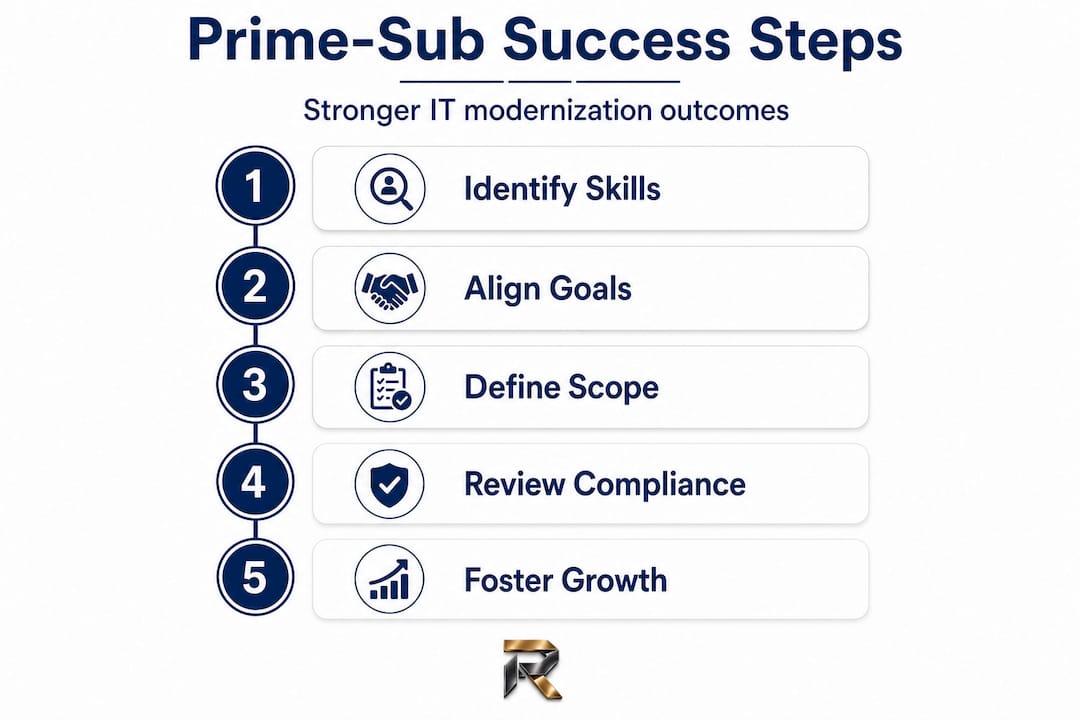
Risk mitigation in complex projects requires clear scope definition, unambiguous payment terms, and aligned performance objectives. When these elements are absent or vague, disputes and delays follow almost inevitably. The relationship between a prime and a sub functions best when it is treated as a structured business partnership, not an informal arrangement.
Core relationship-building best practices for primes managing IT modernization subs include:
- Define the scope of work precisely: Ambiguity in a statement of work is a risk generator. Clearly bounded deliverables with measurable acceptance criteria protect both parties.
- Establish payment milestones tied to deliverables: Payment terms that reflect actual work completion reduce cash flow disputes and create accountability at every project phase.
- Align on technical standards and compliance requirements: Subs must understand what compliance evidence the prime will require for government reporting. This needs to be documented before work begins.
- Create joint governance cadences: Regular program reviews between prime and sub leadership catch scope drift and communication breakdowns before they become contractual issues.
- Protect intellectual property and data rights explicitly: Government IT programs often involve sensitive data. Data handling responsibilities must be defined contractually, not assumed.
The table below illustrates how teaming agreement quality affects risk outcomes:
| Factor | Poor teaming agreement | Effective teaming agreement |
|---|---|---|
| Scope definition | Vague, role-based | Deliverable-specific, measurable |
| Payment terms | Net-60 with no milestones | Milestone-linked, 30-day cycles |
| Dispute resolution | No process defined | Escalation ladder documented |
| IP and data rights | Not addressed | Explicitly assigned by category |
| Reporting obligations | Informal | Scheduled, formatted, contractual |
Long-term collaboration builds past performance records for subs and creates reliable delivery capacity for primes. Primes who invest in structured relationships with successful IT partnership strategies find that their sub partners become more valuable over time, requiring less oversight and delivering more predictable results.
Pro Tip: Schedule a joint post-award review within the first 30 days of contract performance. This meeting sets the tone for the relationship, identifies any gaps between the proposal narrative and program reality, and creates an early opportunity to resolve ambiguity before it becomes a formal dispute.
For primes assessing their IT subcontracting readiness, this structured approach to relationship management is the single most reliable predictor of program health.
Navigating challenges: Pitfalls and how to avoid them
Not every prime-sub partnership delivers the outcomes both parties intend. Understanding the most common failure modes helps primes design agreements and operating models that prevent problems rather than react to them.
Common subcontracting challenges include payment delays, scope creep, unequal power dynamics, and communication breakdowns. Each of these is addressable, but only when mitigation is built into the agreement structure from the start.
The four most significant pitfalls in prime-sub IT partnerships are:
- Payment delays: When primes delay payments to subs, program continuity is threatened. Subs managing payroll and infrastructure costs cannot absorb long payment cycles without consequences for delivery capacity. Prompt payment clauses and milestone-based disbursements resolve most of this risk.
- Scope creep: Government programs frequently evolve mid-performance. Without a formal change control process, subs absorb additional work without corresponding compensation, creating resentment and financial strain.
- Communication breakdowns: Primes and subs operating without regular structured touchpoints tend to develop divergent understandings of program status. By the time discrepancies surface, they have often become contractual disputes.
- Power imbalances: Primes hold contractual authority over subs, which can create dynamics where subs feel unable to raise concerns transparently. Programs managed this way tend to accumulate undisclosed risk.
Subcontracting arrangements succeed when both parties treat the pre-award agreement as the foundation of the working relationship. Every ambiguity left unresolved before award becomes a source of friction after performance begins. Precise agreements are not administrative overhead. They are the primary risk management instrument available to both parties.
For primes operating in complex, flexible contracting in public sector IT environments, building mitigation into the structure of the relationship from the outset is not optional. It is what separates programs that deliver from programs that struggle.
Putting it into action: A framework for successful subcontracting partnerships
Translating strategic intent into operational practice requires a defined process. Primes who consistently build high-performing sub networks follow repeatable methods for sourcing, vetting, and onboarding the right partners.
The mechanics of subcontracting start with market engagement. SUBNet and supplier portals allow primes to post opportunities and negotiate subcontracting plans pre-award, with separate goals established by SB category and contract option period. This structured approach ensures that the subcontracting plan reflects real relationships rather than placeholder commitments.
The step-by-step framework for building a high-value sub network for IT modernization includes:
- Define capability gaps: Before identifying subs, primes should map where their internal capacity falls short relative to contract requirements.
- Post and source systematically: Use SUBNet, GSA supplier portals, and industry networks to identify candidates with relevant certifications and past performance.
- Evaluate compliance posture: For IT modernization programs, subs should demonstrate existing familiarity with required security frameworks, not just a willingness to learn.
- Assess past performance independently: Reference checks with prior prime partners provide more reliable signal than proposal narratives alone.
- Negotiate scope and terms pre-award: Finalizing teaming agreements after contract award creates time pressure that favors imprecise language. Pre-award negotiation produces cleaner agreements.
- Onboard with a structured kick-off: First-week alignment on reporting cadences, tools, and escalation paths sets the operating model for the entire contract period.
The criteria that matter most when evaluating IT modernization subs are:
- Demonstrated compliance certifications relevant to the contract (FedRAMP, CMMC, StateRAMP)
- Past performance on programs of comparable scope and technical complexity
- Ability to own defined deliverables independently, without requiring constant prime oversight
- Financial stability sufficient to manage payroll through standard government payment cycles
- Cultural alignment with the prime's approach to transparency and escalation
Niche cloud and digital skills enable subs to deliver compliance and efficiency outcomes that primes cannot replicate in-house without significant time and investment. The prime partner selection process, when executed rigorously, produces partnerships that strengthen the prime's entire delivery model.
A smarter path: What most primes overlook about IT subs
Most primes engage subcontractors to satisfy a compliance requirement or fill a staffing gap. This transactional mindset consistently undervalues what capable IT subs can actually contribute to program outcomes.
Federal IT services revenue grew 9.3% in Q3 2024, driven partly by acquisitions. But acquisitions are slow, expensive, and culturally complex. Subcontracting offers a faster path to the same outcome when the relationship is structured correctly. Subs who are integrated into solution design from the pursuit phase bring institutional knowledge of specific domains that improves technical approaches, pricing models, and risk identification.
The missed opportunity for most primes is treating subs as execution resources rather than design contributors. An IT modernization sub that specializes in compliance automation, for example, will have developed patterns and toolsets that a generalist prime has not encountered. Introducing that expertise at the proposal stage, not the task order stage, produces materially better technical solutions.
Subs enable organic scaling in ways that acquisitions cannot match. The right sub partner brings capacity, compliance depth, and proven methodology without the integration overhead of a corporate transaction.
The primes that consistently outperform their peers on IT modernization contracts are not the ones with the largest internal workforces. They are the ones who have built the most capable and well-integrated prime contractor roles within a broader ecosystem of specialized partners.
Treating subs as strategic innovation partners, and involving them in solution design before the proposal is written, is the operational change that separates high-performing prime organizations from the rest.
Find your ideal IT modernization subcontracting partners
Prime contractors pursuing federal and state IT modernization contracts need subcontracting partners who bring more than capacity. They need firms who own defined scopes, operate with minimal oversight, and arrive compliance-ready from day one.
Rutledge & Associates, LLC is an SDVOSB, woman-owned, SBA-certified digital systems firm specializing in cloud-native modernization, DevOps automation, compliance automation, and real-time analytics for public sector clients. The firm is structured to function as a high-value subcontractor for primes working on complex, compliance-heavy programs in Maryland, New York, Florida, and beyond.
Explore what a structured IT subcontracting partnership looks like through prime-ready IT partners, or learn more about the full range of services at Rutledge & Associates solutions.
Frequently asked questions
How do prime contractors find qualified IT subcontractors for federal projects?
Primes typically use SUBNet and supplier portals, along with industry networks and existing relationships, to identify and vet qualified subs before proposals are submitted.
What small business categories must be included in federal subcontracting plans?
Under FAR 52.219-9 requirements, large primes must set participation goals for small businesses, small disadvantaged businesses, women-owned small businesses, HUBZone firms, and veteran-owned businesses.
How does subcontracting help primes scale for major IT contracts?
Rapid scaling through subs gives primes immediate access to specialized talent, compliance credentials, and proven delivery methodologies, enabling faster and more effective program ramp-up than internal hiring allows.
What are common challenges in prime-subcontractor relationships?
Payment delays, scope creep, and uneven power dynamics are the most frequent friction points, and all are best addressed through precise teaming agreements negotiated before contract award.