

Vulnerability management is a continuous lifecycle process that identifies, prioritizes, remediates, verifies, and reports on security weaknesses across an organization's digital infrastructure. NIST frames it as a risk-reduction capability that minimizes the window of opportunity for adversaries to exploit known defects in software and hardware. CISA reinforces this framing: a mature program does not just find vulnerabilities, it validates that controls are working and produces auditable evidence of remediation. Done well, vulnerability management shortens exploit windows, supports regulatory compliance, and gives security leaders the data they need to defend budget and demonstrate program effectiveness.
Table of Contents
- Why vulnerability management matters for organizational risk
- How does vulnerability management differ from assessments and pen testing?
- What does the vulnerability management lifecycle look like?
- How should you prioritize vulnerabilities by risk?
- What types of vulnerabilities should a mature program cover?
- Which tools should you evaluate for a VM stack?
- What are the best practices for running an effective VM program?
- How do you measure whether your VM program is working?
- How do you stand up a VM program in 90 days?
- Vulnerability management in government and regulated environments
- Key Takeaways
- The gap between VM theory and what actually breaks programs
- Primereadysub brings outcome-owned VM delivery to government programs
- Authoritative sources and further reading
Why vulnerability management matters for organizational risk
Every unpatched vulnerability is an open door. The question is not whether attackers will find them, but when. A structured vulnerability management process closes those doors systematically, reducing the attack surface before adversaries can move laterally through a network, exfiltrate data, or disrupt services.
For decision-makers, the business case is concrete:
- Reduced exploit windows: Faster identification and remediation means less time for adversaries to act on known weaknesses.
- Prevented lateral movement: Patching network-facing and privilege-escalation vulnerabilities limits how far an attacker can travel once inside.
- Regulatory and contractual compliance: Federal agencies, state governments, and regulated industries face explicit requirements tied to vulnerability handling. Failing to meet them carries reporting obligations and contract risk.
- Improved audit posture: Documented remediation workflows and evidence of control effectiveness satisfy auditors and support FedRAMP, FISMA, and CMMC assessments.
- Lower mean time to remediate (MTTR): A program with defined SLAs and owner accountability consistently outperforms ad-hoc patching on remediation speed.
CISA's Vulnerability Management mission states the goal plainly: reduce the prevalence and impact of vulnerabilities and exploitable conditions across enterprises and technologies. That framing matters. The importance of vulnerability management is not simply operational hygiene; it is a measurable risk-reduction program with direct bearing on organizational resilience.
Statistic callout: NISTIR 8011 Volume 4 frames automated VM as comparing actual versus desired software state across the network — a data-integrity challenge as much as a security one.
How does vulnerability management differ from assessments and pen testing?
These three terms appear together constantly in procurement documents and security roadmaps, and conflating them leads to misaligned expectations and budget waste. The distinction comes down to cadence, output, and purpose.
| Dimension | Vulnerability Management | Vulnerability Assessment | Penetration Testing |
|---|---|---|---|
| Purpose | Continuous risk reduction across the full asset inventory | Point-in-time snapshot of weaknesses present | Adversary emulation to test detection and response |
| Cadence / Output | Ongoing; produces a living remediation backlog with SLAs | Periodic (quarterly, annually); produces a findings report | Scheduled engagements; produces a narrative attack-path report |
| Who runs it | Security operations, IT ops, application owners | Internal security team or third-party assessor | Specialized red team or external pen-test firm |
| Typical use case | Day-to-day risk reduction, compliance evidence, patch prioritization | Compliance snapshot, pre-audit baseline, new environment onboarding | Red-team validation, pre-launch security gate, regulatory requirement |
A vulnerability assessment answers "what exists"; vulnerability management answers "what matters most and how to fix it" through continuous iteration. Penetration testing goes further still, asking "can an attacker chain these weaknesses into a real compromise?" Each has a role, but none substitutes for the others.
A practical example: a state agency running an annual assessment before a FISMA audit gets a compliance snapshot. Without a continuous program, the findings from that assessment age quickly. A pen test the following quarter might reveal that three of those findings were already exploitable in combination — something neither the assessment nor the program caught because remediation stalled.
What does the vulnerability management lifecycle look like?
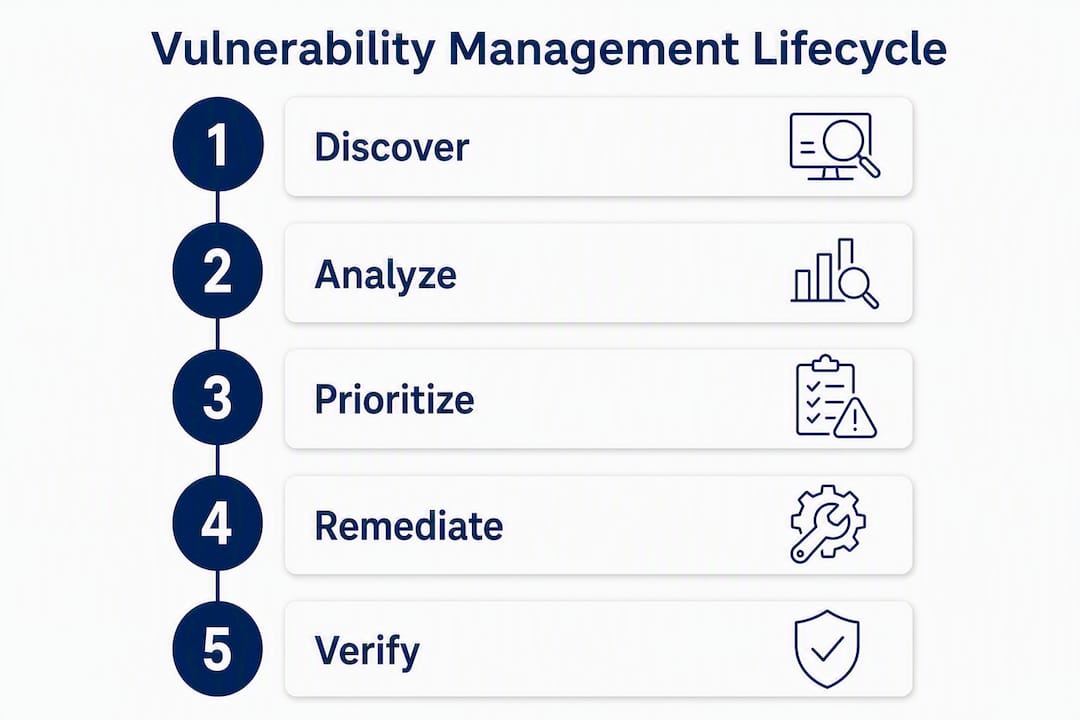
The CISA CRR Resource Guide maps VM into four organizational phases: discovery, analysis, remediation, and reporting. In practice, most mature programs run six steps, each with a defined owner.
-
Discovery (Owner: Security Operations) Enumerate all assets and identify vulnerabilities present. Techniques include credentialed network scanning, agent-based enumeration on endpoints, passive traffic analysis, and SBOM/SCA feed ingestion for software components. BOD 23-01 implementation guidance emphasizes credentialed enumeration for full visibility and allows EDR telemetry as a supplementary data source.
-
Analysis and triage (Owner: Security Operations / Risk Analyst) Validate findings, eliminate false positives, and enrich each vulnerability with asset context (criticality, exposure, compensating controls). This step separates a raw scanner output from an actionable risk register.
-
Prioritization (Owner: Risk Owner / SRE) Rank findings by business impact and exploitability, not CVSS score alone. More on this in the next section.
-
Remediation (Owner: Patching Team / Application Owner) Apply patches, configuration changes, or compensating controls within defined SLA windows. Remediation tasks should flow directly into the ticketing system with ownership assigned.
-
Verification (Owner: Security Operations) Rescan or retest to confirm the fix was applied correctly and the vulnerability is no longer present. Skipping this step is one of the most common program failures.
-
Reporting (Owner: Security Leadership) Produce metrics and dashboards for both technical teams and executive stakeholders. Evidence of remediation feeds compliance documentation and audit packages.
Pro Tip: Map vulnerabilities to business services at the analysis step, not the reporting step. When a finding is tied to a revenue-generating system or a system processing PII, it gets a different remediation priority than the same CVE on an isolated test server. Making that connection early prevents the prioritization step from becoming a CVSS sorting exercise.
How should you prioritize vulnerabilities by risk?
CVSS scores are a starting point, not a prioritization strategy. A CVSS 9.8 vulnerability on an air-gapped internal system with compensating controls is less urgent than a CVSS 6.5 finding on an internet-facing authentication service that is actively being exploited in the wild. Risk-based prioritization accounts for the full picture.
The factors that matter most:
- Exploitability: — Is there a known public exploit? Is it being actively exploited? CISA's Known Exploited Vulnerabilities (KEV) catalog is the authoritative reference for active exploitation status.
The Stakeholder-Specific Vulnerability Categorization (SSVC) framework, developed with CISA input, offers a structured decision tree that incorporates exploitation status, mission impact, and safety considerations. It produces a prioritization outcome (defer, scheduled, out-of-cycle, immediate) rather than a numeric score, which maps more naturally to remediation workflows.
Pro Tip: When a vulnerability appears in CISA's KEV catalog, treat it as an immediate-response trigger regardless of its CVSS score. CISA's incident and vulnerability response playbooks provide specific evaluation and rapid-response steps for actively exploited vulnerabilities, including cross-organizational reporting requirements and compensating control documentation when patches are unavailable.
What types of vulnerabilities should a mature program cover?
A program scoped only to software CVEs will miss a substantial portion of the actual attack surface. Mature programs cover all of the following:
- Software CVEs: Known vulnerabilities in operating systems, applications, and libraries, identified by CVE identifiers and tracked against the NVD. These are what most scanners find natively.
- Configuration weaknesses: Misconfigurations in firewalls, cloud services, identity providers, and databases. Often more exploitable than unpatched software because they require no exploit code.
- Third-party and supply-chain components: Open-source libraries and commercial software components identified through SCA tools and SBOM analysis. A vulnerable dependency buried three layers deep in a build is just as dangerous as a first-party flaw.
- Cloud misconfigurations: Overly permissive IAM policies, publicly exposed storage buckets, and unencrypted data at rest. Cloud-native scanners and CSPM tools surface these; traditional network scanners generally do not.
- Firmware and hardware flaws: Vulnerabilities in BIOS/UEFI, network device firmware, and embedded controllers. These are harder to patch and often missed entirely by software-focused programs.
- Exposed secrets and credentials: Hardcoded API keys, passwords in source code, and overly broad service account permissions. SCA and secrets-scanning tools find these; vulnerability scanners typically do not.
- Zero-days and logical flaws: Vulnerabilities with no CVE or patch available at time of discovery. These require threat intelligence feeds, behavioral detection, and compensating controls rather than patch-based remediation.
The discoverability gap is significant. Credentialed network scanners handle software CVEs and some configuration issues well. Supply-chain components require dedicated SCA tooling and SBOM ingestion. Cloud misconfigurations need CSPM coverage. Hardware flaws often require vendor-specific tooling or manual review. A complete program integrates all of these data sources into a unified risk register.
Which tools should you evaluate for a VM stack?
No single tool covers every category above. A production VM stack typically combines several technology layers, and the integration between them matters as much as any individual capability.
Network and host vulnerability scanners
These form the core of most programs. They perform credentialed and uncredentialed scans, identify CVEs, and flag configuration issues. Rapid7 InsightVM is a widely deployed option in enterprise and government environments, offering risk-scored findings, asset tagging, and integration with ticketing systems and CMDBs. Its live dashboards and remediation workflow features make it practical for teams managing large, heterogeneous asset inventories.

EDR-integrated discovery
CrowdStrike Falcon extends vulnerability discovery through its endpoint agent, surfacing CVEs and misconfigurations from the same telemetry used for threat detection. The advantage is coverage without requiring a separate scan: assets that are online and running the Falcon sensor are continuously enumerated. This is particularly useful for distributed environments where scheduled scans miss transient assets.
Microsoft Defender Vulnerability Management (part of the Microsoft Defender for Endpoint suite) takes a similar approach for Windows-heavy environments, integrating software inventory, CVE mapping, and remediation recommendations directly into the security operations workflow. Its integration with Microsoft Intune and the broader Microsoft 365 Defender ecosystem reduces the tool-switching overhead for teams already in that stack.
SCA and SBOM/VEX tooling
Software composition analysis tools identify vulnerable open-source components in application builds. NIST supply-chain guidance recommends requiring suppliers to provide machine-readable vulnerability advisories (VEX) and SBOM data, enabling automated per-configuration exploitability checks rather than relying on generic CVE listings.
Integration requirements
When evaluating any tool, the integration checklist matters more than the feature list:
- Bidirectional ticketing integration (ServiceNow, Jira, or equivalent)
- CMDB sync for asset ownership and criticality data
- EDR/endpoint telemetry ingestion
- CI/CD pipeline feeds for pre-production scanning
- SBOM/VEX ingestion for supply-chain coverage
- Machine-readable advisory support (CSAF/VEX)
On deployment model: cloud SaaS offerings reduce operational overhead and scale more easily, but government environments with data-residency requirements or air-gapped networks may require on-premises or hybrid deployment. Verify FedRAMP authorization status for any SaaS tool before procurement in a federal context.
What are the best practices for running an effective VM program?
The gap between a functioning VM program and an effective one usually comes down to program-level discipline, not tooling. The following practices separate programs that produce measurable risk reduction from those that generate reports no one acts on.
- Maintain an authoritative asset inventory. Every vulnerability finding needs an owner. Without accurate asset data tied to business services and responsible teams, remediation stalls. Asset inventory is a prerequisite, not a nice-to-have.
- Define and enforce SLAs by severity tier. A common starting point: critical vulnerabilities remediated within 15 days, high within 30, medium within 90. Document these, get leadership sign-off, and track compliance as a primary KPI.
- Schedule recurring scans at a defined cadence. Ad-hoc scanning produces inconsistent coverage. Weekly credentialed scans for critical assets, monthly for the broader inventory, is a defensible baseline for most organizations.
- Use credentialed enumeration. Unauthenticated scans miss a significant portion of installed software and configuration issues. Credentialed scans produce materially more complete findings.
- Integrate with change and patch management. Remediation tasks should flow automatically into the change management workflow. Manual handoffs create delays and accountability gaps.
- Automate evidence collection. NISTIR 8011 Volume 4 specifically addresses automating the collection of evidence for software vulnerability management controls. Automated evidence supports audits without requiring manual compilation.
- Define an exception and acceptance process. Some vulnerabilities cannot be patched immediately. Document the business justification, the compensating controls in place, and a review date. Undocumented exceptions become audit findings.
- Assign clear role ownership. Security operations finds and prioritizes; IT operations and application owners remediate; security leadership reports and governs. Blurred ownership is the most common reason remediation stalls.
Pro Tip: Avoid "discovery inflation" — the condition where scan volume grows faster than remediation capacity, producing a backlog that demoralizes teams and obscures genuine risk. Scope scans to match what the remediation team can realistically process, and expand coverage incrementally as capacity grows.
For teams managing public-sector IT programs, these practices translate directly into the governance structures required for FISMA, CMMC, and state-level compliance frameworks.

How do you measure whether your VM program is working?
KPIs give security leaders the data to demonstrate program effectiveness, identify bottlenecks, and secure continued investment. The following metrics form a practical dashboard for most programs.
| KPI | Definition | Target / Benchmark |
|---|---|---|
| Mean Time to Remediate (MTTR) by severity | Average days from discovery to verified remediation, segmented by critical/high/medium | Critical: ≤15 days; High: ≤30 days |
| SLA compliance rate | Percentage of findings remediated within the defined SLA window | ≥90% for critical/high |
| Asset coverage rate | Percentage of known assets scanned in the last 30 days | — |
| Scan frequency | Number of credentialed scans per asset per month | Weekly for critical assets |
| Verified finding rate | Percentage of scanner findings confirmed as true positives after triage | Tracks false-positive reduction over time |
| Time from disclosure to mitigation | Days from CVE public disclosure (or KEV listing) to deployed patch or compensating control | Tracks responsiveness to emerging threats |
Data sources for these metrics include scanner outputs (Rapid7 InsightVM, CrowdStrike Falcon, Microsoft Defender), the ticketing system (ServiceNow, Jira), CMDB asset records, and EDR telemetry. The most useful dashboards pull from all four.
Reporting cadence should match the audience. Technical teams need weekly or biweekly dashboards showing open findings by severity, SLA compliance, and scan coverage gaps. Executive stakeholders need a monthly or quarterly summary: risk trend (is the backlog growing or shrinking?), SLA compliance rate, and the business-impact framing of any critical open items. Tying VM metrics to the IT risk management framework used by the broader organization makes the data more legible to non-technical decision-makers.
How do you stand up a VM program in 90 days?
A 90-day roadmap gives security leaders a structured path from zero (or near-zero) to a functioning, auditable program. The goal is not perfection at day 90; it is a repeatable process with defined owners, measurable outputs, and a foundation for continuous improvement.
-
Days 1–30: Scope and discover
- Define the program scope: which systems, networks, and environments are in scope for the initial pilot.
- Stand up or configure the primary scanning tool; enable credentialed scanning for the pilot scope.
- Pull an initial asset inventory from CMDB, Active Directory, and cloud provider APIs.
- Identify asset owners and map assets to business services.
- Run the first credentialed scan and produce a baseline findings report.
-
Days 31–60: Triage, prioritize, and pilot remediation
- Triage the baseline findings: eliminate false positives, enrich with asset criticality data.
- Define the SLA matrix (critical/high/medium/low remediation windows) and get leadership approval.
- Integrate the scanner with the ticketing system; assign remediation tickets to asset owners.
- Begin pilot remediation on critical and high findings; track progress against SLA.
- Document the exception and acceptance process.
-
Days 61–90: Automate, expand, and report
- Automate recurring scans at the defined cadence.
- Expand scope beyond the pilot to the full in-scope inventory.
- Build the KPI dashboard (MTTR, SLA compliance, coverage rate).
- Produce the first formal program report for security leadership.
- Identify gaps (coverage blind spots, tooling integration issues, ownership gaps) and document a remediation roadmap for the next quarter.
The IT project lifecycle framework used in public-sector modernization programs maps naturally onto this structure: each 30-day window has defined deliverables, owners, and success criteria, which makes progress visible to stakeholders and auditors alike.
Vulnerability management in government and regulated environments
Federal and state government environments face explicit, documented requirements for vulnerability management that go beyond general best practice. Understanding these mandates is prerequisite knowledge for any security leader operating in or contracting with the public sector.
BOD 23-01 requires federal civilian agencies to improve asset visibility and vulnerability enumeration on their networks. It emphasizes credentialed enumeration, a common data schema for enumeration logs, and the use of EDR tools as supplementary data sources where applicable. Asset visibility is framed as a prerequisite for reliable VM telemetry, not a parallel workstream.
NIST SP 800-40 provides the foundational guidance for creating a patch and vulnerability management program, covering program design, testing effectiveness, and roles for security managers and system administrators. It remains the primary reference for federal agencies and contractors designing VM programs from scratch.
Executive Order 14028 and the associated NIST supply-chain security guidance introduced SBOM and VEX requirements into federal procurement. Agencies and prime contractors should require suppliers to provide machine-readable vulnerability advisories (VEX) and maintain coordinated vulnerability disclosure (CVD) and PSIRT capabilities. This is now a procurement-language expectation, not just a best practice.
"Acquiring entities should require suppliers to provide machine-readable vulnerability advisories (e.g., VEX) and maintain coordinated vulnerability disclosure and PSIRT capabilities. This enables faster, automated assessment of third-party risk and reduces the manual triage burden on government security teams." — NIST, Software Security in Supply Chains: Vulnerability Management
Government VM programs also differ operationally from commercial ones in several ways. Authorization boundaries (ATOs) define what is in scope for scanning. Change management processes are more formal, which affects remediation SLAs. Evidence retention requirements are stricter, making automated evidence collection (per NISTIR 8011) not just efficient but necessary. And supply-chain risk management is a first-class concern, not an afterthought.
For prime contractors and government buyers evaluating subcontractors, vetting IT subcontractors for SBOM/VEX support and PSIRT capabilities should be a standard RFP requirement.
Key Takeaways
Vulnerability management is a continuous, risk-based lifecycle program that requires accurate asset inventory, defined SLAs, automated evidence collection, and owner accountability to produce measurable risk reduction.
| Point | Details |
|---|---|
| VM is a continuous lifecycle | It covers discovery, prioritization, remediation, verification, and reporting — not a one-time scan. |
| Risk-based prioritization beats CVSS-only | Combine asset criticality, exposure, and CISA KEV status to rank what gets fixed first. |
| Asset inventory is the prerequisite | Without accurate asset-to-owner mapping, remediation stalls regardless of tooling. |
| 90-day roadmap accelerates early results | Scope a pilot in days 1–30, run triage and pilot remediation in days 31–60, automate and expand in days 61–90. |
| Primereadysub delivers outcome-owned VM programs | Rutledge & Associates, LLC implements asset inventory, DevSecOps pipelines, and compliance automation for government agencies and prime contractors. |
The gap between VM theory and what actually breaks programs
The conventional wisdom on vulnerability management focuses heavily on tooling: get a scanner, run it regularly, patch what it finds. That framing is not wrong, but it consistently underestimates where programs actually fail.
The most common failure mode is not a technology gap. It is an accountability gap. Scanners find vulnerabilities reliably. What they cannot do is compel an application owner to prioritize a patch over a feature release, or force a network team to remediate a firewall misconfiguration that has been "known" for eight months. The moment a vulnerability finding leaves the security team's queue and enters someone else's backlog, the program depends entirely on organizational accountability structures that most VM frameworks treat as someone else's problem.
The second underappreciated failure is discovery inflation. As scan coverage expands, finding counts grow faster than remediation capacity. Teams respond by raising severity thresholds, deferring medium findings indefinitely, and eventually treating the vulnerability backlog as a compliance artifact rather than an operational risk register. The program produces reports, but it does not reduce risk.
The corrective for both problems is the same: treat VM as a program management challenge, not a security tool deployment. That means defined SLAs with teeth, executive visibility into SLA compliance rates, and remediation ownership that is documented and enforced. It also means scoping scans to match remediation capacity and expanding incrementally, rather than scanning everything on day one and drowning in findings.
NIST and CISA have been consistent on this point for years. NIST's program management guidance frames organizational commitment, defined roles, and documented processes as the critical success factors, not the specific tools chosen. The tools matter, but they are the last variable to optimize, not the first.
Primereadysub brings outcome-owned VM delivery to government programs
Government agencies and prime contractors running compliance-heavy modernization programs need more than a scanner license and a spreadsheet. They need a partner who owns a defined scope, delivers measurable outcomes, and produces the audit-ready evidence that federal and state oversight requires.
Primereadysub (Rutledge & Associates, LLC) delivers exactly that: outcome-owned work packages covering asset inventory buildout, DevSecOps and CI/CD pipeline integration, compliance automation, and security program implementation for public-sector clients in Maryland, New York, and Florida. As a certified SDVOSB, woman-owned, and SBA-certified firm, Primereadysub is positioned to serve as a subcontractor on prime contracts where the program requires a high-value, low-oversight delivery partner for VM-adjacent modernization work.
The 90-day roadmap described in this article is the kind of defined, deliverable-driven engagement Primereadysub is built for. To discuss a scoped engagement for your agency or program, visit primereadysub.com and connect with the team directly.
Authoritative sources and further reading
These primary sources should anchor any VM program design, procurement document, or policy framework. Each covers a distinct layer of the standards and regulatory landscape.
- NIST Glossary: Vulnerability Management — The authoritative NIST definition; use it to anchor program charters and policy language.
- CISA Vulnerability Management — CISA's program-level mission and resources; starting point for understanding federal expectations.
- CISA CRR Resource Guide, Volume 4: Vulnerability Management — Maps VM phases to organizational resilience; useful for maturity assessments and gap analysis.
- CISA Federal Government Cybersecurity Incident & Vulnerability Response Playbooks — Step-by-step guidance for actively exploited vulnerabilities; defines rapid-response SLAs and cross-organizational reporting.
- BOD 23-01 Implementation Guidance: Improving Asset Visibility and Vulnerability Detection — Federal directive on credentialed enumeration and asset visibility; mandatory reading for civilian agency programs.
- NIST: Creating a Program to Manage Security Patches and Vulnerabilities — Program management framing; reinforces organizational commitment and defined roles as success factors.