

The IT project lifecycle is defined as the structured sequence of phases a project follows from initiation through closure, providing the governance framework that separates successful delivery from costly failure. The term you will encounter most in PMI standards and professional practice is "project life cycle," though "IT project lifecycle" is the common shorthand used across government agencies, enterprise IT departments, and consulting firms. Understanding what is IT project lifecycle means recognizing that every project follows a start-to-completion structure usable across methodologies, from waterfall to Agile. For IT professionals and project managers, this framework is not theoretical. It is the operational backbone that determines how scope gets defined, resources get allocated, and stakeholders stay aligned from day one through final acceptance.
What are the common phases of the IT project lifecycle?
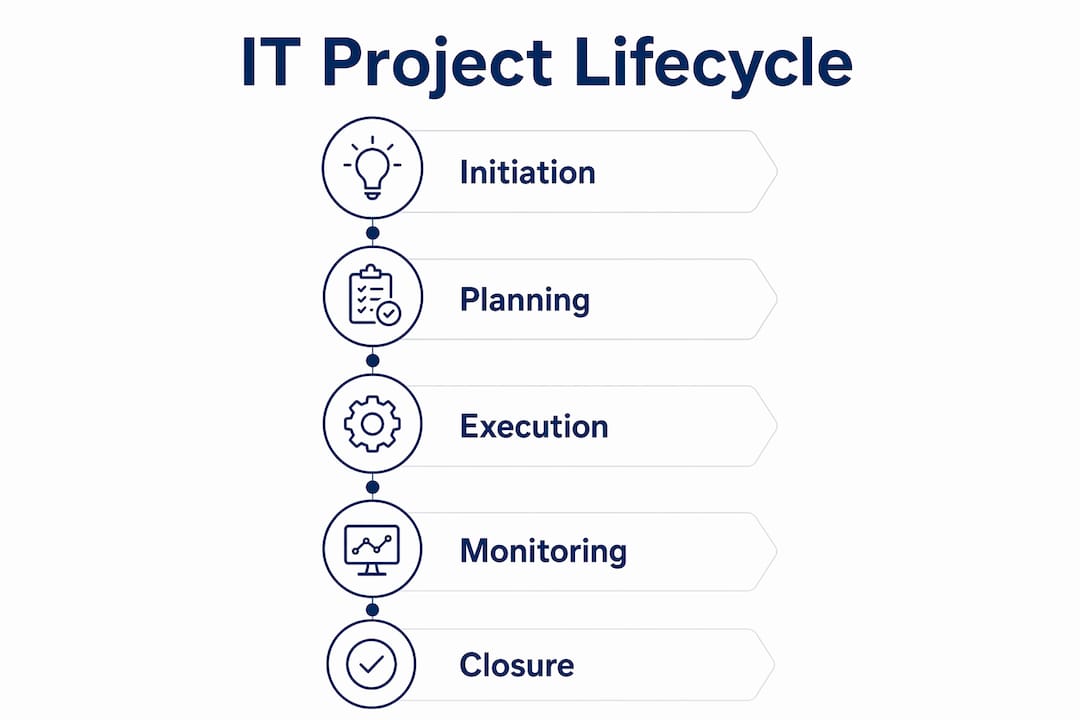
The five-phase project life cycle includes initiation, planning, execution, monitoring and controlling, and closure. Each phase produces specific deliverables and decision points that move the project forward with accountability.
1. Initiation
The initiation phase defines the project's purpose, objectives, and feasibility. In an IT context, this means producing a project charter, identifying key stakeholders, and confirming that the proposed system or solution aligns with organizational goals. A state agency modernizing a benefits processing system, for example, would use initiation to document the business case, estimate high-level costs, and secure executive sponsorship before a single line of code is written.

2. Planning
Planning translates the approved charter into a detailed roadmap. Project managers establish timelines, resource plans, budgets, risk registers, and communication protocols. For IT projects, this phase also involves selecting the development methodology, whether Agile sprints, waterfall phases, or a hybrid model. Skipping thorough planning is the single most common reason IT projects exceed budget or miss scope targets.
3. Execution
Execution is where the technical work happens. IT project execution covers system design, development, testing, and deployment. Teams build deliverables, vendors deliver components, and project managers coordinate dependencies. In a cloud migration project, execution might span several months of parallel workstreams across infrastructure, security, and application layers.
4. Monitoring and controlling
This phase runs concurrently with execution, not after it. Continuous monitoring embeds risk tracking and change management throughout delivery, which reduces expensive fixes that surface late. A project manager tracking sprint velocity, budget burn rate, and open defect counts in real time is practicing monitoring and controlling correctly.
5. Closure
Closure formalizes the end of the project. It includes final deliverable acceptance, contract closeout, lessons learned documentation, and team release. For IT projects, closure also covers deployment confirmation, handoff to operations, and post-implementation review. Skipping a structured closure phase leaves organizations without documented lessons, which compounds risk on the next project.
Pro Tip: Document lessons learned immediately after closure, not weeks later. Memory fades fast, and the institutional knowledge captured in that session directly reduces risk on your next IT project.
How do different project life cycle methodologies apply to IT projects?
Project life cycles fall into four categories: predictive, iterative, adaptive, and hybrid. The choice of life cycle affects phase sequencing and how value gets delivered to stakeholders.
| Methodology | Core approach | Best fit | Key trade-off |
|---|---|---|---|
| Predictive (Waterfall) | Sequential phases with defined scope upfront | Stable requirements, compliance-heavy projects | Low flexibility once scope is locked |
| Iterative | Repeated cycles refining deliverables over time | Projects with evolving requirements | Requires active stakeholder engagement each cycle |
| Adaptive (Agile) | Short delivery bursts driven by prioritized value | Software products with frequent change | Governance overhead if not structured properly |
| Hybrid | Phase gates for governance plus iterative delivery | Large, complex IT programs | Requires disciplined coordination between tracks |
Predictive (Waterfall) works well when requirements are stable and regulatory compliance demands full documentation before build. Federal IT procurement contracts often mandate predictive approaches because auditors need a clear paper trail from requirements through acceptance.
Iterative life cycles suit projects where the end state is known but the path to get there benefits from repeated refinement. A data analytics platform built in three-month cycles, with each cycle producing a working dashboard increment, is a practical example.
Adaptive (Agile) frameworks like Scrum and SAFe (Scaled Agile Framework) prioritize delivering working software in short sprints, typically two weeks. Requirements evolve based on stakeholder feedback, which makes Agile powerful for product development but challenging for fixed-price government contracts without careful scope management.
Hybrid approaches are increasingly the default for large public sector IT programs. Hybrid life cycles use phase gates for governance while conducting iterative deliveries, which reduces big-bang risks without abandoning structured oversight. A state agency modernizing a legacy benefits system might use a predictive framework for procurement and compliance phases while running Agile sprints inside the execution phase.
- Predictive: use when scope is fixed and regulatory documentation is mandatory
- Iterative: use when the solution needs refinement across multiple delivery cycles
- Adaptive: use when requirements will change and stakeholders can engage frequently
- Hybrid: use when governance requirements and delivery speed must coexist
Selecting the appropriate life cycle based on work nature and organizational context drives project success more than any single tool or technique. Defaulting to a methodology out of habit rather than fit is one of the most preventable causes of IT project failure.
What are best practices for managing the IT project lifecycle effectively?
Effective IT project management process execution requires more than knowing the phases. It demands deliberate practices that reduce risk and keep stakeholders aligned throughout delivery.
- Treat monitoring and controlling as continuous. Embedded risk tracking during execution reduces expensive late-stage fixes. Do not wait for a monthly status report to surface a budget variance.
- Use phase gates as real decision points. Lifecycle phase transitions are risk management mechanisms, not bureaucratic checkboxes. At each gate, confirm that objectives, budget, and scope still align before authorizing the next phase.
- Separate SDLC from project lifecycle. The software development lifecycle (SDLC) covers technical steps like requirements, design, coding, and testing. These activities occur inside the execution phase of the project lifecycle. Conflating the two leads to governance gaps where technical teams move forward without project-level authorization.
- Align phases to stakeholder communication rhythms. Initiation and planning phases are the lowest-cost moments to surface misaligned expectations. A stakeholder who disagrees with scope in week two costs far less than one who rejects deliverables in week twenty.
- Build hybrid approaches for complex programs. Large IT modernization efforts rarely fit a single methodology. Combining predictive governance with iterative delivery gives project managers the control they need without sacrificing adaptability.
Pro Tip: At every phase gate, ask one question: "If we stopped the project today, would the organization be better or worse off than when we started?" That question forces honest evaluation of sunk costs and future value.
Common pitfalls to avoid include skipping formal initiation in favor of jumping straight to planning, treating the closure phase as optional, and failing to document scope changes during execution. Each of these shortcuts creates compounding problems that surface at the worst possible moment, typically during final acceptance or post-deployment audit.
How does the IT project lifecycle interact with SDLC and Agile frameworks?
The project management life cycle wraps execution with initiation and closure steps that the SDLC does not address. SDLC focuses on technical development steps inside the execution phase, while the project lifecycle manages overall project governance. Understanding this distinction prevents a common failure mode: technically excellent teams that deliver working software but miss budget, stakeholder expectations, or compliance requirements because no one was managing the project layer.
Agile frameworks like Scrum, Kanban, and SAFe operate primarily within the execution phase of the project lifecycle. Agile influences how requirements and planning evolve during execution, but lifecycle-level governance remains necessary for alignment and formal acceptance. A Scrum team running two-week sprints still needs a project charter, a defined scope baseline, and a formal closure process to satisfy organizational and contractual requirements.
Key integration points between the project lifecycle and Agile or SDLC frameworks include:
- Sprint planning and backlog refinement occur inside the execution phase, not as replacements for project-level planning
- SDLC phases such as requirements, design, and testing map to execution deliverables, not to separate project phases
- Agile retrospectives feed lessons learned into the closure phase and into planning for subsequent iterations
- Governance checkpoints, such as architecture review boards or security assessments, align with phase gates in the project lifecycle rather than individual sprints
For IT professionals working in public sector IT modernization, the interaction between these frameworks is especially consequential. Government contracts often require predictive lifecycle documentation for compliance while the technical team runs Agile delivery. Managing both layers simultaneously, with clear ownership of each, is what separates experienced IT project managers from those still learning the hard way.
Pro Tip: Map your Agile sprint cadence to your project lifecycle phase gates explicitly. When a sprint review coincides with a phase gate, use the sprint demo as the gate artifact. This reduces documentation overhead without sacrificing governance.
Key takeaways
The IT project lifecycle is the governance structure that determines whether an IT project delivers value or drifts into scope creep, budget overrun, and stakeholder frustration.
| Point | Details |
|---|---|
| Five core phases | Initiation, planning, execution, monitoring and controlling, and closure each produce specific deliverables and decision points. |
| Methodology fit matters | Predictive, iterative, adaptive, and hybrid life cycles each suit different project contexts. Choose based on requirements stability and governance needs. |
| Monitoring is continuous | Tracking risk and change during execution, not after, is what prevents costly late-stage failures. |
| SDLC lives inside execution | The software development lifecycle covers technical steps within the execution phase. It does not replace project-level governance. |
| Phase gates reduce risk | Lifecycle transitions are decision points where scope, budget, and objectives should be revalidated before proceeding. |
Why lifecycle discipline separates good IT projects from great ones
Most IT project failures I have observed do not collapse because of bad technology. They collapse because the project governance layer was either absent or treated as an afterthought. Teams sprint forward with energy and technical skill, but without a clear initiation phase, no one has formally agreed on what "done" looks like. Without structured closure, lessons evaporate and the next project inherits the same risks.
The most underrated phase in the IT project development lifecycle is initiation. Organizations routinely compress it to save time, then spend three times as long resolving scope disputes during execution. A well-run initiation phase, where objectives, constraints, and stakeholder expectations are documented and signed off, is the single highest-return investment a project manager can make.
Hybrid methodologies deserve more credit than they typically receive. The instinct in many IT organizations is to pick a side: either full waterfall or full Agile. The reality is that managing multi-partner IT projects in complex public sector environments almost always requires both. Predictive governance satisfies auditors and contracting officers. Iterative delivery satisfies users who need working software faster than a two-year waterfall schedule allows.
The practical advice I would offer any IT project manager is this: learn the lifecycle phases cold, then learn when to flex them. The framework is not a cage. It is a map. The map does not change, but the route you take through it should reflect the specific terrain of your project.
— Randy
How Primereadysub supports IT project lifecycle execution
Primereadysub, operating as Rutledge and Associates, LLC, delivers lifecycle-aligned IT modernization for public sector prime contractors across Maryland, New York, and Florida. The firm owns clearly defined scopes within complex programs, covering everything from cloud-native re-architecting and DevOps pipeline implementation to compliance automation and real-time dashboards. Each engagement is structured around the project lifecycle phases, with defined deliverables at every stage and governance documentation that satisfies federal and state audit requirements. If your program needs a prime-ready IT modernization partner that understands both the technical execution layer and the project governance layer, Primereadysub is built for exactly that work.
FAQ
What is the IT project lifecycle?
The IT project lifecycle is the structured sequence of phases, from initiation through closure, that governs how an IT project is authorized, planned, executed, and formally completed. PMI defines it as a start-to-completion framework applicable across all project types and methodologies.
How many phases does the IT project lifecycle have?
The standard IT project lifecycle has five phases: initiation, planning, execution, monitoring and controlling, and closure. Each phase produces specific deliverables and serves as a decision point before the project advances.
What is the difference between SDLC and the IT project lifecycle?
The SDLC covers technical development steps such as requirements, design, coding, and testing, and these occur inside the execution phase of the broader project lifecycle. The project lifecycle manages overall governance, including authorization, stakeholder alignment, and formal closure.
Which lifecycle methodology is best for IT projects?
No single methodology is universally best. Predictive (waterfall) suits stable, compliance-heavy projects, while Agile suits rapidly changing requirements. Hybrid life cycles combining phase gates with iterative delivery are increasingly standard for large, complex IT programs.
Why is monitoring and controlling a separate phase?
Monitoring and controlling is treated as a continuous activity running alongside execution because embedded risk tracking during delivery catches issues when they are still cheap to fix. Treating it as a late-stage review rather than an ongoing discipline is one of the most common and costly project management mistakes.