

Public sector IT modernization projects fail at a disproportionate rate, and the cause is rarely the technology itself. The role of partners in public IT programs is frequently misunderstood, under-documented, and inconsistently applied across agencies. When roles blur, accountability disappears. Vendors overstep, internal teams disengage, and executive sponsors lose visibility into what is happening on the ground. This guide breaks down who partners are in a government modernization context, how to structure their roles using proven frameworks, and what real-world program designs actually look like when they work.
Table of Contents
- Key takeaways
- The role of partners in public IT defined
- Frameworks for clarifying partner roles
- Real-world partnership models that work
- Sustaining partnerships through the full modernization lifecycle
- My perspective on what actually breaks public IT partnerships
- How Primereadysub helps agencies build partnership structures that hold
- FAQ
Key takeaways
| Point | Details |
|---|---|
| Partners span four categories | Internal teams, vendors, oversight bodies, and community stakeholders each carry distinct responsibilities in public IT programs. |
| RASCI matrices prevent overlap | Assigning Responsible, Accountable, Supportive, Consulted, and Informed roles across every deliverable eliminates costly ambiguity. |
| Procurement design shapes partnership | Bundled contracts and phased supplier engagement reduce interface risk and align vendor incentives with agency outcomes. |
| Chargeback models scale collaboration | Pay-for-usage structures, as seen in Kansas, align financial incentives and encourage efficient service consumption across jurisdictions. |
| Governance forums sustain alignment | Monthly councils and working groups for high-influence partners keep design decisions grounded in real program feedback. |
The role of partners in public IT defined
Before any framework can be applied, decision-makers need a shared definition of what a "partner" actually means in a government IT context. The term gets applied loosely to everyone from a SaaS vendor to a legislative oversight committee, and that ambiguity is where most role confusion begins.
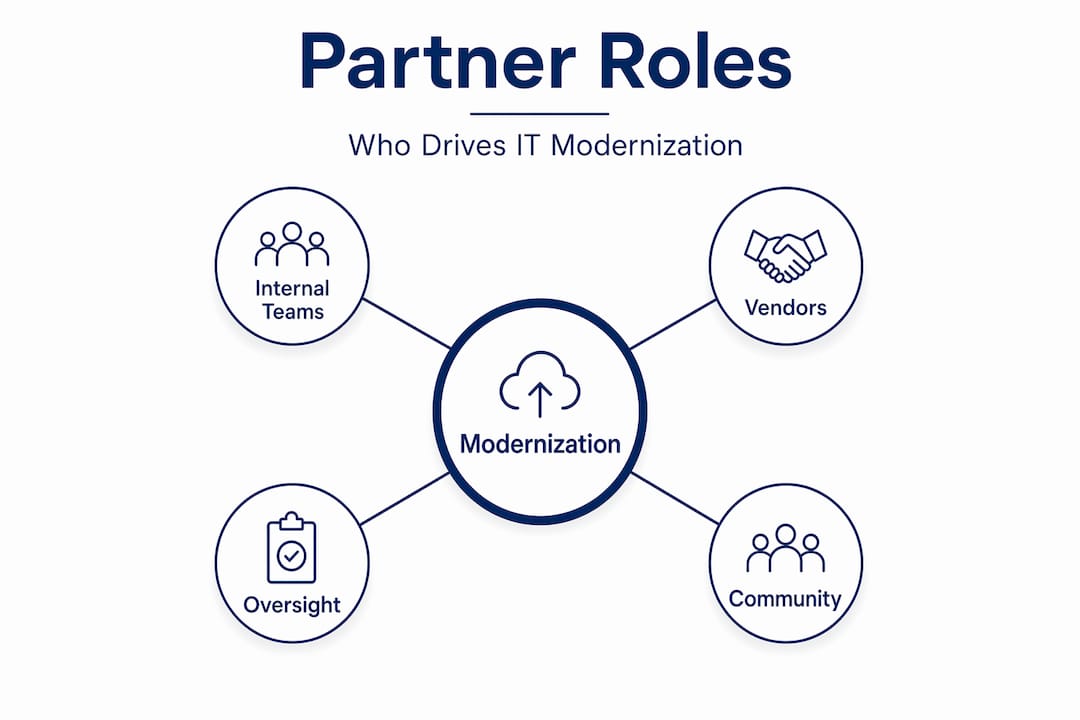
Proactive engagement of partners by influence and interest from the very start of a project is what distinguishes agencies that meet delivery milestones from those that spend months resolving governance disputes after the fact. Partners can be grouped into four categories:
- Internal agency teams: IT staff, program managers, data stewards, legal counsel, and agency leadership. These partners hold institutional knowledge and carry accountability for statutory compliance.
- External vendors and integrators: System integrators, cloud platform providers, software licensors, and subcontractors. They bring technical execution capacity but require clear scope boundaries to function without friction.
- Community and end-user stakeholders: Front-line staff, constituent-facing service workers, and in some cases the public itself. Their input shapes whether a system gets adopted or quietly abandoned after go-live.
- Oversight and governance bodies: Inspectors general, state budget offices, legislative committees, and federal oversight agencies. They may not sit in a sprint review, but their requirements shape every architectural decision.
Each category carries a different combination of influence, interest, and accountability. A vendor has high technical influence but limited institutional authority. A budget office may have low day-to-day involvement but veto power over procurement decisions. Recognizing these distinctions early prevents the classic failure mode where a technically correct solution gets blocked at the final approval gate because a key oversight stakeholder was never consulted.
The role of IT partners in government also changes across the modernization lifecycle. During discovery, vendors and internal IT staff collaborate on current-state assessments. During procurement, executive sponsors and legal teams take the lead. During implementation, integrators and program managers become the primary actors. Mapping who is active at each phase, rather than treating partnership as a static structure, is what effective public IT collaboration actually looks like in practice.
Frameworks for clarifying partner roles
Identifying partners is only the first step. The more critical task is documenting what each partner is expected to do, decide, and approve at every stage of the program. Two tools dominate this space in public sector IT: partner mapping with influence-interest matrices, and RASCI matrices.
Partner mapping and influence-interest analysis
Partner mapping is a structured exercise that plots all identified stakeholders on a grid based on their level of influence over the project and their level of interest in its outcomes. High-influence, high-interest partners such as agency CIOs and program executives require close engagement and direct communication. High-influence, low-interest partners such as budget offices need to be kept informed on key decisions without being burdened with operational detail. Low-influence, high-interest partners such as end users benefit from participatory design workshops rather than formal governance involvement.
ASTHO recommends partner mapping and RASCI matrices as the standard approach for documenting expectations and sustaining engagement across the modernization lifecycle. This is not a one-time exercise. As projects progress from discovery to deployment, influence levels shift, and the matrix needs to reflect that reality.
RASCI matrices in practice
The RASCI model extends the more familiar RACI framework by adding a fifth role: Supportive. In government IT programs where resource constraints are common and staff routinely contribute to tasks outside their primary function, the Supportive designation gives agencies a formal way to acknowledge contributing roles without creating accountability confusion.

| RASCI Role | Definition | Government IT Example |
|---|---|---|
| Responsible | Does the work | Systems integrator building the data pipeline |
| Accountable | Owns the outcome | Agency CIO signing off on go-live approval |
| Supportive | Provides resources or assistance | IT security team reviewing configurations |
| Consulted | Provides input before decisions | Legal counsel reviewing data sharing agreements |
| Informed | Receives updates after decisions | State budget office notified of milestone completions |
RACI matrices resolve ambiguity by designating single accountable owners for every deliverable, which prevents the all-too-common scenario where two parties each assume the other has final sign-off authority. In a phased modernization program, this means maintaining a living RASCI document that gets updated as roles shift between phases.
Pro Tip: Build your RASCI matrix before the procurement solicitation is finalized, not after contract award. Vendors who understand the governance structure before they bid will write more accurate project plans and price more realistically.
Real-world partnership models that work
Theory needs grounding in practice. Two examples from recent public IT programs illustrate how structured partnership approaches play out when applied at scale.
The UK Synergy Programme: bundled procurement as governance design
The UK Synergy Programme took an approach to ERP modernization that directly addressed the multi-vendor interface problem. Rather than procuring ERP and system integration through separate contracts, the program bundled procurement under one contract with a 70% quality and 30% price evaluation weighting. This deliberate weighting signals something important: in complex government IT programs, the cheapest vendor is rarely the right partner.
The Synergy approach also used phased tender and negotiation stages to validate supplier capability before final contract award. This structure is directly relevant to the role of partners in IT delivery because it forces accountability alignment before a single line of code is written. Clear interface governance between multiple vendors, established through governance checkpoints built into the contract structure, was identified as a core risk mitigation strategy.
Kansas shared services: chargeback as incentive alignment
Kansas offers a different but equally instructive model. Through Senate Bill 51, the Kansas Office of Information Technology Services was authorized to provide IT and cybersecurity services to local governments and nonprofits on a pay-for-usage basis. The chargeback model matters here because it shifts the partnership dynamic from obligation to choice.
When local entities pay for services consumed rather than a flat support fee, they become more deliberate consumers. Over-provisioned services get right-sized. Under-resourced municipalities gain access to state-level cybersecurity capability they could not otherwise afford. The chargeback model creates scalable capacity while incentivizing efficient service usage, which is a structural outcome that most partnership agreements fail to engineer by design.
Key lessons from both models for agency IT decision-makers:
- Bundle tightly coupled technical work under a single contract to prevent interface ownership gaps.
- Weight quality over price when procuring for complex, compliance-heavy modernization work.
- Use chargeback or usage-based pricing to create natural incentives for efficient service consumption.
- Integrate governance checkpoints into contract structure rather than treating them as post-award add-ons.
Pro Tip: Before a procurement is published, consider holding supplier engagement workshops as the SNAP 2.0 program did. Optional one-to-one sessions with potential vendors help validate technical approaches and surface integration risks before they become contract disputes.
Sustaining partnerships through the full modernization lifecycle
Most partnership frameworks are designed for project launch. Far fewer are built to survive the friction that emerges six to twelve months into implementation, when priorities shift, budgets tighten, and the original RASCI matrix starts collecting dust.
Sustaining effective collaboration in public sector IT partnerships requires intentional governance structures that outlast the initial enthusiasm of program kickoff. ASTHO's guidance on data modernization identifies monthly governance councils for high-influence, high-interest partners as a critical mechanism for keeping design and implementation decisions grounded in ongoing stakeholder input.
The following practices help agencies maintain partnership health across the full modernization lifecycle:
- Establish tiered communication cadences. High-influence partners need monthly structured forums. Medium-influence partners need quarterly briefings. Low-influence, high-interest partners such as front-line users need periodic feedback loops tied to sprint releases, not just final go-live events.
- Maintain a living RASCI matrix. Every change request, scope addition, or vendor substitution should trigger a RASCI review. This keeps accountability current and prevents role drift from compounding into governance breakdown.
- Define escalation paths explicitly. When a vendor misses a milestone or an agency team lacks capacity to complete their designated responsibilities, the escalation path should be documented in the governance plan, not improvised under pressure.
- Conduct formal partnership health reviews. At each phase gate, assess not just technical progress but relationship quality. Are vendors surfacing risks early? Are internal teams engaged or disengaged? Are oversight bodies receiving the information they need to make timely decisions?
- Adapt roles proactively. The role of stakeholders in IT programs is not fixed. A vendor who was primarily "Responsible" during build becomes primarily "Consulted" during stabilization. Failing to update role expectations after go-live is one of the most common sources of post-deployment conflict.
The role of public-private IT partnerships in government works best when agencies treat governance as a living system rather than a document produced once at project inception and filed away.
My perspective on what actually breaks public IT partnerships
I've watched well-resourced modernization programs stall not because the cloud architecture was wrong or the vendor was incompetent, but because nobody could answer a simple question: who has final sign-off authority on the data migration plan?
In my experience, technology is almost never the limiting factor in public IT programs. Clarity is. Specifically, the absence of clarity about who owns what decision at which moment in the program. The RASCI matrix sounds bureaucratic until you're on week 14 of a go-live delay caused by three parties each waiting for the others to approve a test result.
What I've learned from working in this space is that the agencies with the best outcomes invest in governance design before they invest in any technology. They run partner mapping exercises before the RFP drops. They define escalation paths before they need them. They treat supplier relationships as structured collaborations with documented mutual obligations rather than transactional arrangements governed only by contract terms.
The uncomfortable truth about public sector IT partnerships is that most of the hard work happens before any code is written. Agencies that rush to implementation without establishing role clarity end up spending twice as long fixing the confusion that results. Proactive governance design is not overhead. It is the project.
— Randy
How Primereadysub helps agencies build partnership structures that hold
Agencies managing complex IT modernization programs need partners who arrive with clearly defined scopes, documented delivery frameworks, and the technical depth to execute without requiring constant oversight. Primereadysub, the public sector practice of Rutledge & Associates, LLC, is built specifically for this role.
The firm supports prime contractors and agency leads with outcome-driven modernization services including partner mapping facilitation, DevOps pipeline delivery, compliance automation, and real-time program dashboards. Every engagement is structured around a defined scope, not staff augmentation, which means agencies get clear accountability built into the relationship from day one.
Primereadysub has supported public sector clients in Maryland, New York, and Florida, with demonstrated results in audit readiness, processing time reduction, and program visibility. For prime contractors working on compliance-heavy programs who need a subcontractor that owns their lane and delivers, explore partnership options to see how the firm positions itself within multi-vendor program structures.
FAQ
What is the role of partners in public IT modernization?
Partners in public IT modernization include internal agency teams, vendors, oversight bodies, and end users. Each carries distinct responsibilities across technical execution, governance, and compliance, and their roles must be clearly defined and documented to prevent delays.
How does a RASCI matrix improve IT partnership outcomes?
A RASCI matrix assigns five roles — Responsible, Accountable, Supportive, Consulted, and Informed — to every deliverable, eliminating ambiguity about who owns decisions. RASCI matrices resolve ambiguity by designating single accountable owners, which directly reduces approval delays and scope disputes.
What is a shared services model in public IT?
A shared services model allows a central government entity to provide IT capabilities to multiple agencies or jurisdictions, often on a pay-for-usage basis. The Kansas OITS model allows local entities to pay based on consumption, improving cost transparency and access to enterprise-grade cybersecurity.
When should agencies conduct partner mapping?
Partner mapping should be conducted before a procurement solicitation is finalized. Identifying partners by influence and interest before RFP release allows agencies to design governance structures and communication plans that reflect real stakeholder dynamics from the start.
How do agencies sustain effective partnerships long-term?
Agencies sustain partnerships by maintaining living RASCI documents, running tiered governance councils, defining formal escalation paths, and conducting partnership health reviews at each phase gate. Governance structures need to evolve as program phases change, not remain fixed from project kickoff.