

What federal contract compliance requires from IT modernization managers
Federal contract compliance, in the context of IT modernization, means satisfying a layered set of security, privacy, documentation, and reporting obligations that govern how contractors build, operate, and maintain government information systems. For public sector IT managers, the core reference point is the GAO's Federal Information System Controls Audit Manual (FISCAM), which outlines specific control objectives auditors use when evaluating planning, testing, and reporting across federal IT programs.
The priorities every IT modernization manager must address:
- Security control adherence: Implement controls aligned with NIST SP 800-53 and the NIST Risk Management Framework, covering system categorization, control selection, and continuous monitoring.
- Audit readiness: Maintain living documentation, including a Plan of Action and Milestones (POA&M), that tracks unresolved findings and demonstrates ongoing remediation.
- Automated compliance tracking: Move beyond manual evidence collection toward automated control testing and real-time status dashboards.
- Incident reporting obligations: Know the agency-specific timelines; GSA contracts, for instance, require rapid cyber incident reporting upon discovery.
- Management commitment: Senior leadership must actively govern the compliance program, not delegate it entirely to technical staff.
Understanding what contract compliance demands at the foundational level is the starting point before any automation or audit strategy takes shape.
Table of Contents
- Core regulations that govern federal IT modernization contracts
- Why senior management commitment determines compliance outcomes
- How compliance automation scales federal contract adherence
- Best practices for maintaining audit readiness across the contract lifecycle
- How compliance teams should be structured and who owns what
- Ongoing training and communication strategies that keep compliance current
- Integrating compliance processes with IT modernization initiatives
- Recent regulatory updates IT modernization managers need to know
- Key Takeaways
Core regulations that govern federal IT modernization contracts
Federal IT modernization contracts sit at the intersection of acquisition law, cybersecurity mandates, and privacy requirements. The regulatory stack is dense, but several instruments carry the most weight for day-to-day compliance management.
- FISMA and Executive Order 13556: Contractors must comply with the Federal Information Security Modernization Act and layered security and privacy mandates, including requirements for Controlled Unclassified Information (CUI) handling.
- NIST SP 800-53 and SP 800-171 Rev 3: These publications define the control baselines. The GSA IT Security Procedural Guide enforces SP 800-171 Rev 3 and identifies nine "showstopper" controls that must be implemented without exception.
- DFARS business system requirements: Defense contractors face additional scrutiny under the Defense Federal Acquisition Regulation Supplement, which mandates compliant accounting, estimating, and material management systems.
- FAR Part 39 and agency supplements: Acquisition of IT systems must incorporate security policies, FedRAMP authorization for cloud services, Section 508 accessibility standards, and NIST FIPS-validated cryptography.
- Privacy Act and PII protections: Contracts involving personally identifiable information require specific clauses, agency rules of conduct, and documented risk management procedures throughout the system development lifecycle.
- Records management: Contractors handling federal records must comply with NARA regulations and preserve all records regardless of format, with unauthorized disclosures reported to the contracting officer within two hours.
Across agencies, common compliance threads include rapid cyber incident response, standardized cryptography, and personnel background investigations. Building an agency-agnostic framework around these shared elements reduces duplication and scales more efficiently across multiple contracts.
Why senior management commitment determines compliance outcomes
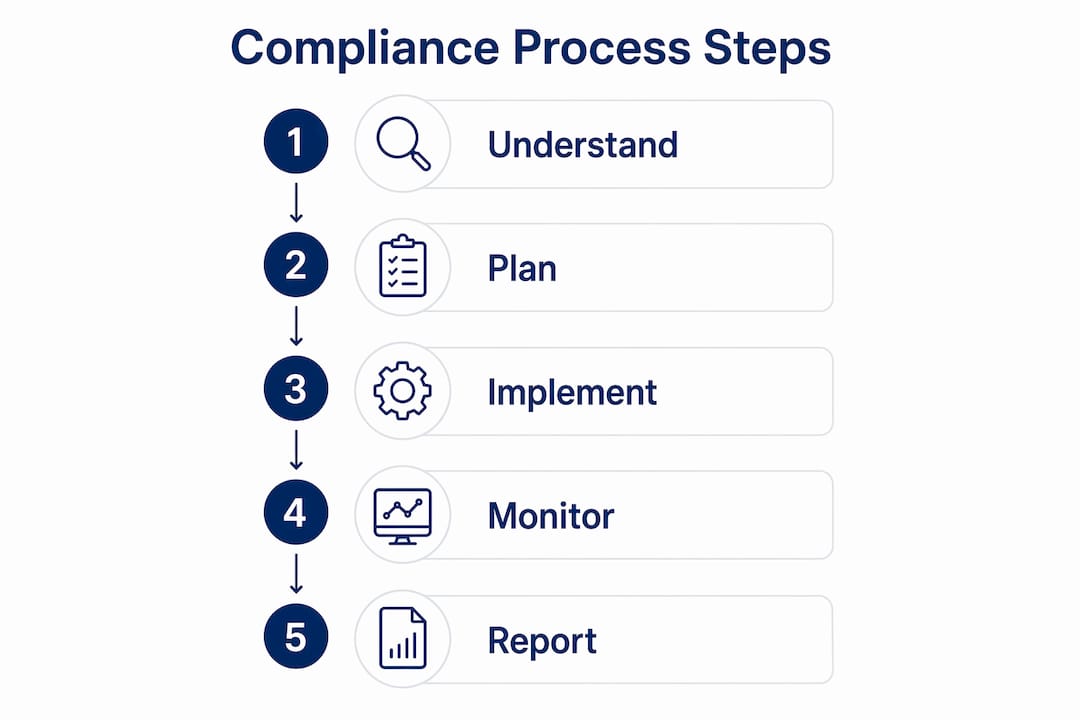
Active leadership involvement is not a soft organizational preference. The GAO's audit standards are explicit: management's proactive engagement in an integrated information security program is fundamental to enterprise-wide compliance and risk mitigation. When leadership treats compliance as a technical checkbox rather than a governance priority, control structures weaken and audit findings multiply.
Pro Tip: Establish a formal compliance steering committee that includes the CIO, program managers, and legal counsel. Meeting quarterly is the minimum; monthly is better during active modernization phases.
Practically, management commitment translates into three concrete actions. First, leadership must allocate sufficient budget and staffing for compliance functions, not treat them as overhead to minimize. Second, executives must establish clear accountability channels so that compliance findings escalate to decision-makers who can authorize remediation resources. Third, they must communicate compliance expectations consistently across the organization, making it clear that audit readiness is a shared responsibility, not solely an IT security function.

How compliance automation scales federal contract adherence
Automation changes the economics of federal contract compliance. Manual evidence collection is slow, error-prone, and difficult to scale across multiple agency contracts. Automated compliance frameworks address this by continuously testing controls, generating audit-ready evidence, and surfacing risk indicators in real time.
Key automation capabilities that matter for IT modernization programs:
- Continuous control monitoring: Automated tools scan system configurations against NIST baselines on a scheduled or event-triggered basis, flagging deviations before they become audit findings.
- Computer Assisted Audit Techniques (CAATs): DFARS business system audits increasingly expect electronic evidence validated through CAATs, not just manual documentation packages.
- POA&M automation: Tracking unresolved findings manually across large programs is unsustainable. Automated POA&M management tools link findings to remediation owners, deadlines, and status updates.
- Real-time dashboards: Program visibility dashboards give managers an accurate picture of compliance posture without waiting for quarterly reviews.
- Evidence packaging: Automated systems can compile and format audit evidence packages, reducing the time compliance teams spend preparing for assessments.
Primereadysub, operating as Rutledge & Associates, LLC, builds these capabilities directly into its IT modernization engagements. The firm's DevOps pipelines and compliance automation architecture are designed so that audit evidence is a byproduct of normal operations, not a separate effort that consumes resources before every review.
Pro Tip: Integrate compliance checks into your CI/CD pipeline from the start of a modernization project. Retrofitting controls after deployment is significantly more expensive and disruptive than building them in at the architecture stage.
Best practices for maintaining audit readiness across the contract lifecycle
Audit readiness is not a state you achieve once. It is a continuous operational discipline that must be embedded into how the program runs day to day. The Authority to Operate (ATO) process is cyclical, requiring ongoing documentation updates and active management of security findings throughout system operation.
Practical strategies for sustained audit readiness:
- Living POA&M management: Treat the POA&M as an operational document, updated continuously rather than refreshed only before audits. Authorities expect it to reflect current, unresolved findings accurately.
- Continuous monitoring alignment: Map your monitoring activities to the NIST Risk Management Framework's monitoring phase, ensuring coverage of all selected controls.
- Incident response documentation: Maintain documented procedures for cyber incidents, including the specific reporting timelines your contracts require. GSA contracts mandate one-hour reporting; other agencies may differ.
- Third-party assessments: Independent assessments validate that controls work as documented, not just as designed. Schedule these proactively rather than waiting for agency-directed reviews.
- Common compliance pitfalls to avoid: Letting POA&M items age without remediation, failing to update system security plans after configuration changes, and treating FedRAMP authorization as a one-time event rather than an ongoing obligation.
Pro Tip: Run internal tabletop exercises simulating an audit notification. Teams that have rehearsed the evidence-gathering process respond faster and with fewer gaps when a real audit begins.
How compliance teams should be structured and who owns what
A functional compliance team for a federal IT modernization program typically spans four distinct roles, each with defined ownership.
The Compliance Program Manager owns the overall compliance posture, maintains the POA&M, coordinates with the contracting officer's representative, and escalates unresolved findings to senior leadership. This role requires both technical literacy and contract knowledge.
The IT Security Officer is responsible for control implementation, continuous monitoring operations, and incident response. In programs subject to DFARS, this person also manages the documentation that auditors from the Defense Contract Audit Agency (DCAA) will review.
Control Owners are the technical staff responsible for specific control families, such as access management, configuration management, or audit logging. They produce the evidence that feeds into compliance assessments and respond to auditor inquiries within their domain.
The Legal and Contracts Advisor reviews contract clauses for compliance flowdowns, monitors regulatory changes, and advises on obligations under FISMA, the Privacy Act, and agency-specific supplements. For public sector IT teams, having this role engaged from the proposal stage prevents costly surprises after award.
Ongoing training and communication strategies that keep compliance current
Compliance knowledge degrades quickly in a regulatory environment that updates as frequently as federal IT contracting does. Training cannot be a one-time onboarding event.
Role-based training is more effective than generic compliance awareness programs. Control owners need technical training on the specific NIST control families they manage. Program managers need training on contract clause interpretation and audit procedures. All staff with system access need annual security awareness training, which is a contractual requirement under most federal IT contracts.
Communication cadence matters as much as content. Monthly compliance status briefings to program leadership, combined with a shared compliance dashboard, keep the entire team aware of open findings and approaching deadlines. When a regulatory update occurs, such as a new GSA procedural guide revision or a CISA directive, a structured change notification process prevents the update from being missed by the teams it affects most.
Integrating compliance processes with IT modernization initiatives
Compliance and modernization are often treated as competing priorities. They do not have to be. The most effective approach embeds compliance requirements into the modernization architecture from the outset, so that security controls, audit logging, and documentation are built into the system rather than layered on afterward.
DevSecOps practices accomplish this by incorporating security testing and compliance validation into every stage of the development pipeline. Infrastructure-as-code tools allow control configurations to be version-controlled and audited automatically. When a system configuration changes, the compliance record updates in parallel.
For managers overseeing legacy system migrations, the NIST Risk Management Framework provides a structured path: categorize the system, select appropriate controls for the new architecture, implement and document them, and obtain authorization before going live. This sequence aligns modernization milestones with compliance checkpoints, making the ATO process a natural part of the project plan rather than a separate track. Primereadysub structures its modernization engagements around this integration model, delivering systems that are audit-ready at deployment.
Recent regulatory updates IT modernization managers need to know
Several significant changes have taken effect or been finalized recently that directly affect federal IT contractors.
The GSA IT Security Procedural Guide (revised January 2025) now enforces NIST SP 800-171 Rev 3 and requires contractors to implement nine specific "showstopper" controls. It also mandates independent third-party assessments and sets a one-hour cyber incident reporting window, a significantly tighter timeline than many contractors previously operated under.
NIST SP 800-171 Rev 3 itself introduced structural changes to the control families, adding new requirements around supply chain risk management and organization-defined parameters that give agencies more flexibility to tailor requirements. Contractors should review their existing system security plans against the Rev 3 control baseline to identify gaps.
The FAR Part 39 framework continues to require that all IT acquisitions incorporate FedRAMP-authorized cloud services where applicable, with validated NIST FIPS 140-2 cryptography for data in transit. Agencies are increasingly enforcing this requirement at the task order level, not just at the base contract.
For defense contractors, DCAA's audit approach continues to emphasize automated IT control testing. Manual documentation packages alone are no longer sufficient to satisfy auditors; electronic evidence validated through CAATs is expected as a standard part of DFARS business system compliance.
Key Takeaways
Federal contract compliance for IT modernization managers requires continuous, automated, and leadership-backed processes aligned with FISCAM, NIST, and agency-specific mandates to sustain audit readiness across the full contract lifecycle.
| Point | Details |
|---|---|
| FISCAM sets the audit baseline | GAO's Federal Information System Controls Audit Manual defines the control objectives auditors apply to federal IT programs. |
| Automation replaces manual evidence | CAATs and continuous monitoring tools are now expected by DCAA and GSA auditors, not optional supplements. |
| POA&M must stay current | Authorities expect a living POA&M that reflects unresolved findings in real time, not a document refreshed before audits. |
| Management drives compliance culture | GAO standards identify senior leadership engagement as fundamental to enterprise-wide risk mitigation and control robustness. |
| GSA's one-hour reporting rule is active | The January 2025 GSA procedural guide requires cyber incident reporting within one hour, a critical timeline for contract compliance teams. |
Primereadysub (Rutledge & Associates, LLC) delivers compliance automation and IT modernization services purpose-built for public sector programs. As an SDVOSB, woman-owned, and SBA-certified firm, the company brings credentialed expertise to compliance-heavy contracts in Maryland, New York, and Florida. Learn more about the firm's IT modernization capabilities and how its outcome-focused approach supports audit readiness from day one.