

A contract-ready team is defined as a compliant, structured group of personnel that meets public sector procurement standards and can perform on a government technology contract from day one. Knowing how to build contract-ready teams is the difference between winning an award and watching it go to a competitor who did the paperwork right. The Federal Acquisition Regulation, specifically FAR 19.702, and SBA subcontracting rules set hard limits on how work is divided between prime contractors and subcontractors. This article covers the compliance requirements, teaming structures, hiring processes, and governance practices that public sector project managers and procurement officers need to get this right.
What are the critical compliance requirements for contract-ready teams?
The FAR 19.702 "50% rule" is the foundational constraint every prime contractor must satisfy. Under this rule, prime contractors must perform at least 50% of the personnel costs on service contracts using their own employees. Failure to meet this threshold triggers compliance findings that can disqualify a firm from future small business set-aside contracts. That consequence is not theoretical. It has ended otherwise competitive firms' access to entire contract vehicles.
SBA affiliation rules add a second layer of risk. The "ostensible subcontractor" doctrine holds that if a subcontractor performs the primary and vital requirements of a contract, the SBA may treat that subcontractor as the actual prime. This finding collapses the size status of the prime and can void the award entirely.
Three compliance requirements shape how project managers must structure their teams:
- FAR 19.702 personnel cost threshold. The prime must own the majority of direct labor costs. Subcontractors fill specialized or surge roles, not core delivery roles.
- SBA ostensible subcontractor rule. Work division must reflect genuine prime control. The prime must manage the project, hold key personnel slots, and direct the work.
- CMMC and DFARS data handling. All teaming partners must be CUI-compliant before exchanging sensitive data. Non-compliance disqualifies proposals and risks contract termination after award.
Compliance is not a proposal-phase checkbox. It is a contract-execution reality. Teams that structure workshare correctly at the teaming stage avoid the costly restructuring that derails delivery after award.
The practical implication is clear. Project managers must map every role to a specific performer, assign a personnel cost percentage to each, and verify that the prime's share clears 50% before the proposal goes out the door.
How to structure teaming agreements and partnerships
Teaming agreements are the legal backbone of contract-ready team assembly. A teaming agreement that lacks a specific solicitation reference is a liability, not an asset. Vague or open-ended agreements cause post-award disputes and create SBA affiliation risks that can unravel the entire award.
The table below compares the two primary partnership structures public sector project managers use when assembling compliant teams.
| Structure | Best use case | Workshare control | SBA affiliation risk |
|---|---|---|---|
| Prime-subcontractor | One firm holds the contract; sub performs defined scope | Prime retains full control | Low if workshare is documented |
| Joint venture (SBA-approved) | Two firms share award eligibility and delivery | Split by JV agreement | Managed through SBA rules |
Effective teaming agreements define three things explicitly: the specific solicitation they cover, the workshare percentage each party performs, and the deliverables each party owns. Percentages must align with FAR 19.702 before the agreement is signed. Adjusting them after award is far more difficult and creates audit exposure.

Hybrid workforce models that combine permanent staff for core knowledge with contractors for specialized surge needs produce the best compliance outcomes. Permanent staff anchor the prime's personnel cost percentage. Contractors fill capability gaps without threatening the 50% threshold.
Pro Tip: Begin teaming discussions during the capture phase, well before the RFP drops. Early capture-phase teaming gives both parties time to vet each other, align on scope, and sign agreements that reflect realistic workshare before deadline pressure sets in.
For a detailed walkthrough of structuring compliant agreements, the government IT teaming guide from Primereadysub covers solicitation-specific agreement structures and workshare documentation in depth.
Step-by-step guide to hiring and onboarding contract personnel
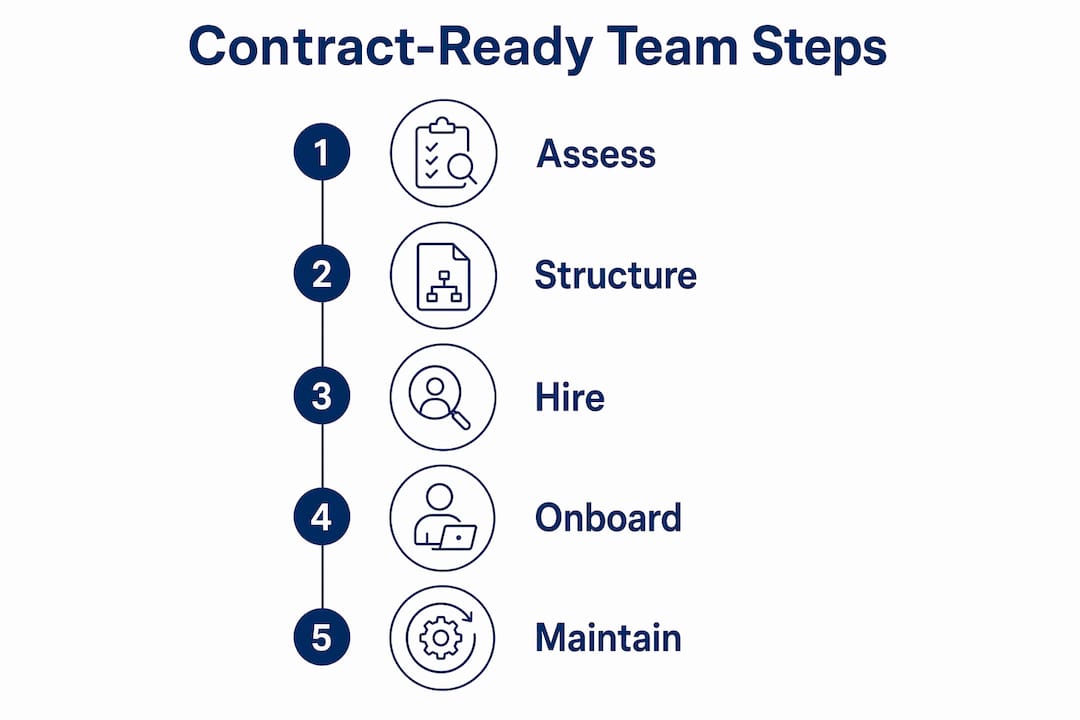
Assembling a contract team efficiently requires a defined process, not ad hoc recruiting. Ambiguous role scopes are the single biggest cause of slow onboarding and poor contractor performance. The steps below address each stage from role definition through full productivity.
-
Define the role with a one-page brief. Specify what "done" looks like for every deliverable. A one-page role brief that defines clear scope and outcomes can reduce contractor onboarding time from 3–4 weeks to less than 2 weeks. Ambiguity costs time and money at every stage.
-
Use pre-approved Master Service Agreements. Standardized MSAs and Statement of Work templates reduce IT staffing contract execution time from 3 weeks to 3–5 days. Every week saved in contracting is a week gained in delivery.
-
Vet candidates with scenario-based assessments. Generic interviews do not reveal how a contractor performs under government compliance constraints. Present candidates with realistic scenarios drawn from the actual contract environment, such as a data handling question tied to DFARS or a timeline question tied to a specific milestone.
-
Stage the onboarding process. Week one covers access, tools, and security clearance requirements. Week two covers the contract scope, reporting structure, and key personnel relationships. Staged onboarding prevents information overload and accelerates time to contribution.
-
Assign an internal lead for every contracted role. Contractors without a named internal counterpart default to working in isolation. The internal lead owns accountability for the contractor's output and serves as the compliance checkpoint between the contractor and the prime's delivery obligations.
Pro Tip: Maintain a pre-qualified contractor pool organized by skill category and clearance level. When a new contract award comes in, you draw from a vetted list rather than starting a search from scratch. This cuts sourcing time significantly and keeps your team assembly process repeatable.
How to maintain proposal readiness and contract compliance over time
Compliance does not end at award. The practices that protect a team's eligibility and performance record must continue through every phase of contract execution.
Key practices for sustained compliance include:
- Monitor workshare continuously. Track actual personnel costs against the FAR 19.702 threshold monthly, not quarterly. Drift happens gradually. Catching it early allows correction before it becomes an audit finding.
- Maintain a key personnel commitment matrix. Linking each resume bullet to RFP requirements and holding signed commitment letters allows rapid, compliant substitution when personnel changes occur. This practice directly mitigates the most common source of contract compliance risk.
- Document flow-down clause compliance. Tracking every applicable FAR clause into subcontracts from the start prevents costly audit failures. Flow-down compliance is complex, and the cost of missing a clause compounds over the contract period.
- Build slack time into proposal phases. High-performing proposal teams allocate 10–20% slack time for key personnel during proposal preparation. This practice improves on-time submission rates and proposal quality without burning out the people the contract depends on.
- Use formal team charters for Integrated Product Teams. IPTs require formal charters with defined decision rights and escalation paths. Without this structure, teams default to informal habits that create friction and slow delivery.
The proposal compliance process guide from Primereadysub provides a structured framework for managing these requirements across the full contract lifecycle, including substitution planning and subcontract reporting.
Key Takeaways
Building contract-ready teams requires documented workshare, solicitation-specific teaming agreements, and continuous compliance monitoring from capture through contract close.
| Point | Details |
|---|---|
| FAR 19.702 is non-negotiable | Prime contractors must cover at least 50% of personnel costs or risk disqualification from set-aside contracts. |
| Teaming agreements must be specific | Tie every agreement to a named solicitation with explicit workshare percentages to avoid SBA affiliation findings. |
| Role clarity accelerates onboarding | A one-page role brief with defined deliverables cuts contractor onboarding time from weeks to days. |
| Compliance is an ongoing practice | Monitor workshare monthly and maintain key personnel commitment letters throughout contract execution. |
| Slack time protects proposal quality | Allocating 10–20% buffer time for key personnel during proposal phases improves submission quality and reduces burnout. |
What I have learned building compliant teams in the public sector
The most common mistake I see project managers make is treating the teaming agreement as a formality. They sign a broad agreement with a partner early in the relationship, then try to retrofit it to a specific solicitation when the RFP drops. By that point, the workshare percentages are wrong, the partner's capabilities do not align with the actual requirements, and there is no time to fix either problem cleanly.
The second mistake is hiring contractors before the role scope is written. I have watched teams spend three weeks onboarding a contractor who spent the first month asking what they were supposed to deliver. That is not a contractor problem. That is a scope problem, and it is entirely preventable.
What actually works is treating team assembly as a program in itself. Start the partner vetting process during capture. Write role briefs before you post positions. Build your MSA templates before you need them. The teams that perform best on government IT contracts are not the ones with the most talented individuals. They are the ones with the clearest structure, the most documented compliance, and the least ambiguity about who owns what.
Proposal readiness is the other area where I see teams underinvest. Burning out your key personnel on a proposal means they start the contract exhausted. The 10–20% slack time rule is not a luxury. It is a delivery risk management practice. The contract-ready partnership guide from Primereadysub captures several of the governance practices I consider non-negotiable for teams that want to perform consistently across multiple awards.
— Randy
Primereadysub's approach to public sector IT team readiness
Primereadysub, operating as Rutledge & Associates, LLC, works with prime contractors and public sector agencies in Maryland, New York, and Florida to build and manage compliant IT modernization teams. The firm holds SDVOSB, woman-owned, and SBA certifications, and specializes in clearly defined scopes rather than staff augmentation. That distinction matters: Primereadysub owns deliverables, not headcount. Project managers working on compliance-heavy programs can engage Primereadysub as a subcontractor that brings its own governance, compliance documentation, and delivery structure. For teams that need a proven IT modernization partner without the overhead of building every compliance function internally, Primereadysub provides a ready-made model.
FAQ
What is the FAR 19.702 rule for contract-ready teams?
FAR 19.702 requires prime contractors on service contracts to perform at least 50% of personnel costs using their own employees. Failure to meet this threshold can disqualify a firm from small business set-aside contracts.
How specific does a teaming agreement need to be?
A teaming agreement must reference a specific solicitation and define workshare percentages for each party. Open-ended agreements create SBA affiliation risks and post-award performance disputes.
How long does contractor onboarding take in government IT projects?
Without a defined role brief, onboarding typically takes 3–4 weeks. A one-page brief that specifies deliverables and scope can reduce that to less than 2 weeks.
What is the ostensible subcontractor rule?
The SBA's ostensible subcontractor doctrine treats a subcontractor as the de facto prime if it performs the primary and vital requirements of the contract. This finding can void the award and collapse the prime's small business size status.
How do you maintain compliance after contract award?
Track actual workshare against FAR thresholds monthly, maintain signed key personnel commitment letters, and document all flow-down clause compliance in subcontracts from the start of performance.