

The process for proposal compliance is defined as the systematic mapping, tracking, and verification of every requirement in a government RFP against your proposal response to guarantee full adherence before submission. For contract managers and proposal coordinators handling public-sector technology contracts, this process determines whether a bid survives initial evaluation or gets disqualified on procedural grounds. The industry standard term for the central tool in this process is the compliance matrix, and it functions as the internal mirror of the government evaluator's scoring checklist. Tools like compliance matrices, proposal checklists, and structured review gates (Pink, Red, and Gold) form the backbone of any defensible compliance workflow. Software platforms such as Vercor and Loopio have further formalized these methods in 2026, reducing the time and error rate associated with manual extraction.
What does the process for proposal compliance actually require?
A compliance matrix is a structured document that maps every RFP requirement to a specific section of your proposal, assigns an owner, and tracks completion status. It is not a summary document. It is a live management tool that governs the entire proposal lifecycle from kickoff to final submission. The compliance matrix functions as an internal mirror of government evaluators' checklists under FAR Part 15, meaning it aligns your response directly with the scoring metrics evaluators apply. Teams that treat it as a static artifact produced at the end of the process consistently miss requirements that cost them the award.

The distinction between a compliance matrix and a proposal checklist is worth clarifying early. The matrix versus checklist distinction is this: the matrix handles granular, requirement-level tracking throughout development, while the checklist serves as a high-level final submission control. Both tools are necessary, and neither replaces the other. Using only a checklist is like using a summary to replace the source document.
The seven-column minimum for federal matrices
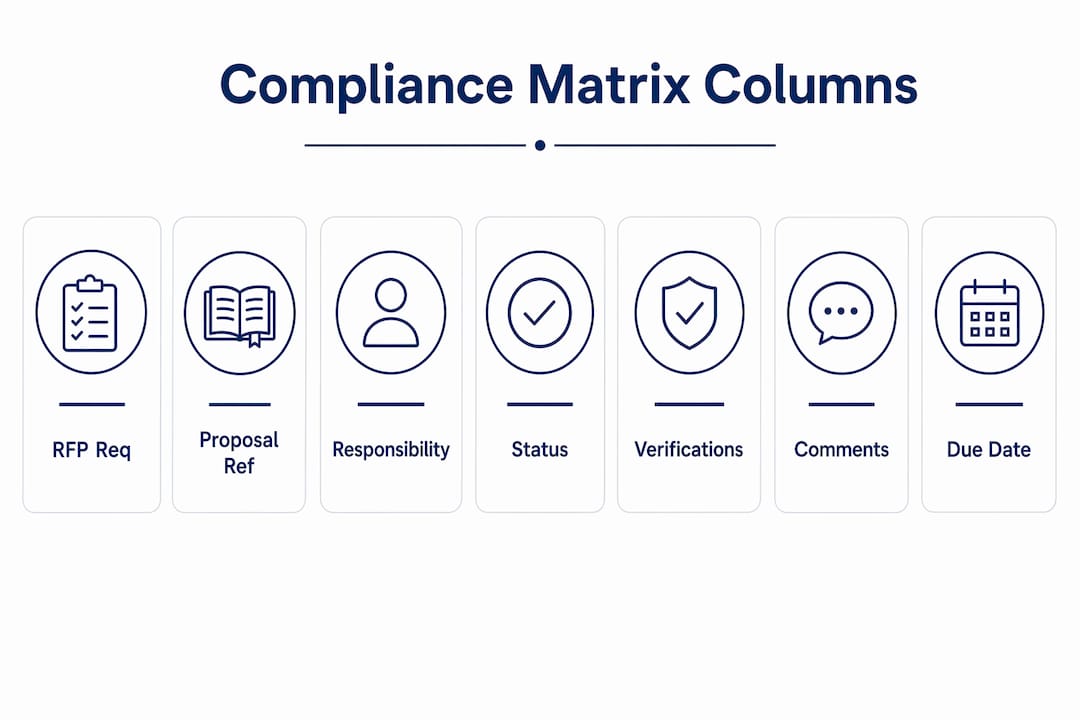
Federal compliance matrices require seven minimum columns to function as a project management and quality control tool: Requirement ID, RFP Source, Requirement Text, Owner, Compliance Status, Proposal Section Reference, and Notes/Comments. Each column serves a distinct purpose. Requirement Text must contain verbatim language from the RFP, not paraphrased summaries. Paraphrasing introduces interpretation errors that evaluators will catch and you will not. The Notes/Comments column is where you document partial compliance, risk flags, or open questions, and it is the column most teams leave empty until it is too late.
Pro Tip: Add an eighth column labeled "Ghost Requirement Flag" to capture implied obligations that appear in Section H, Section J attachments, or amendment language. These are requirements that exist without explicit "shall" or "must" language, and they are the most common source of compliance gaps in technology bids.
How to extract and categorize all RFP requirements efficiently
Systematic requirement extraction is the step that separates teams who build accurate matrices from teams who think they have. The goal is to capture every obligation in the RFP, including those buried in attachments, amendments, and formatting instructions, before a single word of proposal text is written. Structured extraction using section mapping and keyword scanning can cut matrix creation from several days to under two hours. That time savings is not trivial on a proposal with a 30-day turnaround.
The extraction process follows four steps:
-
Section inventory. Catalog every section of the RFP before extracting anything. For federal solicitations, this means Sections C (Statement of Work), L (Instructions to Offerors), M (Evaluation Criteria), J (Attachments), H (Special Contract Requirements), and all issued amendments. Each section type generates different categories of requirements. Section L governs how you submit; Section M governs how you are scored. Both are mandatory compliance targets.
-
Keyword extraction. Scan each section for obligation language: "shall," "must," "will," "is required to," and "offeror shall." Do not stop there. The keyword trap of scanning only for "shall" and "must" is a documented failure mode. Formatting rules, page limits, font specifications, and submission mechanics in Section L carry the same compliance weight as technical requirements in Section C.
-
Deduplication and conflict resolution. The same requirement often appears in multiple sections with slightly different wording. Log both instances, flag the conflict, and resolve it before writing begins. Contradictory requirements are common in large federal technology solicitations, and the safest approach is to address both interpretations explicitly in your response.
-
Status assignment. Assign each extracted requirement an initial status: Not Started, In Progress, Draft Complete, Reviewed, or Final. This transforms the matrix from a static list into a living project tracker from day one.
Pro Tip: When working with solicitations that have multiple amendments, create a separate amendment log tab in your matrix file. Track the amendment number, the requirement it modifies, and the date it was incorporated. Evaluators have flagged proposals that responded to superseded requirements as non-compliant, even when the substantive response was strong.
How should ownership, tracking, and compliance reviews be structured?
Assigning ownership is the step that converts a compliance matrix from a document into an accountability system. Every requirement row in the matrix must carry the name of a specific subject matter expert (SME) or writer, not a team or department. Vague ownership produces vague accountability, and vague accountability produces missed requirements at submission time. Status labels (Not Started, In Progress, Draft Complete, Reviewed, Final) combined with a risk level column (High, Medium, Low) allow the proposal manager to prioritize attention where it matters most.
Structured review gates formalize compliance verification at three points in the proposal lifecycle:
-
Pink Team review occurs early, typically after the first draft of major sections. Its compliance role is to verify that the matrix is complete, that every requirement has an owner, and that the proposal outline maps to the matrix structure. Pink Team is not a writing quality review. It is a structural compliance check.
-
Red Team review occurs at the near-final draft stage. The Pink, Red, and Gold reviews are three mandatory review gates for compliance assurance, with Red Team focused on whether the proposal actually responds to each requirement with sufficient specificity and evidence. Red Team reviewers should work from the matrix, not from the proposal alone.
-
Gold Team review is the final compliance gate before submission. Gold Team confirms that every matrix row is marked Final, that the proposal text cross-references the correct sections, and that no last-minute edits have introduced new gaps. Gold Team should include at least one reviewer who was not involved in writing the proposal.
Version control is a non-negotiable discipline throughout this process. Every time the government issues an amendment, the matrix must be updated before any further writing occurs. Teams that update the proposal text without first updating the matrix lose the ability to track what changed and why.
Pro Tip: Use color coding in the matrix status column: red for Not Started, yellow for In Progress, and green for Final. A single glance at the matrix should tell the proposal manager the overall compliance health of the bid without reading a single row.
Final-stage triangulation is the last compliance check before the package ships. Three-way crosschecks compare the compliance matrix against the RFP text, the compliance matrix against the submitted proposal, and the submission checklist against the final deliverable package. This three-pass method catches subtle errors that single-pass reviews miss, including section numbering mismatches, missing attachments, and certification forms that were updated but not re-signed.
What are the most common compliance errors and how do you fix them?
Most compliance failures are process failures, not knowledge failures. The errors below appear repeatedly in debriefs from federal technology procurements, and each one is preventable with the methods described in this guide.
-
Delaying matrix creation. Teams that build the matrix after writing begins are reverse-engineering compliance rather than building it in. The matrix must exist before the first proposal section is drafted. It defines the structure of the response, not the other way around.
-
Ignoring Section L formatting requirements. Page limits, font sizes, margin specifications, and file naming conventions in Section L are compliance requirements. Proposals have been rejected for exceeding page limits by a single page. These requirements belong in the matrix alongside technical requirements.
-
Failing to incorporate amendments. A solicitation amendment supersedes the original requirement. Proposals that respond to the original language after an amendment has been issued are non-compliant by definition. The amendment log tab described in the extraction section prevents this error.
-
Overloading the matrix with unnecessary detail. A matrix with 400 rows for a 50-page RFP is not more thorough. It is less usable. Consolidate sub-requirements under parent requirements where the RFP structure supports it, and reserve individual rows for distinct, independently verifiable obligations.
-
Reusing standard forms without verification. Certifications, representations, and standard forms (SF-33, SF-1449, FAR 52.212-3) are updated periodically. Using a prior version is a compliance deficiency. Verify the current version number against SAM.gov before including any form in the submission package.
-
Skipping an independent final review. The writer of a section cannot reliably catch their own compliance gaps. The Gold Team reviewer checking final compliance should be someone who did not write the sections they are reviewing. This is not redundancy. It is quality control.
-
Hiding partial compliance. Transparency about partial compliance, documented with clear notes in the matrix and addressed directly in the proposal, is preferred by evaluators over vague claims of full compliance. Evaluators recognize when a requirement is only partially addressed. Acknowledging it with a mitigation strategy builds credibility. Obscuring it destroys it.
Key takeaways
A defensible process for proposal compliance requires a compliance matrix built before writing begins, structured review gates at Pink, Red, and Gold stages, and a final three-way triangulation check before submission.
| Point | Details |
|---|---|
| Build the matrix first | Create the compliance matrix before drafting any proposal section to define structure and ownership from day one. |
| Use seven minimum columns | Federal matrices require Requirement ID, RFP Source, Requirement Text, Owner, Status, Proposal Reference, and Notes to function effectively. |
| Apply all three review gates | Pink, Red, and Gold reviews each serve a distinct compliance validation role and cannot be collapsed into a single pass. |
| Extract beyond "shall" and "must" | Formatting rules, submission mechanics, and amendment changes carry the same compliance weight as technical requirements. |
| Document partial compliance openly | Transparent notes on gaps with mitigation strategies build evaluator trust and reduce disqualification risk. |
Why the matrix is your most underused proposal asset
Most teams I have worked with treat the compliance matrix as a deliverable they produce to show they did their homework. That framing is the problem. The matrix is not evidence of compliance. It is the instrument that produces compliance. When you build it on day one and update it after every amendment, it tells you exactly where the proposal is strong, where it is exposed, and where a writer needs to be redirected before the deadline arrives.
The teams that consistently win competitive technology bids in Maryland, New York, and Florida are not the ones with the most polished prose. They are the ones whose government contract processes are tight enough that no requirement falls through the cracks under deadline pressure. The compliance matrix, used as a live scaffolding rather than a static artifact, is what makes that tightness possible.
One pattern I have seen repeatedly: proposal coordinators who treat the Notes/Comments column as optional are the same ones who discover a ghost requirement two days before submission. That column is where institutional knowledge lives. It is where you record why a requirement was interpreted a certain way, who made that call, and what the fallback position is if the evaluator disagrees. Leaving it empty is leaving your team exposed.
The transparency point deserves emphasis. Evaluators under FAR Part 15 are trained to recognize when a proposal is papering over a gap. A clear note that says "Offeror partially addresses this requirement through X and will achieve full compliance by contract month three" is a stronger position than a vague paragraph that gestures at the requirement without addressing it. Honesty in the matrix translates directly to credibility in the evaluation room.
For teams working with IT teaming agreements, the compliance matrix also serves as the coordination document between prime and sub. Each partner's scope maps to specific matrix rows, and accountability is clear from the first team meeting. That structure prevents the most common teaming failure: two parties assuming the other is covering a requirement that neither has addressed.
— Randy
How Primereadysub supports compliance-heavy technology proposals
Government technology proposals demand more than technical capability. They demand a partner whose scope is defined, documented, and defensible from day one. Primereadysub, the public-sector IT modernization arm of Rutledge & Associates, LLC, works with prime contractors on compliance-intensive bids where every requirement must map cleanly to a deliverable. The team brings direct experience with prime-ready IT partnerships across state and federal technology programs, supporting compliance matrices, review gate preparation, and audit-ready documentation. If your next bid involves cloud modernization, DevOps pipelines, or compliance automation, explore how Rutledge & Associates structures its subcontracting engagements to reduce your compliance burden and strengthen your proposal.
FAQ
What is a compliance matrix in a government proposal?
A compliance matrix is a structured document that maps every RFP requirement to a specific proposal section, assigns an owner, and tracks completion status. It functions as the internal mirror of the government evaluator's scoring checklist under FAR Part 15.
How do you ensure proposal compliance before submission?
Apply a three-stage review process using Pink, Red, and Gold team gates, then conduct a final triangulation check that cross-references the matrix against the RFP, the proposal text, and the submission package.
What is the difference between a compliance matrix and a proposal checklist?
The compliance matrix tracks detailed, requirement-level adherence throughout proposal development, while the checklist is a high-level final submission control. Both tools are necessary and serve different stages of the compliance process.
How long does it take to build a compliance matrix?
Structured extraction using section mapping and keyword scanning can reduce matrix creation time from several days to under two hours. Automation tools like Vercor accelerate this further for large federal solicitations.
What happens if a proposal only partially meets a requirement?
Partial compliance should be documented transparently in the matrix Notes column and addressed directly in the proposal with a mitigation strategy. Evaluators prefer honest documentation over vague compliance claims, and transparency reduces disqualification risk.